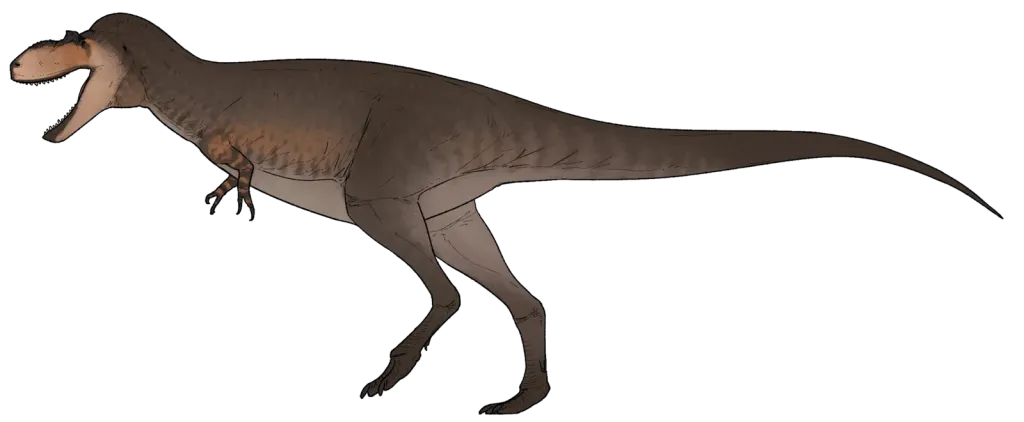
Albertosaurus sarcophagus
Pronunciación: al-BER-toh-SORE-us sar-KOF-ah-gus
Coelurosauria · Tyrannosauridae
A lighter-built relative of T. rex from the Late Cretaceous of Alberta, Canada. A single bonebed at Dry Island held more than two dozen individuals of all ages, which made it one of the best-studied tyrannosaurs.
- Bipedal
- Apex predator
- Possible pack behavior
- Período
- Cretácico· Maastrichtiense
- Dieta
- Carnívoro
- Longitud
- 8–9 m
- Masa
- 1700–3000 kg
- Ubicación
- Alberta, Canada
Respuestas rápidas
- ¿Qué tamaño tenía Albertosaurus sarcophagus?
- Albertosaurus sarcophagus medía unos 8–9 m de largo. Alcanzaba unos 2,3–2,8 m de altura a la cadera. Pesaba alrededor de 1,7–3 t. (Wikipedia: Albertosaurus 2026; Currie 2003)
- ¿Cuándo vivió Albertosaurus sarcophagus?
- Albertosaurus sarcophagus vivió durante el Cretácico Superior, hace unos 72,1–66 millones de años. (Paleobiology Database: Albertosaurus occurrences 2026; Cohen et al. 2023)
- ¿Dónde se han encontrado fósiles de Albertosaurus sarcophagus?
- Se han encontrado fósiles de Albertosaurus sarcophagus en Horseshoe Canyon Formation (Alberta) y Canada. (Osborn 1905; Currie 2003)
- ¿Qué comía Albertosaurus sarcophagus?
- Albertosaurus sarcophagus era carnívoro. (Osborn 1905; Currie 2003)
- ¿Quién nombró a Albertosaurus sarcophagus y cuándo?
- Albertosaurus sarcophagus fue descrito por Henry Fairfield Osborn en 1905. (Osborn 1905; Paleobiology Database: Albertosaurus occurrences 2026)
En esta página

- Período
- Cretácico72,1–66 Ma
- Dieta
- Carnívoro
- Longitud
- 8–9 m
- Masa
- 1,7–3 t
- Ubicación
- Canada
- Clasificación
- Coelurosauria · Tyrannosauridae
- Descrito
- 1905, Henry Fairfield Osborn
Resumen
Este contenido está disponible en inglés.
Albertosaurus sarcophagus lived in what is now Alberta about 70 million years ago, on the coastal plains and swamps of the Horseshoe Canyon Formation. Joseph Burr Tyrrell's Geological Survey of Canada party collected its first skull in 1884 on the Red Deer River, and Henry Fairfield Osborn named it in 1905.
It was a tyrannosaurid of about 8 to 9 m, lighter built than Tyrannosaurus, with longer lower legs and feet. Currie (2003) found that albertosaurines had slightly shorter, lower skulls and longer shins, metatarsals and toes than tyrannosaurines of the same size.
At Dry Island, found by Barnum Brown in 1910 and reopened by Philip Currie in 1997, a single bonebed held the remains of more than 20 individuals. Their growth rings allowed Erickson et al. (2006) to build a "life table": young Albertosaurus survived well, and mortality rose in mid-life.
Significado del nombre
"Alberta lizard"; sarcophagus, Greek for "flesh-eater" (Osborn 1905).
Biología y evidencia
Lo que piensan los científicos sobre cómo vivía este animal y qué tan sólida es la evidencia de cada idea.
Crecimiento
Young Albertosaurus survived well, and mortality rose in mid-life.
Nivel de evidencia: Evidencia moderadaAges from growth rings of many individuals give a survival curve like those of long-lived birds and mammals, which also explains why juvenile fossils are rare.
Evidencia a favor / en contra · 1
Evidencia a favor
Histología · Tyrannosaur age-structure analysis
Growth-ring ages of four tyrannosaur assemblages, including Albertosaurus, show high juvenile survival and higher mortality at mid-life and near maximum lifespan.
Vida social
Albertosaurus lived or hunted in groups.
Nivel de evidencia: HipótesisMany individuals of all ages died at one site, which suggests they were together. The bones could also have been gathered by other causes over time.
Evidencia a favor / en contra · 1
Evidencia a favor
Espécimen · Dry Island Albertosaurus bonebed
A bonebed with the remains of about two dozen Albertosaurus of different ages.
Otros
Albertosaurus was more lightly built than Tyrannosaurus.
Nivel de evidencia: Evidencia sólidaAt the same size, albertosaurines had shorter, lower skulls and longer shins, metatarsals and toes than tyrannosaurines.
Evidencia a favor / en contra · 1
Evidencia a favor
Anatomía comparada · Tyrannosaurid allometry
Bivariate analysis of 85 dimensions across five tyrannosaurid genera: albertosaurines are more lightly built than tyrannosaurines of the same size.
Tamaño
- Longitud
- 8–9 m
- Altura
- 2,5 mrango publicado 2,3–2,8 m
- Masa
- 1700–3000 kg
(29,5 pies)
(8,2 pies)
Basado en large adults (femur c. 1.0 m)
Línea de tiempo
Períodos: Maastrichtiense (72,1–66 Ma), Cretácico Superior (100,5–66 Ma)
Early Maastrichtian bin of the type collection in PBDB; the Horseshoe Canyon fossils are usually quoted at about 70-68 Ma (secondary).
Ubicación
Formaciones
- Horseshoe Canyon Formation · Alberta
- Red Deer River near Kneehills Creek, Alberta · Horseshoe Canyon Formation · Alberta · posición aproximada
Estos son los lugares donde se han encontrado fósiles, no toda el área donde vivía el animal.
Ecosistema

Vivió en: Horseshoe Canyon
hace 73,1–68 millones de años · llanura aluvial, llanura costera, pantano / humedal
Coastal floodplains, estuarine channels and coal swamps of Alberta near the Western Interior Seaway, with periodic marine incursions.
Clasificación
- cladoDinosauria
- cladoSaurischia
- cladoTheropoda
- cladoCoelurosauria
- superfamiliaTyrannosauroidea
- familiaTyrannosauridae
- subfamiliaAlbertosaurinae
- géneroAlbertosaurus
- especieAlbertosaurus sarcophagus
Estado taxonómico: Válido
Registro fósil

| Número de catálogo | Estado | Institución | Hallado |
|---|---|---|---|
| CMN 5600 | Holotipo | Canadian Museum of Nature (CMN) | 1884 |
Lo que se ha encontrado
Holotipo: CMN 5600
- Conservado
- Parcial
- Reconstruido
- Desconocido / no registrado
Región por región (tabla)
| Región | Estado |
|---|---|
| Skull | Parcial |
| Mandible | Desconocido / no registrado |
| Teeth | Desconocido / no registrado |
| Cervical vertebrae | Desconocido / no registrado |
| Dorsal vertebrae | Desconocido / no registrado |
| Sacrum | Desconocido / no registrado |
| Caudal vertebrae | Desconocido / no registrado |
| Ribs | Desconocido / no registrado |
| Gastralia | Desconocido / no registrado |
| Scapula / shoulder girdle | Desconocido / no registrado |
| Humerus | Desconocido / no registrado |
| Forearm (radius / ulna) | Desconocido / no registrado |
| Hand (manus) | Desconocido / no registrado |
| Pelvis | Desconocido / no registrado |
| Femur | Desconocido / no registrado |
| Tibia / fibula | Desconocido / no registrado |
| Foot (pes) | Desconocido / no registrado |

Descubrimiento
- Año de descripción
- 1905
- Descrito por
- Henry Fairfield Osborn
- Espécimen tipo
- CMN 5600
Cronología del descubrimiento
1884 · Primer material hallado
Tyrrell's party collects the first Albertosaurus skull
A partial skull is collected on the Red Deer River, Alberta.
Personas: Joseph Burr Tyrrell
1905 · Descrito formalmente
Osborn names Albertosaurus sarcophagus
Named in the same paper that named Tyrannosaurus rex.
Personas: Henry Fairfield Osborn
1910 · Espécimen recuperado
Barnum Brown finds the Dry Island bonebed
Brown collects Albertosaurus bones from a bonebed that Philip Currie reopened in 1997.
Personas: Barnum Brown, Philip J. Currie
2006 · Estudio importante
Tyrannosaur life tables published
Erickson and colleagues describe tyrannosaur survival patterns from growth rings.
Personas: Gregory M. Erickson, Philip J. Currie
Fuentes
- (2026). Paleobiology Database: Albertosaurus occurrences. The Paleobiology Database (paleobiodb.org), data service 1.2, accessed 2026-09-23. https://paleobiodb.org/data1.2/occs/list.txt?base_name=Albertosaurus&show=coords,paleoloc,strat,loc,ref&pgm=gplates (se abre en una pestaña nueva)
- (2026). Wikipedia: Albertosaurus. Wikipedia (English), accessed 2026-09-23. https://en.wikipedia.org/wiki/Albertosaurus (se abre en una pestaña nueva)
- Cohen, K. M., Harper, D. A. T., Gibbard, P. L. & Car, N. (2023). International Chronostratigraphic Chart (v2023/09). International Commission on Stratigraphy. https://stratigraphy.org/ICSchart/ChronostratChart2023-09.pdf (se abre en una pestaña nueva)
- Currie, P. J. (2003). Allometric growth in tyrannosaurids (Dinosauria: Theropoda) from the Upper Cretaceous of North America and Asia. Canadian Journal of Earth Sciences 40: 651-665. doi:10.1139/e02-083 (se abre en una pestaña nueva)
- Erickson, G. M., Currie, P. J., Inouye, B. D. & Winn, A. A. (2006). Tyrannosaur life tables: an example of nonavian dinosaur population biology. Science 313: 213-217. doi:10.1126/science.1125721 (se abre en una pestaña nueva)
- Osborn, H. F. (1905). Tyrannosaurus and other Cretaceous carnivorous dinosaurs. Bulletin of the American Museum of Natural History 21: 259-265. https://digitallibrary.amnh.org/handle/2246/1464 (se abre en una pestaña nueva)
- Paul, G. S. (2016). The Princeton Field Guide to Dinosaurs (2nd edition). Princeton University Press.