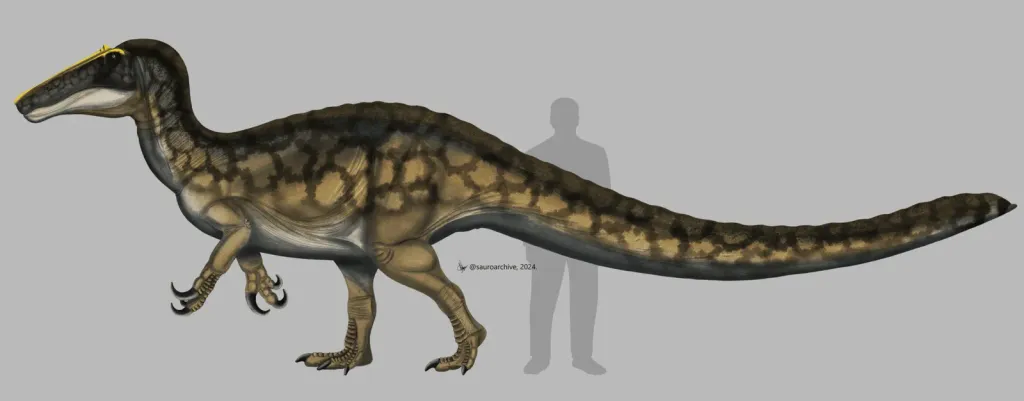
Irritator challengeri
Pronunciación: IR-ih-tay-tor chal-en-JER-eye
Tetanurae · Spinosauridae
A spinosaurid from the Early Cretaceous of north-east Brazil, known from the most complete spinosaurid skull ever found. Its long, narrow snout and conical teeth suited catching fish and other small prey on a tropical coastal lagoon.
- Bipedal
- Crested
- Possibly semiaquatic
- Período
- Cretácico· Aptiense
- Dieta
- Piscívoro
- Longitud
- 6–8 m
- Masa
- 1000 kg
- Ubicación
- Ceará, Brazil, South America
Respuestas rápidas
- ¿Qué tamaño tenía Irritator challengeri?
- Irritator challengeri medía unos 6–8 m de largo. Alcanzaba unos 1,8–2,4 m de altura a la cadera. Pesaba alrededor de 1 t. (Wikipedia: Irritator 2026; Paul 2016)
- ¿Cuándo vivió Irritator challengeri?
- Irritator challengeri vivió durante el Cretácico Inferior, hace unos 119,6–113,2 millones de años. (Paleobiology Database: Irritator challengeri … 2026; Schade et al. 2023)
- ¿Dónde se han encontrado fósiles de Irritator challengeri?
- Se han encontrado fósiles de Irritator challengeri en Romualdo Formation (Ceará) y Brazil. (Martill et al. 1996; Sues et al. 2002)
- ¿Qué comía Irritator challengeri?
- Irritator challengeri era piscívoro o carnívoro. (Martill et al. 1996; Sues et al. 2002)
- ¿Quién nombró a Irritator challengeri y cuándo?
- Irritator challengeri fue descrito por David M. Martill et al. en 1996. (Martill et al. 1996; Schade et al. 2023)
En esta página

IR-ih-tay-tor chal-en-JER-eye
- Período
- Cretácico119,6–113,2 Ma
- Dieta
- Piscívoro
- Longitud
- 6–8 m
- Masa
- 1 t
- Ubicación
- Brazil, South America
- Clasificación
- Tetanurae · Spinosauridae
- Descrito
- 1996, David M. Martill et al.
Resumen
Este contenido está disponible en inglés.
Irritator challengeri lived in the Araripe Basin of north-east Brazil in the late Aptian, a little over 113 million years ago. Its skull came out of a limestone concretion near Santana do Cariri, Ceará, and was sold by fossil dealers to the State Museum of Natural History in Stuttgart, Germany.
Dealers had built up the snout with plaster to make it look longer, which "irritated" the researchers who had to remove it; the species name honours Professor Challenger of Arthur Conan Doyle's "The Lost World". Martill and colleagues (1996) first thought it was a maniraptoran, and Sues and colleagues (2002) showed it was a spinosaurid.
CT scans by Schade and colleagues (2023) revealed almost the whole palate and braincase. The skull had binocular vision in front of the snout and a relatively weak but fast bite, and the lower jaws spread sideways when opening, like those of pelicans. It probably snapped up fish and small vertebrates, and a spinosaurid tooth has even been found in a pterosaur neck bone from the same rocks.
Significado del nombre
From "irritation", for the frustration caused by the dealers' alterations to the skull; challengeri after Professor Challenger in Conan Doyle's "The Lost World" (Martill et al. 1996).
Biología y evidencia
Lo que piensan los científicos sobre cómo vivía este animal y qué tan sólida es la evidencia de cada idea.
Alimentación
Irritator ate pterosaurs as well as fish.
Nivel de evidencia: HipótesisA spinosaurid tooth stuck in a pterosaur bone shows that some spinosaurid of the formation fed on one, by hunting or scavenging; it is not certain the tooth belonged to Irritator.
Evidencia a favor / en contra · 1
Evidencia a favor
Icnofósil · Spinosaurid tooth in a pterosaur vertebra (Romualdo Formation)
A spinosaurid tooth embedded in a pterosaur neck vertebra from the same formation.
Irritator had a relatively weak but fast bite suited to snapping small prey.
Nivel de evidencia: Evidencia moderadaJaw mechanics and the inner ear suggest quick snaps at fish and small vertebrates rather than a crushing bite.
Evidencia a favor / en contra · 2
Evidencia a favor
Espécimen · CT reconstruction of the Irritator skull
Medical and micro-CT reconstructions of SMNS 58022 reveal the palate and braincase, binocular vision in front of the snout, a weak but fast bite and lower jaws that spread sideways when opening.
Espécimen: SMNS 58022
Anatomía comparada · Irritator braincase endocast
A digital endocast and inner ear indicating fast, well-controlled downward head movements and a snout held angled about 45 degrees down.
Espécimen: SMNS 58022
Otros
The Irritator holotype is the most complete spinosaurid skull known.
Nivel de evidencia: Evidencia directaOnly the tip of the snout and the front of the lower jaws are missing, while other spinosaurids are known mostly from snouts and isolated bones.
Evidencia a favor / en contra · 1
Evidencia a favor
Espécimen · CT reconstruction of the Irritator skull
Medical and micro-CT reconstructions of SMNS 58022 reveal the palate and braincase, binocular vision in front of the snout, a weak but fast bite and lower jaws that spread sideways when opening.
Espécimen: SMNS 58022
Tamaño
- Longitud
- 6–8 m
- Altura
- 2 mrango publicado 1,8–2,4 m
- Masa
- 1000 kg
(26,2 pies)
Basado en SMNS 58022
(6,6 pies)
Línea de tiempo
Períodos: Aptiense (121,4–113 Ma), Cretácico Inferior (145–100,5 Ma)
Late Aptian (Schade et al. 2023, after Arai & Assine 2020); PBDB gives the same bin, 119.57-113.2 Ma. Older works, and Wikipedia, date the Romualdo Formation to the Albian.
Ubicación
Formaciones
- Romualdo Formation · Ceará
Lugares
- Near Buxexé, Santana do Cariri, Ceará · Romualdo Formation · Ceará · posición aproximada
Estos son los lugares donde se han encontrado fósiles, no toda el área donde vivía el animal.
Ecosistema

Vivió en: Romualdo (Araripe Basin)
hace 119,57–113,2 millones de años · margen marino, lago
A tropical coastal lagoon with irregular freshwater influence and marine incursions, surrounded by arid to semi-arid land; famous for fish, pterosaurs and soft tissues preserved in limestone concretions.
Clasificación
- cladoDinosauria
- cladoSaurischia
- cladoTheropoda
- cladoTetanurae
- superfamiliaMegalosauroidea
- familiaSpinosauridae
- subfamiliaSpinosaurinae
- géneroIrritator
- especieIrritator challengeri
Estado taxonómico: Válido
Registro fósil

| Número de catálogo | Estado | Institución | Hallado |
|---|---|---|---|
| SMNS 58022 | Holotipo | Staatliches Museum für Naturkunde Stuttgart (SMNS) | — |
Lo que se ha encontrado
Holotipo: SMNS 58022
- Conservado
- Parcial
- Reconstruido
- Desconocido / no registrado
Región por región (tabla)
| Región | Estado |
|---|---|
| Skull | Parcial · Missing most of the premaxillae and the front of the maxillae. |
| Mandible | Parcial · Missing the front ends. |
| Teeth | Parcial |
| Cervical vertebrae | Desconocido / no registrado |
| Dorsal vertebrae | Desconocido / no registrado |
| Sacrum | Desconocido / no registrado |
| Caudal vertebrae | Desconocido / no registrado |
| Ribs | Desconocido / no registrado |
| Gastralia | Desconocido / no registrado |
| Scapula / shoulder girdle | Desconocido / no registrado |
| Humerus | Desconocido / no registrado |
| Forearm (radius / ulna) | Desconocido / no registrado |
| Hand (manus) | Desconocido / no registrado |
| Pelvis | Desconocido / no registrado |
| Femur | Desconocido / no registrado |
| Tibia / fibula | Desconocido / no registrado |
| Foot (pes) | Desconocido / no registrado |

Galería

Descubrimiento
- Año de descripción
- 1996
- Descrito por
- David M. Martill et al.
- Espécimen tipo
- SMNS 58022
Cronología del descubrimiento
1996 · Descrito formalmente
Martill and colleagues name Irritator
Named as a crested maniraptoran, the first dinosaur named from the formation.
Personas: David M. Martill
2002 · Revisión
Irritator redescribed as a spinosaurid
After further preparation, Sues and colleagues confirm it is a spinosaurid.
Personas: Hans-Dieter Sues, David M. Martill
2023 · Estudio importante
CT reappraisal of the Irritator skull
Schade and colleagues reconstruct the whole skull digitally.
Personas: Marco Schade
Fuentes
- (2026). Paleobiology Database: Irritator challengeri occurrence and type collection 28052. The Paleobiology Database (paleobiodb.org), data service 1.2, accessed 2026-09-23. https://paleobiodb.org/data1.2/colls/list.json?coll_id=28052&show=paleoloc,strat,loc,ref,geo&pgm=gplates&vocab=pbdb (se abre en una pestaña nueva)
- (2026). Wikipedia: Irritator. Wikipedia (English), accessed 2026-09-24. https://en.wikipedia.org/wiki/Irritator (se abre en una pestaña nueva)
- Martill, D. M., Cruickshank, A. R. I., Frey, E., Small, P. G. & Clarke, M. (1996). A new crested maniraptoran dinosaur from the Santana Formation (Lower Cretaceous) of Brazil. Journal of the Geological Society 153: 5-8. doi:10.1144/gsjgs.153.1.0005 (se abre en una pestaña nueva)
- Paul, G. S. (2016). The Princeton Field Guide to Dinosaurs (2nd edition). Princeton University Press.
- Schade, M., Rauhut, O. W. M. & Evers, S. W. (2020). Neuroanatomy of the spinosaurid Irritator challengeri (Dinosauria: Theropoda) indicates potential adaptations for piscivory. Scientific Reports 10: 9259. doi:10.1038/s41598-020-66261-w (se abre en una pestaña nueva)
- Schade, M., Rauhut, O. W. M., Foth, C., Moleman, O. & Evers, S. W. (2023). A reappraisal of the cranial and mandibular osteology of the spinosaurid Irritator challengeri (Dinosauria: Theropoda). Palaeontologia Electronica 26(2): a17. doi:10.26879/1242 (se abre en una pestaña nueva)
- Sues, H.-D., Frey, E., Martill, D. M. & Scott, D. M. (2002). Irritator challengeri, a spinosaurid (Dinosauria: Theropoda) from the Lower Cretaceous of Brazil. Journal of Vertebrate Paleontology 22: 535-547. doi:10.1671/0272-4634(2002)022[0535:ICASDT]2.0.CO;2 (se abre en una pestaña nueva)