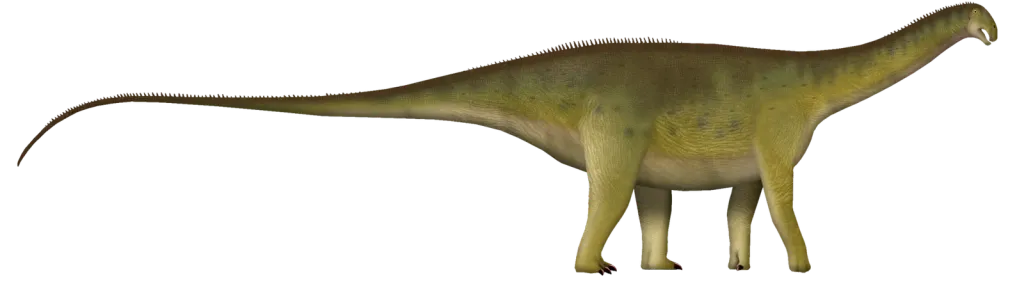
Nigersaurus taqueti
Pronunciación: nee-ZHER-sore-us tah-KET-eye
Sauropoda · Rebbachisauridae
A small rebbachisaurid sauropod from the Early Cretaceous of Niger with a broad, straight-edged muzzle packed with hundreds of teeth that were replaced very quickly: a Cretaceous lawnmower.
- Quadrupedal
- Long necked
- Unusual anatomy
- Período
- Cretácico· Aptiense
- Dieta
- Herbívoro
- Longitud
- 9 m
- Masa
- 1900–4000 kg
- Ubicación
- Agadez Region, Niger
Respuestas rápidas
- ¿Qué tamaño tenía Nigersaurus taqueti?
- Nigersaurus taqueti medía unos 9 m de largo. Alcanzaba unos 1,6–2 m de altura a la cadera. Pesaba alrededor de 1,9–4 t. (Sereno et al. 1999; Sereno et al. 2007)
- ¿Cuándo vivió Nigersaurus taqueti?
- Nigersaurus taqueti vivió durante el Cretácico Inferior, hace unos 121,4–100,5 millones de años. (Cohen et al. 2023; Sereno et al. 1999)
- ¿Dónde se han encontrado fósiles de Nigersaurus taqueti?
- Se han encontrado fósiles de Nigersaurus taqueti en Elrhaz Formation (Agadez Region) y Niger. (Sereno et al. 1999; Sereno et al. 2007)
- ¿Qué comía Nigersaurus taqueti?
- Nigersaurus taqueti era herbívoro. (Sereno et al. 1999; Sereno et al. 2007)
- ¿Quién nombró a Nigersaurus taqueti y cuándo?
- Nigersaurus taqueti fue descrito por Paul C. Sereno et al. en 1999. (Sereno et al. 1999; Sereno et al. 2007)
En esta página

nee-ZHER-sore-us tah-KET-eye
- Período
- Cretácico121,4–100,5 Ma
- Dieta
- Herbívoro
- Longitud
- 9 m
- Masa
- 1,9–4 t
- Ubicación
- Niger
- Clasificación
- Sauropoda · Rebbachisauridae
- Descrito
- 1999, Paul C. Sereno et al.
Resumen
Este contenido está disponible en inglés.
Nigersaurus taqueti lived in what is now the Sahara of Niger in the Early Cretaceous, when the region was a land of rivers and floodplains. French expeditions led by Philippe Taquet found its first bones in the 1960s and 1970s at Gadoufaoua; Paul Sereno's team collected better material in the 1990s and named it in 1999.
For a sauropod it was small, about 9 m long. Its skull was extremely light, with paper-thin bones, and its jaws ended in a wide, straight muzzle lined with more than 500 teeth in columns, each replaced every few weeks. Sereno et al. (2007) argued it grazed close to the ground.
Many of these interpretations are debated: the head posture reconstructed from its inner ear, and the exact tooth replacement rate, which D'Emic et al. (2013) estimated from growth lines in the teeth.
Significado del nombre
"Niger lizard"; taqueti honours French paleontologist Philippe Taquet, who led the first expeditions to its site (Sereno et al. 1999).
Biología y evidencia
Lo que piensan los científicos sobre cómo vivía este animal y qué tan sólida es la evidencia de cada idea.
Alimentación
Nigersaurus grazed close to the ground.
Nivel de evidencia: Evidencia moderadaIts wide, straight muzzle and fast-wearing teeth suit cropping low plants such as ferns or horsetails. A downward head posture was reconstructed from the inner ear, but that method is debated.
Evidencia a favor / en contra · 2
Evidencia a favor
Espécimen · Nigersaurus tooth batteries
Jaws with a straight front edge lined with columns of replacement teeth, more than 500 teeth in all.
Espécimen: MNN GAD512
Anatomía comparada · Nigersaurus inner ear and head posture
CT scans of the inner ear, used to reconstruct the habitual head posture as pointing down.
Espécimen: MNN GAD512
Dientes
Nigersaurus replaced its teeth faster than any other known dinosaur.
Nivel de evidencia: Evidencia sólidaEach tooth position held a column of up to ten replacement teeth, and growth lines show a new tooth came into use every few weeks.
Evidencia a favor / en contra · 2
Evidencia a favor
Espécimen · Nigersaurus tooth batteries
Jaws with a straight front edge lined with columns of replacement teeth, more than 500 teeth in all.
Espécimen: MNN GAD512
Histología · Nigersaurus tooth growth lines
Daily growth lines in the teeth used to calculate how often each tooth was replaced.
Otros
Nigersaurus had an extremely light skeleton full of air spaces.
Nivel de evidencia: Evidencia directaIts skull bones are thin enough to see light through and its vertebrae are hollowed by air sacs, observed directly in the fossils.
Evidencia a favor / en contra · 1
Evidencia a favor
Espécimen · Nigersaurus air-filled skeleton
Very thin skull bones and vertebrae hollowed by air sacs, making the skeleton exceptionally light.
Espécimen: MNN GAD512

Tamaño
- Longitud
- 9 m
- Altura
- 1,8 mrango publicado 1,6–2 m
- Masa
- 1900–4000 kg
(29,5 pies)
(5,9 pies)
Basado en MNN GAD512 and referred material
Línea de tiempo
Períodos: Aptiense (121,4–113 Ma), Albiense (113–100,5 Ma), Cretácico Inferior (145–100,5 Ma)
Ages are the ICS 2023/09 bounds of the Aptian and Albian, the stage(s) the fossils are assigned to; they bracket the record and are not dated first/last appearances. The Elrhaz Formation is usually cited as about 115-105 Ma.
Ubicación
Formaciones
- Elrhaz Formation · Agadez Region
Lugares
- Gadoufaoua, Agadez Region, Niger · Elrhaz Formation · Agadez Region · posición aproximada
Estos son los lugares donde se han encontrado fósiles, no toda el área donde vivía el animal.
Ecosistema

Vivió en: Elrhaz (Gadoufaoua)
hace 115–105 millones de años · sistema fluvial, llanura aluvial, pantano / humedal
Early Cretaceous rivers and swampy floodplains in what is now the Ténéré desert of Niger, with abundant crocodyliforms and fish.
Mismo ecosistema

Clasificación
- cladoDinosauria
- cladoSaurischia
- cladoSauropodomorpha
- cladoSauropoda
- superfamiliaDiplodocoidea
- familiaRebbachisauridae
- géneroNigersaurus
- especieNigersaurus taqueti
Estado taxonómico: Válido
Registro fósil

| Número de catálogo | Estado | Institución | Hallado |
|---|---|---|---|
| MNN GAD512 | Holotipo | Musée National Boubou Hama (MNN) | — |
Lo que se ha encontrado
Holotipo: MNN GAD512
- Conservado
- Parcial
- Reconstruido
- Desconocido / no registrado
Región por región (tabla)
| Región | Estado |
|---|---|
| Skull | Parcial |
| Mandible | Conservado |
| Teeth | Conservado |
| Cervical vertebrae | Parcial |
| Dorsal vertebrae | Desconocido / no registrado |
| Sacrum | Desconocido / no registrado |
| Caudal vertebrae | Desconocido / no registrado |
| Ribs | Desconocido / no registrado |
| Gastralia | Desconocido / no registrado |
| Scapula / shoulder girdle | Desconocido / no registrado |
| Humerus | Desconocido / no registrado |
| Forearm (radius / ulna) | Desconocido / no registrado |
| Hand (manus) | Desconocido / no registrado |
| Pelvis | Desconocido / no registrado |
| Femur | Desconocido / no registrado |
| Tibia / fibula | Desconocido / no registrado |
| Foot (pes) | Desconocido / no registrado |

Descubrimiento
- Año de descripción
- 1999
- Descrito por
- Paul C. Sereno et al.
- Espécimen tipo
- MNN GAD512
Cronología del descubrimiento
1965 · Primer material hallado
Taquet's expeditions find the first Nigersaurus bones
French expeditions led by Philippe Taquet collect sauropod remains at Gadoufaoua (1965-1972).
Personas: Philippe Taquet
1999 · Descrito formalmente
Sereno et al. name Nigersaurus taqueti
Named in a paper on Cretaceous sauropods of the Sahara.
Personas: Paul C. Sereno
2007 · Estudio importante
Skull of Nigersaurus reconstructed
CT scans reveal the extreme skull and tooth batteries.
Personas: Paul C. Sereno
Fuentes
- Cohen, K. M., Harper, D. A. T., Gibbard, P. L. & Car, N. (2023). International Chronostratigraphic Chart (v2023/09). International Commission on Stratigraphy. https://stratigraphy.org/ICSchart/ChronostratChart2023-09.pdf (se abre en una pestaña nueva)
- D'Emic, M. D., Whitlock, J. A., Smith, K. M., Fisher, D. C. & Wilson, J. A. (2013). Evolution of high tooth replacement rates in sauropod dinosaurs. PLoS ONE 8(7): e69235. doi:10.1371/journal.pone.0069235 (se abre en una pestaña nueva)
- Paul, G. S. (2016). The Princeton Field Guide to Dinosaurs (2nd edition). Princeton University Press.
- Sereno, P. C., Beck, A. L., Dutheil, D. B., et al. (1999). Cretaceous sauropods from the Sahara and the uneven rate of skeletal evolution among dinosaurs. Science 286: 1342-1347. doi:10.1126/science.286.5443.1342 (se abre en una pestaña nueva)
- Sereno, P. C., Wilson, J. A., Witmer, L. M., Whitlock, J. A., Maga, A., Ide, O. & Rowe, T. A. (2007). Structural extremes in a Cretaceous dinosaur. PLoS ONE 2(11): e1230. doi:10.1371/journal.pone.0001230 (se abre en una pestaña nueva)