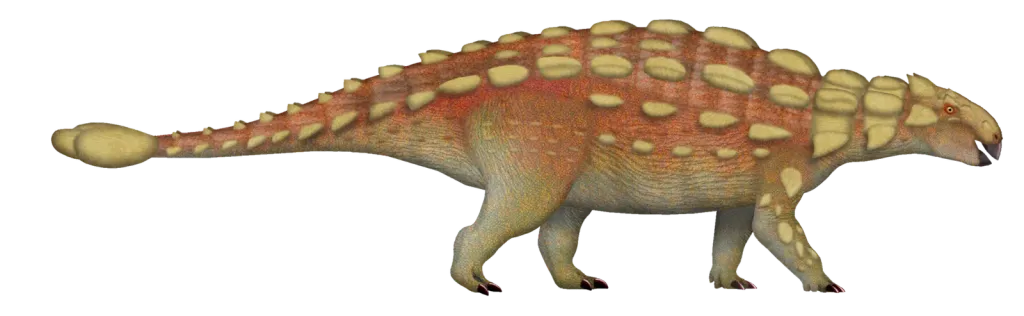
Ankylosaurus magniventris
उच्चारण: an-KY-loh-SORE-us mag-nih-VEN-tris
Ankylosauria · Ankylosauridae
A heavily armored, club-tailed ankylosaur from the very end of the Cretaceous of western North America, the largest known member of its group and a neighbour of T. rex and Triceratops.
- Armored
- Tail club
- Quadrupedal
- Giant
- Movie icon
- काल
- क्रिटेशियस· मास्ट्रिख्टियन
- आहार
- शाकाहारी
- लंबाई
- 6–8 m
- द्रव्यमान
- 4,800–8,000 kg
- स्थान
- Montana, Wyoming, Alberta
त्वरित उत्तर
- Ankylosaurus magniventris कितना बड़ा था?
- Ankylosaurus magniventris लगभग 6–8 m लंबा था। कूल्हों तक इसकी ऊँचाई लगभग 1.5–1.8 m थी। इसका वज़न लगभग 4.8–8 t था। (Arbour & Mallon 2017; Paul 2016)
- Ankylosaurus magniventris कब रहता था?
- Ankylosaurus magniventris उत्तर क्रिटेशियस में, लगभग 7.21–6.6 करोड़ वर्ष पहले रहता था। (Cohen et al. 2023; Arbour & Mallon 2017)
- Ankylosaurus magniventris के जीवाश्म कहाँ मिले हैं?
- Ankylosaurus magniventris के जीवाश्म Hell Creek Formation (Montana), Lance Formation (Wyoming), और Scollard Formation (Alberta) में मिले हैं। (Brown 1908; Arbour & Mallon 2017)
- Ankylosaurus magniventris क्या खाता था?
- Ankylosaurus magniventris एक शाकाहारी था। (Brown 1908; Arbour & Mallon 2017)
- Ankylosaurus magniventris का नाम किसने और कब रखा?
- Ankylosaurus magniventris का वर्णन Barnum Brown ने 1908 में किया। (Brown 1908)
- क्या Ankylosaurus magniventris Jurassic Park में था?
- हाँ। Ankylosaurus magniventris Jurassic Park III (2001), Jurassic World (2015), Jurassic World: Fallen Kingdom (2018), Jurassic World Dominion (2022), और Jurassic World Rebirth (2025) में दिखाई देता है। फ़िल्मों में कई बातें काल्पनिक हैं; यह पेज उनकी तुलना जीवाश्म प्रमाणों से करता है। (Wikipedia: Dinosaurs in Jurassic Park 2026; Arbour 2009)
इस पेज पर

- काल
- क्रिटेशियस72.1–66 Ma
- आहार
- शाकाहारी
- लंबाई
- 6–8 m
- द्रव्यमान
- 4.8–8 t
- वर्गीकरण
- Ankylosauria · Ankylosauridae
- वर्णित
- 1908, Barnum Brown
अवलोकन
यह सामग्री अंग्रेज़ी में उपलब्ध है।
Ankylosaurus magniventris lived in western North America at the end of the Cretaceous, in the same landscapes as Tyrannosaurus and Triceratops. Barnum Brown named it in 1908 from a skull roof and armor found in the Hell Creek Formation of Montana.
It was a low, wide, four-legged plant-eater covered in bony plates (osteoderms) set in the skin, with horns at the back of its skull and a heavy club of fused bone at the end of its tail. It is the largest known ankylosaurid, but it is also known from surprisingly few specimens: no complete skeleton has been found.
Arbour and Mallon (2017) re-examined all the material. They found an unusual nose with looping nasal passages, small leaf-shaped teeth, and estimated a length of roughly 6 to 8 m. The tail club could deliver strong blows, probably against predators or rivals.
नाम का अर्थ
From Greek ankylos ("fused, bent") and sauros ("lizard"), for the fused bones of the skull and armor; magniventris, Latin for "great belly" (Brown 1908).
जीवविज्ञान और साक्ष्य
वैज्ञानिक इस जानवर के जीवन के बारे में क्या सोचते हैं, और हर विचार के पक्ष में साक्ष्य कितने मज़बूत हैं।
भोजन
Ankylosaurus fed on low plants, cropping them with a wide beak.
साक्ष्य स्तर: मध्यम साक्ष्यA low body, a wide muzzle and small leaf-shaped teeth point to a low-level plant-eater. Its diet has not been observed directly.
त्वचा और आवरण
Ankylosaurus was covered in bony armor plates set in its skin.
साक्ष्य स्तर: प्रत्यक्ष साक्ष्यThe osteoderms themselves are fossilised with the specimens. How exactly they were arranged over the body is reconstructed from better-preserved relatives.
इंद्रियाँ
The looping nasal passages of Ankylosaurus helped it control heat and moisture or produce sounds.
साक्ष्य स्तर: परिकल्पनाThe shape of the nasal passages is known; their function is inferred from similar passages in other ankylosaurs and living animals.
पक्ष / विपक्ष में साक्ष्य · 1
पक्ष में साक्ष्य
तुलनात्मक शरीर रचना · Ankylosaurus looping nasal passages
The nostrils face sideways and lead into convoluted nasal passages, unusual among ankylosaurids.
नमूना: CMN 8880
व्यवहार
Ankylosaurus could swing its tail club hard enough to break bone.
साक्ष्य स्तर: मध्यम साक्ष्यModels of ankylosaurid tail clubs show large clubs could hit hard enough to fracture bone. The club of Ankylosaurus is known from one specimen, so its exact force is estimated from relatives.
पक्ष / विपक्ष में साक्ष्य · 2
पक्ष में साक्ष्य
नमूना · Ankylosaurus tail club (AMNH 5214)
A club of large fused osteoderms at the end of a tail stiffened by interlocking vertebrae.
नमूना: AMNH 5214
जैवयांत्रिक मॉडल · Ankylosaurid tail club impact model
Estimates of the force of tail-club swings in ankylosaurids, large enough to break bone.
आकार
- लंबाई
- 6–8 m
- ऊँचाई
- 1.7 mप्रकाशित सीमा 1.5–1.8 m
- द्रव्यमान
- 4,800–8,000 kg
(26.2 फ़ुट)
AMNH 5214 (smallest) to CMN 8880 (largest skull) पर आधारित
(5.6 फ़ुट)
AMNH 5214 पर आधारित
समयरेखा
काल: मास्ट्रिख्टियन (72.1–66 Ma), उत्तर क्रिटेशियस (100.5–66 Ma)
Ages are the ICS 2023/09 bounds of the Maastrichtian, the stage(s) the fossils are assigned to; they bracket the record and are not dated first/last appearances. Known specimens come from the latest Maastrichtian (Hell Creek, Lance, Scollard), so the real range is much narrower, roughly the last 2-3 million years of the Cretaceous.
स्थान
संरचनाएँ
- Hell Creek Formation · Montana
- Lance Formation · Wyoming
- Scollard Formation · Alberta
- Gilbert Creek, Hell Creek Formation, Montana · Hell Creek Formation · Montana · स्थिति अनुमानित
- Red Deer River, Scollard Formation, Alberta · Scollard Formation · Alberta · स्थिति अनुमानित
ये वे स्थान हैं जहाँ जीवाश्म मिले हैं, न कि वह पूरा क्षेत्र जहाँ यह जानवर रहता था।
पारितंत्र
यहाँ रहता था: Hell Creek
68–66 मिलियन वर्ष पहले · बाढ़ का मैदान, नदी तंत्र, वन, तटीय मैदान
Warm, humid coastal lowlands and river floodplains west of the retreating Western Interior Seaway at the very end of the Cretaceous, with forests of conifers and flowering plants. The ecosystem ends at the Cretaceous-Paleogene extinction.


वर्गीकरण
- क्लेडDinosauria
- क्लेडOrnithischia
- क्लेडThyreophora
- क्लेडAnkylosauria
- कुलAnkylosauridae
- उपकुलAnkylosaurinae
- वंशAnkylosaurus
- प्रजातिAnkylosaurus magniventris
वर्गिकीय स्थिति: मान्य
जीवाश्म अभिलेख

| कैटलॉग संख्या | स्थिति | संस्थान | मिला |
|---|---|---|---|
| AMNH 5895 | होलोटाइप | American Museum of Natural History (AMNH) | 1906 |
| AMNH 5214 | संदर्भित नमूना | American Museum of Natural History (AMNH) | 1910 |
| CMN 8880 | संदर्भित नमूना | Canadian Museum of Nature (CMN) | — |
क्या मिला है
होलोटाइप: AMNH 5895
- संरक्षित
- आंशिक
- पुनर्निर्मित
- अज्ञात / दर्ज नहीं
होलोटाइप: AMNH 5895
क्षेत्र-दर-क्षेत्र (तालिका)
| क्षेत्र | स्थिति |
|---|---|
| Skull | आंशिक · Skull roof. |
| Mandible | अज्ञात / दर्ज नहीं |
| Teeth | आंशिक |
| Cervical vertebrae | आंशिक |
| Dorsal vertebrae | आंशिक |
| Sacrum | अज्ञात / दर्ज नहीं |
| Caudal vertebrae | अज्ञात / दर्ज नहीं |
| Ribs | आंशिक |
| Gastralia | अज्ञात / दर्ज नहीं |
| Scapula / shoulder girdle | आंशिक |
| Humerus | अज्ञात / दर्ज नहीं |
| Forearm (radius / ulna) | अज्ञात / दर्ज नहीं |
| Hand (manus) | अज्ञात / दर्ज नहीं |
| Pelvis | अज्ञात / दर्ज नहीं |
| Femur | अज्ञात / दर्ज नहीं |
| Tibia / fibula | अज्ञात / दर्ज नहीं |
| Foot (pes) | अज्ञात / दर्ज नहीं |
संदर्भित नमूना: AMNH 5214
क्षेत्र-दर-क्षेत्र (तालिका)
| क्षेत्र | स्थिति |
|---|---|
| Skull | आंशिक |
| Mandible | आंशिक |
| Teeth | अज्ञात / दर्ज नहीं |
| Cervical vertebrae | अज्ञात / दर्ज नहीं |
| Dorsal vertebrae | अज्ञात / दर्ज नहीं |
| Sacrum | अज्ञात / दर्ज नहीं |
| Caudal vertebrae | आंशिक · Tail with club. |
| Ribs | आंशिक |
| Gastralia | अज्ञात / दर्ज नहीं |
| Scapula / shoulder girdle | अज्ञात / दर्ज नहीं |
| Humerus | आंशिक |
| Forearm (radius / ulna) | अज्ञात / दर्ज नहीं |
| Hand (manus) | अज्ञात / दर्ज नहीं |
| Pelvis | अज्ञात / दर्ज नहीं |
| Femur | अज्ञात / दर्ज नहीं |
| Tibia / fibula | अज्ञात / दर्ज नहीं |
| Foot (pes) | अज्ञात / दर्ज नहीं |
संदर्भित नमूना: CMN 8880
क्षेत्र-दर-क्षेत्र (तालिका)
| क्षेत्र | स्थिति |
|---|---|
| Skull | संरक्षित |
| Mandible | अज्ञात / दर्ज नहीं |
| Teeth | अज्ञात / दर्ज नहीं |
| Cervical vertebrae | अज्ञात / दर्ज नहीं |
| Dorsal vertebrae | अज्ञात / दर्ज नहीं |
| Sacrum | अज्ञात / दर्ज नहीं |
| Caudal vertebrae | अज्ञात / दर्ज नहीं |
| Ribs | अज्ञात / दर्ज नहीं |
| Gastralia | अज्ञात / दर्ज नहीं |
| Scapula / shoulder girdle | अज्ञात / दर्ज नहीं |
| Humerus | अज्ञात / दर्ज नहीं |
| Forearm (radius / ulna) | अज्ञात / दर्ज नहीं |
| Hand (manus) | अज्ञात / दर्ज नहीं |
| Pelvis | अज्ञात / दर्ज नहीं |
| Femur | अज्ञात / दर्ज नहीं |
| Tibia / fibula | अज्ञात / दर्ज नहीं |
| Foot (pes) | अज्ञात / दर्ज नहीं |

खोज
- वर्णन का वर्ष
- 1908
- वर्णनकर्ता
- Barnum Brown
- प्ररूप नमूना
- AMNH 5895

खोज की समयरेखा
1906 · पहली सामग्री मिली
Barnum Brown collects the Ankylosaurus holotype
Brown collects a partial skull and armor in the Hell Creek Formation of Montana.
लोग: Barnum Brown
1908 · औपचारिक रूप से वर्णित
Brown names Ankylosaurus magniventris
Brown names the genus and the family Ankylosauridae.
लोग: Barnum Brown
1910 · नमूना प्राप्त हुआ
Tail club specimen collected in Alberta
Brown collects the specimen with the only known Ankylosaurus tail club.
लोग: Barnum Brown
2017 · प्रमुख अध्ययन
Arbour and Mallon redescribe Ankylosaurus
A full re-examination of all specimens with new size estimates.
लोग: Victoria M. Arbour
Jurassic Park और Jurassic World में
फ़िल्में
- Jurassic Park III (2001)
- Jurassic World (2015)
- Jurassic World: Fallen Kingdom (2018)
- Jurassic World Dominion (2022)
- Jurassic World Rebirth (2025)
यह सामग्री अंग्रेज़ी में उपलब्ध है।
पर्दे पर
An armoured tank that swings its tail club, killed by the Indominus rex in Jurassic World.
फ़िल्म बनाम जीवाश्म
- The tail club was a real weapon: models suggest strikes strong enough to break bone.
- Ankylosaurus itself is known from partial skeletons, so much of its body in any reconstruction is borrowed from relatives.
फ़िल्मों के नाम केवल पहचान के लिए दिए गए हैं। DinoDex का Jurassic Park / Jurassic World फ़्रैंचाइज़ से कोई संबंध नहीं है और न ही उसे उनका समर्थन प्राप्त है। फ़िल्मों में दिखे सभी डायनासोर
स्रोत
- (2026). Wikipedia: Dinosaurs in Jurassic Park. Wikipedia. https://en.wikipedia.org/wiki/Dinosaurs_in_Jurassic_Park (नए टैब में खुलता है)
- (2026). Wikipedia: Jurassic World Rebirth. Wikipedia. https://en.wikipedia.org/wiki/Jurassic_World_Rebirth (नए टैब में खुलता है)
- Arbour, V. M. (2009). Estimating impact forces of tail club strikes by ankylosaurid dinosaurs. PLoS ONE 4(8): e6738. doi:10.1371/journal.pone.0006738 (नए टैब में खुलता है)
- Arbour, V. M. & Mallon, J. C. (2017). Unusual cranial and postcranial anatomy in the archetypal ankylosaur Ankylosaurus magniventris. FACETS 2: 764-794. doi:10.1139/facets-2017-0063 (नए टैब में खुलता है)
- Brown, B. (1908). The Ankylosauridae, a new family of armored dinosaurs from the Upper Cretaceous. Bulletin of the American Museum of Natural History 24: 187-201.
- Cohen, K. M., Harper, D. A. T., Gibbard, P. L. & Car, N. (2023). International Chronostratigraphic Chart (v2023/09). International Commission on Stratigraphy. https://stratigraphy.org/ICSchart/ChronostratChart2023-09.pdf (नए टैब में खुलता है)
- Paul, G. S. (2016). The Princeton Field Guide to Dinosaurs (2nd edition). Princeton University Press.