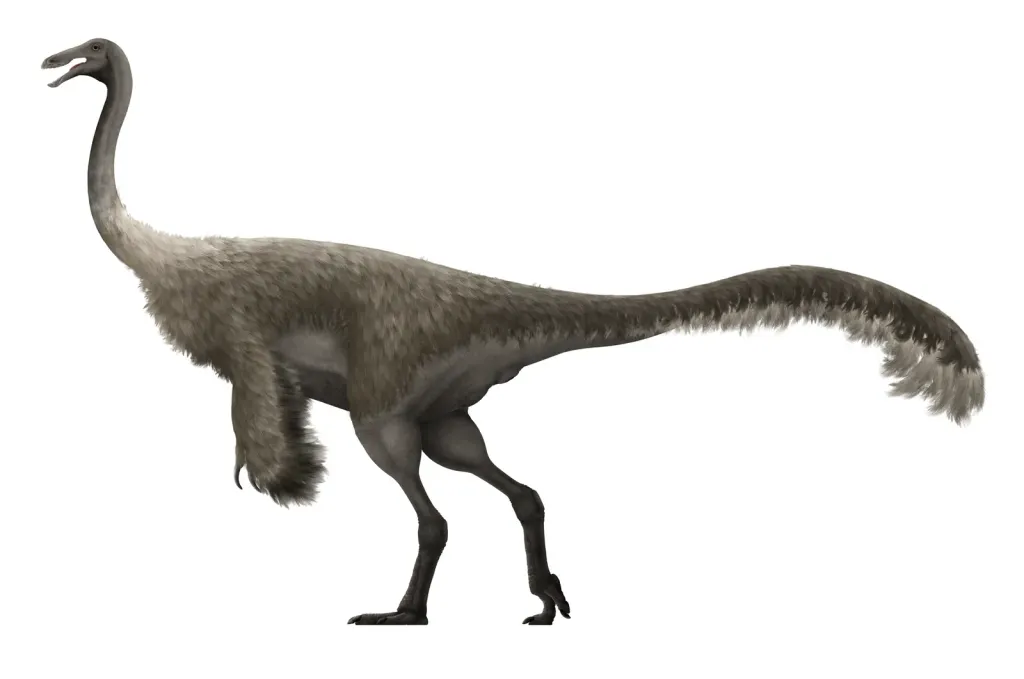
Gallimimus bullatus
उच्चारण: GAL-ih-MY-mus bul-AY-tus
Ornithomimosauria · Ornithomimidae
The largest known ornithomimid, an "ostrich dinosaur" about 6 m long from the Late Cretaceous of Mongolia. Toothless and long-legged, it was probably a fast runner, and it is famous for the flocking scene in Jurassic Park.
- Bipedal
- Movie icon
- काल
- क्रिटेशियस· मास्ट्रिख्टियन
- आहार
- सर्वाहारी
- लंबाई
- 6 m
- द्रव्यमान
- 400–490 kg
- स्थान
- Ömnögovi Province, Mongolia, Asia
त्वरित उत्तर
- Gallimimus bullatus कितना बड़ा था?
- Gallimimus bullatus लगभग 6 m लंबा था। कूल्हों तक इसकी ऊँचाई लगभग 1.9 m थी। इसका वज़न लगभग 400–490 kg था। (Wikipedia: Gallimimus 2026)
- Gallimimus bullatus कब रहता था?
- Gallimimus bullatus उत्तर क्रिटेशियस में, लगभग 7.21–6.6 करोड़ वर्ष पहले रहता था। (Paleobiology Database: Gallimimus bullatus oc… 2026; Cohen et al. 2023)
- Gallimimus bullatus के जीवाश्म कहाँ मिले हैं?
- Gallimimus bullatus के जीवाश्म Nemegt Formation (Ömnögovi Province) और Mongolia में मिले हैं। (Osmólska et al. 1972; Norell et al. 2001)
- Gallimimus bullatus क्या खाता था?
- Gallimimus bullatus एक सर्वाहारी था। (Osmólska et al. 1972; Norell et al. 2001)
- Gallimimus bullatus का नाम किसने और कब रखा?
- Gallimimus bullatus का वर्णन Halszka Osmólska, Ewa Roniewicz & Rinchen Barsbold ने 1972 में किया। (Osmólska et al. 1972; Paleobiology Database: Gallimimus bullatus oc… 2026)
- क्या Gallimimus bullatus Jurassic Park में था?
- हाँ। Gallimimus bullatus Jurassic Park (1993), The Lost World: Jurassic Park (1997), Jurassic World (2015), Jurassic World: Fallen Kingdom (2018), और Jurassic World Dominion (2022) में दिखाई देता है। फ़िल्मों में कई बातें काल्पनिक हैं; यह पेज उनकी तुलना जीवाश्म प्रमाणों से करता है। (Wikipedia: Dinosaurs in Jurassic Park 2026; Norell et al. 2001)
इस पेज पर

GAL-ih-MY-mus bul-AY-tus
- काल
- क्रिटेशियस72.1–66 Ma
- आहार
- सर्वाहारी
- लंबाई
- 6 m
- द्रव्यमान
- 0.4–0.5 t
- स्थान
- Mongolia, Asia
- वर्गीकरण
- Ornithomimosauria · Ornithomimidae
- वर्णित
- 1972, Halszka Osmólska, Ewa Roniewicz & Rinchen Barsbold
अवलोकन
यह सामग्री अंग्रेज़ी में उपलब्ध है।
Gallimimus bullatus lived in the Nemegt Formation of Mongolia at the end of the Cretaceous. The Polish-Mongolian expeditions of 1963-1965 found many ornithomimid skeletons of different ages in the Nemegt Basin; the largest, found by Zofia Kielan-Jaworowska at Tsagan Khushu in 1964, became the holotype when Halszka Osmólska, Ewa Roniewicz and Rinchen Barsbold named the species in 1972.
It had a small, toothless head with a horny beak, a long neck, short arms with three clawed fingers and long hind legs built for running. Adults were about 6 m long. Feathers have not been found with Gallimimus, but they are known from its relative Ornithomimus.
What it ate is debated. Soft-tissue beaks of ornithomimids described by Norell, Makovicky and Currie (2001) suggested straining food from water or sediment, while others see an omnivore or plant-eater. It is the most common ornithomimid of the Nemegt, alongside Deinocheirus and Tarbosaurus.
नाम का अर्थ
"Chicken mimic", from Latin gallus, for neck vertebrae like those of galliform birds; bullatus from the Roman bulla, for a bulb-shaped structure at the base of the skull (Osmólska et al. 1972).
जीवविज्ञान और साक्ष्य
वैज्ञानिक इस जानवर के जीवन के बारे में क्या सोचते हैं, और हर विचार के पक्ष में साक्ष्य कितने मज़बूत हैं।
गति
Gallimimus was a fast runner.
साक्ष्य स्तर: मध्यम साक्ष्यIts long legs match those of fast-running birds; speeds of about 42-56 km/h have been estimated.
पक्ष / विपक्ष में साक्ष्य · 1
पक्ष में साक्ष्य
तुलनात्मक शरीर रचना · Gallimimus hind-limb proportions
Long hind limbs with long shins and feet, like those of fast-running birds.
भोजन
Gallimimus strained small food from water or sediment with its beak.
साक्ष्य स्तर: विवादितComb-like structures in ornithomimid beaks suggested filter-feeding; others read them as ridges for cropping tough plants, and an omnivorous diet is also proposed.
पक्ष / विपक्ष में साक्ष्य · 1
पक्ष में साक्ष्य
नमूना · Ornithomimid beaks with soft tissue
Two ornithomimid specimens preserving the soft tissue of the beak, with comb-like structures.
आकार
- लंबाई
- 6 m
- ऊँचाई
- 1.9 m
- द्रव्यमान
- 400–490 kg
(19.7 फ़ुट)
IGM 100/11 पर आधारित
(6.2 फ़ुट)
IGM 100/11 पर आधारित
समयरेखा
काल: मास्ट्रिख्टियन (72.1–66 Ma), उत्तर क्रिटेशियस (100.5–66 Ma)
Maastrichtian bounds of the type collection in PBDB.
स्थान
संरचनाएँ
- Nemegt Formation · Ömnögovi Province
- Tsagan Khushu, site 3 (Nemegt Basin) · Nemegt Formation · Ömnögovi Province · स्थिति अनुमानित
ये वे स्थान हैं जहाँ जीवाश्म मिले हैं, न कि वह पूरा क्षेत्र जहाँ यह जानवर रहता था।
पारितंत्र

यहाँ रहता था: Nemegt
72–68 मिलियन वर्ष पहले · नदी तंत्र, बाढ़ का मैदान, वन, दलदल / आर्द्रभूमि
Wetter than the Djadokhta dunes before it: braided rivers, channels and floodplain forests in the Late Cretaceous Gobi, supporting large herbivores and the tyrannosaurid Tarbosaurus.


वर्गीकरण
- क्लेडDinosauria
- क्लेडSaurischia
- क्लेडTheropoda
- क्लेडCoelurosauria
- क्लेडOrnithomimosauria
- कुलOrnithomimidae
- वंशGallimimus
- प्रजातिGallimimus bullatus
वर्गिकीय स्थिति: मान्य
जीवाश्म अभिलेख

| कैटलॉग संख्या | स्थिति | संस्थान | मिला |
|---|---|---|---|
| IGM 100/11 | होलोटाइप | Institute of Paleontology, Mongolian Academy of Sciences (MPC) | 1964 |
क्या मिला है
होलोटाइप: IGM 100/11
- संरक्षित
- आंशिक
- पुनर्निर्मित
- अज्ञात / दर्ज नहीं
क्षेत्र-दर-क्षेत्र (तालिका)
| क्षेत्र | स्थिति |
|---|---|
| Skull | आंशिक · Distorted snout. |
| Mandible | आंशिक |
| Teeth | अज्ञात / दर्ज नहीं |
| Cervical vertebrae | अज्ञात / दर्ज नहीं |
| Dorsal vertebrae | अज्ञात / दर्ज नहीं |
| Sacrum | अज्ञात / दर्ज नहीं |
| Caudal vertebrae | अज्ञात / दर्ज नहीं |
| Ribs | अज्ञात / दर्ज नहीं |
| Gastralia | अज्ञात / दर्ज नहीं |
| Scapula / shoulder girdle | अज्ञात / दर्ज नहीं |
| Humerus | अज्ञात / दर्ज नहीं |
| Forearm (radius / ulna) | अज्ञात / दर्ज नहीं |
| Hand (manus) | अज्ञात / दर्ज नहीं |
| Pelvis | संरक्षित |
| Femur | अज्ञात / दर्ज नहीं |
| Tibia / fibula | अज्ञात / दर्ज नहीं |
| Foot (pes) | अज्ञात / दर्ज नहीं |

खोज
- वर्णन का वर्ष
- 1972
- वर्णनकर्ता
- Halszka Osmólska, Ewa Roniewicz & Rinchen Barsbold
- प्ररूप नमूना
- IGM 100/11
खोज की समयरेखा
1964 · पहली सामग्री मिली
Kielan-Jaworowska finds the Gallimimus holotype
The largest of several ornithomimid skeletons is found at Tsagan Khushu.
लोग: Zofia Kielan-Jaworowska
1972 · औपचारिक रूप से वर्णित
Osmólska, Roniewicz and Barsbold name Gallimimus
Named in Palaeontologia Polonica, then the best-preserved ornithomimid known.
लोग: Halszka Osmólska, Ewa Roniewicz, Rinchen Barsbold
Jurassic Park और Jurassic World में
फ़िल्में
- Jurassic Park (1993)
- The Lost World: Jurassic Park (1997)
- Jurassic World (2015)
- Jurassic World: Fallen Kingdom (2018)
- Jurassic World Dominion (2022)
यह सामग्री अंग्रेज़ी में उपलब्ध है।
पर्दे पर
The flock that stampedes past Alan Grant and the children in the first film, modelled on ostriches.
फ़िल्म बनाम जीवाश्म
- Gallimimus had a toothless beak, probably for a plant-heavy or mixed diet; the films show it only as fleeing prey.
- Like its ostrich-dinosaur relatives it was probably feathered; the film animals are scaly.
फ़िल्मों के नाम केवल पहचान के लिए दिए गए हैं। DinoDex का Jurassic Park / Jurassic World फ़्रैंचाइज़ से कोई संबंध नहीं है और न ही उसे उनका समर्थन प्राप्त है। फ़िल्मों में दिखे सभी डायनासोर
स्रोत
- (2026). Paleobiology Database: Gallimimus bullatus occurrences and type collection 38704. The Paleobiology Database (paleobiodb.org), data service 1.2, accessed 2026-09-23. https://paleobiodb.org/data1.2/occs/list.txt?taxon_name=Gallimimus%20bullatus&show=coords,paleoloc,strat,loc,ref&pgm=gplates (नए टैब में खुलता है)
- (2026). Wikipedia: Gallimimus. Wikipedia (English), accessed 2026-09-24. https://en.wikipedia.org/wiki/Gallimimus (नए टैब में खुलता है)
- (2026). Wikipedia: Dinosaurs in Jurassic Park. Wikipedia. https://en.wikipedia.org/wiki/Dinosaurs_in_Jurassic_Park (नए टैब में खुलता है)
- Cohen, K. M., Harper, D. A. T., Gibbard, P. L. & Car, N. (2023). International Chronostratigraphic Chart (v2023/09). International Commission on Stratigraphy. https://stratigraphy.org/ICSchart/ChronostratChart2023-09.pdf (नए टैब में खुलता है)
- Norell, M. A., Makovicky, P. J. & Currie, P. J. (2001). The beaks of ostrich dinosaurs. Nature 412: 873-874. doi:10.1038/35091139 (नए टैब में खुलता है)
- Osmólska, H., Roniewicz, E. & Barsbold, R. (1972). A new dinosaur, Gallimimus bullatus n. gen., n. sp. (Ornithomimidae) from the Upper Cretaceous of Mongolia. Palaeontologia Polonica 27: 103-143.
- Paul, G. S. (2016). The Princeton Field Guide to Dinosaurs (2nd edition). Princeton University Press.
- Shay, D. & Duncan, J. (1993). The Making of Jurassic Park. Ballantine Books.