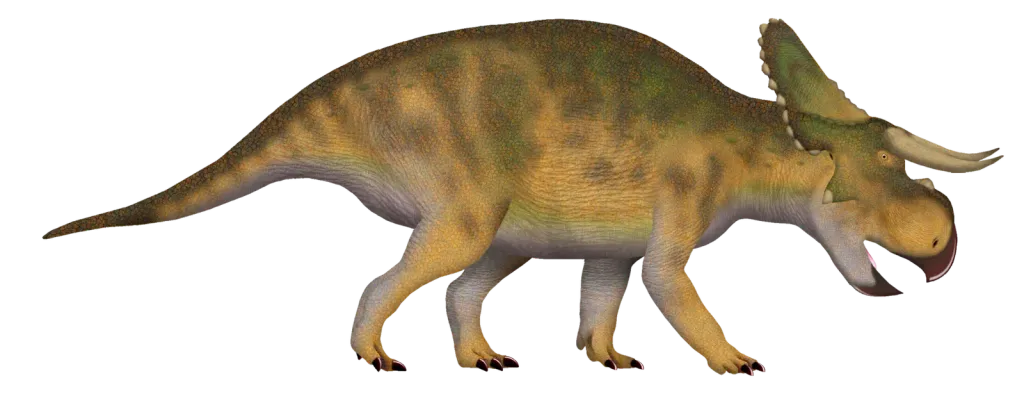
Nasutoceratops titusi
उच्चारण: nah-SOO-toh-SERR-ah-tops TY-tus-eye
Ceratopsia · Ceratopsidae
A big-nosed horned dinosaur from the Late Cretaceous of southern Utah, with a short, deep snout and the longest brow horns of any centrosaurine. It lived about 76 million years ago on the island continent of Laramidia.
- Horned
- Quadrupedal
- Skin impressions known
- काल
- क्रिटेशियस· कैम्पेनियन
- आहार
- शाकाहारी
- लंबाई
- 4.5 m
- द्रव्यमान
- 1,500 kg
- स्थान
- Utah, United States
त्वरित उत्तर
- Nasutoceratops titusi कितना बड़ा था?
- Nasutoceratops titusi लगभग 4.5 m लंबा था। कूल्हों तक इसकी ऊँचाई लगभग 1.4–1.8 m थी। इसका वज़न लगभग 1.5 t था। (Wikipedia: Nasutoceratops 2026; Paul 2016)
- Nasutoceratops titusi कब रहता था?
- Nasutoceratops titusi उत्तर क्रिटेशियस में, लगभग 7.6–7.55 करोड़ वर्ष पहले रहता था। (Sampson et al. 2013; Paleobiology Database: Nasutoceratops titusi … 2026)
- Nasutoceratops titusi के जीवाश्म कहाँ मिले हैं?
- Nasutoceratops titusi के जीवाश्म Kaiparowits Formation (Utah) और United States में मिले हैं। (Sampson et al. 2013; Paleobiology Database: Nasutoceratops titusi … 2026)
- Nasutoceratops titusi क्या खाता था?
- Nasutoceratops titusi एक शाकाहारी था। (Sampson et al. 2013; Paleobiology Database: Nasutoceratops titusi … 2026)
- Nasutoceratops titusi का नाम किसने और कब रखा?
- Nasutoceratops titusi का वर्णन Scott D. Sampson et al. ने 2013 में किया। (Sampson et al. 2013; Paleobiology Database: Nasutoceratops titusi … 2026)
- क्या Nasutoceratops titusi Jurassic Park में था?
- हाँ। Nasutoceratops titusi Jurassic World Dominion (2022) में दिखाई देता है। फ़िल्मों में कई बातें काल्पनिक हैं; यह पेज उनकी तुलना जीवाश्म प्रमाणों से करता है। (Wikipedia: Dinosaurs in Jurassic Park 2026; Sampson et al. 2013)
इस पेज पर

- काल
- क्रिटेशियस76–75.5 Ma
- आहार
- शाकाहारी
- लंबाई
- 4.5 m
- द्रव्यमान
- 1.5 t
- स्थान
- United States
- वर्गीकरण
- Ceratopsia · Ceratopsidae
- वर्णित
- 2013, Scott D. Sampson et al.
अवलोकन
यह सामग्री अंग्रेज़ी में उपलब्ध है।
Nasutoceratops titusi lived about 76 million years ago in what is now southern Utah, on Laramidia, the western island continent of North America. Eric Lund found its skull in 2006 in the Kaiparowits Formation of Grand Staircase-Escalante National Monument, and Scott Sampson and colleagues named it in 2013.
Its 1.8 m skull had an unusually short, deep snout with a hugely enlarged nasal opening, a low nasal horn and forward-curving brow horns spanning about 40% of the skull length, the longest of any centrosaurine. Its frill was broad and plain.
Nasutoceratops was the first centrosaurine from the south of Laramidia of the same age as the many northern ones. Sampson and colleagues saw it as support for separate northern and southern dinosaur provinces on Laramidia, an idea other researchers have contested.
नाम का अर्थ
From Latin nasutus ("large-nosed") and Latinized Greek ceratops ("horned face"); titusi honours Alan Titus, palaeontologist at Grand Staircase-Escalante National Monument (Sampson et al. 2013).
जीवविज्ञान और साक्ष्य
वैज्ञानिक इस जानवर के जीवन के बारे में क्या सोचते हैं, और हर विचार के पक्ष में साक्ष्य कितने मज़बूत हैं।
अन्य
Laramidia was divided into northern and southern dinosaur provinces.
साक्ष्य स्तर: विवादितSampson and colleagues saw a southern centrosaurine lineage living at the same time as northern ones as strong support; others argue the differences reflect age and sampling.
पक्ष / विपक्ष में साक्ष्य · 1
पक्ष में साक्ष्य
वंशवृक्षीय अनुमान · Centrosaurine phylogeny with Nasutoceratops
Nasutoceratops is the sister taxon of Avaceratops in an early-branching centrosaurine subclade.
Nasutoceratops had an unusually large, air-filled nose.
साक्ष्य स्तर: प्रत्यक्ष साक्ष्यThe nasal opening region makes up about three-quarters of the snout in front of the eyes, and the nasal bones hold an internal air space.
पक्ष / विपक्ष में साक्ष्य · 1
पक्ष में साक्ष्य
नमूना · Nasutoceratops holotype skull
A 1.8 m skull with a hypertrophied narial region (about 75% of preorbital length), pneumatic nasals, a short snout and rostrolaterally directed brow horns spanning about 40% of skull length.
नमूना: UMNH VP 16800
Nasutoceratops had the longest brow horns of any centrosaurine.
साक्ष्य स्तर: प्रत्यक्ष साक्ष्यIn the holotype they span about 40% of the skull length and reach almost to the tip of the snout.
पक्ष / विपक्ष में साक्ष्य · 1
पक्ष में साक्ष्य
नमूना · Nasutoceratops holotype skull
A 1.8 m skull with a hypertrophied narial region (about 75% of preorbital length), pneumatic nasals, a short snout and rostrolaterally directed brow horns spanning about 40% of skull length.
नमूना: UMNH VP 16800
आकार
- लंबाई
- 4.5 m
- ऊँचाई
- 1.6 mप्रकाशित सीमा 1.4–1.8 m
- द्रव्यमान
- 1,500 kg
(14.8 फ़ुट)
(5.2 फ़ुट)
समयरेखा
काल: कैम्पेनियन (83.6–72.1 Ma), उत्तर क्रिटेशियस (100.5–66 Ma)
Middle unit of the Kaiparowits Formation, about 75.97-75.51 Ma (Sampson et al. 2013, recalibrated after Roberts et al.); PBDB bins the collection as late Campanian.
स्थान
संरचनाएँ
- Kaiparowits Formation · Utah
स्थान
- UMNH VP Locality 940, Grand Staircase-Escalante · Kaiparowits Formation · Utah · स्थिति अनुमानित
ये वे स्थान हैं जहाँ जीवाश्म मिले हैं, न कि वह पूरा क्षेत्र जहाँ यह जानवर रहता था।
पारितंत्र

यहाँ रहता था: Kaiparowits
बाढ़ का मैदान, नदी तंत्र, दलदल / आर्द्रभूमि
Alluvial floodplains of large rivers on coastal southern Laramidia, with wetlands and swamps, west of the Western Interior Seaway.
वर्गीकरण
- क्लेडDinosauria
- क्लेडOrnithischia
- क्लेडCeratopsia
- कुलCeratopsidae
- उपकुलCentrosaurinae
- वंशNasutoceratops
- प्रजातिNasutoceratops titusi
वर्गिकीय स्थिति: मान्य
जीवाश्म अभिलेख

| कैटलॉग संख्या | स्थिति | संस्थान | मिला |
|---|---|---|---|
| UMNH VP 16800 | होलोटाइप | Natural History Museum of Utah (UMNH) | 2006 |
| UMNH VP 19466 | संदर्भित नमूना | Natural History Museum of Utah (UMNH) | — |
क्या मिला है
होलोटाइप: UMNH VP 16800
- संरक्षित
- आंशिक
- पुनर्निर्मित
- अज्ञात / दर्ज नहीं
होलोटाइप: UMNH VP 16800
क्षेत्र-दर-क्षेत्र (तालिका)
| क्षेत्र | स्थिति |
|---|---|
| Skull | संरक्षित |
| Mandible | अज्ञात / दर्ज नहीं |
| Teeth | अज्ञात / दर्ज नहीं |
| Cervical vertebrae | आंशिक · Syncervical. |
| Dorsal vertebrae | आंशिक · Three fragmentary dorsals. |
| Sacrum | अज्ञात / दर्ज नहीं |
| Caudal vertebrae | अज्ञात / दर्ज नहीं |
| Ribs | अज्ञात / दर्ज नहीं |
| Gastralia | अज्ञात / दर्ज नहीं |
| Scapula / shoulder girdle | अज्ञात / दर्ज नहीं |
| Humerus | संरक्षित |
| Forearm (radius / ulna) | आंशिक |
| Hand (manus) | अज्ञात / दर्ज नहीं |
| Pelvis | अज्ञात / दर्ज नहीं |
| Femur | अज्ञात / दर्ज नहीं |
| Tibia / fibula | अज्ञात / दर्ज नहीं |
| Foot (pes) | अज्ञात / दर्ज नहीं |
संदर्भित नमूना: UMNH VP 19466
क्षेत्र-दर-क्षेत्र (तालिका)
| क्षेत्र | स्थिति |
|---|---|
| Skull | आंशिक |
| Mandible | अज्ञात / दर्ज नहीं |
| Teeth | अज्ञात / दर्ज नहीं |
| Cervical vertebrae | अज्ञात / दर्ज नहीं |
| Dorsal vertebrae | अज्ञात / दर्ज नहीं |
| Sacrum | अज्ञात / दर्ज नहीं |
| Caudal vertebrae | अज्ञात / दर्ज नहीं |
| Ribs | अज्ञात / दर्ज नहीं |
| Gastralia | अज्ञात / दर्ज नहीं |
| Scapula / shoulder girdle | अज्ञात / दर्ज नहीं |
| Humerus | अज्ञात / दर्ज नहीं |
| Forearm (radius / ulna) | अज्ञात / दर्ज नहीं |
| Hand (manus) | अज्ञात / दर्ज नहीं |
| Pelvis | अज्ञात / दर्ज नहीं |
| Femur | अज्ञात / दर्ज नहीं |
| Tibia / fibula | अज्ञात / दर्ज नहीं |
| Foot (pes) | अज्ञात / दर्ज नहीं |
खोज
- वर्णन का वर्ष
- 2013
- वर्णनकर्ता
- Scott D. Sampson et al.
- प्ररूप नमूना
- UMNH VP 16800

खोज की समयरेखा
2006 · पहली सामग्री मिली
Nasutoceratops skull found at UMNH Locality 940
Found during the Kaiparowits Basin Project surveys of Grand Staircase-Escalante National Monument.
लोग: Eric K. Lund
2013 · औपचारिक रूप से वर्णित
Sampson and colleagues name Nasutoceratops titusi
The "large-nosed horned face" is named in Proceedings of the Royal Society B.
लोग: Scott D. Sampson, Eric K. Lund
Jurassic Park और Jurassic World में
फ़िल्में
- Jurassic World Dominion (2022)
यह सामग्री अंग्रेज़ी में उपलब्ध है।
पर्दे पर
A horned herbivore that returns in Dominion after its debut in the short Battle at Big Rock.
फ़िल्म बनाम जीवाश्म
- The real animal had a short snout and long, forward-curving brow horns, and is known from Utah.
फ़िल्मों के नाम केवल पहचान के लिए दिए गए हैं। DinoDex का Jurassic Park / Jurassic World फ़्रैंचाइज़ से कोई संबंध नहीं है और न ही उसे उनका समर्थन प्राप्त है। फ़िल्मों में दिखे सभी डायनासोर
स्रोत
- (2026). Paleobiology Database: Nasutoceratops titusi occurrence and type collection 97803. The Paleobiology Database (paleobiodb.org), data service 1.2, accessed 2026-09-23. https://paleobiodb.org/data1.2/colls/list.json?coll_id=97803&show=paleoloc,strat,loc,ref,geo&pgm=gplates&vocab=pbdb (नए टैब में खुलता है)
- (2026). Wikipedia: Nasutoceratops. Wikipedia (English), accessed 2026-09-24. https://en.wikipedia.org/wiki/Nasutoceratops (नए टैब में खुलता है)
- (2026). Wikipedia: Dinosaurs in Jurassic Park. Wikipedia. https://en.wikipedia.org/wiki/Dinosaurs_in_Jurassic_Park (नए टैब में खुलता है)
- Paul, G. S. (2016). The Princeton Field Guide to Dinosaurs (2nd edition). Princeton University Press.
- Sampson, S. D., Lund, E. K., Loewen, M. A., Farke, A. A. & Clayton, K. E. (2013). A remarkable short-snouted horned dinosaur from the Late Cretaceous (late Campanian) of southern Laramidia. Proceedings of the Royal Society B 280: 20131186. doi:10.1098/rspb.2013.1186 (नए टैब में खुलता है)