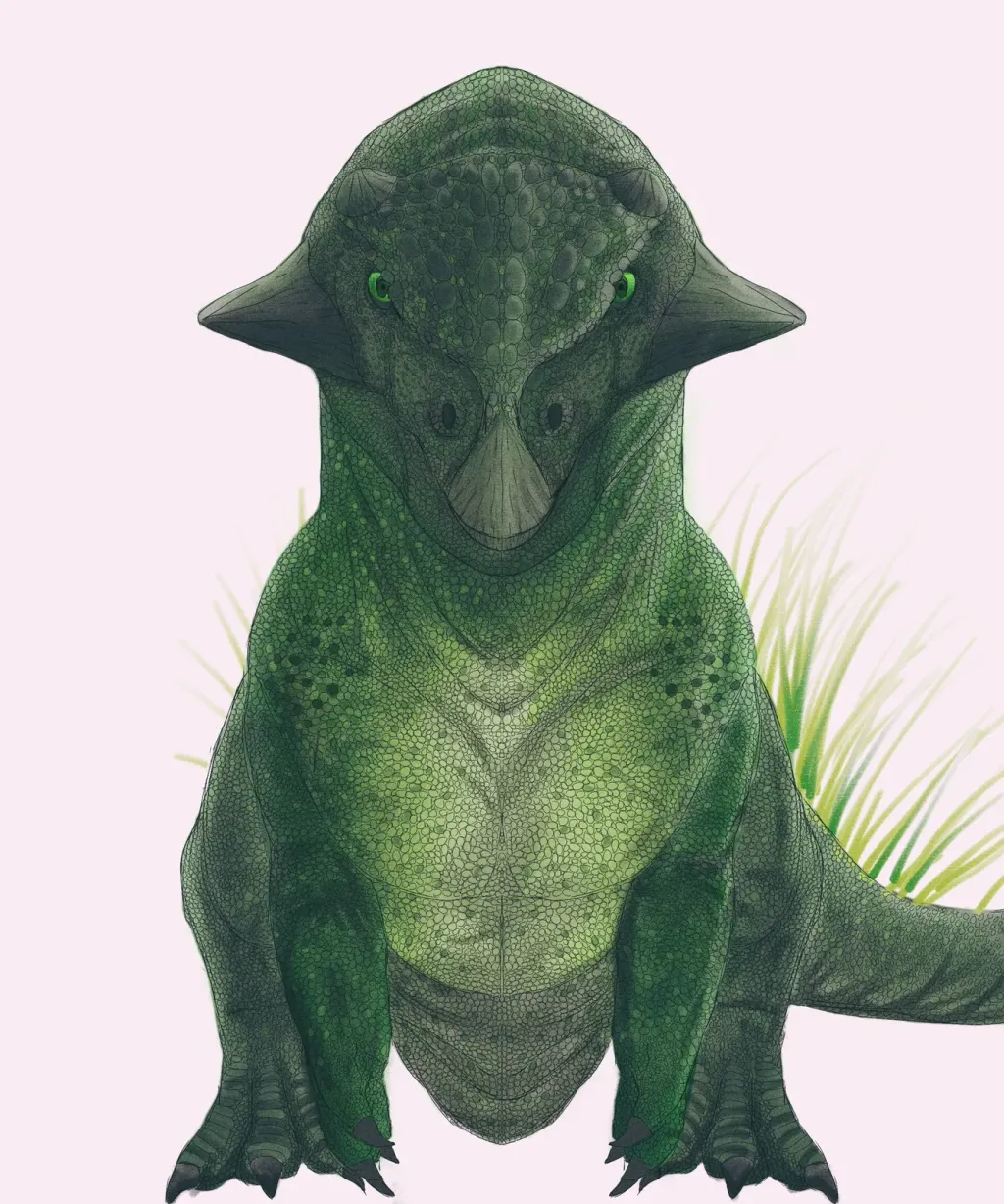
Psittacosaurus mongoliensis
उच्चारण: SIT-ah-koh-SORE-us mon-goh-lee-EN-sis
Ceratopsia
The "parrot lizard", a small two-legged early horned dinosaur from the Early Cretaceous of Mongolia with a deep, beaked skull. Its genus is known from hundreds of skeletons, and one specimen kept skin, colour and bristles on its tail.
- Bipedal
- Skin impressions known
- Exceptional preservation
- काल
- क्रिटेशियस· प्रारंभिक क्रिटेशियस
- आहार
- शाकाहारी
- लंबाई
- 2 m
- द्रव्यमान
- अज्ञात
- स्थान
- Övörkhangai Province, Mongolia, Asia
त्वरित उत्तर
- Psittacosaurus mongoliensis कितना बड़ा था?
- Psittacosaurus mongoliensis लगभग 2 m लंबा था। कूल्हों तक इसकी ऊँचाई लगभग 0.5–0.6 m थी। (Wikipedia: Psittacosaurus 2026; Paul 2016)
- Psittacosaurus mongoliensis कब रहता था?
- Psittacosaurus mongoliensis प्रारंभिक क्रिटेशियस में, लगभग 14.31–10.05 करोड़ वर्ष पहले रहता था। (Paleobiology Database: Psittacosaurus mongoli… 2026)
- Psittacosaurus mongoliensis के जीवाश्म कहाँ मिले हैं?
- Psittacosaurus mongoliensis के जीवाश्म Öösh Formation (Övörkhangai Province) और Mongolia में मिले हैं। (Osborn 1923; Mayr et al. 2002)
- Psittacosaurus mongoliensis क्या खाता था?
- Psittacosaurus mongoliensis एक शाकाहारी था। (Osborn 1923; Mayr et al. 2002)
- Psittacosaurus mongoliensis का नाम किसने और कब रखा?
- Psittacosaurus mongoliensis का वर्णन Henry Fairfield Osborn ने 1923 में किया। (Osborn 1923; Paleobiology Database: Psittacosaurus mongoli… 2026)
इस पेज पर

- काल
- क्रिटेशियस143.1–100.5 Ma
- आहार
- शाकाहारी
- लंबाई
- 2 m
- द्रव्यमान
- अज्ञात
- स्थान
- Mongolia, Asia
- वर्गीकरण
- Ceratopsia
- वर्णित
- 1923, Henry Fairfield Osborn
अवलोकन
यह सामग्री अंग्रेज़ी में उपलब्ध है।
Psittacosaurus mongoliensis lived in the Early Cretaceous in what is now Mongolia. During the American Museum's Central Asiatic Expedition of 1922, the expedition's driver, Wong, found a nearly complete skeleton at Red Mesa, Artsa Bogdo, in the Oshih Basin, and Henry Fairfield Osborn named it in 1923 for its parrot-like beak.
It was one of the earliest ceratopsians, a distant relative of Triceratops without horns or a large frill, with a short, deep skull, a strong beak and small bony cheek bosses. Adults walked on two legs, and the largest P. mongoliensis reached about 2 m.
Psittacosaurus is the most species-rich non-avian dinosaur genus and one of the best known, with growth series from hatchlings to adults. A Chinese Psittacosaurus specimen preserves long bristles on the tail (Mayr et al. 2002) and a countershaded skin pattern suggesting it lived in forests (Vinther et al. 2016).
नाम का अर्थ
"Parrot lizard", from Greek psittakos and sauros, for its beak; mongoliensis for Mongolia (Osborn 1923).
जीवविज्ञान और साक्ष्य
वैज्ञानिक इस जानवर के जीवन के बारे में क्या सोचते हैं, और हर विचार के पक्ष में साक्ष्य कितने मज़बूत हैं।
गति
Adult Psittacosaurus walked on two legs.
साक्ष्य स्तर: मज़बूत साक्ष्यIts short arms could not reach the ground in a walking pose; young individuals may have used all four legs.
त्वचा और आवरण
Psittacosaurus was countershaded and lived in forests.
साक्ष्य स्तर: मध्यम साक्ष्यIts dark back grading into a light belly matches the camouflage best suited to diffuse light under a canopy. The specimen is an undetermined Chinese species.
पक्ष / विपक्ष में साक्ष्य · 1
पक्ष में साक्ष्य
त्वचा की छाप · Psittacosaurus colour pattern (SMF R 4970)
Fossil melanin in the skin of Psittacosaurus sp. SMF R 4970 from the Jehol Biota shows a dark back, a light belly and a gradual transition, tested on a life-size model under different light.
Psittacosaurus had long bristles on its tail.
साक्ष्य स्तर: प्रत्यक्ष साक्ष्यThey are preserved on a Chinese Psittacosaurus specimen; whether they are related to the filaments of theropods is not established. Not known for P. mongoliensis itself.
पक्ष / विपक्ष में साक्ष्य · 1
पक्ष में साक्ष्य
त्वचा की छाप · Psittacosaurus tail bristles
A Psittacosaurus from the Early Cretaceous of China with well-preserved skin and long, bristle-like structures on the upper part of the tail.

आकार
- लंबाई
- 2 m
- ऊँचाई
- 0.5 mप्रकाशित सीमा 0.5–0.6 m
- द्रव्यमान
- अज्ञात
(6.6 फ़ुट)
(1.6 फ़ुट)
adults पर आधारित
समयरेखा
काल: प्रारंभिक क्रिटेशियस (145–100.5 Ma)
PBDB bins the type collection only as "Early Cretaceous" (143.1-100.5 Ma); the Oshih locality is usually given as Aptian-Albian (secondary), and the genus as about 125-105 Ma.
स्थान
संरचनाएँ
- Öösh Formation · Övörkhangai Province
- Red Mesa, Artsa Bogdo, Oshih Basin (AMNH loc. 11494) · Öösh Formation · Övörkhangai Province · स्थिति अनुमानित
ये वे स्थान हैं जहाँ जीवाश्म मिले हैं, न कि वह पूरा क्षेत्र जहाँ यह जानवर रहता था।
पारितंत्र
यहाँ रहता था: Öösh (Oshih Basin)
143.1–100.5 मिलियन वर्ष पहले · अन्य
Early Cretaceous terrestrial beds of the Oshih Basin in central Mongolia; PBDB records the setting only as "terrestrial indet.", and the sources we opened do not describe it further.
वर्गीकरण
- क्लेडDinosauria
- क्लेडOrnithischia
- क्लेडCeratopsia
- वंशPsittacosaurus
- प्रजातिPsittacosaurus mongoliensis
वर्गिकीय स्थिति: मान्य
जीवाश्म अभिलेख

| कैटलॉग संख्या | स्थिति | संस्थान | मिला |
|---|---|---|---|
| AMNH 6254 “Red Mesa skeleton” | होलोटाइप | American Museum of Natural History (AMNH) | 1922 |
क्या मिला है
होलोटाइप: AMNH 6254 “Red Mesa skeleton”
- संरक्षित
- आंशिक
- पुनर्निर्मित
- अज्ञात / दर्ज नहीं
क्षेत्र-दर-क्षेत्र (तालिका)
| क्षेत्र | स्थिति |
|---|---|
| Skull | संरक्षित |
| Mandible | संरक्षित |
| Teeth | अज्ञात / दर्ज नहीं |
| Cervical vertebrae | अज्ञात / दर्ज नहीं |
| Dorsal vertebrae | अज्ञात / दर्ज नहीं |
| Sacrum | अज्ञात / दर्ज नहीं |
| Caudal vertebrae | अज्ञात / दर्ज नहीं |
| Ribs | अज्ञात / दर्ज नहीं |
| Gastralia | अज्ञात / दर्ज नहीं |
| Scapula / shoulder girdle | अज्ञात / दर्ज नहीं |
| Humerus | अज्ञात / दर्ज नहीं |
| Forearm (radius / ulna) | अज्ञात / दर्ज नहीं |
| Hand (manus) | अज्ञात / दर्ज नहीं |
| Pelvis | अज्ञात / दर्ज नहीं |
| Femur | अज्ञात / दर्ज नहीं |
| Tibia / fibula | अज्ञात / दर्ज नहीं |
| Foot (pes) | अज्ञात / दर्ज नहीं |

खोज
- वर्णन का वर्ष
- 1923
- वर्णनकर्ता
- Henry Fairfield Osborn
- प्ररूप नमूना
- AMNH 6254
खोज की समयरेखा
1922 · पहली सामग्री मिली
Red Mesa Psittacosaurus skeleton found
The expedition driver finds a nearly complete skeleton in the Oshih Basin.
लोग: Wong (expedition driver), Roy Chapman Andrews
1923 · औपचारिक रूप से वर्णित
Osborn names Psittacosaurus mongoliensis
Named in American Museum Novitates together with Protiguanodon, later found to be the same animal.
लोग: Henry Fairfield Osborn
2016 · प्रमुख अध्ययन
Psittacosaurus colour pattern reconstructed
Vinther and colleagues reconstruct countershading from fossil melanin.
लोग: Jakob Vinther, Gerald Mayr
स्रोत
- (2026). Paleobiology Database: Psittacosaurus mongoliensis type collection 48936. The Paleobiology Database (paleobiodb.org), data service 1.2, accessed 2026-09-23. https://paleobiodb.org/data1.2/colls/list.json?coll_id=48936&show=paleoloc,strat,loc,ref,geo&pgm=gplates&vocab=pbdb (नए टैब में खुलता है)
- (2026). Wikipedia: Psittacosaurus. Wikipedia (English), accessed 2026-09-24. https://en.wikipedia.org/wiki/Psittacosaurus (नए टैब में खुलता है)
- Mayr, G., Peters, D. S., Plodowski, G. & Vogel, O. (2002). Bristle-like integumentary structures at the tail of the horned dinosaur Psittacosaurus. Naturwissenschaften 89: 361-365. doi:10.1007/s00114-002-0339-6 (नए टैब में खुलता है)
- Osborn, H. F. (1923). Two Lower Cretaceous dinosaurs of Mongolia. American Museum Novitates 95: 1-10.
- Paul, G. S. (2016). The Princeton Field Guide to Dinosaurs (2nd edition). Princeton University Press.
- Vinther, J., Nicholls, R., Lautenschlager, S., Pittman, M., Kaye, T. G., Rayfield, E., Mayr, G. & Cuthill, I. C. (2016). 3D camouflage in an ornithischian dinosaur. Current Biology 26: 2456-2462. doi:10.1016/j.cub.2016.06.065 (नए टैब में खुलता है)