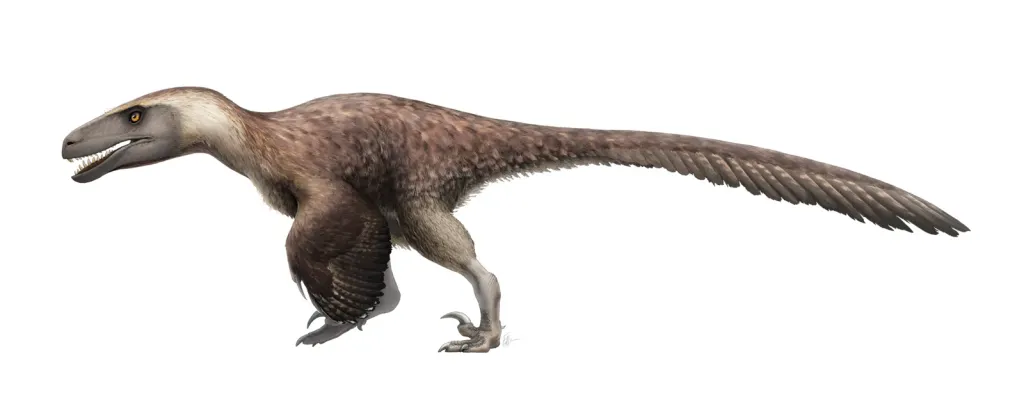
Utahraptor ostrommaysi
उच्चारण: YOO-tah-RAP-tor os-trom-MAY-zeye
Eudromaeosauria · Dromaeosauridae
The largest known dromaeosaurid, a heavily built "raptor" several metres long from the Early Cretaceous Cedar Mountain Formation of Utah, with a sickle claw over 20 cm long.
- Feathered
- Bipedal
- Sickle claw
- Giant
- Possible pack behavior
- काल
- क्रिटेशियस· बैरेमियन
- आहार
- मांसाहारी
- लंबाई
- 5.5–7 m
- द्रव्यमान
- अज्ञात
- स्थान
- Utah
त्वरित उत्तर
- Utahraptor ostrommaysi कितना बड़ा था?
- Utahraptor ostrommaysi लगभग 5.5–7 m लंबा था। कूल्हों तक इसकी ऊँचाई लगभग 1.3–1.6 m थी। (Kirkland et al. 1993; Paul 2010)
- Utahraptor ostrommaysi कब रहता था?
- Utahraptor ostrommaysi प्रारंभिक क्रिटेशियस में, लगभग 12.58–12.14 करोड़ वर्ष पहले रहता था। (Cohen et al. 2023; Kirkland et al. 1993)
- Utahraptor ostrommaysi के जीवाश्म कहाँ मिले हैं?
- Utahraptor ostrommaysi के जीवाश्म Cedar Mountain Formation (Utah) में मिले हैं। (Kirkland et al. 1993; Paul 2010)
- Utahraptor ostrommaysi क्या खाता था?
- Utahraptor ostrommaysi एक मांसाहारी था। (Kirkland et al. 1993; Paul 2010)
- Utahraptor ostrommaysi का नाम किसने और कब रखा?
- Utahraptor ostrommaysi का वर्णन James I. Kirkland, Robert Gaston & Donald Burge ने 1993 में किया। (Kirkland et al. 1993)
इस पेज पर

YOO-tah-RAP-tor os-trom-MAY-zeye
- काल
- क्रिटेशियस125.8–121.4 Ma
- आहार
- मांसाहारी
- लंबाई
- 5.5–7 m
- द्रव्यमान
- अज्ञात
- वर्गीकरण
- Eudromaeosauria · Dromaeosauridae
- वर्णित
- 1993, James I. Kirkland, Robert Gaston & Donald Burge
अवलोकन
यह सामग्री अंग्रेज़ी में उपलब्ध है।
Utahraptor ostrommaysi lived in what is now eastern Utah in the Early Cretaceous. Its remains come from the Yellow Cat Member of the Cedar Mountain Formation. James Kirkland, Robert Gaston and Donald Burge named it in 1993, honouring John Ostrom, who first described Deinonychus, and Chris Mays of Dinamation.
It was the giant of the dromaeosaurids: much heavier and longer than Deinonychus, with a huge sickle claw on each foot. Unlike its lighter relatives it had relatively short, strong legs, suggesting it overpowered prey rather than chasing it over long distances.
In 2001 a sandstone block was found near Moab with the bones of several Utahraptor individuals, from adults to juveniles, mixed with an iguanodont. It may be a quicksand trap that caught a group, but the block is still being prepared and the interpretation is open. The age of the Yellow Cat Member is also debated.
नाम का अर्थ
"Utah's plunderer", from Utah and Latin raptor; ostrommaysi honours John Ostrom and Chris Mays (Kirkland, Gaston & Burge 1993).
जीवविज्ञान और साक्ष्य
वैज्ञानिक इस जानवर के जीवन के बारे में क्या सोचते हैं, और हर विचार के पक्ष में साक्ष्य कितने मज़बूत हैं।
गति
Utahraptor was built for power rather than speed.
साक्ष्य स्तर: मध्यम साक्ष्यIts lower legs are short and stout compared with lighter relatives, which points to strength over endurance running.
पक्ष / विपक्ष में साक्ष्य · 1
पक्ष में साक्ष्य
तुलनात्मक शरीर रचना · Utahraptor robust hind limbs
Shorter, sturdier lower legs and a larger sickle claw than in Deinonychus, suggesting power rather than speed.
नमूना: CEU 184v.86
पंख
Utahraptor had feathers.
साक्ष्य स्तर: मज़बूत साक्ष्यFeathers are not preserved with it, but they are known in its close relatives on both sides of the family tree.
पक्ष / विपक्ष में साक्ष्य · 1
पक्ष में साक्ष्य
वंशवृक्षीय अनुमान · Dromaeosaur quill knobs and feathered relatives
Close relatives are preserved with feathers, and Velociraptor shows quill knobs; Deinonychus sits inside this feathered group.
सामाजिक जीवन
Utahraptor lived in family groups.
साक्ष्य स्तर: परिकल्पनाA block with adults and young together suggests they were together when they died, but the site is still being prepared and a trap could gather unrelated animals.
पक्ष / विपक्ष में साक्ष्य · 1
पक्ष में साक्ष्य
नमूना · Utahraptor multi-individual block
Several Utahraptor of different ages buried together with a possible prey animal, perhaps trapped in quicksand.
आकार
- लंबाई
- 5.5–7 m
- ऊँचाई
- 1.5 mप्रकाशित सीमा 1.3–1.6 m
- द्रव्यमान
- अज्ञात
(23 फ़ुट)
(4.9 फ़ुट)
BYU material and Stikes Quarry specimens पर आधारित
समयरेखा
काल: बैरेमियन (125.8–121.4 Ma), प्रारंभिक क्रिटेशियस (145–100.5 Ma)
Ages are the ICS 2023/09 bounds of the Barremian, the stage(s) the fossils are assigned to; they bracket the record and are not dated first/last appearances. The Yellow Cat Member is usually cited as Barremian, but some dating work suggests it is older (Valanginian-Hauterivian); the range is uncertain.
स्थान
संरचनाएँ
- Cedar Mountain Formation · Utah
स्थान
- Gaston Quarry, Grand County, Utah · Cedar Mountain Formation · Utah · स्थिति अनुमानित
ये वे स्थान हैं जहाँ जीवाश्म मिले हैं, न कि वह पूरा क्षेत्र जहाँ यह जानवर रहता था।
पारितंत्र
यहाँ रहता था: Yellow Cat
बाढ़ का मैदान, नदी तंत्र, अन्य
Early Cretaceous semi-arid floodplains with seasonal rivers and springs in what is now eastern Utah. Its age is debated.
वर्गीकरण
- क्लेडDinosauria
- क्लेडSaurischia
- क्लेडTheropoda
- क्लेडCoelurosauria
- क्लेडManiraptora
- कुलDromaeosauridae
- क्लेडEudromaeosauria
- वंशUtahraptor
- प्रजातिUtahraptor ostrommaysi
वर्गिकीय स्थिति: मान्य
जीवाश्म अभिलेख

| कैटलॉग संख्या | स्थिति | संस्थान | मिला |
|---|---|---|---|
| CEU 184v.86 | होलोटाइप | Prehistoric Museum, Utah State University Eastern (CEU) | 1991 |
| UGS Utahraptor megablock “Utahraptor megablock” | संदर्भित नमूना | Utah Geological Survey (UGS) | 2001 |
क्या मिला है
होलोटाइप: CEU 184v.86
- संरक्षित
- आंशिक
- पुनर्निर्मित
- अज्ञात / दर्ज नहीं
होलोटाइप: CEU 184v.86
क्षेत्र-दर-क्षेत्र (तालिका)
| क्षेत्र | स्थिति |
|---|---|
| Skull | अज्ञात / दर्ज नहीं |
| Mandible | अज्ञात / दर्ज नहीं |
| Teeth | अज्ञात / दर्ज नहीं |
| Cervical vertebrae | अज्ञात / दर्ज नहीं |
| Dorsal vertebrae | अज्ञात / दर्ज नहीं |
| Sacrum | अज्ञात / दर्ज नहीं |
| Caudal vertebrae | अज्ञात / दर्ज नहीं |
| Ribs | अज्ञात / दर्ज नहीं |
| Gastralia | अज्ञात / दर्ज नहीं |
| Scapula / shoulder girdle | अज्ञात / दर्ज नहीं |
| Humerus | अज्ञात / दर्ज नहीं |
| Forearm (radius / ulna) | अज्ञात / दर्ज नहीं |
| Hand (manus) | अज्ञात / दर्ज नहीं |
| Pelvis | अज्ञात / दर्ज नहीं |
| Femur | अज्ञात / दर्ज नहीं |
| Tibia / fibula | अज्ञात / दर्ज नहीं |
| Foot (pes) | आंशिक · Second-toe claw. |
संदर्भित नमूना: UGS Utahraptor megablock “Utahraptor megablock”
क्षेत्र-दर-क्षेत्र (तालिका)
| क्षेत्र | स्थिति |
|---|---|
| Skull | आंशिक |
| Mandible | अज्ञात / दर्ज नहीं |
| Teeth | अज्ञात / दर्ज नहीं |
| Cervical vertebrae | आंशिक |
| Dorsal vertebrae | अज्ञात / दर्ज नहीं |
| Sacrum | अज्ञात / दर्ज नहीं |
| Caudal vertebrae | अज्ञात / दर्ज नहीं |
| Ribs | अज्ञात / दर्ज नहीं |
| Gastralia | अज्ञात / दर्ज नहीं |
| Scapula / shoulder girdle | अज्ञात / दर्ज नहीं |
| Humerus | अज्ञात / दर्ज नहीं |
| Forearm (radius / ulna) | अज्ञात / दर्ज नहीं |
| Hand (manus) | अज्ञात / दर्ज नहीं |
| Pelvis | अज्ञात / दर्ज नहीं |
| Femur | आंशिक |
| Tibia / fibula | अज्ञात / दर्ज नहीं |
| Foot (pes) | अज्ञात / दर्ज नहीं |

खोज
- वर्णन का वर्ष
- 1993
- वर्णनकर्ता
- James I. Kirkland, Robert Gaston & Donald Burge
- प्ररूप नमूना
- CEU 184v.86
खोज की समयरेखा
1991 · पहली सामग्री मिली
Utahraptor claw found at Gaston Quarry
A giant foot claw is found in the Cedar Mountain Formation of Utah.
लोग: Carl Limoni, Robert Gaston
1993 · औपचारिक रूप से वर्णित
Kirkland, Gaston and Burge name Utahraptor
The largest known dromaeosaurid is named, the same year Jurassic Park showed oversized raptors.
लोग: James I. Kirkland, Robert Gaston
2001 · नमूना प्राप्त हुआ
Utahraptor megablock found
A block with several Utahraptor individuals is found near Moab.
लोग: Matt Stikes
स्रोत
- Cohen, K. M., Harper, D. A. T., Gibbard, P. L. & Car, N. (2023). International Chronostratigraphic Chart (v2023/09). International Commission on Stratigraphy. https://stratigraphy.org/ICSchart/ChronostratChart2023-09.pdf (नए टैब में खुलता है)
- Kirkland, J. I., Gaston, R. & Burge, D. (1993). A large dromaeosaur (Theropoda) from the Lower Cretaceous of eastern Utah. Hunteria 2(10): 1-16.
- Paul, G. S. (2010). The Princeton Field Guide to Dinosaurs. Princeton University Press.
- Paul, G. S. (2016). The Princeton Field Guide to Dinosaurs (2nd edition). Princeton University Press.