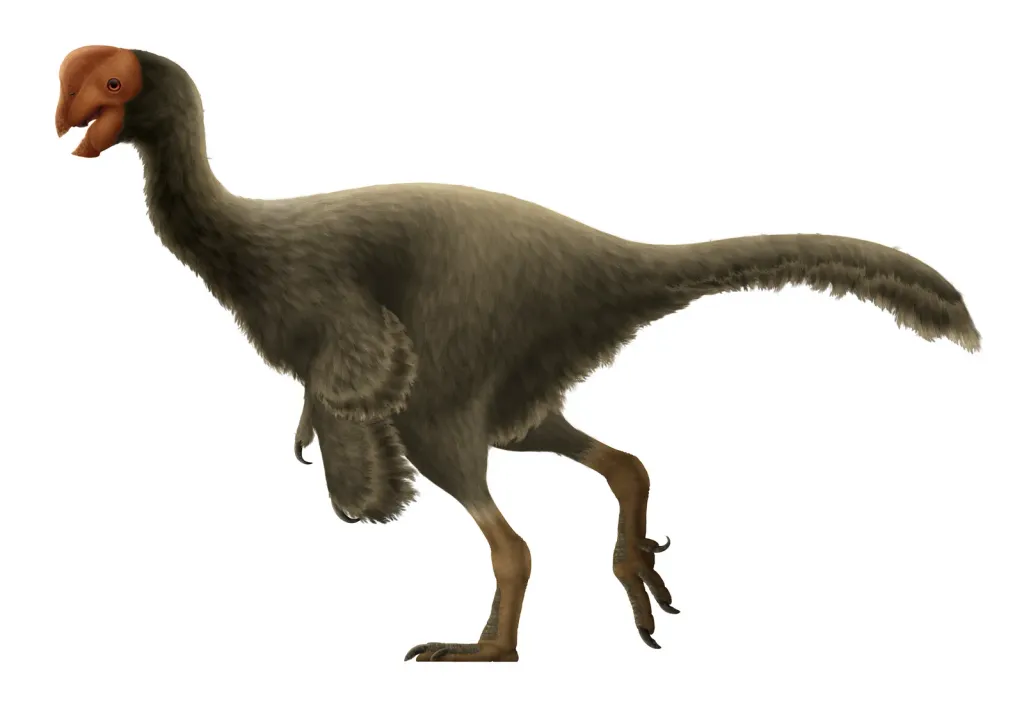
Oviraptor philoceratops
発音: OH-vih-RAP-tor fil-oh-SERR-ah-tops
Maniraptora · Oviraptoridae
The "egg thief", a beaked, feathered theropod from the Late Cretaceous of Mongolia, found in 1923 lying on a nest of eggs. Later finds showed the nest was its own: it was brooding, not stealing.
- Bipedal
- Feathered
- Eggs known
- Famous specimen
- 時代
- 白亜紀· カンパニアン期
- 食性
- 雑食
- 全長
- 1.6–2 m
- 体重
- 33–40 kg
- 産地
- Ömnögovi Province, Mongolia, Asia
クイックアンサー
- Oviraptor philoceratopsの大きさは?
- Oviraptor philoceratopsの全長は約1.6–2 mでした。腰の高さは約0.7–0.9 mでした。体重は約33–40 kgでした。 (Wikipedia: Oviraptor 2026; Paul 2016)
- Oviraptor philoceratopsはいつ生きていた?
- Oviraptor philoceratopsは白亜紀後期、約7500万〜7100万年前に生きていました。 (Paleobiology Database: Oviraptor philoceratop… 2026; Dashzeveg et al. 2005)
- Oviraptor philoceratopsの化石はどこで見つかった?
- Oviraptor philoceratopsの化石はDjadokhta Formation (Ömnögovi Province)、Mongoliaで見つかっています。 (Osborn 1924; Norell et al. 1994)
- Oviraptor philoceratopsは何を食べていた?
- Oviraptor philoceratopsは雑食でした。 (Osborn 1924; Norell et al. 1994)
- Oviraptor philoceratopsは誰がいつ命名した?
- Oviraptor philoceratopsは1924年にHenry Fairfield Osbornによって記載されました。 (Osborn 1924; Paleobiology Database: Oviraptor philoceratop… 2026)
このページの内容

- 時代
- 白亜紀75–71 Ma
- 食性
- 雑食
- 全長
- 1.6–2 m
- 体重
- 0–0 t
- 産地
- Mongolia, Asia
- 分類
- Maniraptora · Oviraptoridae
- 記載
- 1924, Henry Fairfield Osborn
概要
このコンテンツは英語でご覧いただけます。
Oviraptor philoceratops lived among the dunes of the Djadokhta Formation of Mongolia in the Late Cretaceous. The American Museum's Central Asiatic Expedition found its only skeleton at the Flaming Cliffs in 1923, lying over a nest of about fifteen eggs, and Henry Fairfield Osborn named it in 1924.
Osborn thought the eggs belonged to Protoceratops and named it "egg thief, fond of ceratopsians", while warning that the name might be misleading. In 1994 an oviraptorid embryo was found inside the same type of egg, and in 1995 a related oviraptorid was found sitting on its nest like a brooding bird (Norell et al. 1994, 1995). The type Oviraptor was most likely a parent that died brooding its own eggs.
It was a small, toothless theropod, about 1.6 to 2 m long, with a deep beak, long arms with three clawed fingers and, like its relatives, feathers. The holotype skull is badly crushed, but related oviraptorids suggest a crest.
名前の意味
"Egg seizer" or "egg thief", from Latin ovum and raptor; philoceratops, "fond of ceratopsians", for the eggs once thought to be Protoceratops's (Osborn 1924).
生態と証拠
この動物がどのように暮らしていたかについての科学者の考えと、それぞれの説を支える証拠の強さです。
営巣
The Oviraptor holotype died brooding its own nest.
証拠レベル:強い証拠An oviraptorid embryo in the same type of egg and relatives found sitting on nests show the eggs were its own.
賛成・反対の証拠 · 2
支持する証拠
標本 · Oviraptorid embryo in a Flaming Cliffs-type egg
An oviraptorid embryo inside an egg of the type found under the Oviraptor holotype in 1923.
標本 · Oviraptorid preserved brooding its nest
An oviraptorid skeleton sitting on its nest in a bird-like brooding posture.

サイズ
- 全長
- 1.6–2 m
- 体高
- 0.8 m文献上の範囲 0.7–0.9 m
- 体重
- 33–40 kg
(6.6 フィート)
AMNH 6517 に基づく
(2.6 フィート)
AMNH 6517 に基づく
タイムライン
時代: カンパニアン期 (83.6–72.1 Ma), 白亜紀後期 (100.5–66 Ma)
Djadokhta Formation, about 75-71 Ma: magnetostratigraphy suggests, without clearly establishing, deposition during the late Campanian polarity changes (Dashzeveg et al. 2005). PBDB bins the type collection in the late Campanian (83.6-72.2 Ma).
産地
累層
- Djadokhta Formation · Ömnögovi Province
- Shabarakh Usu (Flaming Cliffs, Bayn Dzak), AMNH loc. 12049 · Djadokhta Formation · Ömnögovi Province · 位置はおおよそ
これは化石が見つかった場所で、この動物が暮らしていた範囲全体ではありません。
生態系
生息環境: Djadokhta
75–71 百万年前 · 砂漠・砂丘, その他
An arid landscape of sand dunes and interdune areas in the Late Cretaceous Gobi, with occasional water. Sandslides and dune collapses buried animals alive, preserving articulated skeletons and nests.


分類
- クレードDinosauria
- クレードSaurischia
- クレードTheropoda
- クレードCoelurosauria
- クレードManiraptora
- 下目Oviraptorosauria
- 科Oviraptoridae
- 属Oviraptor
- 種Oviraptor philoceratops
分類上の地位: 有効
化石記録

| 標本番号 | 種別 | 所蔵機関 | 発見 |
|---|---|---|---|
| AMNH 6517 | ホロタイプ | American Museum of Natural History (AMNH) | 1923 |
見つかった部位
ホロタイプ: AMNH 6517
- 保存
- 部分的
- 復元
- 不明・未記録
部位ごと(表)
| 部位 | 状態 |
|---|---|
| Skull | 部分的 · Badly crushed. |
| Mandible | 不明・未記録 |
| Teeth | 不明・未記録 |
| Cervical vertebrae | 部分的 |
| Dorsal vertebrae | 部分的 |
| Sacrum | 不明・未記録 |
| Caudal vertebrae | 不明・未記録 |
| Ribs | 部分的 |
| Gastralia | 不明・未記録 |
| Scapula / shoulder girdle | 保存 · With the furcula. |
| Humerus | 不明・未記録 |
| Forearm (radius / ulna) | 保存 |
| Hand (manus) | 部分的 |
| Pelvis | 部分的 · Left ilium. |
| Femur | 不明・未記録 |
| Tibia / fibula | 不明・未記録 |
| Foot (pes) | 不明・未記録 |

発見
- 記載年
- 1924
- 記載者
- Henry Fairfield Osborn
- タイプ標本
- AMNH 6517

発見の年表
1923 · 最初の化石の発見
Oviraptor found on a nest at the Flaming Cliffs
The Central Asiatic Expedition finds a skeleton lying over a nest of eggs.
人物:Roy Chapman Andrews
1924 · 正式に記載
Osborn names Oviraptor philoceratops
Named with Velociraptor and Saurornithoides; the "egg thief".
人物:Henry Fairfield Osborn
1994 · 再検討
Oviraptorid embryo identifies the Flaming Cliffs eggs
Norell and colleagues show the eggs are oviraptorid, not Protoceratops.
人物:Mark A. Norell, James M. Clark
出典
- (2026). Paleobiology Database: Oviraptor philoceratops occurrence 1244254 (collection 46152). The Paleobiology Database (paleobiodb.org), data service 1.2, accessed 2026-09-23. https://paleobiodb.org/data1.2/colls/list.json?coll_id=46152&show=paleoloc,strat,loc,ref,geo&pgm=gplates&vocab=pbdb(新しいタブで開きます)
- (2026). Wikipedia: Oviraptor. Wikipedia (English), accessed 2026-09-24. https://en.wikipedia.org/wiki/Oviraptor(新しいタブで開きます)
- Dashzeveg, D., Dingus, L., Loope, D. B., Swisher, C. C., III, Dulam, T. & Sweeney, M. R. (2005). New stratigraphic subdivision, depositional environment, and age estimate for the Upper Cretaceous Djadokhta Formation, southern Ulan Nur Basin, Mongolia. American Museum Novitates 3498: 1-31. https://digitallibrary.amnh.org/server/api/core/bitstreams/0df4baac-12e4-44ae-8ef7-3328b22e8604/content(新しいタブで開きます)
- Norell, M. A., Clark, J. M., Chiappe, L. M. & Dashzeveg, D. (1995). A nesting dinosaur. Nature 378: 774-776. doi:10.1038/378774a0(新しいタブで開きます)
- Norell, M. A., Clark, J. M., Dashzeveg, D., Barsbold, R., Chiappe, L. M., Davidson, A. R., McKenna, M. C., Perle, A. & Novacek, M. J. (1994). A theropod dinosaur embryo and the affinities of the Flaming Cliffs dinosaur eggs. Science 266: 779-782. doi:10.1126/science.266.5186.779(新しいタブで開きます)
- Osborn, H. F. (1924). Three new Theropoda, Protoceratops zone, central Mongolia. American Museum Novitates 144: 1-12.
- Paul, G. S. (2016). The Princeton Field Guide to Dinosaurs (2nd edition). Princeton University Press.