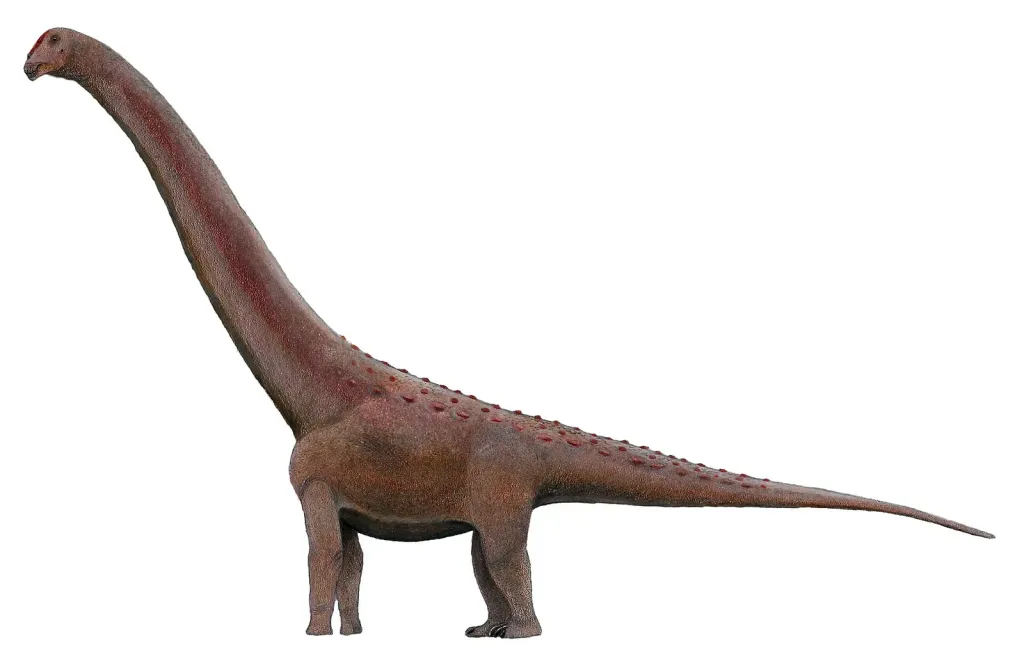
Patagotitan mayorum
発音: PAT-ah-go-TY-tan may-OR-um
Titanosauria
A giant titanosaur from the latest Early Cretaceous of Chubut, Argentina, known from at least six individuals in one quarry. Its describers estimated 69 tonnes; later work suggests 50 to 55 tonnes.
- Giant
- Long necked
- Quadrupedal
- 時代
- 白亜紀· アルビアン期
- 食性
- 植物食
- 全長
- 31–37 m
- 体重
- 50,000–69,000 kg
- 産地
- Chubut Province, Argentina
クイックアンサー
- Patagotitan mayorumの大きさは?
- Patagotitan mayorumの全長は約31–37 mでした。腰の高さは約4.4–5.2 mでした。体重は約50–69 tでした。 (Wikipedia: Patagotitan 2026; Carballido et al. 2017)
- Patagotitan mayorumはいつ生きていた?
- Patagotitan mayorumは白亜紀前期、約1.018億〜1.014億年前に生きていました。 (Carballido et al. 2017; Paleobiology Database: Patagotitan occurrences 2026)
- Patagotitan mayorumの化石はどこで見つかった?
- Patagotitan mayorumの化石はCerro Barcino Formation (Chubut Province)、Argentinaで見つかっています。 (Carballido et al. 2017; Paul 2019)
- Patagotitan mayorumは何を食べていた?
- Patagotitan mayorumは植物食でした。 (Carballido et al. 2017; Paul 2019)
- Patagotitan mayorumは誰がいつ命名した?
- Patagotitan mayorumは2017年にJosé L. Carballido et al.によって記載されました。 (Carballido et al. 2017)
このページの内容

PAT-ah-go-TY-tan may-OR-um
- 時代
- 白亜紀101.8–101.4 Ma
- 食性
- 植物食
- 全長
- 31–37 m
- 体重
- 50–69 t
- 産地
- Argentina
- 分類
- Titanosauria
- 記載
- 2017, José L. Carballido et al.
概要
このコンテンツは英語でご覧いただけます。
Patagotitan mayorum lived in Patagonia about 101.6 million years ago, at the end of the Early Cretaceous. A farm worker found the first bone in 2010 on the La Flecha ranch in Chubut Province; teams from the Museo Paleontológico Egidio Feruglio excavated the quarry, and José Carballido and colleagues named it in 2017.
At least six individuals were found in the same quarry, so almost the whole skeleton is known from repeated bones. The holotype (MPEF-PV 3400) includes neck, back and tail vertebrae, the shoulder, both pubes and both femora.
From the size of its limb bones Carballido et al. estimated 69 tonnes (with a standard error of 17 tonnes). Gregory Paul (2019) found it lighter, about 50 to 55 tonnes, and smaller than Argentinosaurus. A cast of the skeleton is displayed at the American Museum of Natural History.
名前の意味
From Patagonia and the Titans of Greek myth, "symbolic of strength and large size"; mayorum honours the Mayo family of the La Flecha ranch (Carballido et al. 2017).
生態と証拠
この動物がどのように暮らしていたかについての科学者の考えと、それぞれの説を支える証拠の強さです。
社会性
Several Patagotitan died at the same place on separate occasions.
証拠レベル:中程度の証拠The six individuals lie in three separate horizons, so the site records repeated deaths rather than a single herd dying together.
賛成・反対の証拠 · 1
支持する証拠
標本 · Patagotitan multi-individual quarry
At least six individuals of similar size in one quarry, in three closely spaced horizons.
標本: MPEF-PV 3400
その他
Patagotitan weighed more than 50 tonnes.
証拠レベル:強い証拠Two independent methods give 50 to 69 tonnes. Whether it was heavier than Argentinosaurus is disputed.
賛成・反対の証拠 · 2
支持する証拠
バイオメカニクスモデル · Patagotitan limb-scaling mass estimate
Femur and humerus circumferences give 69 t (standard error 17 t), about 15% more than Dreadnoughtus with the same equation.
標本: MPEF-PV 3400
バイオメカニクスモデル · Patagotitan volumetric mass estimate
A volumetric model gives 50-55 t, with dorsal vertebrae smaller than those of Argentinosaurus.
サイズ
- 全長
- 31–37 m
- 体高
- 4.8 m文献上の範囲 4.4–5.2 m
- 体重
- 50,000–69,000 kg
(121.4 フィート)
(15.7 フィート)
MPEF-PV 3400 (femur 2.38 m) に基づく
MPEF-PV 3400 and paratypes に基づく
タイムライン
時代: アルビアン期 (113–100.5 Ma), 白亜紀前期 (145–100.5 Ma)
U-Pb age of the type horizon, 101.62 ± 0.18 Ma (latest Albian). PBDB gives the broader Albian bounds 113.2-100.5 Ma.
産地
累層
- Cerro Barcino Formation · Chubut Province
- La Flecha ranch, 15 km W of Los Altares, Chubut · Cerro Barcino Formation · Chubut Province · 位置はおおよそ
これは化石が見つかった場所で、この動物が暮らしていた範囲全体ではありません。
生態系
生息環境: Cerro Castaño
113–100.5 百万年前 · 氾濫原, 河川系
Humid floodplains of central Patagonia at the end of the Early Cretaceous.
分類
- クレードDinosauria
- クレードSaurischia
- クレードSauropodomorpha
- クレードSauropoda
- クレードMacronaria
- クレードTitanosauria
- 属Patagotitan
- 種Patagotitan mayorum
分類上の地位: 有効
化石記録

| 標本番号 | 種別 | 所蔵機関 | 発見 |
|---|---|---|---|
| MPEF-PV 3400 | ホロタイプ | Museo Paleontológico Egidio Feruglio (MPEF) | — |
見つかった部位
ホロタイプ: MPEF-PV 3400
- 保存
- 部分的
- 復元
- 不明・未記録
部位ごと(表)
| 部位 | 状態 |
|---|---|
| Skull | 不明・未記録 |
| Mandible | 不明・未記録 |
| Teeth | 不明・未記録 |
| Cervical vertebrae | 部分的 · One anterior and two middle cervicals. |
| Dorsal vertebrae | 部分的 · Seven dorsals. |
| Sacrum | 不明・未記録 |
| Caudal vertebrae | 部分的 · Six anterior caudals and three chevrons. |
| Ribs | 部分的 |
| Gastralia | 不明・未記録 |
| Scapula / shoulder girdle | 部分的 · Right scapulocoracoid and both sternal plates. |
| Humerus | 不明・未記録 |
| Forearm (radius / ulna) | 不明・未記録 |
| Hand (manus) | 不明・未記録 |
| Pelvis | 部分的 · Both pubes. |
| Femur | 保存 · Both femora. |
| Tibia / fibula | 不明・未記録 |
| Foot (pes) | 不明・未記録 |
発見
- 記載年
- 2017
- 記載者
- José L. Carballido et al.
- タイプ標本
- MPEF-PV 3400

発見の年表
2010 · 最初の化石の発見
A farm worker finds a giant femur at La Flecha
The first bone is found on La Flecha ranch, Chubut.
2017 · 正式に記載
Carballido et al. name Patagotitan mayorum
The giant titanosaur is named with a dated type horizon and a mass estimate.
人物:José L. Carballido, Diego Pol
出典
- (2026). Paleobiology Database: Patagotitan occurrences. The Paleobiology Database (paleobiodb.org), data service 1.2, accessed 2026-09-23. https://paleobiodb.org/data1.2/occs/list.txt?base_name=Patagotitan&show=coords,paleoloc,strat,loc,ref&pgm=gplates(新しいタブで開きます)
- (2026). Wikipedia: Patagotitan. Wikipedia (English), accessed 2026-09-23. https://en.wikipedia.org/wiki/Patagotitan(新しいタブで開きます)
- Carballido, J. L., Pol, D., Otero, A., Cerda, I. A., Salgado, L., Garrido, A. C., Ramezani, J., Cúneo, N. R. & Krause, J. M. (2017). A new giant titanosaur sheds light on body mass evolution among sauropod dinosaurs. Proceedings of the Royal Society B 284: 20171219. doi:10.1098/rspb.2017.1219(新しいタブで開きます)
- Paul, G. S. (2016). The Princeton Field Guide to Dinosaurs (2nd edition). Princeton University Press.
- Paul, G. S. (2019). Determining the largest known land animal: a critical comparison of differing methods for restoring the volume and mass of extinct animals. Annals of Carnegie Museum 85(4): 335-358. doi:10.2992/007.085.0403(新しいタブで開きます)