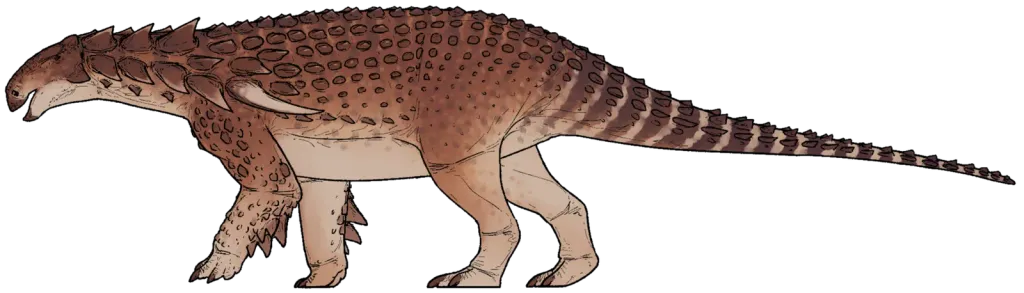
Borealopelta markmitchelli
Pronúncia: bor-ee-AL-oh-PEL-tah mark-MICH-el-eye
Ankylosauria · Nodosauridae
A nodosaur from the Early Cretaceous of Alberta preserved in 3D with its skin, horn-covered armor, pigment and last meal. Found in an oil-sands mine in 2011, it had washed out to sea and was buried on the sea floor.
- Armored
- Quadrupedal
- Exceptional preservation
- Skin impressions known
- Famous specimen
- Período
- Cretáceo· Albiano
- Dieta
- Herbívoro
- Comprimento
- 5,5 m
- Massa
- 1.300 kg
- Local
- Alberta, Canada
Respostas rápidas
- Qual era o tamanho do Borealopelta markmitchelli?
- O Borealopelta markmitchelli tinha cerca de 5,5 m de comprimento. Media cerca de 1,2–1,6 m de altura no quadril. Pesava cerca de 1,3 t. (Wikipedia: Borealopelta 2026; Paul 2016)
- Quando viveu o Borealopelta markmitchelli?
- O Borealopelta markmitchelli viveu no Cretáceo Inferior, há cerca de 113–100,5 milhões de anos. (Brown et al. 2020; Cohen et al. 2023)
- Onde foram encontrados fósseis do Borealopelta markmitchelli?
- Fósseis do Borealopelta markmitchelli foram encontrados em Clearwater Formation (Alberta) e Canada. (Brown et al. 2017; Brown 2017)
- O que o Borealopelta markmitchelli comia?
- O Borealopelta markmitchelli era herbívoro. (Brown et al. 2017; Brown 2017)
- Quem deu nome ao Borealopelta markmitchelli, e quando?
- O Borealopelta markmitchelli foi descrito por Caleb M. Brown et al. em 2017. (Brown et al. 2017; Brown 2017)
Nesta página

- Período
- Cretáceo113–100,5 Ma
- Dieta
- Herbívoro
- Comprimento
- 5,5 m
- Massa
- 1,3 t
- Local
- Canada
- Classificação
- Ankylosauria · Nodosauridae
- Descrito
- 2017, Caleb M. Brown et al.
Visão geral
Este conteúdo está disponível em inglês.
Borealopelta markmitchelli lived in what is now northern Alberta in the Early Cretaceous (early Albian). Its body floated out to sea and sank, and was buried in marine sediments of the Clearwater Formation. Shawn Funk found it in 2011 while digging at the Suncor Millennium Mine near Fort McMurray; technician Mark Mitchell spent nearly six years preparing it.
It is one of the best-preserved dinosaurs ever found: the front half of the body is in three dimensions, with the bony armor still capped by horn (keratin) sheaths and covered by scales. Melanin traces show it was darker on the back than on the belly, a camouflage pattern called countershading, which suggests that even a 1.3-tonne armored animal was hunted by large predators.
A mass in its belly holds its last meal: mostly fern leaves, with some twigs and about 6% charcoal. The plants point to feeding in late spring or summer, perhaps on regrowth after a wildfire (Brown et al. 2020).
Significado do nome
"Northern shield", from Latin borealis ("northern") and Greek peltē ("shield"); markmitchelli honours Mark Mitchell, who prepared the specimen (Brown et al. 2017).
Biologia e evidências
O que os cientistas pensam sobre como este animal vivia e quão fortes são as evidências de cada ideia.
Alimentação
Borealopelta fed on plants regrowing after a wildfire.
Nível de evidência: HipóteseAbout 6% of the meal is charcoal, which may mean it browsed ferns in a recently burned forest.
Evidências a favor / contra · 1
Evidências a favor
Espécime · Borealopelta stomach contents
A mass in the abdomen made of 88% leaf tissue, 85% of it leptosporangiate ferns, with stems, wood and about 6% charcoal.
Espécime: TMP 2011.033.0001
The last meal of Borealopelta was mostly ferns.
Nível de evidência: Evidência diretaPlant remains preserved in its stomach are dominated by fern leaves, with few cycads or conifers. It is one meal, not a full diet.
Evidências a favor / contra · 1
Evidências a favor
Espécime · Borealopelta stomach contents
A mass in the abdomen made of 88% leaf tissue, 85% of it leptosporangiate ferns, with stems, wood and about 6% charcoal.
Espécime: TMP 2011.033.0001
Pele e revestimento
Borealopelta was countershaded, darker above and lighter below.
Nível de evidência: Evidência moderadaChemical traces of melanin show the pattern. Countershading is camouflage, which implies that large predators hunted even this armored animal.
Evidências a favor / contra · 1
Evidências a favor
Outro · Borealopelta melanin pattern
Melanin identified by mass spectrometry in the organic residues, with a darker back and lighter underside, and paler parascapular spines.
Espécime: TMP 2011.033.0001
The armor of Borealopelta was covered by horn sheaths and scales.
Nível de evidência: Evidência diretaThe sheaths are preserved in place over the bony plates, which shows spines were longer in life than the bone alone suggests.
Evidências a favor / contra · 1
Evidências a favor
Impressão de pele · Borealopelta keratin sheaths and scales
Organic scales and horn-like keratin sheaths cap and exaggerate nearly all osteoderms along the body.
Espécime: TMP 2011.033.0001

Tamanho
- Comprimento
- 5,5 m
- Altura
- 1,4 mintervalo publicado 1,2–1,6 m
- Massa
- 1.300 kg
(18 pés)
Com base em TMP 2011.033.0001
(4,6 pés)
Com base em TMP 2011.033.0001
Com base em TMP 2011.033.0001
Linha do tempo
Períodos: Albiano (113–100,5 Ma), Cretáceo Inferior (145–100,5 Ma)
Albian stage bounds; ammonite, pollen and foraminifera date the Wabiskaw Member to the Early Albian (Brown et al. 2020). PBDB still lists the occurrence as Aptian.
Local
Formações
- Clearwater Formation · Alberta
- Suncor Millennium Mine, near Fort McMurray, Alberta · Clearwater Formation · Alberta
Estes são os locais onde fósseis foram encontrados, não toda a área onde o animal vivia.
Ecossistema
Viveu em: Clearwater Sea
margem marinha
An Early Cretaceous shallow sea (between fair- and storm-weather wave base) 200-400 km off the coast; Borealopelta is a land animal carried out to sea.
Classificação
- cladoDinosauria
- cladoOrnithischia
- cladoThyreophora
- cladoAnkylosauria
- famíliaNodosauridae
- gêneroBorealopelta
- espécieBorealopelta markmitchelli
Status taxonômico: Válido
Registro fóssil

| Número de catálogo | Status | Instituição | Encontrado |
|---|---|---|---|
| TMP 2011.033.0001 | Holótipo | Royal Tyrrell Museum of Palaeontology (TMP) | 2011 |
O que foi encontrado
Holótipo: TMP 2011.033.0001
- Preservado
- Parcial
- Reconstruído
- Desconhecido / não registrado
Região por região (tabela)
| Região | Estado |
|---|---|
| Skull | Preservado |
| Mandible | Desconhecido / não registrado |
| Teeth | Desconhecido / não registrado |
| Cervical vertebrae | Preservado |
| Dorsal vertebrae | Preservado |
| Sacrum | Parcial |
| Caudal vertebrae | Desconhecido / não registrado |
| Ribs | Preservado |
| Gastralia | Desconhecido / não registrado |
| Scapula / shoulder girdle | Desconhecido / não registrado |
| Humerus | Desconhecido / não registrado |
| Forearm (radius / ulna) | Desconhecido / não registrado |
| Hand (manus) | Desconhecido / não registrado |
| Pelvis | Desconhecido / não registrado |
| Femur | Desconhecido / não registrado |
| Tibia / fibula | Desconhecido / não registrado |
| Foot (pes) | Desconhecido / não registrado |

Descoberta
- Ano da descrição
- 2017
- Descrito por
- Caleb M. Brown et al.
- Espécime-tipo
- TMP 2011.033.0001
Linha do tempo da descoberta
2011 · Primeiro material encontrado
Shawn Funk finds a nodosaur in an oil-sands mine
A heavy-equipment operator hits the fossil at the Suncor Millennium Mine; the Royal Tyrrell Museum excavates it.
Pessoas: Shawn Funk, Donald M. Henderson
2017 · Descrito formalmente
Brown et al. name Borealopelta markmitchelli
The new nodosaur is described with evidence of countershading.
Pessoas: Caleb M. Brown, Donald M. Henderson
2020 · Estudo importante
The last meal of Borealopelta is described
The stomach contents are analysed plant by plant.
Pessoas: Caleb M. Brown
Fontes
- (2026). Paleobiology Database: Borealopelta occurrences. The Paleobiology Database (paleobiodb.org), data service 1.2, accessed 2026-09-23. https://paleobiodb.org/data1.2/occs/list.txt?base_name=Borealopelta&show=coords,paleoloc,strat,loc,ref&pgm=gplates (abre em nova aba)
- (2026). Wikipedia: Borealopelta. Wikipedia (English), accessed 2026-09-23. https://en.wikipedia.org/wiki/Borealopelta (abre em nova aba)
- Brown, C. M. (2017). An exceptionally preserved armored dinosaur reveals the morphology and allometry of osteoderms and their horny epidermal coverings. PeerJ 5: e4066. doi:10.7717/peerj.4066 (abre em nova aba)
- Brown, C. M., Greenwood, D. R., Kalyniuk, J. E., Braman, D. R., Henderson, D. M., Greenwood, C. L. & Basinger, J. F. (2020). Dietary palaeoecology of an Early Cretaceous armoured dinosaur (Ornithischia; Nodosauridae) based on floral analysis of stomach contents. Royal Society Open Science 7: 200305. doi:10.1098/rsos.200305 (abre em nova aba)
- Brown, C. M., Henderson, D. M., Vinther, J., Fletcher, I., Sistiaga, A., Herrera, J. & Summons, R. E. (2017). An exceptionally preserved three-dimensional armored dinosaur reveals insights into coloration and Cretaceous predator-prey dynamics. Current Biology 27: 2514-2521. doi:10.1016/j.cub.2017.06.071 (abre em nova aba)
- Cohen, K. M., Harper, D. A. T., Gibbard, P. L. & Car, N. (2023). International Chronostratigraphic Chart (v2023/09). International Commission on Stratigraphy. https://stratigraphy.org/ICSchart/ChronostratChart2023-09.pdf (abre em nova aba)
- Paul, G. S. (2016). The Princeton Field Guide to Dinosaurs (2nd edition). Princeton University Press.