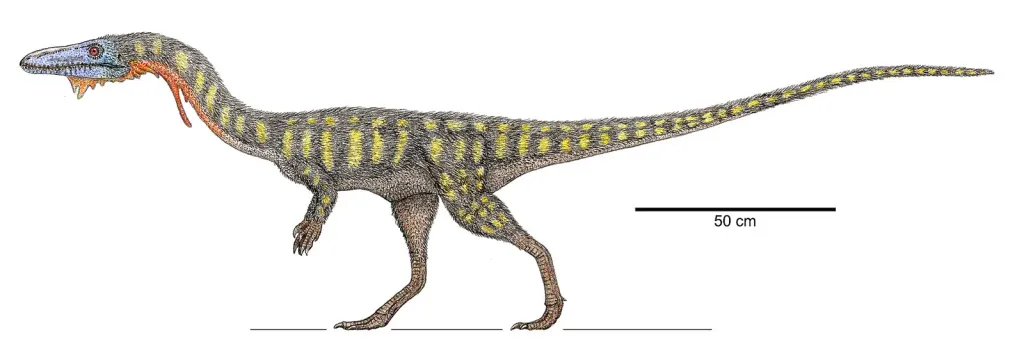
Coelophysis bauri
Pronúncia: SEE-loh-FY-sis BOW-er-eye
Neotheropoda · Coelophysidae
One of the earliest known theropods, a slender, 3 m predator from the Late Triassic of New Mexico. Hundreds of skeletons from the Ghost Ranch quarry make it one of the best-known early dinosaurs.
- Bipedal
- Famous specimen
- Período
- Triássico· Triássico Superior
- Dieta
- Carnívoro
- Comprimento
- 3 m
- Massa
- 15–25 kg
- Local
- New Mexico, United States
Respostas rápidas
- Qual era o tamanho do Coelophysis bauri?
- O Coelophysis bauri tinha cerca de 3 m de comprimento. Media cerca de 0,5–0,7 m de altura no quadril. Pesava cerca de 15–25 kg. (Wikipedia: Coelophysis 2026; Paul 2016)
- Quando viveu o Coelophysis bauri?
- O Coelophysis bauri viveu no Triássico Superior, há cerca de 205,7–201,4 milhões de anos. (Paleobiology Database: Coelophysis bauri coll… 2026)
- Onde foram encontrados fósseis do Coelophysis bauri?
- Fósseis do Coelophysis bauri foram encontrados em Chinle Formation (New Mexico) e United States. (Cope 1887; Colbert 1947)
- O que o Coelophysis bauri comia?
- O Coelophysis bauri era carnívoro. (Cope 1887; Colbert 1947)
- Quem deu nome ao Coelophysis bauri, e quando?
- O Coelophysis bauri foi descrito por Edward Drinker Cope em 1887. (Cope 1887; Paleobiology Database: Coelophysis bauri coll… 2026)
Nesta página

SEE-loh-FY-sis BOW-er-eye
- Período
- Triássico205,7–201,4 Ma
- Dieta
- Carnívoro
- Comprimento
- 3 m
- Massa
- 0–0 t
- Local
- United States
- Classificação
- Neotheropoda · Coelophysidae
- Descrito
- 1887, Edward Drinker Cope
Visão geral
Este conteúdo está disponível em inglês.
Coelophysis bauri lived at the end of the Triassic in what is now northern New Mexico, near the equator of the supercontinent Pangaea. Edward Drinker Cope named its first, fragmentary bones as Coelurus bauri in 1887 and moved them to the new genus Coelophysis in 1889.
In 1947 George Whitaker, in Edwin Colbert's American Museum crew, found a bonebed at Ghost Ranch packed with complete skeletons of all sizes. Because Cope's scrappy type bones could not be matched to them with certainty, the ICZN made a complete Ghost Ranch skeleton, AMNH 7224, the neotype in 1996.
It was a lightly built, two-legged hunter up to about 3 m long with a long, narrow head and grasping hands. Some Ghost Ranch skeletons were long said to hold eaten juveniles of their own kind, but Nesbitt and colleagues (2006) showed the "gut contents" were small crocodile-line reptiles, not young Coelophysis.
Significado do nome
"Hollow form", from Greek koilos ("hollow") and physis ("form"), for its hollow bones; bauri honours the palaeontologist Georg Baur (Cope 1887, 1889).
Biologia e evidências
O que os cientistas pensam sobre como este animal vivia e quão fortes são as evidências de cada ideia.
Alimentação
Coelophysis ate small crocodile-line reptiles.
Nível de evidência: Evidência forteThe gut contents of Ghost Ranch skeletons belong to early crocodylomorphs.
Evidências a favor / contra · 1
Evidências a favor
Espécime · Coelophysis "cannibal" gut contents re-examined
Anatomy and histology of the supposed juvenile Coelophysis inside two Ghost Ranch skeletons show they are early crocodylomorphs.

Tamanho
- Comprimento
- 3 m
- Altura
- 0,6 mintervalo publicado 0,5–0,7 m
- Massa
- 15–25 kg
(9,8 pés)
(2 pés)
Com base em Ghost Ranch adults
Linha do tempo
Períodos: Triássico Superior (237–201,4 Ma), Triássico (251,9–201,4 Ma)
Rhaetian bin of the Ghost Ranch neotype quarry in PBDB. Cope's original sites are binned as Norian (227.3-205.7 Ma); the Petrified Forest Member is dated to about 211.9 Ma (secondary), and the age of the Ghost Ranch beds is debated.
Local
Formações
- Chinle Formation · New Mexico
Locais
- Ghost Ranch Quarry (Whitaker Quarry), Rio Arriba County · Chinle Formation · New Mexico · posição aproximada
Estes são os locais onde fósseis foram encontrados, não toda a área onde o animal vivia.
Ecossistema

Viveu em: Chinle (Ghost Ranch)
há 205,7–201,4 milhões de anos · planície de inundação, sistema fluvial
Late Triassic river floodplains of north-central New Mexico, near the equator of Pangaea; the Ghost Ranch bonebed is a crevasse-splay deposit.
Classificação
- cladoDinosauria
- cladoSaurischia
- cladoTheropoda
- cladoNeotheropoda
- superfamíliaCoelophysoidea
- famíliaCoelophysidae
- gêneroCoelophysis
- espécieCoelophysis bauri
Status taxonômico: Válido
Registro fóssil

| Número de catálogo | Status | Instituição | Encontrado |
|---|---|---|---|
| AMNH 7224 | Neótipo | American Museum of Natural History (AMNH) | 1947 |
O que foi encontrado
Neótipo: AMNH 7224
- Preservado
- Parcial
- Reconstruído
- Desconhecido / não registrado
Região por região (tabela)
| Região | Estado |
|---|---|
| Skull | Preservado |
| Mandible | Desconhecido / não registrado |
| Teeth | Desconhecido / não registrado |
| Cervical vertebrae | Preservado |
| Dorsal vertebrae | Preservado |
| Sacrum | Desconhecido / não registrado |
| Caudal vertebrae | Desconhecido / não registrado |
| Ribs | Desconhecido / não registrado |
| Gastralia | Desconhecido / não registrado |
| Scapula / shoulder girdle | Desconhecido / não registrado |
| Humerus | Desconhecido / não registrado |
| Forearm (radius / ulna) | Desconhecido / não registrado |
| Hand (manus) | Desconhecido / não registrado |
| Pelvis | Preservado |
| Femur | Preservado |
| Tibia / fibula | Desconhecido / não registrado |
| Foot (pes) | Desconhecido / não registrado |

Descoberta
- Ano da descrição
- 1887
- Descrito por
- Edward Drinker Cope
- Espécime-tipo
- AMNH 7224
Linha do tempo da descoberta
1881 · Primeiro material encontrado
Baldwin collects the first Coelophysis bones
David Baldwin collects fragmentary bones at Arroyo Seco, Rio Arriba County, for Cope.
Pessoas: David Baldwin
1887 · Descrito formalmente
Cope names Coelurus bauri
Cope names the species in the genus Coelurus; he erects Coelophysis for it in 1889.
Pessoas: Edward Drinker Cope
1947 · Espécime recuperado
Ghost Ranch Coelophysis quarry discovered
George Whitaker of Colbert's crew finds a bonebed full of complete skeletons.
Pessoas: George Whitaker, Edwin H. Colbert
2006 · Estudo importante
Coelophysis cannibalism refuted
Nesbitt and colleagues show the gut contents are crocodylomorphs.
Pessoas: Sterling J. Nesbitt, Mark A. Norell
Fontes
- (2026). Paleobiology Database: Coelophysis bauri collections 48422 (Ghost Ranch) and 52498 (Arroyo Seco). The Paleobiology Database (paleobiodb.org), data service 1.2, accessed 2026-09-23. https://paleobiodb.org/data1.2/colls/list.json?coll_id=48422,52498&show=paleoloc,strat,loc,ref,geo&pgm=gplates&vocab=pbdb (abre em nova aba)
- (2026). Wikipedia: Coelophysis. Wikipedia (English), accessed 2026-09-24. https://en.wikipedia.org/wiki/Coelophysis (abre em nova aba)
- Colbert, E. H. (1947). The little dinosaurs of Ghost Ranch. Natural History 56(9).
- Cope, E. D. (1887). The dinosaurian genus Coelurus. American Naturalist 21: 367-369.
- Nesbitt, S. J., Turner, A. H., Erickson, G. M. & Norell, M. A. (2006). Prey choice and cannibalistic behaviour in the theropod Coelophysis. Biology Letters 2: 611-614. doi:10.1098/rsbl.2006.0524 (abre em nova aba)
- Paul, G. S. (2016). The Princeton Field Guide to Dinosaurs (2nd edition). Princeton University Press.