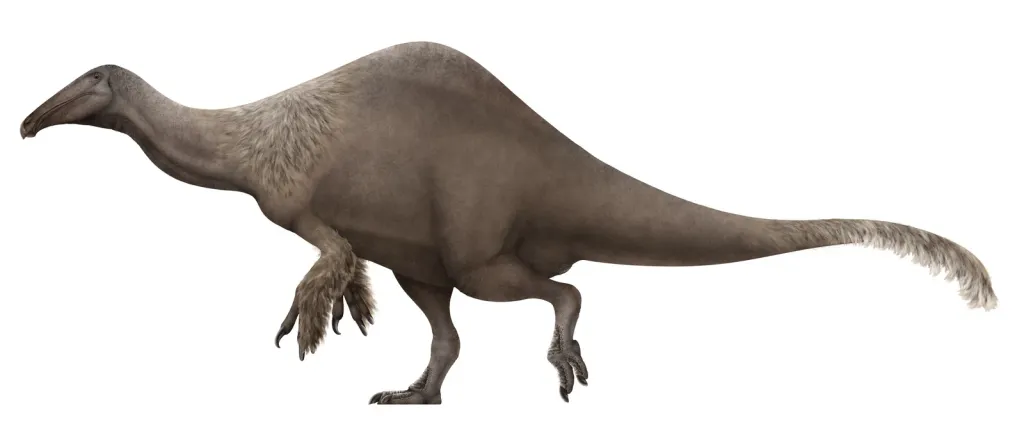
Deinocheirus mirificus
Pronúncia: DYE-noh-KY-rus mih-RIF-ih-kus
Ornithomimosauria · Deinocheiridae
A giant, humpbacked ornithomimosaur from the Late Cretaceous of Mongolia, known for decades only from a pair of 2.4 m arms. New skeletons in 2014 revealed a duck-like snout, a sail on its back and a stomach full of stones and fish.
- Bipedal
- Giant
- Giant claws
- Sail backed
- Unusual anatomy
- Período
- Cretáceo· Maastrichtiano
- Dieta
- Onívoro
- Comprimento
- 11 m
- Massa
- 6.360 kg
- Local
- Ömnögovi Province, Mongolia, Asia
Respostas rápidas
- Qual era o tamanho do Deinocheirus mirificus?
- O Deinocheirus mirificus tinha cerca de 11 m de comprimento. Media cerca de 2,9–3,5 m de altura no quadril. Pesava cerca de 6,4 t. (Wikipedia: Deinocheirus 2026; Lee et al. 2014)
- Quando viveu o Deinocheirus mirificus?
- O Deinocheirus mirificus viveu no Cretáceo Superior, há cerca de 72,1–66 milhões de anos. (Paleobiology Database: Deinocheirus occurrences 2026; Cohen et al. 2023)
- Onde foram encontrados fósseis do Deinocheirus mirificus?
- Fósseis do Deinocheirus mirificus foram encontrados em Nemegt Formation (Ömnögovi Province) e Mongolia. (Osmólska & Roniewicz 1970; Lee et al. 2014)
- O que o Deinocheirus mirificus comia?
- O Deinocheirus mirificus era onívoro. (Osmólska & Roniewicz 1970; Lee et al. 2014)
- Quem deu nome ao Deinocheirus mirificus, e quando?
- O Deinocheirus mirificus foi descrito por Halszka Osmólska & Ewa Roniewicz em 1970. (Osmólska & Roniewicz 1970; Lee et al. 2014)
Nesta página

DYE-noh-KY-rus mih-RIF-ih-kus
- Período
- Cretáceo72,1–66 Ma
- Dieta
- Onívoro
- Comprimento
- 11 m
- Massa
- 6,4 t
- Local
- Mongolia, Asia
- Classificação
- Ornithomimosauria · Deinocheiridae
- Descrito
- 1970, Halszka Osmólska & Ewa Roniewicz
Visão geral
Este conteúdo está disponível em inglês.
Deinocheirus mirificus lived in the Nemegt Formation of Mongolia at the end of the Cretaceous. The 1965 Polish-Mongolian expedition found its holotype at Altan Uul III: mostly a pair of giant forelimbs, 2.4 m long, with shoulder girdles. Halszka Osmólska and Ewa Roniewicz named it in 1970, and for almost fifty years it remained a mystery.
Two new skeletons, found in 2006 and 2009, were described by Lee and colleagues in 2014. Deinocheirus turned out to be the largest ornithomimosaur: a heavily built, slow animal with a long, toothless snout, a deep jaw, very tall spines along the back, short hind legs and broad, blunt toe claws.
More than a thousand gastroliths and fish remains in its body cavity suggest it was a giant omnivore of wet environments. Parts of one skeleton had been poached and sold abroad before being returned to Mongolia in 2014.
Significado do nome
"Terrible hand", from Greek deinos ("terrible") and cheir ("hand"); mirificus, Latin for "unusual, peculiar" (Osmólska & Roniewicz 1970).
Biologia e evidências
O que os cientistas pensam sobre como este animal vivia e quão fortes são as evidências de cada ideia.
Locomoção
Deinocheirus was a slow, heavy animal rather than a runner.
Nível de evidência: Evidência moderadaUnlike its fast relatives, it had short hind limbs and a heavily built body.
Evidências a favor / contra · 1
Evidências a favor
Espécime · New Deinocheirus skeletons
Two skeletons showing an elongate snout, deep jaw, tall neural spines, a pygostyle, a U-shaped furcula, an expanded pelvis, short hind limbs and broad-tipped toe claws.
Espécime: MPC-D 100/127, MPC-D 100/128
Alimentação
Deinocheirus was a giant omnivore that also ate fish.
Nível de evidência: Evidência moderadaIts skull suggests plant-eating, while gut stones and fish remains show a mixed diet in wet environments.
Evidências a favor / contra · 2
Evidências a favor
Espécime · Deinocheirus gastroliths and stomach contents
More than a thousand gastroliths and fish remains in the body cavity.
Espécime: MPC-D 100/127
Espécime · New Deinocheirus skeletons
Two skeletons showing an elongate snout, deep jaw, tall neural spines, a pygostyle, a U-shaped furcula, an expanded pelvis, short hind limbs and broad-tipped toe claws.
Espécime: MPC-D 100/127, MPC-D 100/128
Outros
Deinocheirus was the largest ornithomimosaur.
Nível de evidência: Evidência fortePhylogenetic analysis of the new skeletons places it in Ornithomimosauria, the "ostrich dinosaurs", of which it is by far the biggest.
Evidências a favor / contra · 1
Evidências a favor
Espécime · New Deinocheirus skeletons
Two skeletons showing an elongate snout, deep jaw, tall neural spines, a pygostyle, a U-shaped furcula, an expanded pelvis, short hind limbs and broad-tipped toe claws.
Espécime: MPC-D 100/127, MPC-D 100/128
Tamanho
- Comprimento
- 11 m
- Altura
- 3,2 mintervalo publicado 2,9–3,5 m
- Massa
- 6.360 kg
(36,1 pés)
(10,5 pés)
Com base em MPC-D 100/127 (femur c. 1.32 m)
Linha do tempo
Períodos: Maastrichtiano (72,1–66 Ma), Cretáceo Superior (100,5–66 Ma)
Maastrichtian bounds of the type collection in PBDB.
Local
Formações
- Nemegt Formation · Ömnögovi Province
- Altan Uul III, Nemegt Basin, Ömnögovi · Nemegt Formation · Ömnögovi Province · posição aproximada
Estes são os locais onde fósseis foram encontrados, não toda a área onde o animal vivia.
Ecossistema

Viveu em: Nemegt
há 72–68 milhões de anos · sistema fluvial, planície de inundação, floresta, pântano / área úmida
Wetter than the Djadokhta dunes before it: braided rivers, channels and floodplain forests in the Late Cretaceous Gobi, supporting large herbivores and the tyrannosaurid Tarbosaurus.
Mesmo ecossistema

Mesmo ecossistema

Mesmo ecossistema

Classificação
- cladoDinosauria
- cladoSaurischia
- cladoTheropoda
- cladoCoelurosauria
- cladoOrnithomimosauria
- famíliaDeinocheiridae
- gêneroDeinocheirus
- espécieDeinocheirus mirificus
Status taxonômico: Válido
Registro fóssil

| Número de catálogo | Status | Instituição | Encontrado |
|---|---|---|---|
| MPC-D 100/18 | Holótipo | Institute of Paleontology, Mongolian Academy of Sciences (MPC) | 1965 |
| MPC-D 100/127 | Espécime referido | Institute of Paleontology, Mongolian Academy of Sciences (MPC) | 2009 |
| MPC-D 100/128 | Espécime referido | Institute of Paleontology, Mongolian Academy of Sciences (MPC) | 2006 |
O que foi encontrado
Holótipo: MPC-D 100/18
- Preservado
- Parcial
- Reconstruído
- Desconhecido / não registrado
Holótipo: MPC-D 100/18
Região por região (tabela)
| Região | Estado |
|---|---|
| Skull | Desconhecido / não registrado |
| Mandible | Desconhecido / não registrado |
| Teeth | Desconhecido / não registrado |
| Cervical vertebrae | Desconhecido / não registrado |
| Dorsal vertebrae | Desconhecido / não registrado |
| Sacrum | Desconhecido / não registrado |
| Caudal vertebrae | Desconhecido / não registrado |
| Ribs | Desconhecido / não registrado |
| Gastralia | Desconhecido / não registrado |
| Scapula / shoulder girdle | Preservado |
| Humerus | Preservado |
| Forearm (radius / ulna) | Preservado |
| Hand (manus) | Preservado |
| Pelvis | Desconhecido / não registrado |
| Femur | Desconhecido / não registrado |
| Tibia / fibula | Desconhecido / não registrado |
| Foot (pes) | Desconhecido / não registrado |
Espécime referido: MPC-D 100/127
Região por região (tabela)
| Região | Estado |
|---|---|
| Skull | Desconhecido / não registrado |
| Mandible | Desconhecido / não registrado |
| Teeth | Desconhecido / não registrado |
| Cervical vertebrae | Desconhecido / não registrado |
| Dorsal vertebrae | Desconhecido / não registrado |
| Sacrum | Desconhecido / não registrado |
| Caudal vertebrae | Desconhecido / não registrado |
| Ribs | Desconhecido / não registrado |
| Gastralia | Desconhecido / não registrado |
| Scapula / shoulder girdle | Desconhecido / não registrado |
| Humerus | Desconhecido / não registrado |
| Forearm (radius / ulna) | Preservado |
| Hand (manus) | Preservado |
| Pelvis | Desconhecido / não registrado |
| Femur | Desconhecido / não registrado |
| Tibia / fibula | Desconhecido / não registrado |
| Foot (pes) | Desconhecido / não registrado |

Descoberta
- Ano da descrição
- 1970
- Descrito por
- Halszka Osmólska & Ewa Roniewicz
- Espécime-tipo
- MPC-D 100/18
Linha do tempo da descoberta
1965 · Primeiro material encontrado
Giant arms found at Altan Uul III
The Polish-Mongolian expedition collects a pair of 2.4 m forelimbs.
Pessoas: Zofia Kielan-Jaworowska
1970 · Descrito formalmente
Osmólska and Roniewicz name Deinocheirus
The "terrible hand" is named with its own family.
Pessoas: Halszka Osmólska, Ewa Roniewicz
2014 · Estudo importante
Deinocheirus mystery solved
Lee and colleagues describe two new skeletons revealing the whole animal.
Pessoas: Yuong-Nam Lee, Philip J. Currie
Fontes
- (2026). Paleobiology Database: Deinocheirus occurrences. The Paleobiology Database (paleobiodb.org), data service 1.2, accessed 2026-09-23. https://paleobiodb.org/data1.2/occs/list.txt?base_name=Deinocheirus&show=coords,paleoloc,strat,loc,ref&pgm=gplates (abre em nova aba)
- (2026). Wikipedia: Deinocheirus. Wikipedia (English), accessed 2026-09-23. https://en.wikipedia.org/wiki/Deinocheirus (abre em nova aba)
- Cohen, K. M., Harper, D. A. T., Gibbard, P. L. & Car, N. (2023). International Chronostratigraphic Chart (v2023/09). International Commission on Stratigraphy. https://stratigraphy.org/ICSchart/ChronostratChart2023-09.pdf (abre em nova aba)
- Lee, Y.-N., Barsbold, R., Currie, P. J., Kobayashi, Y., Lee, H.-J., Godefroit, P., Escuillié, F. & Chinzorig, T. (2014). Resolving the long-standing enigmas of a giant ornithomimosaur Deinocheirus mirificus. Nature 515: 257-260. doi:10.1038/nature13874 (abre em nova aba)
- Osmólska, H. & Roniewicz, E. (1970). Deinocheiridae, a new family of theropod dinosaurs. Palaeontologia Polonica 21: 5-19.
- Paul, G. S. (2016). The Princeton Field Guide to Dinosaurs (2nd edition). Princeton University Press.