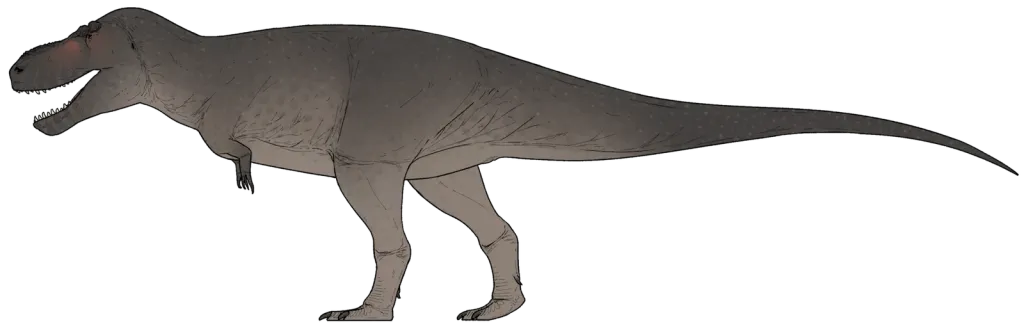
Tyrannosaurus rex
Pronúncia: tie-RAN-oh-SORE-us REKS
Coelurosauria · Tyrannosauridae
A giant tyrannosaurid theropod from the very end of the Cretaceous in western North America, and one of the largest land predators known. Adults probably weighed around 6 to 8 tonnes.
- Bipedal
- Giant
- Apex predator
- Famous specimen
- Movie icon
- Skin impressions known
- Período
- Cretáceo· Maastrichtiano
- Dieta
- Carnívoro
- Comprimento
- 12,3 mintervalo publicado 12,3–13 m
- Massa
- 6.000–9.500 kg
- Local
- Montana, South Dakota, North Dakota, Wyoming, Alberta, Saskatchewan
Respostas rápidas
- Qual era o tamanho do Tyrannosaurus rex?
- O Tyrannosaurus rex tinha cerca de 12,3–13 m de comprimento. Media cerca de 3,6–4 m de altura no quadril. Pesava cerca de 6–9,5 t. (Brochu 2003; Persons et al. 2020)
- Quando viveu o Tyrannosaurus rex?
- O Tyrannosaurus rex viveu no Cretáceo Superior, há cerca de 68–66 milhões de anos. (Cohen et al. 2023; Fowler 2017)
- Onde foram encontrados fósseis do Tyrannosaurus rex?
- Fósseis do Tyrannosaurus rex foram encontrados em Hell Creek Formation (Montana), Lance Formation (Wyoming), Scollard Formation (Alberta), Frenchman Formation (Saskatchewan), South Dakota e North Dakota. (Osborn 1905; Brochu 2003)
- O que o Tyrannosaurus rex comia?
- O Tyrannosaurus rex era carnívoro. (Osborn 1905; Brochu 2003)
- Quem deu nome ao Tyrannosaurus rex, e quando?
- O Tyrannosaurus rex foi descrito por Henry Fairfield Osborn em 1905. (Osborn 1905)
- Tyrannosaurus rex aparece em Jurassic Park?
- Sim. Tyrannosaurus rex aparece em Jurassic Park: O Parque dos Dinossauros (1993), O Mundo Perdido: Jurassic Park (1997), Jurassic Park III (2001), Jurassic World: O Mundo dos Dinossauros (2015), Jurassic World: Reino Ameaçado (2018), Jurassic World: Domínio (2022) e Jurassic World: Recomeço (2025). Os filmes tomam liberdades; esta página os compara com o que os fósseis mostram. (Wikipedia: Dinosaurs in Jurassic Park 2026; Stevens 2006)
Nesta página

tie-RAN-oh-SORE-us REKS
- Período
- Cretáceo68–66 Ma
- Dieta
- Carnívoro
- Comprimento
- 12,3 m
- Massa
- 6–9,5 t
- Classificação
- Coelurosauria · Tyrannosauridae
- Descrito
- 1905, Henry Fairfield Osborn
Visão geral
Este conteúdo está disponível em inglês.
Tyrannosaurus rex lived in western North America during the Maastrichtian, the last age of the Cretaceous, and its fossils come from rock units such as the Hell Creek, Lance, Scollard and Frenchman formations. It was named by Henry Fairfield Osborn in 1905.
It is known from many specimens, including nearly complete skeletons such as FMNH PR 2081 ("Sue") and RSM P2523.8 ("Scotty"). Computer models of mounted skeletons put typical adults at roughly 6 to 8 tonnes, with the largest individuals likely heavier.
Estimates of size vary between studies and between individuals. The figures on this page are given as ranges, each with the study it comes from.
Significado do nome
From Greek tyrannos ("tyrant") and sauros ("lizard"), with Latin rex ("king"): "tyrant lizard king" (Osborn 1905).
Biologia e evidências
O que os cientistas pensam sobre como este animal vivia e quão fortes são as evidências de cada ideia.
Locomoção
An adult Tyrannosaurus rex could walk fast but could not truly run.
Nível de evidência: Evidência moderadaTo run, an animal needs enough leg muscle and bones strong enough for the impact. Models of a 6-9 tonne adult say T. rex had neither for a real run, so estimated top speeds are those of a brisk walk. Juveniles, being lighter, were probably faster.
Evidências a favor / contra · 1
Evidências a favor
Modelo biomecânico · T. rex limb muscle models limit running speed
Models of leg muscle mass needed for fast running (Hutchinson & Garcia 2002) and multibody simulations with bone-stress limits (Sellers et al. 2017) both find that a large adult could not run fast.
Alimentação
Tyrannosaurus rex had one of the strongest bites of any land animal and could crush and eat bone.
Nível de evidência: Evidência forteThree kinds of evidence agree: bitten bones with deep punctures, droppings full of crushed bone, and computer models of the jaw muscles. Together they show a bite strong enough to shatter bone, unusual among dinosaurs.
Evidências a favor / contra · 3
Evidências a favor
Icnofóssil · Tooth-marked Triceratops and Edmontosaurus bones
Deep punctures and drag marks attributed to T. rex teeth on a Triceratops pelvis, used to estimate bite force experimentally.
Icnofóssil · Bone-filled tyrannosaur coprolite (Saskatchewan)
A large coprolite full of crushed bone fragments of a juvenile dinosaur, attributed to T. rex by size and age.
Modelo biomecânico · Bite force simulations for T. rex
Muscle reconstruction and multibody dynamics giving bite forces in the tens of kilonewtons at the back teeth.
Pele e revestimento
Adult Tyrannosaurus rex had mostly scaly skin; if it had feathers, they were limited.
Nível de evidência: Evidência moderadaThe only T. rex skin found is scaly, and covers small patches from the neck, hips and tail. Its relative Yutyrannus had long feathers, so feathers on the back of T. rex cannot be ruled out, but a fluffy adult T. rex is not supported.
Evidências a favor / contra · 2
Evidências a favor
Impressão de pele · Scaly skin patches of a T. rex (HMNS / Wyrex)
Small patches of scaly skin from the neck, pelvis and tail of a T. rex, with no trace of feathers.
Evidências contra
Impressão de penas · Feathered giant tyrannosauroid Yutyrannus
Long filamentous feathers preserved on a 9 m Early Cretaceous tyrannosauroid from China, showing large tyrannosauroids could be feathered.
Crescimento
Tyrannosaurus rex grew very fast as a teenager and reached adult size at around 20 years old.
Nível de evidência: Evidência forteBones grow in yearly layers, like tree rings. Counting them in T. rex bones shows a growth spurt in the teens, when an individual could gain hundreds of kilograms a year, then a slowdown near 20. Sue is estimated to have died in her late twenties.
Evidências a favor / contra · 1
Evidências a favor
Histologia · Tyrannosaurid bone histology growth curves
Growth lines counted in thin sections of long bones and ribs of several T. rex individuals, including Sue, fitted to a growth curve with a steep adolescent phase.
Espécime: FMNH PR 2081 “Sue”

Tamanho
- Comprimento
- 12,3 mintervalo publicado 12,3–13 m
- Altura
- 3,9 mintervalo publicado 3,6–4 m
- Massa
- 6.000–9.500 kg
(40,4 pés)
Com base em FMNH PR 2081 "Sue"
(12,8 pés)
Com base em FMNH PR 2081 "Sue" and other large adults
Com base em FMNH PR 2081 "Sue" (largest of five mounted skeletons modelled)
Linha do tempo
Períodos: Maastrichtiano (72,1–66 Ma), Cretáceo Superior (100,5–66 Ma)
endAgeMa 66.0 = end of the Maastrichtian (ICS 2023/09). startAgeMa left empty: no primary source verified for the first appearance.
Local
Formações
- Hell Creek Formation · Montana
- Lance Formation · Wyoming
- Scollard Formation · Alberta
- Frenchman Formation · Saskatchewan
- Tyrannosaurus type locality, Hell Creek, Garfield County, Montana · Hell Creek Formation · Montana · posição aproximada
- Sue site, Cheyenne River Indian Reservation, near Faith, South Dakota · Hell Creek Formation · South Dakota · posição aproximada
- Stan site, Harding County, South Dakota · Hell Creek Formation · South Dakota · posição aproximada
- Scotty site, Frenchman River valley near Eastend, Saskatchewan · Frenchman Formation · Saskatchewan · posição aproximada
Estes são os locais onde fósseis foram encontrados, não toda a área onde o animal vivia.
Ecossistema

Viveu em: Hell Creek
há 68–66 milhões de anos · planície de inundação, sistema fluvial, floresta, planície costeira
Warm, humid coastal lowlands and river floodplains west of the retreating Western Interior Seaway at the very end of the Cretaceous, with forests of conifers and flowering plants. The ecosystem ends at the Cretaceous-Paleogene extinction.
Mesmo ecossistema

Mesmo ecossistema

Mesmo ecossistema

Mesmo ecossistema

Classificação
- cladoDinosauria
- cladoSaurischia
- cladoTheropoda
- cladoCoelurosauria
- superfamíliaTyrannosauroidea
- famíliaTyrannosauridae
- subfamíliaTyrannosaurinae
- gêneroTyrannosaurus
- espécieTyrannosaurus rex
Status taxonômico: Válido
Registro fóssil

| Número de catálogo | Status | Instituição | Encontrado |
|---|---|---|---|
| CM 9380 | Holótipo | Carnegie Museum of Natural History (CM) | 1902 |
| FMNH PR 2081 “Sue” | Espécime referido | Field Museum of Natural History (FMNH) | 1990 |
| BHI 3033 “Stan” | Espécime referido | Black Hills Institute of Geological Research (BHI) | 1987 |
| RSKM P2523.8 “Scotty” | Espécime referido | Royal Saskatchewan Museum (RSKM) | 1991 |
O que foi encontrado
Holótipo: CM 9380
- Preservado
- Parcial
- Reconstruído
- Desconhecido / não registrado
Holótipo: CM 9380
Região por região (tabela)
| Região | Estado |
|---|---|
| Skull | Parcial |
| Mandible | Parcial |
| Teeth | Desconhecido / não registrado |
| Cervical vertebrae | Desconhecido / não registrado |
| Dorsal vertebrae | Parcial |
| Sacrum | Desconhecido / não registrado |
| Caudal vertebrae | Desconhecido / não registrado |
| Ribs | Desconhecido / não registrado |
| Gastralia | Desconhecido / não registrado |
| Scapula / shoulder girdle | Desconhecido / não registrado |
| Humerus | Desconhecido / não registrado · Not reliably known for the holotype. |
| Forearm (radius / ulna) | Desconhecido / não registrado |
| Hand (manus) | Desconhecido / não registrado |
| Pelvis | Parcial |
| Femur | Preservado |
| Tibia / fibula | Parcial |
| Foot (pes) | Desconhecido / não registrado |
Espécime referido: FMNH PR 2081 “Sue”
Região por região (tabela)
| Região | Estado |
|---|---|
| Skull | Preservado |
| Mandible | Preservado |
| Teeth | Preservado |
| Cervical vertebrae | Preservado |
| Dorsal vertebrae | Preservado |
| Sacrum | Preservado |
| Caudal vertebrae | Parcial |
| Ribs | Preservado |
| Gastralia | Preservado |
| Scapula / shoulder girdle | Preservado |
| Humerus | Preservado |
| Forearm (radius / ulna) | Preservado |
| Hand (manus) | Parcial |
| Pelvis | Preservado |
| Femur | Preservado |
| Tibia / fibula | Preservado |
| Foot (pes) | Parcial |
Espécime referido: BHI 3033 “Stan”
Região por região (tabela)
| Região | Estado |
|---|---|
| Skull | Preservado · One of the best-preserved T. rex skulls. |
| Mandible | Preservado |
| Teeth | Desconhecido / não registrado |
| Cervical vertebrae | Parcial |
| Dorsal vertebrae | Parcial |
| Sacrum | Desconhecido / não registrado |
| Caudal vertebrae | Desconhecido / não registrado |
| Ribs | Desconhecido / não registrado |
| Gastralia | Desconhecido / não registrado |
| Scapula / shoulder girdle | Desconhecido / não registrado |
| Humerus | Desconhecido / não registrado |
| Forearm (radius / ulna) | Desconhecido / não registrado |
| Hand (manus) | Desconhecido / não registrado |
| Pelvis | Parcial |
| Femur | Parcial |
| Tibia / fibula | Desconhecido / não registrado |
| Foot (pes) | Desconhecido / não registrado |
Espécime referido: RSKM P2523.8 “Scotty”
Região por região (tabela)
| Região | Estado |
|---|---|
| Skull | Parcial |
| Mandible | Desconhecido / não registrado |
| Teeth | Desconhecido / não registrado |
| Cervical vertebrae | Desconhecido / não registrado |
| Dorsal vertebrae | Parcial |
| Sacrum | Desconhecido / não registrado |
| Caudal vertebrae | Desconhecido / não registrado |
| Ribs | Desconhecido / não registrado |
| Gastralia | Desconhecido / não registrado |
| Scapula / shoulder girdle | Desconhecido / não registrado |
| Humerus | Desconhecido / não registrado |
| Forearm (radius / ulna) | Desconhecido / não registrado |
| Hand (manus) | Desconhecido / não registrado |
| Pelvis | Parcial |
| Femur | Preservado |
| Tibia / fibula | Desconhecido / não registrado |
| Foot (pes) | Desconhecido / não registrado |

Galeria

Descoberta
- Ano da descrição
- 1905
- Descrito por
- Henry Fairfield Osborn
- Espécime-tipo
- CM 9380 (holotype; originally AMNH 973)
Linha do tempo da descoberta
1902 · Primeiro material encontrado
Barnum Brown finds the Tyrannosaurus holotype
Barnum Brown excavates a partial skeleton in the Hell Creek badlands of Montana for the American Museum.
Pessoas: Barnum Brown
1905 · Descrito formalmente
Osborn names Tyrannosaurus rex (and Dynamosaurus imperiosus)
In the same paper Osborn also names Dynamosaurus imperiosus from another skeleton; he synonymized it with T. rex a year later.
Pessoas: Henry Fairfield Osborn
1941 · Revisão
Holotype sold to the Carnegie Museum
The AMNH sells the type specimen to the Carnegie Museum in Pittsburgh, reportedly to keep it safe from wartime bombing.
1990 · Espécime recuperado
Sue found by Sue Hendrickson
The largest and most complete T. rex known at the time is found near Faith, South Dakota.
Pessoas: Sue Hendrickson
2003 · Estudo importante
Brochu publishes the osteology of Sue
The first full monograph of a nearly complete T. rex skeleton, with CT scans of the skull.
2020 · Estudo importante
Scotty described as the largest known T. rex
Persons, Currie and Erickson describe Scotty as an old adult with an estimated mass above that of Sue.
Em Jurassic Park e Jurassic World
Filmes
- Jurassic Park: O Parque dos Dinossauros (1993)
- O Mundo Perdido: Jurassic Park (1997)
- Jurassic Park III (2001)
- Jurassic World: O Mundo dos Dinossauros (2015)
- Jurassic World: Reino Ameaçado (2018)
- Jurassic World: Domínio (2022)
- Jurassic World: Recomeço (2025)
Este conteúdo está disponível em inglês.
Na tela
The franchise's signature predator: a huge, scaly, roaring hunter that appears in every film.
Filme × fósseis
- The first film suggests it cannot see prey that stands still. Skull studies point the other way: T. rex had some of the best binocular vision of any large theropod.
- The films show it keeping pace with a speeding jeep. Biomechanical models make an adult T. rex a fast walker, not a sprinter.
- The scaly skin is broadly consistent with the fossils: skin impressions from tyrannosaurids show scales.
Os títulos dos filmes são citados apenas para identificação. O DinoDex não tem vínculo com a franquia Jurassic Park / Jurassic World nem é endossado por ela. Todos os dinossauros que aparecem nos filmes
Fontes
- (2026). Wikipedia: Dinosaurs in Jurassic Park. Wikipedia. https://en.wikipedia.org/wiki/Dinosaurs_in_Jurassic_Park (abre em nova aba)
- (2026). Wikipedia: Jurassic World Rebirth. Wikipedia. https://en.wikipedia.org/wiki/Jurassic_World_Rebirth (abre em nova aba)
- Bell, P. R., Campione, N. E., Persons, W. S., Currie, P. J., Larson, P. L., Tanke, D. H. & Bakker, R. T. (2017). Tyrannosauroid integument reveals conflicting patterns of gigantism and feather evolution. Biology Letters 13: 20170092. doi:10.1098/rsbl.2017.0092 (abre em nova aba)
- Brochu, C. A. (2003). Osteology of Tyrannosaurus rex: insights from a nearly complete skeleton and high-resolution computed tomographic analysis of the skull. Journal of Vertebrate Paleontology 22 (sup4); Society of Vertebrate Paleontology Memoir 7. doi:10.1080/02724634.2003.10010947 (abre em nova aba)
- Cohen, K. M., Harper, D. A. T., Gibbard, P. L. & Car, N. (2023). International Chronostratigraphic Chart (v2023/09). International Commission on Stratigraphy. https://stratigraphy.org/ICSchart/ChronostratChart2023-09.pdf (abre em nova aba)
- Fowler, D. W. (2017). Revised geochronology, correlation, and dinosaur stratigraphic ranges of the Santonian-Maastrichtian (Late Cretaceous) formations of the Western Interior of North America. PLoS ONE 12(11): e0188426. doi:10.1371/journal.pone.0188426 (abre em nova aba)
- Hutchinson, J. R. & Garcia, M. (2002). Tyrannosaurus was not a fast runner. Nature 415: 1018-1021. doi:10.1038/4151018a (abre em nova aba)
- Hutchinson, J. R., Bates, K. T., Molnar, J., Allen, V. & Makovicky, P. J. (2011). A computational analysis of limb and body dimensions in Tyrannosaurus rex with implications for locomotion, ontogeny, and growth. PLoS ONE 6(10): e26037. doi:10.1371/journal.pone.0026037 (abre em nova aba)
- Osborn, H. F. (1905). Tyrannosaurus and other Cretaceous carnivorous dinosaurs. Bulletin of the American Museum of Natural History 21: 259-265. https://digitallibrary.amnh.org/handle/2246/1464 (abre em nova aba)
- Paul, G. S. (2016). The Princeton Field Guide to Dinosaurs (2nd edition). Princeton University Press.
- Persons, W. S., Currie, P. J. & Erickson, G. M. (2020). An older and exceptionally large adult specimen of Tyrannosaurus rex. The Anatomical Record 303(4): 656-672. doi:10.1002/ar.24118 (abre em nova aba)
- Sellers, W. I., Pond, S. B., Brassey, C. A., Manning, P. L. & Bates, K. T. (2017). Investigating the running abilities of Tyrannosaurus rex using stress-constrained multibody dynamic analysis. PeerJ 5: e3420. doi:10.7717/peerj.3420 (abre em nova aba)
- Stevens, K. A. (2006). Binocular vision in theropod dinosaurs. Journal of Vertebrate Paleontology. doi:10.1671/0272-4634(2006)26[321:BVITD]2.0.CO;2 (abre em nova aba)