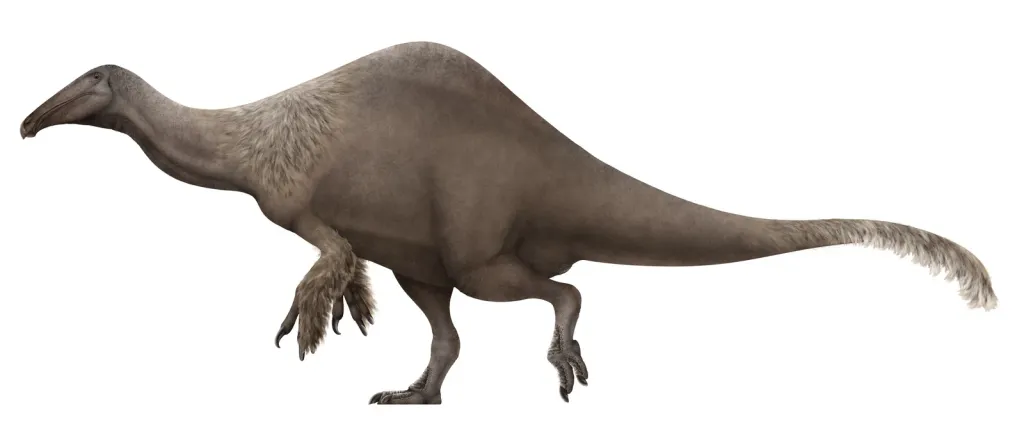
Deinocheirus mirificus
Pronounced DYE-noh-KY-rus mih-RIF-ih-kus
Ornithomimosauria · Deinocheiridae
A giant, humpbacked ornithomimosaur from the Late Cretaceous of Mongolia, known for decades only from a pair of 2.4 m arms. New skeletons in 2014 revealed a duck-like snout, a sail on its back and a stomach full of stones and fish.
- Bipedal
- Giant
- Giant claws
- Sail backed
- Unusual anatomy
- Period
- Cretaceous· Maastrichtian
- Diet
- Omnivore
- Length
- 11 m
- Mass
- 6,360 kg
- Location
- Ömnögovi Province, Mongolia, Asia
Quick answers
- How big was Deinocheirus mirificus?
- Deinocheirus mirificus was about 11 m long. It stood about 2.9–3.5 m tall at the hips. It weighed about 6.4 t. (Wikipedia: Deinocheirus 2026; Lee et al. 2014)
- When did Deinocheirus mirificus live?
- Deinocheirus mirificus lived during the Late Cretaceous, about 72.1–66 million years ago. (Paleobiology Database: Deinocheirus occurrences 2026; Cohen et al. 2023)
- Where have Deinocheirus mirificus fossils been found?
- Fossils of Deinocheirus mirificus have been found in Nemegt Formation (Ömnögovi Province) and Mongolia. (Osmólska & Roniewicz 1970; Lee et al. 2014)
- What did Deinocheirus mirificus eat?
- Deinocheirus mirificus was a omnivore. (Osmólska & Roniewicz 1970; Lee et al. 2014)
- Who named Deinocheirus mirificus, and when?
- Deinocheirus mirificus was described by Halszka Osmólska & Ewa Roniewicz in 1970. (Osmólska & Roniewicz 1970; Lee et al. 2014)
On this page

DYE-noh-KY-rus mih-RIF-ih-kus
- Period
- Cretaceous72.1–66 Ma
- Diet
- Omnivore
- Length
- 11 m
- Mass
- 6.4 t
- Location
- Mongolia, Asia
- Classification
- Ornithomimosauria · Deinocheiridae
- Described
- 1970, Halszka Osmólska & Ewa Roniewicz
Overview
Deinocheirus mirificus lived in the Nemegt Formation of Mongolia at the end of the Cretaceous. The 1965 Polish-Mongolian expedition found its holotype at Altan Uul III: mostly a pair of giant forelimbs, 2.4 m long, with shoulder girdles. Halszka Osmólska and Ewa Roniewicz named it in 1970, and for almost fifty years it remained a mystery.
Two new skeletons, found in 2006 and 2009, were described by Lee and colleagues in 2014. Deinocheirus turned out to be the largest ornithomimosaur: a heavily built, slow animal with a long, toothless snout, a deep jaw, very tall spines along the back, short hind legs and broad, blunt toe claws.
More than a thousand gastroliths and fish remains in its body cavity suggest it was a giant omnivore of wet environments. Parts of one skeleton had been poached and sold abroad before being returned to Mongolia in 2014.
Name meaning
"Terrible hand", from Greek deinos ("terrible") and cheir ("hand"); mirificus, Latin for "unusual, peculiar" (Osmólska & Roniewicz 1970).
Biology & evidence
What scientists think about how this animal lived, and how strong the evidence for each idea is.
Locomotion
Deinocheirus was a slow, heavy animal rather than a runner.
Evidence level: Moderate evidenceUnlike its fast relatives, it had short hind limbs and a heavily built body.
Evidence for / against · 1
Evidence for
Specimen · New Deinocheirus skeletons
Two skeletons showing an elongate snout, deep jaw, tall neural spines, a pygostyle, a U-shaped furcula, an expanded pelvis, short hind limbs and broad-tipped toe claws.
Specimen: MPC-D 100/127, MPC-D 100/128
Feeding
Deinocheirus was a giant omnivore that also ate fish.
Evidence level: Moderate evidenceIts skull suggests plant-eating, while gut stones and fish remains show a mixed diet in wet environments.
Evidence for / against · 2
Evidence for
Specimen · Deinocheirus gastroliths and stomach contents
More than a thousand gastroliths and fish remains in the body cavity.
Specimen: MPC-D 100/127
Specimen · New Deinocheirus skeletons
Two skeletons showing an elongate snout, deep jaw, tall neural spines, a pygostyle, a U-shaped furcula, an expanded pelvis, short hind limbs and broad-tipped toe claws.
Specimen: MPC-D 100/127, MPC-D 100/128
Other
Deinocheirus was the largest ornithomimosaur.
Evidence level: Strong evidencePhylogenetic analysis of the new skeletons places it in Ornithomimosauria, the "ostrich dinosaurs", of which it is by far the biggest.
Evidence for / against · 1
Evidence for
Specimen · New Deinocheirus skeletons
Two skeletons showing an elongate snout, deep jaw, tall neural spines, a pygostyle, a U-shaped furcula, an expanded pelvis, short hind limbs and broad-tipped toe claws.
Specimen: MPC-D 100/127, MPC-D 100/128
Size
- Length
- 11 m
- Height
- 3.2 mpublished range 2.9–3.5 m
- Mass
- 6,360 kg
(36.1 ft)
(10.5 ft)
Based on MPC-D 100/127 (femur c. 1.32 m)
Timeline
Periods: Maastrichtian (72.1–66 Ma), Late Cretaceous (100.5–66 Ma)
Maastrichtian bounds of the type collection in PBDB.
Location
Formations
- Nemegt Formation · Ömnögovi Province
- Altan Uul III, Nemegt Basin, Ömnögovi · Nemegt Formation · Ömnögovi Province · position approximate
These are the places where fossils have been found, not the full area where the animal lived.
Ecosystem

Lived in: Nemegt
72–68 million years ago · river system, floodplain, forest, swamp / wetland
Wetter than the Djadokhta dunes before it: braided rivers, channels and floodplain forests in the Late Cretaceous Gobi, supporting large herbivores and the tyrannosaurid Tarbosaurus.

Same ecosystem

Same ecosystem

Classification
- cladeDinosauria
- cladeSaurischia
- cladeTheropoda
- cladeCoelurosauria
- cladeOrnithomimosauria
- familyDeinocheiridae
- genusDeinocheirus
- speciesDeinocheirus mirificus
Taxonomic status: Valid
Fossil record

| Catalog number | Status | Institution | Found |
|---|---|---|---|
| MPC-D 100/18 | Holotype | Institute of Paleontology, Mongolian Academy of Sciences (MPC) | 1965 |
| MPC-D 100/127 | Referred specimen | Institute of Paleontology, Mongolian Academy of Sciences (MPC) | 2009 |
| MPC-D 100/128 | Referred specimen | Institute of Paleontology, Mongolian Academy of Sciences (MPC) | 2006 |
What has been found
Holotype: MPC-D 100/18
- Preserved
- Partial
- Reconstructed
- Unknown / not recorded
Holotype: MPC-D 100/18
Region by region (table)
| Region | State |
|---|---|
| Skull | Unknown / not recorded |
| Mandible | Unknown / not recorded |
| Teeth | Unknown / not recorded |
| Cervical vertebrae | Unknown / not recorded |
| Dorsal vertebrae | Unknown / not recorded |
| Sacrum | Unknown / not recorded |
| Caudal vertebrae | Unknown / not recorded |
| Ribs | Unknown / not recorded |
| Gastralia | Unknown / not recorded |
| Scapula / shoulder girdle | Preserved |
| Humerus | Preserved |
| Forearm (radius / ulna) | Preserved |
| Hand (manus) | Preserved |
| Pelvis | Unknown / not recorded |
| Femur | Unknown / not recorded |
| Tibia / fibula | Unknown / not recorded |
| Foot (pes) | Unknown / not recorded |
Referred specimen: MPC-D 100/127
Region by region (table)
| Region | State |
|---|---|
| Skull | Unknown / not recorded |
| Mandible | Unknown / not recorded |
| Teeth | Unknown / not recorded |
| Cervical vertebrae | Unknown / not recorded |
| Dorsal vertebrae | Unknown / not recorded |
| Sacrum | Unknown / not recorded |
| Caudal vertebrae | Unknown / not recorded |
| Ribs | Unknown / not recorded |
| Gastralia | Unknown / not recorded |
| Scapula / shoulder girdle | Unknown / not recorded |
| Humerus | Unknown / not recorded |
| Forearm (radius / ulna) | Preserved |
| Hand (manus) | Preserved |
| Pelvis | Unknown / not recorded |
| Femur | Unknown / not recorded |
| Tibia / fibula | Unknown / not recorded |
| Foot (pes) | Unknown / not recorded |

Discovery
- Year described
- 1970
- Described by
- Halszka Osmólska & Ewa Roniewicz
- Type specimen
- MPC-D 100/18
Discovery timeline
1965 · First material found
Giant arms found at Altan Uul III
The Polish-Mongolian expedition collects a pair of 2.4 m forelimbs.
People: Zofia Kielan-Jaworowska
1970 · Formally described
Osmólska and Roniewicz name Deinocheirus
The "terrible hand" is named with its own family.
People: Halszka Osmólska, Ewa Roniewicz
2014 · Major study
Deinocheirus mystery solved
Lee and colleagues describe two new skeletons revealing the whole animal.
People: Yuong-Nam Lee, Philip J. Currie
Sources
- (2026). Paleobiology Database: Deinocheirus occurrences. The Paleobiology Database (paleobiodb.org), data service 1.2, accessed 2026-09-23. https://paleobiodb.org/data1.2/occs/list.txt?base_name=Deinocheirus&show=coords,paleoloc,strat,loc,ref&pgm=gplates (opens in a new tab)
- (2026). Wikipedia: Deinocheirus. Wikipedia (English), accessed 2026-09-23. https://en.wikipedia.org/wiki/Deinocheirus (opens in a new tab)
- Cohen, K. M., Harper, D. A. T., Gibbard, P. L. & Car, N. (2023). International Chronostratigraphic Chart (v2023/09). International Commission on Stratigraphy. https://stratigraphy.org/ICSchart/ChronostratChart2023-09.pdf (opens in a new tab)
- Lee, Y.-N., Barsbold, R., Currie, P. J., Kobayashi, Y., Lee, H.-J., Godefroit, P., Escuillié, F. & Chinzorig, T. (2014). Resolving the long-standing enigmas of a giant ornithomimosaur Deinocheirus mirificus. Nature 515: 257-260. doi:10.1038/nature13874 (opens in a new tab)
- Osmólska, H. & Roniewicz, E. (1970). Deinocheiridae, a new family of theropod dinosaurs. Palaeontologia Polonica 21: 5-19.
- Paul, G. S. (2016). The Princeton Field Guide to Dinosaurs (2nd edition). Princeton University Press.