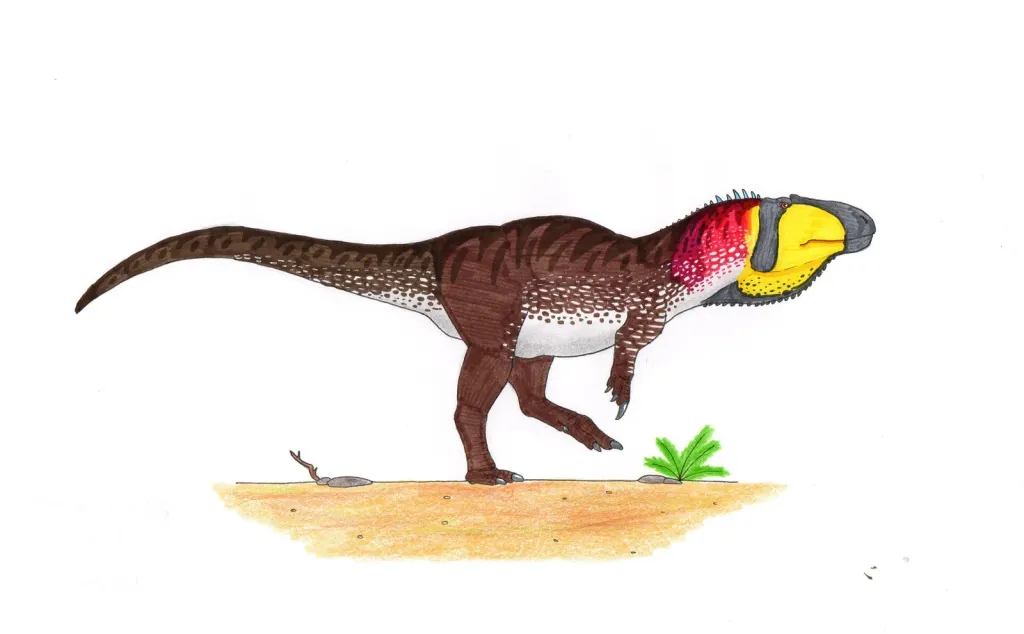
Megalosaurus bucklandii
Pronounced MEG-ah-loh-SORE-us buk-LAN-dee-eye
Tetanurae · Megalosauridae
A large meat-eating dinosaur from the Middle Jurassic of Oxfordshire, England, and the first dinosaur to be scientifically named, by William Buckland in 1824. Its type specimen is a lower jaw kept in Oxford.
- Bipedal
- Famous specimen
- Period
- Jurassic· Middle Jurassic
- Diet
- Carnivore
- Length
- 6 m
- Mass
- 700–943 kg
- Location
- Oxfordshire, United Kingdom
Quick answers
- How big was Megalosaurus bucklandii?
- Megalosaurus bucklandii was about 6 m long. It stood about 1.8–2.1 m tall at the hips. It weighed about 700–943 kg. (Paul 2010; Wikipedia: Megalosaurus 2026)
- When did Megalosaurus bucklandii live?
- Megalosaurus bucklandii lived during the Middle Jurassic, about 168.2–165.3 million years ago. (Paleobiology Database: Megalosaurus occurrences 2026)
- Where have Megalosaurus bucklandii fossils been found?
- Fossils of Megalosaurus bucklandii have been found in Taynton Limestone Formation (Oxfordshire) and United Kingdom. (Buckland 1824; Benson et al. 2008)
- What did Megalosaurus bucklandii eat?
- Megalosaurus bucklandii was a carnivore. (Buckland 1824; Benson et al. 2008)
- Who named Megalosaurus bucklandii, and when?
- Megalosaurus bucklandii was described by William Buckland in 1824. (Buckland 1824; History 2026)
On this page

- Period
- Jurassic168.2–165.3 Ma
- Diet
- Carnivore
- Length
- 6 m
- Mass
- 0.7–0.9 t
- Location
- United Kingdom
- Classification
- Tetanurae · Megalosauridae
- Described
- 1824, William Buckland
Overview
Megalosaurus bucklandii lived in what is now southern England in the Middle Jurassic (Bathonian), on a coastline with lagoons and seasonal dry spells. Bones from the quarries around Stonesfield, north-west of Oxford, reached the University of Oxford from the 1790s; William Buckland described them in 1824 as the "great fossil lizard", and Gideon Mantell added the species name bucklandii in 1827.
It was a two-legged predator several metres long with blade-like, serrated teeth. Its jaw (OUMNH PAL-J.13505) is the type specimen. In 1842 Richard Owen used Megalosaurus, Iguanodon and Hylaeosaurus to define a new group, the Dinosauria.
For a long time almost any large Jurassic or Cretaceous theropod was called Megalosaurus. Benson and colleagues (2008) showed that the type jaw has unique features, so the species is valid, but warned that other bones could not be referred to it with certainty; a larger study (Benson 2010) later described more of the Stonesfield material as Megalosaurus.
Name meaning
"Great lizard", from Greek megas ("great") and sauros ("lizard") (Buckland 1824); bucklandii honours William Buckland (Mantell 1827).
Biology & evidence
What scientists think about how this animal lived, and how strong the evidence for each idea is.
Other
Megalosaurus was one of the three animals used to define the Dinosauria in 1842.
Evidence level: Direct evidenceRichard Owen coined "Dinosauria" in 1842 for Megalosaurus, Iguanodon and Hylaeosaurus. This is a historical fact, not a biological inference.
Evidence for / against · 1
Evidence for
Specimen · Megalosaurus lectotype dentary
A right dentary diagnosed by two unique characters: a groove along the lower outer surface and a slit-like anterior Meckelian foramen.
Specimen: OUMNH PAL-J.13505
Only the type jaw can be assigned to Megalosaurus bucklandii with certainty.
Evidence level: DisputedIn 2008 Benson and colleagues found no other bones that could be referred to the species with certainty. In 2010 Benson described much of the Stonesfield material as Megalosaurus, so the question depends on how much variation one accepts.
Evidence for / against · 2
Evidence for
Specimen · Megalosaurus lectotype dentary
A right dentary diagnosed by two unique characters: a groove along the lower outer surface and a slit-like anterior Meckelian foramen.
Specimen: OUMNH PAL-J.13505
Evidence against
Comparative anatomy · Megalosaurus Stonesfield skeleton description
A full description of the Stonesfield theropod bones treated as Megalosaurus bucklandii.
Megalosaurus was the first dinosaur to be scientifically described.
Evidence level: Strong evidenceBuckland described it in 1824, a year before Mantell named Iguanodon. An earlier printed mention (Parkinson 1822) had no description.
Evidence for / against · 1
Evidence for
Specimen · Megalosaurus lectotype dentary
A right dentary diagnosed by two unique characters: a groove along the lower outer surface and a slit-like anterior Meckelian foramen.
Specimen: OUMNH PAL-J.13505
Size
- Length
- 6 m
- Height
- 1.9 mpublished range 1.8–2.1 m
- Mass
- 700–943 kg
(19.7 ft)
(6.2 ft)
Based on OUMNH J13561 (femur c. 0.8 m) and Stonesfield material
Based on NHMUK PV OR 31806 (femur 803 mm) for the upper value
Timeline
Periods: Middle Jurassic (174.7–161.5 Ma)
Middle Bathonian bounds of the Stonesfield collection in PBDB.
Location
Formations
- Taynton Limestone Formation · Oxfordshire
- Stonesfield quarries, Oxfordshire · Taynton Limestone Formation · Oxfordshire · position approximate
These are the places where fossils have been found, not the full area where the animal lived.
Ecosystem
Lived in: Stonesfield (Taynton Limestone)
coastal plain, marine margin
A Middle Jurassic coastline in southern England, perhaps seasonally dry, with mangrove-like vegetation.
Classification
- cladeDinosauria
- cladeSaurischia
- cladeTheropoda
- cladeTetanurae
- superfamilyMegalosauroidea
- familyMegalosauridae
- genusMegalosaurus
- speciesMegalosaurus bucklandii
Taxonomic status: Valid
Fossil record

| Catalog number | Status | Institution | Found |
|---|---|---|---|
| OUMNH PAL-J.13505 | Lectotype | Oxford University Museum of Natural History (OUMNH) | 1797 |
What has been found
Lectotype: OUMNH PAL-J.13505
- Preserved
- Partial
- Reconstructed
- Unknown / not recorded
Region by region (table)
| Region | State |
|---|---|
| Skull | Unknown / not recorded |
| Mandible | Partial · Right dentary. |
| Teeth | Partial |
| Cervical vertebrae | Unknown / not recorded |
| Dorsal vertebrae | Unknown / not recorded |
| Sacrum | Unknown / not recorded |
| Caudal vertebrae | Unknown / not recorded |
| Ribs | Unknown / not recorded |
| Gastralia | Unknown / not recorded |
| Scapula / shoulder girdle | Unknown / not recorded |
| Humerus | Unknown / not recorded |
| Forearm (radius / ulna) | Unknown / not recorded |
| Hand (manus) | Unknown / not recorded |
| Pelvis | Unknown / not recorded |
| Femur | Unknown / not recorded |
| Tibia / fibula | Unknown / not recorded |
| Foot (pes) | Unknown / not recorded |

Gallery

Discovery
- Year described
- 1824
- Described by
- William Buckland
- Type specimen
- OUMNH PAL-J.13505

Discovery timeline
1797 · First material found
Oxford acquires the Megalosaurus jaw
A jaw from the Stonesfield quarries is acquired by the University of Oxford.
1824 · Formally described
Buckland describes Megalosaurus
Buckland presents the "great fossil lizard of Stonesfield" to the Geological Society of London.
People: William Buckland
2008 · Revision
Benson et al. confirm Megalosaurus bucklandii as a valid species
The lectotype jaw is shown to have unique features.
People: Roger B. J. Benson
Sources
- (2026). Paleobiology Database: Megalosaurus occurrences. The Paleobiology Database (paleobiodb.org), data service 1.2, accessed 2026-09-23. https://paleobiodb.org/data1.2/occs/list.txt?base_name=Megalosaurus&show=coords,paleoloc,strat,loc,ref&pgm=gplates (opens in a new tab)
- (2026). Wikipedia: Megalosaurus. Wikipedia (English), accessed 2026-09-23. https://en.wikipedia.org/wiki/Megalosaurus (opens in a new tab)
- Benson, R. B. J. (2010). A description of Megalosaurus bucklandii (Dinosauria: Theropoda) from the Bathonian of the UK and the relationships of Middle Jurassic theropods. Zoological Journal of the Linnean Society 158: 882-935. doi:10.1111/j.1096-3642.2009.00569.x (opens in a new tab)
- Benson, R. B. J., Barrett, P. M., Powell, H. P. & Norman, D. B. (2008). The taxonomic status of Megalosaurus bucklandii (Dinosauria, Theropoda) from the Middle Jurassic of Oxfordshire, UK. Palaeontology 51: 419-424. doi:10.1111/j.1475-4983.2008.00751.x (opens in a new tab)
- Buckland, W. (1824). Notice on the Megalosaurus or great Fossil Lizard of Stonesfield. Transactions of the Geological Society of London, series 2, 1: 390-396. doi:10.1144/transgslb.1.2.390 (opens in a new tab)
- Oxford University Museum of Natural History (2026). Megalosaurus dentary (OUMNH PAL-J.13505), 3D model and record. Sketchfab (museum account @morethanadodo). https://sketchfab.com/3d-models/megalosaurus-dentary-oumnh-pal-j13505-95c26e991aeb4ebfacd6ceec76e08cba (opens in a new tab)
- Paul, G. S. (2010). The Princeton Field Guide to Dinosaurs. Princeton University Press.
- Paul, G. S. (2016). The Princeton Field Guide to Dinosaurs (2nd edition). Princeton University Press.