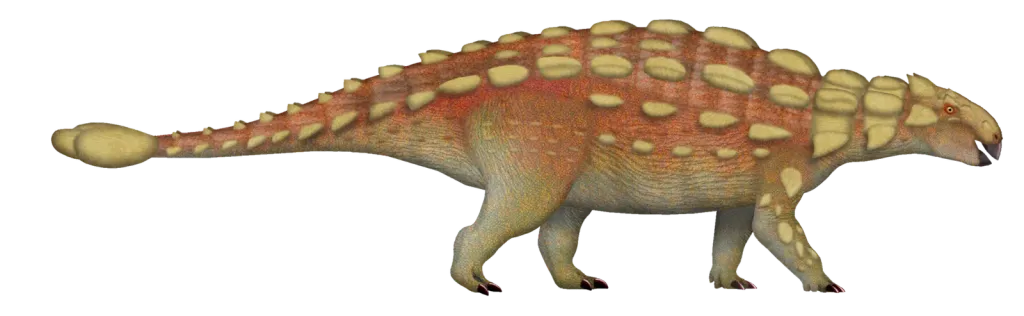
Ankylosaurus magniventris
Pronunciación: an-KY-loh-SORE-us mag-nih-VEN-tris
Ankylosauria · Ankylosauridae
A heavily armored, club-tailed ankylosaur from the very end of the Cretaceous of western North America, the largest known member of its group and a neighbour of T. rex and Triceratops.
- Armored
- Tail club
- Quadrupedal
- Giant
- Movie icon
- Período
- Cretácico· Maastrichtiense
- Dieta
- Herbívoro
- Longitud
- 6–8 m
- Masa
- 4800–8000 kg
- Ubicación
- Montana, Wyoming, Alberta
Respuestas rápidas
- ¿Qué tamaño tenía Ankylosaurus magniventris?
- Ankylosaurus magniventris medía unos 6–8 m de largo. Alcanzaba unos 1,5–1,8 m de altura a la cadera. Pesaba alrededor de 4,8–8 t. (Arbour & Mallon 2017; Paul 2016)
- ¿Cuándo vivió Ankylosaurus magniventris?
- Ankylosaurus magniventris vivió durante el Cretácico Superior, hace unos 72,1–66 millones de años. (Cohen et al. 2023; Arbour & Mallon 2017)
- ¿Dónde se han encontrado fósiles de Ankylosaurus magniventris?
- Se han encontrado fósiles de Ankylosaurus magniventris en Hell Creek Formation (Montana), Lance Formation (Wyoming) y Scollard Formation (Alberta). (Brown 1908; Arbour & Mallon 2017)
- ¿Qué comía Ankylosaurus magniventris?
- Ankylosaurus magniventris era herbívoro. (Brown 1908; Arbour & Mallon 2017)
- ¿Quién nombró a Ankylosaurus magniventris y cuándo?
- Ankylosaurus magniventris fue descrito por Barnum Brown en 1908. (Brown 1908)
- ¿Aparece Ankylosaurus magniventris en Jurassic Park?
- Sí. Ankylosaurus magniventris aparece en Jurassic Park III (2001), Jurassic World (2015), Jurassic World: El reino caído (2018), Jurassic World: Dominio (2022) y Jurassic World Rebirth (2025). Las películas se toman libertades; esta página las compara con la evidencia fósil. (Wikipedia: Dinosaurs in Jurassic Park 2026; Arbour 2009)
En esta página

- Período
- Cretácico72,1–66 Ma
- Dieta
- Herbívoro
- Longitud
- 6–8 m
- Masa
- 4,8–8 t
- Clasificación
- Ankylosauria · Ankylosauridae
- Descrito
- 1908, Barnum Brown
Resumen
Este contenido está disponible en inglés.
Ankylosaurus magniventris lived in western North America at the end of the Cretaceous, in the same landscapes as Tyrannosaurus and Triceratops. Barnum Brown named it in 1908 from a skull roof and armor found in the Hell Creek Formation of Montana.
It was a low, wide, four-legged plant-eater covered in bony plates (osteoderms) set in the skin, with horns at the back of its skull and a heavy club of fused bone at the end of its tail. It is the largest known ankylosaurid, but it is also known from surprisingly few specimens: no complete skeleton has been found.
Arbour and Mallon (2017) re-examined all the material. They found an unusual nose with looping nasal passages, small leaf-shaped teeth, and estimated a length of roughly 6 to 8 m. The tail club could deliver strong blows, probably against predators or rivals.
Significado del nombre
From Greek ankylos ("fused, bent") and sauros ("lizard"), for the fused bones of the skull and armor; magniventris, Latin for "great belly" (Brown 1908).
Biología y evidencia
Lo que piensan los científicos sobre cómo vivía este animal y qué tan sólida es la evidencia de cada idea.
Alimentación
Ankylosaurus fed on low plants, cropping them with a wide beak.
Nivel de evidencia: Evidencia moderadaA low body, a wide muzzle and small leaf-shaped teeth point to a low-level plant-eater. Its diet has not been observed directly.
Piel y cobertura
Ankylosaurus was covered in bony armor plates set in its skin.
Nivel de evidencia: Evidencia directaThe osteoderms themselves are fossilised with the specimens. How exactly they were arranged over the body is reconstructed from better-preserved relatives.
Sentidos
The looping nasal passages of Ankylosaurus helped it control heat and moisture or produce sounds.
Nivel de evidencia: HipótesisThe shape of the nasal passages is known; their function is inferred from similar passages in other ankylosaurs and living animals.
Evidencia a favor / en contra · 1
Evidencia a favor
Anatomía comparada · Ankylosaurus looping nasal passages
The nostrils face sideways and lead into convoluted nasal passages, unusual among ankylosaurids.
Espécimen: CMN 8880
Comportamiento
Ankylosaurus could swing its tail club hard enough to break bone.
Nivel de evidencia: Evidencia moderadaModels of ankylosaurid tail clubs show large clubs could hit hard enough to fracture bone. The club of Ankylosaurus is known from one specimen, so its exact force is estimated from relatives.
Evidencia a favor / en contra · 2
Evidencia a favor
Espécimen · Ankylosaurus tail club (AMNH 5214)
A club of large fused osteoderms at the end of a tail stiffened by interlocking vertebrae.
Espécimen: AMNH 5214
Modelo biomecánico · Ankylosaurid tail club impact model
Estimates of the force of tail-club swings in ankylosaurids, large enough to break bone.
Tamaño
- Longitud
- 6–8 m
- Altura
- 1,7 mrango publicado 1,5–1,8 m
- Masa
- 4800–8000 kg
(26,2 pies)
Basado en AMNH 5214 (smallest) to CMN 8880 (largest skull)
(5,6 pies)
Basado en AMNH 5214
Línea de tiempo
Períodos: Maastrichtiense (72,1–66 Ma), Cretácico Superior (100,5–66 Ma)
Ages are the ICS 2023/09 bounds of the Maastrichtian, the stage(s) the fossils are assigned to; they bracket the record and are not dated first/last appearances. Known specimens come from the latest Maastrichtian (Hell Creek, Lance, Scollard), so the real range is much narrower, roughly the last 2-3 million years of the Cretaceous.
Ubicación
Formaciones
- Hell Creek Formation · Montana
- Lance Formation · Wyoming
- Scollard Formation · Alberta
- Gilbert Creek, Hell Creek Formation, Montana · Hell Creek Formation · Montana · posición aproximada
- Red Deer River, Scollard Formation, Alberta · Scollard Formation · Alberta · posición aproximada
Estos son los lugares donde se han encontrado fósiles, no toda el área donde vivía el animal.
Ecosistema
Vivió en: Hell Creek
hace 68–66 millones de años · llanura aluvial, sistema fluvial, bosque, llanura costera
Warm, humid coastal lowlands and river floodplains west of the retreating Western Interior Seaway at the very end of the Cretaceous, with forests of conifers and flowering plants. The ecosystem ends at the Cretaceous-Paleogene extinction.
Mismo ecosistema

Mismo ecosistema


Mismo ecosistema

Clasificación
- cladoDinosauria
- cladoOrnithischia
- cladoThyreophora
- cladoAnkylosauria
- familiaAnkylosauridae
- subfamiliaAnkylosaurinae
- géneroAnkylosaurus
- especieAnkylosaurus magniventris
Estado taxonómico: Válido
Registro fósil

| Número de catálogo | Estado | Institución | Hallado |
|---|---|---|---|
| AMNH 5895 | Holotipo | American Museum of Natural History (AMNH) | 1906 |
| AMNH 5214 | Espécimen referido | American Museum of Natural History (AMNH) | 1910 |
| CMN 8880 | Espécimen referido | Canadian Museum of Nature (CMN) | — |
Lo que se ha encontrado
Holotipo: AMNH 5895
- Conservado
- Parcial
- Reconstruido
- Desconocido / no registrado
Holotipo: AMNH 5895
Región por región (tabla)
| Región | Estado |
|---|---|
| Skull | Parcial · Skull roof. |
| Mandible | Desconocido / no registrado |
| Teeth | Parcial |
| Cervical vertebrae | Parcial |
| Dorsal vertebrae | Parcial |
| Sacrum | Desconocido / no registrado |
| Caudal vertebrae | Desconocido / no registrado |
| Ribs | Parcial |
| Gastralia | Desconocido / no registrado |
| Scapula / shoulder girdle | Parcial |
| Humerus | Desconocido / no registrado |
| Forearm (radius / ulna) | Desconocido / no registrado |
| Hand (manus) | Desconocido / no registrado |
| Pelvis | Desconocido / no registrado |
| Femur | Desconocido / no registrado |
| Tibia / fibula | Desconocido / no registrado |
| Foot (pes) | Desconocido / no registrado |
Espécimen referido: AMNH 5214
Región por región (tabla)
| Región | Estado |
|---|---|
| Skull | Parcial |
| Mandible | Parcial |
| Teeth | Desconocido / no registrado |
| Cervical vertebrae | Desconocido / no registrado |
| Dorsal vertebrae | Desconocido / no registrado |
| Sacrum | Desconocido / no registrado |
| Caudal vertebrae | Parcial · Tail with club. |
| Ribs | Parcial |
| Gastralia | Desconocido / no registrado |
| Scapula / shoulder girdle | Desconocido / no registrado |
| Humerus | Parcial |
| Forearm (radius / ulna) | Desconocido / no registrado |
| Hand (manus) | Desconocido / no registrado |
| Pelvis | Desconocido / no registrado |
| Femur | Desconocido / no registrado |
| Tibia / fibula | Desconocido / no registrado |
| Foot (pes) | Desconocido / no registrado |
Espécimen referido: CMN 8880
Región por región (tabla)
| Región | Estado |
|---|---|
| Skull | Conservado |
| Mandible | Desconocido / no registrado |
| Teeth | Desconocido / no registrado |
| Cervical vertebrae | Desconocido / no registrado |
| Dorsal vertebrae | Desconocido / no registrado |
| Sacrum | Desconocido / no registrado |
| Caudal vertebrae | Desconocido / no registrado |
| Ribs | Desconocido / no registrado |
| Gastralia | Desconocido / no registrado |
| Scapula / shoulder girdle | Desconocido / no registrado |
| Humerus | Desconocido / no registrado |
| Forearm (radius / ulna) | Desconocido / no registrado |
| Hand (manus) | Desconocido / no registrado |
| Pelvis | Desconocido / no registrado |
| Femur | Desconocido / no registrado |
| Tibia / fibula | Desconocido / no registrado |
| Foot (pes) | Desconocido / no registrado |

Descubrimiento
- Año de descripción
- 1908
- Descrito por
- Barnum Brown
- Espécimen tipo
- AMNH 5895

Cronología del descubrimiento
1906 · Primer material hallado
Barnum Brown collects the Ankylosaurus holotype
Brown collects a partial skull and armor in the Hell Creek Formation of Montana.
Personas: Barnum Brown
1908 · Descrito formalmente
Brown names Ankylosaurus magniventris
Brown names the genus and the family Ankylosauridae.
Personas: Barnum Brown
1910 · Espécimen recuperado
Tail club specimen collected in Alberta
Brown collects the specimen with the only known Ankylosaurus tail club.
Personas: Barnum Brown
2017 · Estudio importante
Arbour and Mallon redescribe Ankylosaurus
A full re-examination of all specimens with new size estimates.
Personas: Victoria M. Arbour
En Jurassic Park y Jurassic World
Películas
- Jurassic Park III (2001)
- Jurassic World (2015)
- Jurassic World: El reino caído (2018)
- Jurassic World: Dominio (2022)
- Jurassic World Rebirth (2025)
Este contenido está disponible en inglés.
En pantalla
An armoured tank that swings its tail club, killed by the Indominus rex in Jurassic World.
Película frente a fósiles
- The tail club was a real weapon: models suggest strikes strong enough to break bone.
- Ankylosaurus itself is known from partial skeletons, so much of its body in any reconstruction is borrowed from relatives.
Los títulos de las películas se citan solo para identificarlas. DinoDex no está afiliado a la franquicia Jurassic Park / Jurassic World ni cuenta con su respaldo. Todos los dinosaurios que aparecen en las películas
Fuentes
- (2026). Wikipedia: Dinosaurs in Jurassic Park. Wikipedia. https://en.wikipedia.org/wiki/Dinosaurs_in_Jurassic_Park (se abre en una pestaña nueva)
- (2026). Wikipedia: Jurassic World Rebirth. Wikipedia. https://en.wikipedia.org/wiki/Jurassic_World_Rebirth (se abre en una pestaña nueva)
- Arbour, V. M. (2009). Estimating impact forces of tail club strikes by ankylosaurid dinosaurs. PLoS ONE 4(8): e6738. doi:10.1371/journal.pone.0006738 (se abre en una pestaña nueva)
- Arbour, V. M. & Mallon, J. C. (2017). Unusual cranial and postcranial anatomy in the archetypal ankylosaur Ankylosaurus magniventris. FACETS 2: 764-794. doi:10.1139/facets-2017-0063 (se abre en una pestaña nueva)
- Brown, B. (1908). The Ankylosauridae, a new family of armored dinosaurs from the Upper Cretaceous. Bulletin of the American Museum of Natural History 24: 187-201.
- Cohen, K. M., Harper, D. A. T., Gibbard, P. L. & Car, N. (2023). International Chronostratigraphic Chart (v2023/09). International Commission on Stratigraphy. https://stratigraphy.org/ICSchart/ChronostratChart2023-09.pdf (se abre en una pestaña nueva)
- Paul, G. S. (2016). The Princeton Field Guide to Dinosaurs (2nd edition). Princeton University Press.