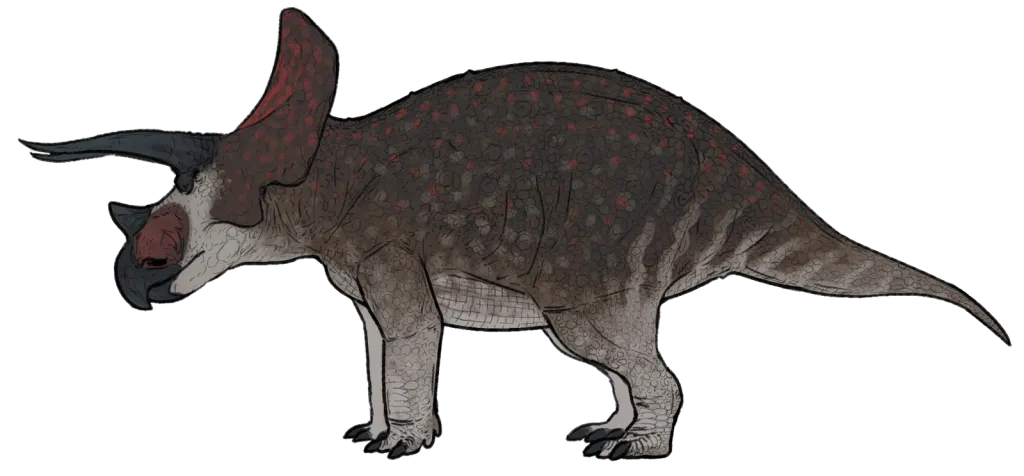
Triceratops horridus
Pronunciación: try-SER-ah-tops HOR-ih-dus
Ceratopsia · Ceratopsidae
A large three-horned chasmosaurine ceratopsid from the very end of the Cretaceous of western North America, living alongside Tyrannosaurus rex in the Hell Creek and Lance formations.
- Horned
- Quadrupedal
- Giant
- Skin impressions known
- Movie icon
- Período
- Cretácico· Maastrichtiense
- Dieta
- Herbívoro
- Longitud
- 8–9 m
- Masa
- 6000–10.000 kg
- Ubicación
- Montana, Wyoming, South Dakota, North Dakota
Respuestas rápidas
- ¿Qué tamaño tenía Triceratops horridus?
- Triceratops horridus medía unos 8–9 m de largo. Alcanzaba unos 2,4–3 m de altura a la cadera. Pesaba alrededor de 6–10 t. (Paul 2010; Paul 2016)
- ¿Cuándo vivió Triceratops horridus?
- Triceratops horridus vivió durante el Cretácico Superior, hace unos 68–66 millones de años. (Cohen et al. 2023; Fowler 2017)
- ¿Dónde se han encontrado fósiles de Triceratops horridus?
- Se han encontrado fósiles de Triceratops horridus en Hell Creek Formation (Montana), Lance Formation (Wyoming), South Dakota y North Dakota. (Marsh 1889; Paul 2010)
- ¿Qué comía Triceratops horridus?
- Triceratops horridus era herbívoro. (Marsh 1889; Paul 2010)
- ¿Quién nombró a Triceratops horridus y cuándo?
- Triceratops horridus fue descrito por Othniel Charles Marsh en 1889. (Marsh 1889)
- ¿Aparece Triceratops horridus en Jurassic Park?
- Sí. Triceratops horridus aparece en Jurassic Park (Parque Jurásico) (1993), El mundo perdido: Jurassic Park (1997), Jurassic Park III (2001), Jurassic World (2015), Jurassic World: El reino caído (2018) y Jurassic World: Dominio (2022). Las películas se toman libertades; esta página las compara con la evidencia fósil. (Wikipedia: Dinosaurs in Jurassic Park 2026; Farke et al. 2009)
En esta página

try-SER-ah-tops HOR-ih-dus
- Período
- Cretácico68–66 Ma
- Dieta
- Herbívoro
- Longitud
- 8–9 m
- Masa
- 6–10 t
- Clasificación
- Ceratopsia · Ceratopsidae
- Descrito
- 1889, Othniel Charles Marsh
Resumen
Este contenido está disponible en inglés.
Triceratops horridus lived in western North America during the Maastrichtian, the last age of the Cretaceous. O. C. Marsh first described it in 1889 as Ceratops horridus from a skull (YPM 1820) collected by John Bell Hatcher in the Lance Formation of Wyoming, and moved it to the new genus Triceratops later that year.
It was a heavy, four-legged plant eater with a short nose horn, two long brow horns and a solid bony frill. Its fossils are among the most common dinosaur remains in the Hell Creek and Lance formations, where it shared its world with Tyrannosaurus rex.
Complete skeletons are rare, so body size is less certain than the many skulls suggest. The figures below are given as ranges with their source.
Significado del nombre
From Greek tri- ("three"), keras ("horn") and ops ("face"): "three-horned face"; Latin horridus means "rough" or "bristling" (Marsh 1889).
Biología y evidencia
Lo que piensan los científicos sobre cómo vivía este animal y qué tan sólida es la evidencia de cada idea.
Piel y cobertura
Triceratops was covered in large, non-overlapping scales.
Nivel de evidencia: Evidencia moderadaA nearly complete Triceratops in Houston preserves skin with large polygonal scales. The skin has been shown and discussed but not yet fully published, so the details may change.
Evidencia a favor / en contra · 1
Evidencia a favor
Impresión de piel · Triceratops skin impression (Lane specimen)
Large patches of skin with big polygonal scales, some with a central bump, from a nearly complete Triceratops in Houston.
Crecimiento
Torosaurus is the fully adult form of Triceratops.
Nivel de evidencia: En disputaScannella and Horner argued that the frill of Triceratops opened up with age until it looked like Torosaurus. Others found immature Torosaurus and no clear transitional skulls. Most researchers still keep them as separate genera.
Evidencia a favor / en contra · 2
Evidencia a favor
Espécimen · Triceratops skull growth series
A series of skulls from juvenile to large adult showing the frill thinning, lengthening and opening holes with age.
Evidencia en contra
Anatomía comparada · Torosaurus specimens with mature bone but no Triceratops transition
Torosaurus specimens that are not fully mature and lack the transitional features predicted if they were old Triceratops.
Comportamiento
Triceratops used its horns to fight other Triceratops.
Nivel de evidencia: Evidencia moderadaMany Triceratops skulls carry healed wounds on the frill and cheeks that fit the horns of another Triceratops, much more often than in related horned dinosaurs. This points to horn-locking fights, like those of modern antelope.
Evidencia a favor / en contra · 1
Evidencia a favor
Espécimen · Healed horn and frill lesions in Triceratops
Healed wounds on squamosals (frill bones) of Triceratops are far more frequent than in Centrosaurus and match the shape of Triceratops horn tips.

Tamaño
- Longitud
- 8–9 m
- Altura
- 2,7 mrango publicado 2,4–3 m
- Masa
- 6000–10.000 kg
(29,5 pies)
(8,9 pies)
Basado en composite mounts (e.g. USNM 4842 "Hatcher")
Línea de tiempo
Períodos: Maastrichtiense (72,1–66 Ma), Cretácico Superior (100,5–66 Ma)
endAgeMa 66.0 = end of the Maastrichtian (ICS 2023/09). startAgeMa left empty: no primary source verified for the first appearance.
Ubicación
Formaciones
- Hell Creek Formation · Montana
- Lance Formation · Wyoming
- Lance Formation outcrops, Niobrara County, Wyoming · Lance Formation · Wyoming · posición aproximada
Estos son los lugares donde se han encontrado fósiles, no toda el área donde vivía el animal.
Ecosistema
Vivió en: Hell Creek
hace 68–66 millones de años · llanura aluvial, sistema fluvial, bosque, llanura costera
Warm, humid coastal lowlands and river floodplains west of the retreating Western Interior Seaway at the very end of the Cretaceous, with forests of conifers and flowering plants. The ecosystem ends at the Cretaceous-Paleogene extinction.
Mismo ecosistema

Mismo ecosistema


Mismo ecosistema

Clasificación
- cladoDinosauria
- cladoOrnithischia
- cladoCeratopsia
- familiaCeratopsidae
- subfamiliaChasmosaurinae
- géneroTriceratops
- especieTriceratops horridus
Estado taxonómico: Válido
Registro fósil

| Número de catálogo | Estado | Institución | Hallado |
|---|---|---|---|
| YPM 1820 | Holotipo | Yale Peabody Museum (YPM) | 1888 |
| USNM 4842 “Hatcher” | Espécimen referido | National Museum of Natural History, Smithsonian Institution (USNM) | — |
Lo que se ha encontrado
Holotipo: YPM 1820
- Conservado
- Parcial
- Reconstruido
- Desconocido / no registrado
Holotipo: YPM 1820
Región por región (tabla)
| Región | Estado |
|---|---|
| Skull | Parcial · Horn cores and partial skull. |
| Mandible | Desconocido / no registrado |
| Teeth | Desconocido / no registrado |
| Cervical vertebrae | Desconocido / no registrado |
| Dorsal vertebrae | Desconocido / no registrado |
| Sacrum | Desconocido / no registrado |
| Caudal vertebrae | Desconocido / no registrado |
| Ribs | Desconocido / no registrado |
| Gastralia | Desconocido / no registrado |
| Scapula / shoulder girdle | Desconocido / no registrado |
| Humerus | Desconocido / no registrado |
| Forearm (radius / ulna) | Desconocido / no registrado |
| Hand (manus) | Desconocido / no registrado |
| Pelvis | Desconocido / no registrado |
| Femur | Desconocido / no registrado |
| Tibia / fibula | Desconocido / no registrado |
| Foot (pes) | Desconocido / no registrado |
Espécimen referido: USNM 4842 “Hatcher”
Región por región (tabla)
| Región | Estado |
|---|---|
| Skull | Reconstruido |
| Mandible | Desconocido / no registrado |
| Teeth | Desconocido / no registrado |
| Cervical vertebrae | Desconocido / no registrado |
| Dorsal vertebrae | Parcial |
| Sacrum | Desconocido / no registrado |
| Caudal vertebrae | Desconocido / no registrado |
| Ribs | Desconocido / no registrado |
| Gastralia | Desconocido / no registrado |
| Scapula / shoulder girdle | Desconocido / no registrado |
| Humerus | Desconocido / no registrado |
| Forearm (radius / ulna) | Desconocido / no registrado |
| Hand (manus) | Desconocido / no registrado |
| Pelvis | Parcial |
| Femur | Conservado |
| Tibia / fibula | Desconocido / no registrado |
| Foot (pes) | Desconocido / no registrado |

Descubrimiento
- Año de descripción
- 1889
- Descrito por
- Othniel Charles Marsh
- Espécimen tipo
- YPM 1820 (holotype of Ceratops horridus)

Cronología del descubrimiento
1887 · Primer material hallado
Horn cores found near Denver named Bison alticornis
Marsh first mistakes a pair of horn cores from Colorado for those of a giant bison; they were later recognised as Triceratops.
Personas: Othniel Charles Marsh
1889 · Descrito formalmente
Marsh names Ceratops horridus, then Triceratops
Marsh names Ceratops horridus from Hatcher's skull and, later in 1889, the new genus Triceratops.
Personas: Othniel Charles Marsh, John Bell Hatcher
2010 · Revisión
Torosaurus proposed as adult Triceratops
Scannella and Horner propose that Torosaurus is the mature form of Triceratops; the idea is contested.
En Jurassic Park y Jurassic World
Películas
- Jurassic Park (Parque Jurásico) (1993)
- El mundo perdido: Jurassic Park (1997)
- Jurassic Park III (2001)
- Jurassic World (2015)
- Jurassic World: El reino caído (2018)
- Jurassic World: Dominio (2022)
Este contenido está disponible en inglés.
En pantalla
A sick Triceratops is the park's gentle patient in the first film; later films show it in herds and in fights.
Película frente a fósiles
- The anatomy is broadly faithful. Healed horn wounds on skulls suggest Triceratops really did lock horns with each other.
Los títulos de las películas se citan solo para identificarlas. DinoDex no está afiliado a la franquicia Jurassic Park / Jurassic World ni cuenta con su respaldo. Todos los dinosaurios que aparecen en las películas
Fuentes
- (2026). Wikipedia: Dinosaurs in Jurassic Park. Wikipedia. https://en.wikipedia.org/wiki/Dinosaurs_in_Jurassic_Park (se abre en una pestaña nueva)
- Cohen, K. M., Harper, D. A. T., Gibbard, P. L. & Car, N. (2023). International Chronostratigraphic Chart (v2023/09). International Commission on Stratigraphy. https://stratigraphy.org/ICSchart/ChronostratChart2023-09.pdf (se abre en una pestaña nueva)
- Farke, A. A., Wolff, E. D. S. & Tanke, D. H. (2009). Evidence of combat in Triceratops. PLoS ONE 4(1): e4252. doi:10.1371/journal.pone.0004252 (se abre en una pestaña nueva)
- Fowler, D. W. (2017). Revised geochronology, correlation, and dinosaur stratigraphic ranges of the Santonian-Maastrichtian (Late Cretaceous) formations of the Western Interior of North America. PLoS ONE 12(11): e0188426. doi:10.1371/journal.pone.0188426 (se abre en una pestaña nueva)
- Marsh, O. C. (1889). Notice of gigantic horned Dinosauria from the Cretaceous. American Journal of Science (series 3) 38: 173-175.
- Paul, G. S. (2010). The Princeton Field Guide to Dinosaurs. Princeton University Press.
- Paul, G. S. (2016). The Princeton Field Guide to Dinosaurs (2nd edition). Princeton University Press.
- Shay, D. & Duncan, J. (1993). The Making of Jurassic Park. Ballantine Books.