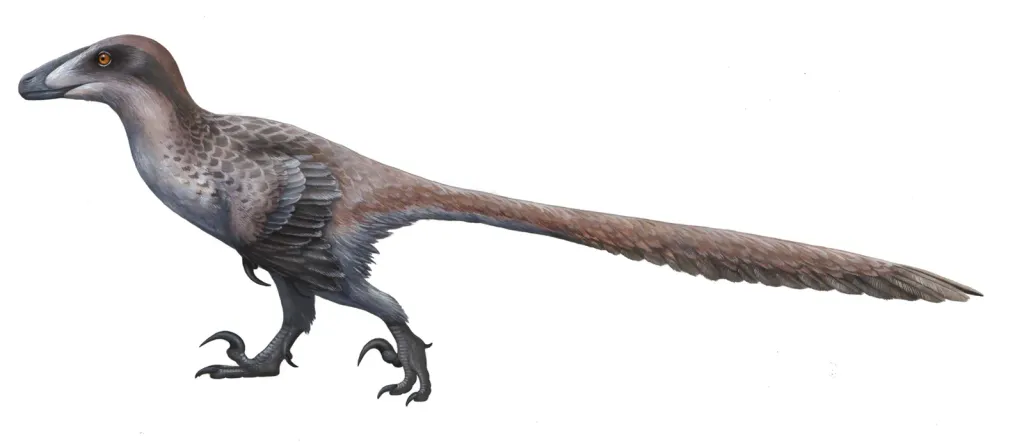
Deinonychus antirrhopus
Pronunciación: dye-NON-ih-kus an-tee-ROH-pus
Eudromaeosauria · Dromaeosauridae
A wolf-sized dromaeosaurid with a large sickle claw from the Early Cretaceous of Montana. Its 1969 description started the "dinosaur renaissance" and the idea that birds descend from dinosaurs; it was the model for the films' "raptors".
- Feathered
- Bipedal
- Sickle claw
- Possible pack behavior
- Eggs known
- Movie icon
- Período
- Cretácico· Aptiense
- Dieta
- Carnívoro
- Longitud
- 3,3–3,4 m
- Masa
- 60–100 kg
- Ubicación
- Montana, Wyoming
Respuestas rápidas
- ¿Qué tamaño tenía Deinonychus antirrhopus?
- Deinonychus antirrhopus medía unos 3,3–3,4 m de largo. Alcanzaba unos 0,8–1 m de altura a la cadera. Pesaba alrededor de 60–100 kg. (Ostrom 1969; Paul 2010)
- ¿Cuándo vivió Deinonychus antirrhopus?
- Deinonychus antirrhopus vivió durante el Cretácico Inferior, hace unos 121,4–100,5 millones de años. (Cohen et al. 2023; Ostrom 1969)
- ¿Dónde se han encontrado fósiles de Deinonychus antirrhopus?
- Se han encontrado fósiles de Deinonychus antirrhopus en Cloverly Formation (Montana) y Wyoming. (Ostrom 1969; Ostrom 1969)
- ¿Qué comía Deinonychus antirrhopus?
- Deinonychus antirrhopus era carnívoro. (Ostrom 1969; Ostrom 1969)
- ¿Quién nombró a Deinonychus antirrhopus y cuándo?
- Deinonychus antirrhopus fue descrito por John H. Ostrom en 1969. (Ostrom 1969; Ostrom 1969)
En esta página

dye-NON-ih-kus an-tee-ROH-pus
- Período
- Cretácico121,4–100,5 Ma
- Dieta
- Carnívoro
- Longitud
- 3,3–3,4 m
- Masa
- 0,1–0,1 t
- Clasificación
- Eudromaeosauria · Dromaeosauridae
- Descrito
- 1969, John H. Ostrom
Resumen
Este contenido está disponible en inglés.
Deinonychus antirrhopus lived in western North America in the Early Cretaceous, about 115 to 108 million years ago. John Ostrom and Grant Meyer found its remains in the Cloverly Formation of Montana in 1964, and Ostrom named it in 1969.
It was a light, agile predator about 3 m long, with a stiffened tail, grasping hands and an enlarged, raised claw on the second toe of each foot. Ostrom argued that such an animal must have been active and warm-blooded, and noticed its many similarities with Archaeopteryx and birds. This work revived the idea that birds are living dinosaurs.
Several Deinonychus have been found with skeletons of the plant-eater Tenontosaurus, which led to the idea of pack hunting. Roach and Brinkman (2007) argued instead for mobbing behaviour like that of modern crocodiles or Komodo dragons. The "Velociraptor" of Jurassic Park was modelled largely on Deinonychus.
Significado del nombre
From Greek deinos ("terrible") and onyx ("claw"); antirrhopus, "counterbalancing", for the stiff tail (Ostrom 1969).
Biología y evidencia
Lo que piensan los científicos sobre cómo vivía este animal y qué tan sólida es la evidencia de cada idea.
Plumas
Deinonychus had feathers.
Nivel de evidencia: Evidencia sólidaNo feathers are preserved with Deinonychus, but its close relatives had them, some with quill knobs on the arm; it is bracketed on both sides by feathered animals.
Evidencia a favor / en contra · 1
Evidencia a favor
Inferencia filogenética · Dromaeosaur quill knobs and feathered relatives
Close relatives are preserved with feathers, and Velociraptor shows quill knobs; Deinonychus sits inside this feathered group.
Reproducción
Deinonychus laid hard-shelled eggs and may have brooded them like birds.
Nivel de evidencia: HipótesisAn egg found against the belly ribs of a Deinonychus suggests it was brooding or about to lay. The link between egg and skeleton is not certain.
Evidencia a favor / en contra · 1
Evidencia a favor
Espécimen · Deinonychus egg with gastralia
An egg associated with a Deinonychus skeleton, with shell structure like other maniraptorans.
Espécimen: AMNH 3015-egg
Biomecánica
Deinonychus used its sickle claws to pin down prey.
Nivel de evidencia: HipótesisComparisons with hawks and eagles suggest the claw held struggling prey down while the animal fed, rather than slashing it.
Evidencia a favor / en contra · 1
Evidencia a favor
Anatomía comparada · Raptor prey restraint model
Comparison of dromaeosaur feet with those of living birds of prey: the sickle claw pinned prey down rather than slashing it open.
Vida social
Deinonychus hunted in cooperative packs.
Nivel de evidencia: En disputaSeveral Deinonychus were found with a Tenontosaurus, suggesting group attacks. Critics argue that living relatives rarely cooperate, and that these sites fit a free-for-all mob better than a coordinated pack.
Evidencia a favor / en contra · 2
Evidencia a favor
Espécimen · Deinonychus found with Tenontosaurus skeletons
Deinonychus teeth and skeletons found at several Tenontosaurus sites, at one quarry with several Deinonychus individuals.
Espécimen: AMNH 3015
Evidencia en contra
Anatomía comparada · Theropod group-behaviour review
Comparison with living archosaurs: birds and crocodiles rarely hunt cooperatively; the Deinonychus-Tenontosaurus sites fit mobbing and cannibalism better than a coordinated pack.

Tamaño
- Longitud
- 3,3–3,4 m
- Altura
- 0,9 mrango publicado 0,8–1 m
- Masa
- 60–100 kg
(11,2 pies)
(3 pies)
Basado en YPM 5205 and referred (femur c. 0.34 m)
Línea de tiempo
Períodos: Aptiense (121,4–113 Ma), Albiense (113–100,5 Ma), Cretácico Inferior (145–100,5 Ma)
Ages are the ICS 2023/09 bounds of the Aptian and Albian, the stage(s) the fossils are assigned to; they bracket the record and are not dated first/last appearances. The Cloverly beds with Deinonychus are usually dated to about 115-108 Ma.
Ubicación
Formaciones
- Cloverly Formation · Montana
- Cloverly Formation near Bridger, Carbon County, Montana · Cloverly Formation · Montana · posición aproximada
Estos son los lugares donde se han encontrado fósiles, no toda el área donde vivía el animal.
Ecosistema
Vivió en: Antlers
hace 120–112 millones de años · llanura aluvial, sistema fluvial, llanura costera
Early Cretaceous plains of the Trinity Group in Oklahoma, Arkansas and north-east Texas.
Mismo ecosistema

Vivió en: Cloverly
hace 115–108 millones de años · llanura aluvial, sistema fluvial, bosque
Early Cretaceous river floodplains of Montana and Wyoming, with seasonal climate and conifer forests; the plant-eater Tenontosaurus was the commonest large dinosaur.
Clasificación
- cladoDinosauria
- cladoSaurischia
- cladoTheropoda
- cladoCoelurosauria
- cladoManiraptora
- familiaDromaeosauridae
- cladoEudromaeosauria
- géneroDeinonychus
- especieDeinonychus antirrhopus
Estado taxonómico: Válido
Registro fósil

| Número de catálogo | Estado | Institución | Hallado |
|---|---|---|---|
| YPM 5205 | Holotipo | Yale Peabody Museum (YPM) | 1964 |
| AMNH 3015 | Espécimen referido | American Museum of Natural History (AMNH) | 1931 |
| AMNH 3015-egg | Espécimen | American Museum of Natural History (AMNH) | — |
Lo que se ha encontrado
Holotipo: YPM 5205
- Conservado
- Parcial
- Reconstruido
- Desconocido / no registrado
Holotipo: YPM 5205
Región por región (tabla)
| Región | Estado |
|---|---|
| Skull | Desconocido / no registrado |
| Mandible | Desconocido / no registrado |
| Teeth | Desconocido / no registrado |
| Cervical vertebrae | Desconocido / no registrado |
| Dorsal vertebrae | Desconocido / no registrado |
| Sacrum | Desconocido / no registrado |
| Caudal vertebrae | Desconocido / no registrado |
| Ribs | Desconocido / no registrado |
| Gastralia | Desconocido / no registrado |
| Scapula / shoulder girdle | Desconocido / no registrado |
| Humerus | Desconocido / no registrado |
| Forearm (radius / ulna) | Desconocido / no registrado |
| Hand (manus) | Desconocido / no registrado |
| Pelvis | Desconocido / no registrado |
| Femur | Desconocido / no registrado |
| Tibia / fibula | Desconocido / no registrado |
| Foot (pes) | Conservado · Left foot with sickle claw. |
Espécimen referido: AMNH 3015
Región por región (tabla)
| Región | Estado |
|---|---|
| Skull | Desconocido / no registrado |
| Mandible | Desconocido / no registrado |
| Teeth | Desconocido / no registrado |
| Cervical vertebrae | Desconocido / no registrado |
| Dorsal vertebrae | Parcial |
| Sacrum | Desconocido / no registrado |
| Caudal vertebrae | Desconocido / no registrado |
| Ribs | Desconocido / no registrado |
| Gastralia | Desconocido / no registrado |
| Scapula / shoulder girdle | Desconocido / no registrado |
| Humerus | Desconocido / no registrado |
| Forearm (radius / ulna) | Desconocido / no registrado |
| Hand (manus) | Parcial |
| Pelvis | Desconocido / no registrado |
| Femur | Desconocido / no registrado |
| Tibia / fibula | Desconocido / no registrado |
| Foot (pes) | Parcial |
Espécimen: AMNH 3015-egg
Región por región (tabla)
| Región | Estado |
|---|---|
| Skull | Desconocido / no registrado |
| Mandible | Desconocido / no registrado |
| Teeth | Desconocido / no registrado |
| Cervical vertebrae | Desconocido / no registrado |
| Dorsal vertebrae | Desconocido / no registrado |
| Sacrum | Desconocido / no registrado |
| Caudal vertebrae | Desconocido / no registrado |
| Ribs | Desconocido / no registrado |
| Gastralia | Parcial |
| Scapula / shoulder girdle | Desconocido / no registrado |
| Humerus | Desconocido / no registrado |
| Forearm (radius / ulna) | Desconocido / no registrado |
| Hand (manus) | Desconocido / no registrado |
| Pelvis | Desconocido / no registrado |
| Femur | Desconocido / no registrado |
| Tibia / fibula | Desconocido / no registrado |
| Foot (pes) | Desconocido / no registrado |

Descubrimiento
- Año de descripción
- 1969
- Descrito por
- John H. Ostrom
- Espécimen tipo
- YPM 5205
Cronología del descubrimiento
1931 · Primer material hallado
Barnum Brown collects an undescribed raptor
Brown collects a small theropod with a Tenontosaurus in Montana, informally called "Daptosaurus", but never publishes it.
Personas: Barnum Brown
1964 · Espécimen recuperado
Ostrom and Meyer find Deinonychus
A Yale expedition finds the claw and skeletons near Bridger, Montana.
Personas: John H. Ostrom, Grant E. Meyer
1969 · Descrito formalmente
Ostrom names Deinonychus antirrhopus
The description and the full osteology later the same year start the "dinosaur renaissance".
Personas: John H. Ostrom
2006 · Estudio importante
Deinonychus egg described
An egg found with a Deinonychus is described.
Fuentes
- Cohen, K. M., Harper, D. A. T., Gibbard, P. L. & Car, N. (2023). International Chronostratigraphic Chart (v2023/09). International Commission on Stratigraphy. https://stratigraphy.org/ICSchart/ChronostratChart2023-09.pdf (se abre en una pestaña nueva)
- Fowler, D. W., Freedman, E. A., Scannella, J. B. & Kambic, R. E. (2011). The predatory ecology of Deinonychus and the origin of flapping in birds. PLoS ONE 6(12): e28964. doi:10.1371/journal.pone.0028964 (se abre en una pestaña nueva)
- Maxwell, W. D. & Ostrom, J. H. (1995). Taphonomy and paleobiological implications of Tenontosaurus-Deinonychus associations. Journal of Vertebrate Paleontology 15(4): 707-712. doi:10.1080/02724634.1995.10011256 (se abre en una pestaña nueva)
- Ostrom, J. H. (1969). A new theropod dinosaur from the Lower Cretaceous of Montana. Postilla 128: 1-17.
- Ostrom, J. H. (1969). Osteology of Deinonychus antirrhopus, an unusual theropod from the Lower Cretaceous of Montana. Bulletin of the Peabody Museum of Natural History 30: 1-165.
- Paul, G. S. (2010). The Princeton Field Guide to Dinosaurs. Princeton University Press.
- Paul, G. S. (2016). The Princeton Field Guide to Dinosaurs (2nd edition). Princeton University Press.
- Roach, B. T. & Brinkman, D. L. (2007). A reevaluation of cooperative pack hunting and gregariousness in Deinonychus antirrhopus and other nonavian theropod dinosaurs. Bulletin of the Peabody Museum of Natural History 48(1): 103-138. doi:10.3374/0079-032X(2007)48[103:AROCPH]2.0.CO;2 (se abre en una pestaña nueva)