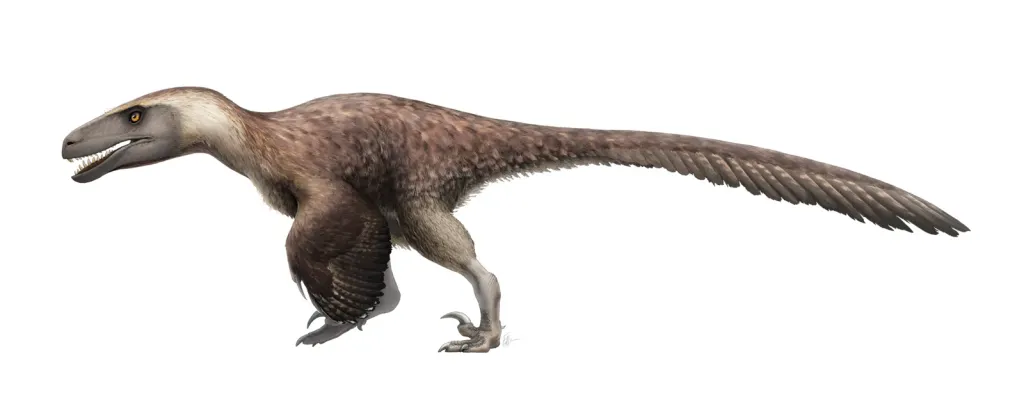
Utahraptor ostrommaysi
Pronunciación: YOO-tah-RAP-tor os-trom-MAY-zeye
Eudromaeosauria · Dromaeosauridae
The largest known dromaeosaurid, a heavily built "raptor" several metres long from the Early Cretaceous Cedar Mountain Formation of Utah, with a sickle claw over 20 cm long.
- Feathered
- Bipedal
- Sickle claw
- Giant
- Possible pack behavior
- Período
- Cretácico· Barremiense
- Dieta
- Carnívoro
- Longitud
- 5,5–7 m
- Masa
- Desconocido
- Ubicación
- Utah
Respuestas rápidas
- ¿Qué tamaño tenía Utahraptor ostrommaysi?
- Utahraptor ostrommaysi medía unos 5,5–7 m de largo. Alcanzaba unos 1,3–1,6 m de altura a la cadera. (Kirkland et al. 1993; Paul 2010)
- ¿Cuándo vivió Utahraptor ostrommaysi?
- Utahraptor ostrommaysi vivió durante el Cretácico Inferior, hace unos 125,8–121,4 millones de años. (Cohen et al. 2023; Kirkland et al. 1993)
- ¿Dónde se han encontrado fósiles de Utahraptor ostrommaysi?
- Se han encontrado fósiles de Utahraptor ostrommaysi en Cedar Mountain Formation (Utah). (Kirkland et al. 1993; Paul 2010)
- ¿Qué comía Utahraptor ostrommaysi?
- Utahraptor ostrommaysi era carnívoro. (Kirkland et al. 1993; Paul 2010)
- ¿Quién nombró a Utahraptor ostrommaysi y cuándo?
- Utahraptor ostrommaysi fue descrito por James I. Kirkland, Robert Gaston & Donald Burge en 1993. (Kirkland et al. 1993)
En esta página

YOO-tah-RAP-tor os-trom-MAY-zeye
- Período
- Cretácico125,8–121,4 Ma
- Dieta
- Carnívoro
- Longitud
- 5,5–7 m
- Masa
- Desconocido
- Clasificación
- Eudromaeosauria · Dromaeosauridae
- Descrito
- 1993, James I. Kirkland, Robert Gaston & Donald Burge
Resumen
Este contenido está disponible en inglés.
Utahraptor ostrommaysi lived in what is now eastern Utah in the Early Cretaceous. Its remains come from the Yellow Cat Member of the Cedar Mountain Formation. James Kirkland, Robert Gaston and Donald Burge named it in 1993, honouring John Ostrom, who first described Deinonychus, and Chris Mays of Dinamation.
It was the giant of the dromaeosaurids: much heavier and longer than Deinonychus, with a huge sickle claw on each foot. Unlike its lighter relatives it had relatively short, strong legs, suggesting it overpowered prey rather than chasing it over long distances.
In 2001 a sandstone block was found near Moab with the bones of several Utahraptor individuals, from adults to juveniles, mixed with an iguanodont. It may be a quicksand trap that caught a group, but the block is still being prepared and the interpretation is open. The age of the Yellow Cat Member is also debated.
Significado del nombre
"Utah's plunderer", from Utah and Latin raptor; ostrommaysi honours John Ostrom and Chris Mays (Kirkland, Gaston & Burge 1993).
Biología y evidencia
Lo que piensan los científicos sobre cómo vivía este animal y qué tan sólida es la evidencia de cada idea.
Locomoción
Utahraptor was built for power rather than speed.
Nivel de evidencia: Evidencia moderadaIts lower legs are short and stout compared with lighter relatives, which points to strength over endurance running.
Evidencia a favor / en contra · 1
Evidencia a favor
Anatomía comparada · Utahraptor robust hind limbs
Shorter, sturdier lower legs and a larger sickle claw than in Deinonychus, suggesting power rather than speed.
Espécimen: CEU 184v.86
Plumas
Utahraptor had feathers.
Nivel de evidencia: Evidencia sólidaFeathers are not preserved with it, but they are known in its close relatives on both sides of the family tree.
Evidencia a favor / en contra · 1
Evidencia a favor
Inferencia filogenética · Dromaeosaur quill knobs and feathered relatives
Close relatives are preserved with feathers, and Velociraptor shows quill knobs; Deinonychus sits inside this feathered group.
Vida social
Utahraptor lived in family groups.
Nivel de evidencia: HipótesisA block with adults and young together suggests they were together when they died, but the site is still being prepared and a trap could gather unrelated animals.
Evidencia a favor / en contra · 1
Evidencia a favor
Espécimen · Utahraptor multi-individual block
Several Utahraptor of different ages buried together with a possible prey animal, perhaps trapped in quicksand.
Tamaño
- Longitud
- 5,5–7 m
- Altura
- 1,5 mrango publicado 1,3–1,6 m
- Masa
- Desconocido
(23 pies)
(4,9 pies)
Basado en BYU material and Stikes Quarry specimens
Línea de tiempo
Períodos: Barremiense (125,8–121,4 Ma), Cretácico Inferior (145–100,5 Ma)
Ages are the ICS 2023/09 bounds of the Barremian, the stage(s) the fossils are assigned to; they bracket the record and are not dated first/last appearances. The Yellow Cat Member is usually cited as Barremian, but some dating work suggests it is older (Valanginian-Hauterivian); the range is uncertain.
Ubicación
Formaciones
- Cedar Mountain Formation · Utah
Lugares
- Gaston Quarry, Grand County, Utah · Cedar Mountain Formation · Utah · posición aproximada
Estos son los lugares donde se han encontrado fósiles, no toda el área donde vivía el animal.
Ecosistema
Vivió en: Yellow Cat
llanura aluvial, sistema fluvial, otro
Early Cretaceous semi-arid floodplains with seasonal rivers and springs in what is now eastern Utah. Its age is debated.
Clasificación
- cladoDinosauria
- cladoSaurischia
- cladoTheropoda
- cladoCoelurosauria
- cladoManiraptora
- familiaDromaeosauridae
- cladoEudromaeosauria
- géneroUtahraptor
- especieUtahraptor ostrommaysi
Estado taxonómico: Válido
Registro fósil

| Número de catálogo | Estado | Institución | Hallado |
|---|---|---|---|
| CEU 184v.86 | Holotipo | Prehistoric Museum, Utah State University Eastern (CEU) | 1991 |
| UGS Utahraptor megablock “Utahraptor megablock” | Espécimen referido | Utah Geological Survey (UGS) | 2001 |
Lo que se ha encontrado
Holotipo: CEU 184v.86
- Conservado
- Parcial
- Reconstruido
- Desconocido / no registrado
Holotipo: CEU 184v.86
Región por región (tabla)
| Región | Estado |
|---|---|
| Skull | Desconocido / no registrado |
| Mandible | Desconocido / no registrado |
| Teeth | Desconocido / no registrado |
| Cervical vertebrae | Desconocido / no registrado |
| Dorsal vertebrae | Desconocido / no registrado |
| Sacrum | Desconocido / no registrado |
| Caudal vertebrae | Desconocido / no registrado |
| Ribs | Desconocido / no registrado |
| Gastralia | Desconocido / no registrado |
| Scapula / shoulder girdle | Desconocido / no registrado |
| Humerus | Desconocido / no registrado |
| Forearm (radius / ulna) | Desconocido / no registrado |
| Hand (manus) | Desconocido / no registrado |
| Pelvis | Desconocido / no registrado |
| Femur | Desconocido / no registrado |
| Tibia / fibula | Desconocido / no registrado |
| Foot (pes) | Parcial · Second-toe claw. |
Espécimen referido: UGS Utahraptor megablock “Utahraptor megablock”
Región por región (tabla)
| Región | Estado |
|---|---|
| Skull | Parcial |
| Mandible | Desconocido / no registrado |
| Teeth | Desconocido / no registrado |
| Cervical vertebrae | Parcial |
| Dorsal vertebrae | Desconocido / no registrado |
| Sacrum | Desconocido / no registrado |
| Caudal vertebrae | Desconocido / no registrado |
| Ribs | Desconocido / no registrado |
| Gastralia | Desconocido / no registrado |
| Scapula / shoulder girdle | Desconocido / no registrado |
| Humerus | Desconocido / no registrado |
| Forearm (radius / ulna) | Desconocido / no registrado |
| Hand (manus) | Desconocido / no registrado |
| Pelvis | Desconocido / no registrado |
| Femur | Parcial |
| Tibia / fibula | Desconocido / no registrado |
| Foot (pes) | Desconocido / no registrado |

Descubrimiento
- Año de descripción
- 1993
- Descrito por
- James I. Kirkland, Robert Gaston & Donald Burge
- Espécimen tipo
- CEU 184v.86
Cronología del descubrimiento
1991 · Primer material hallado
Utahraptor claw found at Gaston Quarry
A giant foot claw is found in the Cedar Mountain Formation of Utah.
Personas: Carl Limoni, Robert Gaston
1993 · Descrito formalmente
Kirkland, Gaston and Burge name Utahraptor
The largest known dromaeosaurid is named, the same year Jurassic Park showed oversized raptors.
Personas: James I. Kirkland, Robert Gaston
2001 · Espécimen recuperado
Utahraptor megablock found
A block with several Utahraptor individuals is found near Moab.
Personas: Matt Stikes
Fuentes
- Cohen, K. M., Harper, D. A. T., Gibbard, P. L. & Car, N. (2023). International Chronostratigraphic Chart (v2023/09). International Commission on Stratigraphy. https://stratigraphy.org/ICSchart/ChronostratChart2023-09.pdf (se abre en una pestaña nueva)
- Kirkland, J. I., Gaston, R. & Burge, D. (1993). A large dromaeosaur (Theropoda) from the Lower Cretaceous of eastern Utah. Hunteria 2(10): 1-16.
- Paul, G. S. (2010). The Princeton Field Guide to Dinosaurs. Princeton University Press.
- Paul, G. S. (2016). The Princeton Field Guide to Dinosaurs (2nd edition). Princeton University Press.