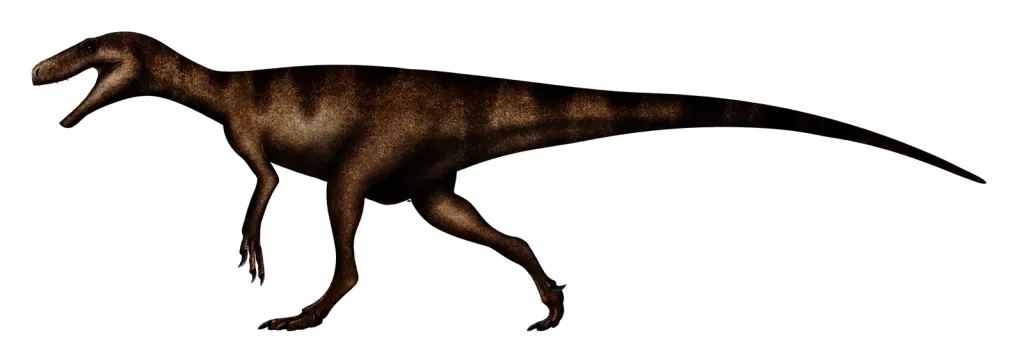
Herrerasaurus ischigualastensis
Pronunciación: heh-RARE-ah-SORE-us ish-ee-GWAH-las-TEN-sis
Saurischia · Herrerasauridae
One of the earliest known dinosaurs, a two-legged predator from the Late Triassic of north-west Argentina, about 230 million years old. A complete skull found in 1988 showed it was an agile hunter with grasping hands.
- Bipedal
- Apex predator
- Período
- Triásico· Triásico Superior
- Dieta
- Carnívoro
- Longitud
- 4,5–6 m
- Masa
- 200–350 kg
- Ubicación
- San Juan Province, Argentina
Respuestas rápidas
- ¿Qué tamaño tenía Herrerasaurus ischigualastensis?
- Herrerasaurus ischigualastensis medía unos 4,5–6 m de largo. Alcanzaba unos 1–1,3 m de altura a la cadera. Pesaba alrededor de 200–350 kg. (Wikipedia: Herrerasaurus 2026; Sereno & Novas 1992)
- ¿Cuándo vivió Herrerasaurus ischigualastensis?
- Herrerasaurus ischigualastensis vivió durante el Triásico Superior, hace unos 237–227,3 millones de años. (Paleobiology Database: Herrerasaurus occurrences 2026; Martinez et al. 2011)
- ¿Dónde se han encontrado fósiles de Herrerasaurus ischigualastensis?
- Se han encontrado fósiles de Herrerasaurus ischigualastensis en Ischigualasto Formation (San Juan Province) y Argentina. (Reig 1963; Sereno & Novas 1992)
- ¿Qué comía Herrerasaurus ischigualastensis?
- Herrerasaurus ischigualastensis era carnívoro. (Reig 1963; Sereno & Novas 1992)
- ¿Quién nombró a Herrerasaurus ischigualastensis y cuándo?
- Herrerasaurus ischigualastensis fue descrito por Osvaldo A. Reig en 1963. (Reig 1963; Paleobiology Database: Herrerasaurus occurrences 2026)
En esta página

- Período
- Triásico237–227,3 Ma
- Dieta
- Carnívoro
- Longitud
- 4,5–6 m
- Masa
- 0,2–0,4 t
- Ubicación
- Argentina
- Clasificación
- Saurischia · Herrerasauridae
- Descrito
- 1963, Osvaldo A. Reig
Resumen
Este contenido está disponible en inglés.
Herrerasaurus ischigualastensis lived about 230 million years ago in the Late Triassic, in the river valleys of what is now San Juan Province, Argentina. The goatherd Victorino Herrera noticed its bones in the Ischigualasto Valley in 1959, and Osvaldo Reig named it after him in 1963.
For decades it was known only from partial skeletons, and its place in the family tree was unclear. In 1988 a team led by Paul Sereno found a complete skull and skeleton; Sereno and Fernando Novas (1992) showed it was an agile, two-legged predator with short, grasping and raking forelimbs.
It lived at a time when dinosaurs were still rare. The Ischigualasto Formation records the first dinosaurs as dominant carnivores and small herbivores, alongside rhynchosaurs, cynodonts and large crocodile-line reptiles (Martinez et al. 2011).
Significado del nombre
"Herrera's lizard", after Victorino Herrera, who found the first remains; ischigualastensis for the Ischigualasto Valley (Reig 1963).
Biología y evidencia
Lo que piensan los científicos sobre cómo vivía este animal y qué tan sólida es la evidencia de cada idea.
Locomoción
Herrerasaurus was an agile two-legged predator with grasping hands.
Nivel de evidencia: Evidencia sólidaIts complete skeleton shows long hind limbs and short arms with claws for grasping and raking.
Evidencia a favor / en contra · 1
Evidencia a favor
Espécimen · Complete Herrerasaurus skull and skeleton
A complete skull and skeleton found in 1988, showing a bipedal predator with short forelimbs specialised for grasping and raking.
Otros
Herrerasaurus was an early theropod.
Nivel de evidencia: En disputaSereno and Novas called it a primitive theropod; other analyses place herrerasaurids just outside the theropods or outside the saurischian split.
Evidencia a favor / en contra · 1
Evidencia a favor
Espécimen · Complete Herrerasaurus skull and skeleton
A complete skull and skeleton found in 1988, showing a bipedal predator with short forelimbs specialised for grasping and raking.
Herrerasaurus is one of the oldest known dinosaurs, about 230 million years old.
Nivel de evidencia: Evidencia sólidaIts rocks are dated by radiometric methods to the mid Carnian of the Late Triassic, among the earliest records of dinosaurs anywhere.
Evidencia a favor / en contra · 1
Evidencia a favor
Otro · Ischigualasto faunal record and radiometric ages
Biozones and 40Ar/39Ar ages bracketing the Ischigualasto Formation, showing early dinosaurs as dominant carnivores about 230 million years ago.
Tamaño
- Longitud
- 4,5–6 m
- Altura
- 1,1 mrango publicado 1–1,3 m
- Masa
- 200–350 kg
(19,7 pies)
(3,6 pies)
Basado en largest individuals (femora c. 0.47 m)
Línea de tiempo
Períodos: Triásico Superior (237–201,4 Ma), Triásico (251,9–201,4 Ma)
Carnian bounds of the type collection in PBDB (PBDB time scale). Martinez et al. (2011) bracket the formation with 40Ar/39Ar ages and place its early dinosaurs about 230 million years ago (mid Carnian).
Ubicación
Formaciones
- Ischigualasto Formation · San Juan Province
Lugares
- Valle Pintado, Ischigualasto Valley, San Juan · Ischigualasto Formation · San Juan Province · posición aproximada
Estos son los lugares donde se han encontrado fósiles, no toda el área donde vivía el animal.
Ecosistema
Vivió en: Ischigualasto
hace 231,7–225 millones de años · llanura aluvial, sistema fluvial
Late Triassic river floodplains of north-west Argentina with cool temperatures and strongly seasonal rainfall; the earliest dinosaurs lived among rhynchosaurs, cynodonts and crocodile-line reptiles.
Clasificación
- cladoDinosauria
- cladoSaurischia
- familiaHerrerasauridae
- géneroHerrerasaurus
- especieHerrerasaurus ischigualastensis
Estado taxonómico: Válido
Registro fósil

| Número de catálogo | Estado | Institución | Hallado |
|---|---|---|---|
| PVL 2566 | Holotipo | Instituto Miguel Lillo (PVL) | 1959 |
Aún no se ha registrado qué huesos conserva cada espécimen.

Descubrimiento
- Año de descripción
- 1963
- Descrito por
- Osvaldo A. Reig
- Espécimen tipo
- PVL 2566
Cronología del descubrimiento
1959 · Primer material hallado
Victorino Herrera finds bones in the Ischigualasto Valley
A goatherd notices dinosaur bones near San Juan.
Personas: Victorino Herrera
1963 · Descrito formalmente
Reig names Herrerasaurus
Osvaldo Reig names the dinosaur after its finder.
Personas: Osvaldo A. Reig
1988 · Espécimen recuperado
Complete Herrerasaurus skull found
A team led by Paul Sereno finds a complete skull and skeleton, described in 1992.
Personas: Paul C. Sereno, Fernando E. Novas
Fuentes
- (2026). Paleobiology Database: Herrerasaurus occurrences. The Paleobiology Database (paleobiodb.org), data service 1.2, accessed 2026-09-23. https://paleobiodb.org/data1.2/occs/list.txt?base_name=Herrerasaurus&show=coords,paleoloc,strat,loc,ref&pgm=gplates (se abre en una pestaña nueva)
- (2026). Wikipedia: Herrerasaurus. Wikipedia (English), accessed 2026-09-23. https://en.wikipedia.org/wiki/Herrerasaurus (se abre en una pestaña nueva)
- Martinez, R. N., Sereno, P. C., Alcober, O. A., Colombi, C. E., Renne, P. R., Montañez, I. P. & Currie, B. S. (2011). A basal dinosaur from the dawn of the dinosaur era in southwestern Pangaea. Science 331: 206-210. doi:10.1126/science.1198467 (se abre en una pestaña nueva)
- Paul, G. S. (2016). The Princeton Field Guide to Dinosaurs (2nd edition). Princeton University Press.
- Reig, O. A. (1963). La presencia de dinosaurios saurisquios en los "Estratos de Ischigualasto" (Mesotriásico Superior) de las provincias de San Juan y La Rioja (República Argentina). Ameghiniana.
- Sereno, P. C. & Novas, F. E. (1992). The complete skull and skeleton of an early dinosaur. Science 258: 1137-1140. doi:10.1126/science.258.5085.1137 (se abre en una pestaña nueva)