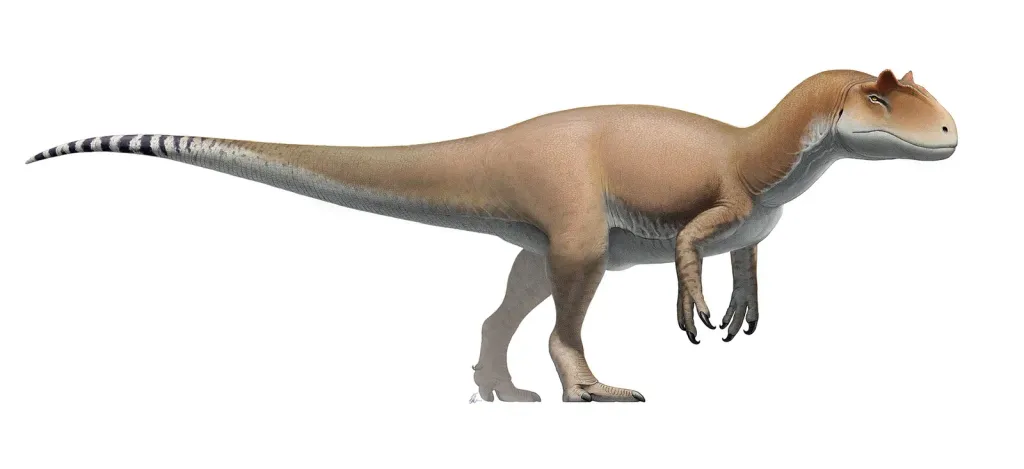
Allosaurus fragilis
Pronunciación: AL-oh-SORE-us FRAJ-ih-lis
Tetanurae · Allosauridae
The commonest large predator of the Late Jurassic Morrison Formation of the western United States, an allosauroid theropod known from hundreds of individuals, many from the Cleveland-Lloyd Quarry in Utah.
- Bipedal
- Apex predator
- Movie icon
- Possible pack behavior
- Período
- Jurásico· Kimmeridgiense
- Dieta
- Carnívoro
- Longitud
- 8,5 m
- Masa
- 1500–1700 kg
- Ubicación
- Colorado, Utah, United States
Respuestas rápidas
- ¿Qué tamaño tenía Allosaurus fragilis?
- Allosaurus fragilis medía unos 8,5 m de largo. Alcanzaba unos 1,9–2,4 m de altura a la cadera. Pesaba alrededor de 1,5–1,7 t. (Paul 2010; Paul 2016)
- ¿Cuándo vivió Allosaurus fragilis?
- Allosaurus fragilis vivió durante el Jurásico Superior, hace unos 154,8–145 millones de años. (Cohen et al. 2023; Chure & Loewen 2020)
- ¿Dónde se han encontrado fósiles de Allosaurus fragilis?
- Se han encontrado fósiles de Allosaurus fragilis en Morrison Formation (Colorado) y United States. (Marsh 1877; Madsen 1976)
- ¿Qué comía Allosaurus fragilis?
- Allosaurus fragilis era carnívoro. (Marsh 1877; Madsen 1976)
- ¿Quién nombró a Allosaurus fragilis y cuándo?
- Allosaurus fragilis fue descrito por Othniel Charles Marsh en 1877. (Marsh 1877)
- ¿Aparece Allosaurus fragilis en Jurassic Park?
- Sí. Allosaurus fragilis aparece en Jurassic World: El reino caído (2018) y Jurassic World: Dominio (2022). Las películas se toman libertades; esta página las compara con la evidencia fósil. (Wikipedia: Dinosaurs in Jurassic Park 2026; Madsen 1976)
En esta página

AL-oh-SORE-us FRAJ-ih-lis
- Período
- Jurásico154,8–145 Ma
- Dieta
- Carnívoro
- Longitud
- 8,5 m
- Masa
- 1,5–1,7 t
- Ubicación
- United States
- Clasificación
- Tetanurae · Allosauridae
- Descrito
- 1877, Othniel Charles Marsh
Resumen
Este contenido está disponible en inglés.
Allosaurus fragilis lived in western North America in the Late Jurassic, alongside Stegosaurus and giant sauropods such as Brachiosaurus. O. C. Marsh named it in 1877 from partial remains (YPM 1930) from Garden Park, Colorado, during the "Bone Wars".
It was a large, bipedal predator with a long, narrow skull, a pair of small horns in front of the eyes, three-fingered arms with large claws and serrated, blade-like teeth. The Cleveland-Lloyd Quarry in Utah has yielded bones of dozens of individuals, which James Madsen used for his 1976 monograph, still the standard description of the species.
Not every Morrison Allosaurus belongs to A. fragilis. Chure and Loewen (2020) named A. jimmadseni from the lower part of the formation, including the well-known specimen "Big Al" (MOR 693), which older size estimates used as a stand-in for A. fragilis.
Significado del nombre
From Greek allos ("different, other") and sauros ("lizard"), for its unusual vertebrae; Latin fragilis ("fragile") refers to the lightly built vertebrae (Marsh 1877).
Biología y evidencia
Lo que piensan los científicos sobre cómo vivía este animal y qué tan sólida es la evidencia de cada idea.
Alimentación
Allosaurus attacked with an open-mouthed strike, using its upper teeth like a hatchet.
Nivel de evidencia: HipótesisIts skull could withstand strong impacts though its bite was relatively weak, which led to the idea that it slammed its upper jaw into prey. This is an interpretation of a model, not an observed behaviour.
Evidencia a favor / en contra · 1
Evidencia a favor
Modelo biomecánico · Allosaurus skull finite-element model
A finite-element model of the Allosaurus skull finds it strong under impact but with a modest bite muscle force.
Lesiones y enfermedades
Allosaurus often survived serious injuries and infections.
Nivel de evidencia: Evidencia sólidaHealed fractures and infected bones are common in Allosaurus skeletons, including a young animal with injuries to many bones.
Evidencia a favor / en contra · 1
Evidencia a favor
Espécimen · Injuries and infections in Allosaurus skeletons
Many Allosaurus bones, including a sub-adult with 19 injured or infected bones, show a hard, injury-prone life.
Comportamiento
Allosaurus preyed on or fought Stegosaurus.
Nivel de evidencia: Evidencia sólidaAn Allosaurus bone was wounded by a Stegosaurus spike and healed, direct proof of a violent encounter between the two.
Evidencia a favor / en contra · 1
Evidencia a favor
Espécimen · Allosaurus vertebra pierced by a Stegosaurus spike
An Allosaurus tail vertebra with a healed puncture matching the size and shape of a Stegosaurus tail spike.
Vida social
Allosaurus lived and hunted in groups.
Nivel de evidencia: En disputaMany Allosaurus were found together at Cleveland-Lloyd, but the site is read as a trap or a drought gathering. Mass death does not show group living.
Evidencia a favor / en contra · 1
Evidencia en contra
Otro · Cleveland-Lloyd Quarry taphonomy
Tens of Allosaurus individuals mixed in one quarry, interpreted variously as a predator trap, a drought assemblage or a slow build-up.

Tamaño
- Longitud
- 8,5 m
- Altura
- 2,1 mrango publicado 1,9–2,4 m
- Masa
- 1500–1700 kg
(27,9 pies)
(6,9 pies)
Basado en AMNH 5753 / USNM 4734 (femur c. 0.85 m)
Basado en MOR 693 "Big Al" (volumetric model); general adult (Paul 2010)
Línea de tiempo
Períodos: Kimmeridgiense (154,8–149,2 Ma), Tithoniense (149,2–145 Ma), Jurásico Superior (161,5–145 Ma)
Ages are the ICS 2023/09 bounds of the Kimmeridgian and Tithonian, the stage(s) the fossils are assigned to; they bracket the record and are not dated first/last appearances. Chure & Loewen (2020) restrict A. fragilis to the upper part of the Morrison Formation, so the real range is narrower.
Ubicación
Formaciones
- Morrison Formation · Colorado
Lugares
- Garden Park, near Cañon City, Colorado · Morrison Formation · Colorado · posición aproximada
Estos son los lugares donde se han encontrado fósiles, no toda el área donde vivía el animal.
Ecosistema
Vivió en: Morrison
hace 156–147 millones de años · llanura aluvial, sistema fluvial, bosque abierto, lago
A vast, seasonally dry floodplain crossed by rivers in the western interior of North America in the Late Jurassic, with a wet and a dry season, conifer and fern vegetation along the water and giant sauropods in abundance.
Mismo ecosistema

Mismo ecosistema

Mismo ecosistema

Mismo ecosistema

Mismo ecosistema

Mismo ecosistema

Clasificación
- cladoDinosauria
- cladoSaurischia
- cladoTheropoda
- cladoTetanurae
- superfamiliaAllosauroidea
- familiaAllosauridae
- géneroAllosaurus
- especieAllosaurus fragilis
Estado taxonómico: Válido
Registro fósil

| Número de catálogo | Estado | Institución | Hallado |
|---|---|---|---|
| YPM 1930 | Holotipo | Yale Peabody Museum (YPM) | 1877 |
| USNM 4734 | Espécimen referido | National Museum of Natural History, Smithsonian Institution (USNM) | 1883 |
Lo que se ha encontrado
Holotipo: YPM 1930
- Conservado
- Parcial
- Reconstruido
- Desconocido / no registrado
Holotipo: YPM 1930
Región por región (tabla)
| Región | Estado |
|---|---|
| Skull | Desconocido / no registrado |
| Mandible | Desconocido / no registrado |
| Teeth | Parcial |
| Cervical vertebrae | Desconocido / no registrado |
| Dorsal vertebrae | Parcial |
| Sacrum | Desconocido / no registrado |
| Caudal vertebrae | Desconocido / no registrado |
| Ribs | Desconocido / no registrado |
| Gastralia | Desconocido / no registrado |
| Scapula / shoulder girdle | Desconocido / no registrado |
| Humerus | Parcial |
| Forearm (radius / ulna) | Desconocido / no registrado |
| Hand (manus) | Desconocido / no registrado |
| Pelvis | Desconocido / no registrado |
| Femur | Desconocido / no registrado |
| Tibia / fibula | Desconocido / no registrado |
| Foot (pes) | Desconocido / no registrado |
Espécimen referido: USNM 4734
Región por región (tabla)
| Región | Estado |
|---|---|
| Skull | Conservado |
| Mandible | Conservado |
| Teeth | Desconocido / no registrado |
| Cervical vertebrae | Conservado |
| Dorsal vertebrae | Conservado |
| Sacrum | Desconocido / no registrado |
| Caudal vertebrae | Parcial |
| Ribs | Desconocido / no registrado |
| Gastralia | Desconocido / no registrado |
| Scapula / shoulder girdle | Desconocido / no registrado |
| Humerus | Conservado |
| Forearm (radius / ulna) | Desconocido / no registrado |
| Hand (manus) | Conservado |
| Pelvis | Conservado |
| Femur | Conservado |
| Tibia / fibula | Desconocido / no registrado |
| Foot (pes) | Conservado |

Galería

Descubrimiento
- Año de descripción
- 1877
- Descrito por
- Othniel Charles Marsh
- Espécimen tipo
- YPM 1930
Cronología del descubrimiento
1877 · Descrito formalmente
Marsh names Allosaurus fragilis
O. C. Marsh names the genus from partial remains from Garden Park, Colorado.
Personas: Othniel Charles Marsh
1883 · Espécimen recuperado
Felch collects a complete Allosaurus at Garden Park
Marshall Felch collects the skeleton later described by Gilmore (1920).
Personas: Marshall P. Felch
1976 · Estudio importante
Madsen publishes the Allosaurus osteology
James Madsen describes Allosaurus from the thousands of bones of the Cleveland-Lloyd Quarry.
Personas: James H. Madsen Jr.
2020 · Revisión
Allosaurus jimmadseni split from A. fragilis
Chure and Loewen name a second species from the lower Morrison Formation.
Personas: Daniel J. Chure
En Jurassic Park y Jurassic World
Películas
- Jurassic World: El reino caído (2018)
- Jurassic World: Dominio (2022)
Este contenido está disponible en inglés.
En pantalla
A large predator sharing the screen with Cretaceous animals in Fallen Kingdom and Dominion.
Película frente a fósiles
- Allosaurus lived in the Late Jurassic, tens of millions of years before T. rex; the films mix animals from different eras.
- It really did clash with Stegosaurus: a spike wound in an Allosaurus tail bone shows it.
Los títulos de las películas se citan solo para identificarlas. DinoDex no está afiliado a la franquicia Jurassic Park / Jurassic World ni cuenta con su respaldo. Todos los dinosaurios que aparecen en las películas
Fuentes
- (2026). Wikipedia: Dinosaurs in Jurassic Park. Wikipedia. https://en.wikipedia.org/wiki/Dinosaurs_in_Jurassic_Park (se abre en una pestaña nueva)
- Bates, K. T., Manning, P. L., Hodgetts, D. & Sellers, W. I. (2009). Estimating mass properties of dinosaurs using laser imaging and 3D computer modelling. PLoS ONE 4(2): e4532. doi:10.1371/journal.pone.0004532 (se abre en una pestaña nueva)
- Carpenter, K., Sanders, F., McWhinney, L. A. & Wood, L. (2005). Evidence for predator-prey relationships: examples for Allosaurus and Stegosaurus. In Carpenter, K. (ed.), The Carnivorous Dinosaurs, Indiana University Press, pp. 325-350.
- Chure, D. J. & Loewen, M. A. (2020). Cranial anatomy of Allosaurus jimmadseni, a new species from the lower part of the Morrison Formation (Upper Jurassic) of Western North America. PeerJ 8: e7803. doi:10.7717/peerj.7803 (se abre en una pestaña nueva)
- Cohen, K. M., Harper, D. A. T., Gibbard, P. L. & Car, N. (2023). International Chronostratigraphic Chart (v2023/09). International Commission on Stratigraphy. https://stratigraphy.org/ICSchart/ChronostratChart2023-09.pdf (se abre en una pestaña nueva)
- Madsen, J. H., Jr. (1976). Allosaurus fragilis: a revised osteology. Utah Geological and Mineral Survey Bulletin 109: 1-163.
- Marsh, O. C. (1877). Notice of new dinosaurian reptiles from the Jurassic formation. American Journal of Science (series 3) 14: 514-516.
- Paul, G. S. (2010). The Princeton Field Guide to Dinosaurs. Princeton University Press.
- Paul, G. S. (2016). The Princeton Field Guide to Dinosaurs (2nd edition). Princeton University Press.