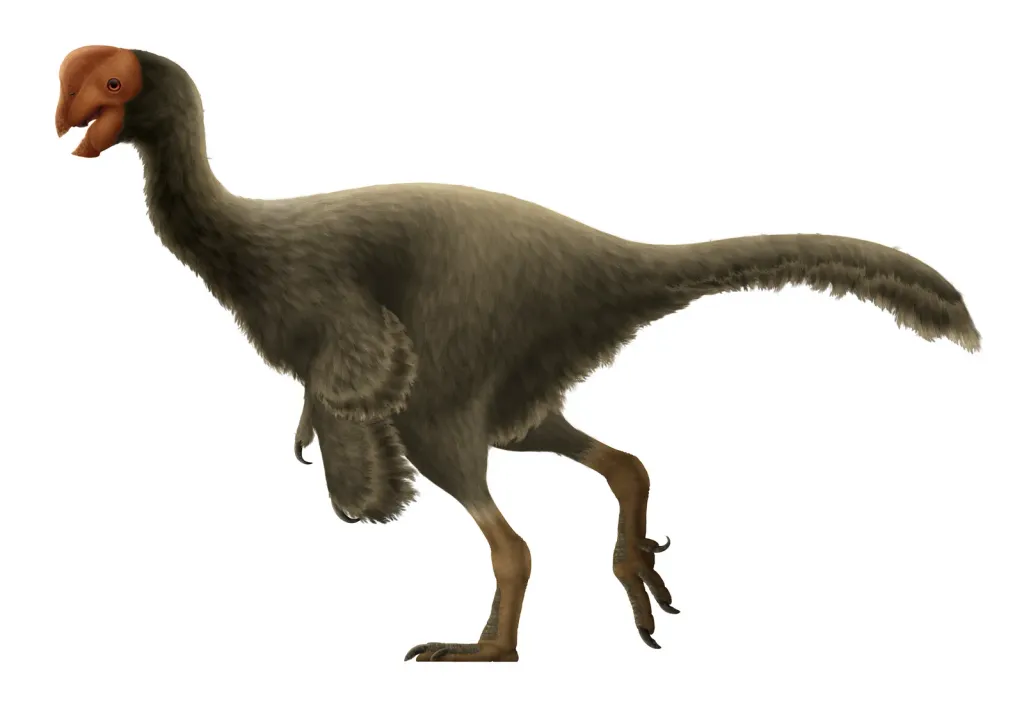
Oviraptor philoceratops
Pronunciación: OH-vih-RAP-tor fil-oh-SERR-ah-tops
Maniraptora · Oviraptoridae
The "egg thief", a beaked, feathered theropod from the Late Cretaceous of Mongolia, found in 1923 lying on a nest of eggs. Later finds showed the nest was its own: it was brooding, not stealing.
- Bipedal
- Feathered
- Eggs known
- Famous specimen
- Período
- Cretácico· Campaniense
- Dieta
- Omnívoro
- Longitud
- 1,6–2 m
- Masa
- 33–40 kg
- Ubicación
- Ömnögovi Province, Mongolia, Asia
Respuestas rápidas
- ¿Qué tamaño tenía Oviraptor philoceratops?
- Oviraptor philoceratops medía unos 1,6–2 m de largo. Alcanzaba unos 0,7–0,9 m de altura a la cadera. Pesaba alrededor de 33–40 kg. (Wikipedia: Oviraptor 2026; Paul 2016)
- ¿Cuándo vivió Oviraptor philoceratops?
- Oviraptor philoceratops vivió durante el Cretácico Superior, hace unos 75–71 millones de años. (Paleobiology Database: Oviraptor philoceratop… 2026; Dashzeveg et al. 2005)
- ¿Dónde se han encontrado fósiles de Oviraptor philoceratops?
- Se han encontrado fósiles de Oviraptor philoceratops en Djadokhta Formation (Ömnögovi Province) y Mongolia. (Osborn 1924; Norell et al. 1994)
- ¿Qué comía Oviraptor philoceratops?
- Oviraptor philoceratops era omnívoro. (Osborn 1924; Norell et al. 1994)
- ¿Quién nombró a Oviraptor philoceratops y cuándo?
- Oviraptor philoceratops fue descrito por Henry Fairfield Osborn en 1924. (Osborn 1924; Paleobiology Database: Oviraptor philoceratop… 2026)
En esta página

- Período
- Cretácico75–71 Ma
- Dieta
- Omnívoro
- Longitud
- 1,6–2 m
- Masa
- 0–0 t
- Ubicación
- Mongolia, Asia
- Clasificación
- Maniraptora · Oviraptoridae
- Descrito
- 1924, Henry Fairfield Osborn
Resumen
Este contenido está disponible en inglés.
Oviraptor philoceratops lived among the dunes of the Djadokhta Formation of Mongolia in the Late Cretaceous. The American Museum's Central Asiatic Expedition found its only skeleton at the Flaming Cliffs in 1923, lying over a nest of about fifteen eggs, and Henry Fairfield Osborn named it in 1924.
Osborn thought the eggs belonged to Protoceratops and named it "egg thief, fond of ceratopsians", while warning that the name might be misleading. In 1994 an oviraptorid embryo was found inside the same type of egg, and in 1995 a related oviraptorid was found sitting on its nest like a brooding bird (Norell et al. 1994, 1995). The type Oviraptor was most likely a parent that died brooding its own eggs.
It was a small, toothless theropod, about 1.6 to 2 m long, with a deep beak, long arms with three clawed fingers and, like its relatives, feathers. The holotype skull is badly crushed, but related oviraptorids suggest a crest.
Significado del nombre
"Egg seizer" or "egg thief", from Latin ovum and raptor; philoceratops, "fond of ceratopsians", for the eggs once thought to be Protoceratops's (Osborn 1924).
Biología y evidencia
Lo que piensan los científicos sobre cómo vivía este animal y qué tan sólida es la evidencia de cada idea.
Anidación
The Oviraptor holotype died brooding its own nest.
Nivel de evidencia: Evidencia sólidaAn oviraptorid embryo in the same type of egg and relatives found sitting on nests show the eggs were its own.
Evidencia a favor / en contra · 2
Evidencia a favor
Espécimen · Oviraptorid embryo in a Flaming Cliffs-type egg
An oviraptorid embryo inside an egg of the type found under the Oviraptor holotype in 1923.
Espécimen · Oviraptorid preserved brooding its nest
An oviraptorid skeleton sitting on its nest in a bird-like brooding posture.

Tamaño
- Longitud
- 1,6–2 m
- Altura
- 0,8 mrango publicado 0,7–0,9 m
- Masa
- 33–40 kg
(6,6 pies)
Basado en AMNH 6517
(2,6 pies)
Basado en AMNH 6517
Línea de tiempo
Períodos: Campaniense (83,6–72,1 Ma), Cretácico Superior (100,5–66 Ma)
Djadokhta Formation, about 75-71 Ma: magnetostratigraphy suggests, without clearly establishing, deposition during the late Campanian polarity changes (Dashzeveg et al. 2005). PBDB bins the type collection in the late Campanian (83.6-72.2 Ma).
Ubicación
Formaciones
- Djadokhta Formation · Ömnögovi Province
- Shabarakh Usu (Flaming Cliffs, Bayn Dzak), AMNH loc. 12049 · Djadokhta Formation · Ömnögovi Province · posición aproximada
Estos son los lugares donde se han encontrado fósiles, no toda el área donde vivía el animal.
Ecosistema
Vivió en: Djadokhta
hace 75–71 millones de años · desierto / dunas, otro
An arid landscape of sand dunes and interdune areas in the Late Cretaceous Gobi, with occasional water. Sandslides and dune collapses buried animals alive, preserving articulated skeletons and nests.
Mismo ecosistema

Mismo ecosistema

Clasificación
- cladoDinosauria
- cladoSaurischia
- cladoTheropoda
- cladoCoelurosauria
- cladoManiraptora
- infraordenOviraptorosauria
- familiaOviraptoridae
- géneroOviraptor
- especieOviraptor philoceratops
Estado taxonómico: Válido
Registro fósil

| Número de catálogo | Estado | Institución | Hallado |
|---|---|---|---|
| AMNH 6517 | Holotipo | American Museum of Natural History (AMNH) | 1923 |
Lo que se ha encontrado
Holotipo: AMNH 6517
- Conservado
- Parcial
- Reconstruido
- Desconocido / no registrado
Región por región (tabla)
| Región | Estado |
|---|---|
| Skull | Parcial · Badly crushed. |
| Mandible | Desconocido / no registrado |
| Teeth | Desconocido / no registrado |
| Cervical vertebrae | Parcial |
| Dorsal vertebrae | Parcial |
| Sacrum | Desconocido / no registrado |
| Caudal vertebrae | Desconocido / no registrado |
| Ribs | Parcial |
| Gastralia | Desconocido / no registrado |
| Scapula / shoulder girdle | Conservado · With the furcula. |
| Humerus | Desconocido / no registrado |
| Forearm (radius / ulna) | Conservado |
| Hand (manus) | Parcial |
| Pelvis | Parcial · Left ilium. |
| Femur | Desconocido / no registrado |
| Tibia / fibula | Desconocido / no registrado |
| Foot (pes) | Desconocido / no registrado |

Descubrimiento
- Año de descripción
- 1924
- Descrito por
- Henry Fairfield Osborn
- Espécimen tipo
- AMNH 6517

Cronología del descubrimiento
1923 · Primer material hallado
Oviraptor found on a nest at the Flaming Cliffs
The Central Asiatic Expedition finds a skeleton lying over a nest of eggs.
Personas: Roy Chapman Andrews
1924 · Descrito formalmente
Osborn names Oviraptor philoceratops
Named with Velociraptor and Saurornithoides; the "egg thief".
Personas: Henry Fairfield Osborn
1994 · Revisión
Oviraptorid embryo identifies the Flaming Cliffs eggs
Norell and colleagues show the eggs are oviraptorid, not Protoceratops.
Personas: Mark A. Norell, James M. Clark
Fuentes
- (2026). Paleobiology Database: Oviraptor philoceratops occurrence 1244254 (collection 46152). The Paleobiology Database (paleobiodb.org), data service 1.2, accessed 2026-09-23. https://paleobiodb.org/data1.2/colls/list.json?coll_id=46152&show=paleoloc,strat,loc,ref,geo&pgm=gplates&vocab=pbdb (se abre en una pestaña nueva)
- (2026). Wikipedia: Oviraptor. Wikipedia (English), accessed 2026-09-24. https://en.wikipedia.org/wiki/Oviraptor (se abre en una pestaña nueva)
- Dashzeveg, D., Dingus, L., Loope, D. B., Swisher, C. C., III, Dulam, T. & Sweeney, M. R. (2005). New stratigraphic subdivision, depositional environment, and age estimate for the Upper Cretaceous Djadokhta Formation, southern Ulan Nur Basin, Mongolia. American Museum Novitates 3498: 1-31. https://digitallibrary.amnh.org/server/api/core/bitstreams/0df4baac-12e4-44ae-8ef7-3328b22e8604/content (se abre en una pestaña nueva)
- Norell, M. A., Clark, J. M., Chiappe, L. M. & Dashzeveg, D. (1995). A nesting dinosaur. Nature 378: 774-776. doi:10.1038/378774a0 (se abre en una pestaña nueva)
- Norell, M. A., Clark, J. M., Dashzeveg, D., Barsbold, R., Chiappe, L. M., Davidson, A. R., McKenna, M. C., Perle, A. & Novacek, M. J. (1994). A theropod dinosaur embryo and the affinities of the Flaming Cliffs dinosaur eggs. Science 266: 779-782. doi:10.1126/science.266.5186.779 (se abre en una pestaña nueva)
- Osborn, H. F. (1924). Three new Theropoda, Protoceratops zone, central Mongolia. American Museum Novitates 144: 1-12.
- Paul, G. S. (2016). The Princeton Field Guide to Dinosaurs (2nd edition). Princeton University Press.