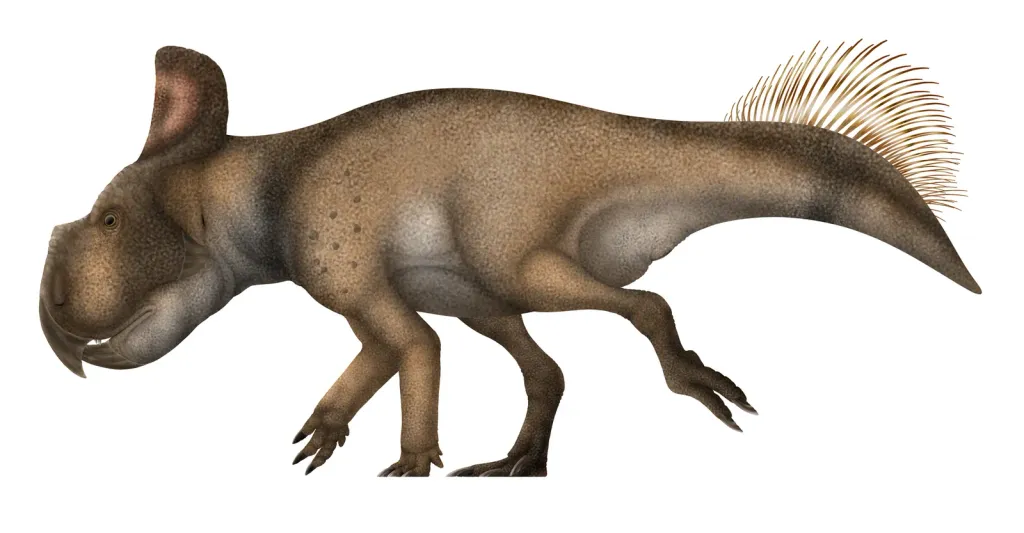
Protoceratops andrewsi
Pronunciación: PRO-toh-SERR-ah-tops AN-droo-zye
Ceratopsia · Protoceratopsidae
A sheep-sized horned dinosaur with a large frill and a parrot-like beak from the Late Cretaceous Gobi Desert of Mongolia. Hundreds of skeletons are known, including one locked in combat with a Velociraptor.
- Quadrupedal
- Eggs known
- Famous specimen
- Período
- Cretácico· Campaniense
- Dieta
- Herbívoro
- Longitud
- 2–2,5 m
- Masa
- 62–104 kg
- Ubicación
- Ömnögovi Province, Mongolia, Asia
Respuestas rápidas
- ¿Qué tamaño tenía Protoceratops andrewsi?
- Protoceratops andrewsi medía unos 2–2,5 m de largo. Alcanzaba unos 0,6–0,8 m de altura a la cadera. Pesaba alrededor de 62–104 kg. (Wikipedia: Protoceratops 2026; Paul 2016)
- ¿Cuándo vivió Protoceratops andrewsi?
- Protoceratops andrewsi vivió durante el Cretácico Superior, hace unos 75–71 millones de años. (Paleobiology Database: Protoceratops andrewsi… 2026; Dashzeveg et al. 2005)
- ¿Dónde se han encontrado fósiles de Protoceratops andrewsi?
- Se han encontrado fósiles de Protoceratops andrewsi en Djadokhta Formation (Ömnögovi Province) y Mongolia. (Granger & Gregory 1923; Hone et al. 2016)
- ¿Qué comía Protoceratops andrewsi?
- Protoceratops andrewsi era herbívoro. (Granger & Gregory 1923; Hone et al. 2016)
- ¿Quién nombró a Protoceratops andrewsi y cuándo?
- Protoceratops andrewsi fue descrito por Walter Granger & William K. Gregory en 1923. (Granger & Gregory 1923; Paleobiology Database: Protoceratops andrewsi… 2026)
En esta página

PRO-toh-SERR-ah-tops AN-droo-zye
- Período
- Cretácico75–71 Ma
- Dieta
- Herbívoro
- Longitud
- 2–2,5 m
- Masa
- 0,1–0,1 t
- Ubicación
- Mongolia, Asia
- Clasificación
- Ceratopsia · Protoceratopsidae
- Descrito
- 1923, Walter Granger & William K. Gregory
Resumen
Este contenido está disponible en inglés.
Protoceratops andrewsi lived among the sand dunes of the Djadokhta Formation in what is now the Gobi Desert of Mongolia, in the Late Cretaceous. The photographer James B. Shackelford of the American Museum's Central Asiatic Expedition found the first skull at the Flaming Cliffs (Shabarakh Usu) in 1922, and Walter Granger and William K. Gregory named it in 1923 after the expedition leader Roy Chapman Andrews.
It was an early relative of the large horned dinosaurs, about 2 m long, with a big head, a bony frill and a small bump in place of a nose horn. The frill and nasal bump grew faster than the rest of the body as the animal matured, which suggests they were used as social or sexual signals (Hone et al. 2016).
Protoceratops is one of the best known dinosaurs, with many skeletons from hatchlings to adults. Its eggs were originally soft-shelled (Norell et al. 2020), and the famous "Fighting Dinosaurs" specimen preserves one locked in combat with Velociraptor.
Significado del nombre
"First horned face", from Greek protos, keras and ops; andrewsi after Roy Chapman Andrews, leader of the Central Asiatic Expeditions (Granger & Gregory 1923).
Biología y evidencia
Lo que piensan los científicos sobre cómo vivía este animal y qué tan sólida es la evidencia de cada idea.
Huevos
Protoceratops laid soft-shelled eggs.
Nivel de evidencia: Evidencia sólidaThe eggshells were originally organic, not mineralised, and resemble the soft eggshells of some turtles.
Evidencia a favor / en contra · 1
Evidencia a favor
Espécimen · Protoceratops eggshell chemistry and histology
Raman spectra and histology of exceptionally preserved Protoceratops eggs cluster them with soft, non-mineralised eggshells.
Comportamiento
The frill of Protoceratops was a social or sexual signal.
Nivel de evidencia: HipótesisStructures that grow disproportionately as an animal matures are typical of signals; other uses, such as anchoring jaw muscles, are not ruled out.
Evidencia a favor / en contra · 1
Evidencia a favor
Anatomía comparada · Protoceratops frill and nasal allometry
Frill and nasal boss grow faster than the rest of the skull through growth (positive allometry).
Otros
Protoceratops was prey of Velociraptor.
Nivel de evidencia: Evidencia directaThe Fighting Dinosaurs show the two in combat, and Velociraptor tooth marks on Protoceratops bones show feeding.
Evidencia a favor / en contra · 1
Evidencia a favor
Espécimen · Fighting Dinosaurs specimen
A Velociraptor and a Protoceratops buried in the middle of a fight; the raptor's sickle claw is at the neck of its prey, whose jaws grip the raptor's arm.
Espécimen: MPC-D 100/25 “Fighting Dinosaurs”
Tamaño
- Longitud
- 2–2,5 m
- Altura
- 0,7 mrango publicado 0,6–0,8 m
- Masa
- 62–104 kg
(8,2 pies)
(2,3 pies)
Basado en adults
Línea de tiempo
Períodos: Campaniense (83,6–72,1 Ma), Cretácico Superior (100,5–66 Ma)
Djadokhta Formation, about 75-71 Ma: magnetostratigraphy suggests, without clearly establishing, deposition during the late Campanian polarity changes (Dashzeveg et al. 2005). PBDB bins the type collection in the whole late Campanian (83.6-72.2 Ma).
Ubicación
Formaciones
- Djadokhta Formation · Ömnögovi Province
- Shabarakh Usu (Flaming Cliffs, Bayn Dzak), AMNH loc. 12049 · Djadokhta Formation · Ömnögovi Province · posición aproximada
Estos son los lugares donde se han encontrado fósiles, no toda el área donde vivía el animal.
Ecosistema

Vivió en: Djadokhta
hace 75–71 millones de años · desierto / dunas, otro
An arid landscape of sand dunes and interdune areas in the Late Cretaceous Gobi, with occasional water. Sandslides and dune collapses buried animals alive, preserving articulated skeletons and nests.
Mismo ecosistema

Mismo ecosistema

Clasificación
- cladoDinosauria
- cladoOrnithischia
- cladoCeratopsia
- familiaProtoceratopsidae
- géneroProtoceratops
- especieProtoceratops andrewsi
Estado taxonómico: Válido
Registro fósil

| Número de catálogo | Estado | Institución | Hallado |
|---|---|---|---|
| AMNH 6251 | Holotipo | American Museum of Natural History (AMNH) | 1922 |
Lo que se ha encontrado
Holotipo: AMNH 6251
- Conservado
- Parcial
- Reconstruido
- Desconocido / no registrado
Región por región (tabla)
| Región | Estado |
|---|---|
| Skull | Parcial |
| Mandible | Desconocido / no registrado |
| Teeth | Desconocido / no registrado |
| Cervical vertebrae | Desconocido / no registrado |
| Dorsal vertebrae | Desconocido / no registrado |
| Sacrum | Desconocido / no registrado |
| Caudal vertebrae | Desconocido / no registrado |
| Ribs | Desconocido / no registrado |
| Gastralia | Desconocido / no registrado |
| Scapula / shoulder girdle | Desconocido / no registrado |
| Humerus | Desconocido / no registrado |
| Forearm (radius / ulna) | Desconocido / no registrado |
| Hand (manus) | Desconocido / no registrado |
| Pelvis | Desconocido / no registrado |
| Femur | Desconocido / no registrado |
| Tibia / fibula | Desconocido / no registrado |
| Foot (pes) | Desconocido / no registrado |
Descubrimiento
- Año de descripción
- 1923
- Descrito por
- Walter Granger & William K. Gregory
- Espécimen tipo
- AMNH 6251
Cronología del descubrimiento
1922 · Primer material hallado
Shackelford finds the first Protoceratops skull
The expedition photographer spots a small skull at the Flaming Cliffs.
Personas: James B. Shackelford, Roy Chapman Andrews
1923 · Descrito formalmente
Granger and Gregory name Protoceratops andrewsi
Named as a "pre-ceratopsian" in American Museum Novitates.
Personas: Walter Granger, William K. Gregory
2020 · Estudio importante
Protoceratops eggs shown to be soft-shelled
Norell and colleagues show the first dinosaur eggs were soft.
Personas: Mark A. Norell
Fuentes
- (2026). Paleobiology Database: Protoceratops andrewsi occurrences and type collection 46152. The Paleobiology Database (paleobiodb.org), data service 1.2, accessed 2026-09-23. https://paleobiodb.org/data1.2/occs/list.txt?taxon_name=Protoceratops%20andrewsi&show=coords,paleoloc,strat,loc,ref&pgm=gplates (se abre en una pestaña nueva)
- (2026). Wikipedia: Protoceratops. Wikipedia (English), accessed 2026-09-24. https://en.wikipedia.org/wiki/Protoceratops (se abre en una pestaña nueva)
- Dashzeveg, D., Dingus, L., Loope, D. B., Swisher, C. C., III, Dulam, T. & Sweeney, M. R. (2005). New stratigraphic subdivision, depositional environment, and age estimate for the Upper Cretaceous Djadokhta Formation, southern Ulan Nur Basin, Mongolia. American Museum Novitates 3498: 1-31. https://digitallibrary.amnh.org/server/api/core/bitstreams/0df4baac-12e4-44ae-8ef7-3328b22e8604/content (se abre en una pestaña nueva)
- Granger, W. & Gregory, W. K. (1923). Protoceratops andrewsi, a pre-ceratopsian dinosaur from Mongolia, with an appendix on the structural relationships of the Protoceratops beds. American Museum Novitates 72: 1-9.
- Hone, D. W. E., Wood, D. & Knell, R. J. (2016). Positive allometry for exaggerated structures in the ceratopsian dinosaur Protoceratops andrewsi supports socio-sexual signaling. Palaeontologia Electronica 19.1.5A. doi:10.26879/591 (se abre en una pestaña nueva)
- Norell, M. A., Wiemann, J., Fabbri, M., Yu, C., Marsicano, C. A., Moore-Nall, A., Varricchio, D. J., Pol, D. & Zelenitsky, D. K. (2020). The first dinosaur egg was soft. Nature 583: 406-410. doi:10.1038/s41586-020-2412-8 (se abre en una pestaña nueva)
- Paul, G. S. (2016). The Princeton Field Guide to Dinosaurs (2nd edition). Princeton University Press.