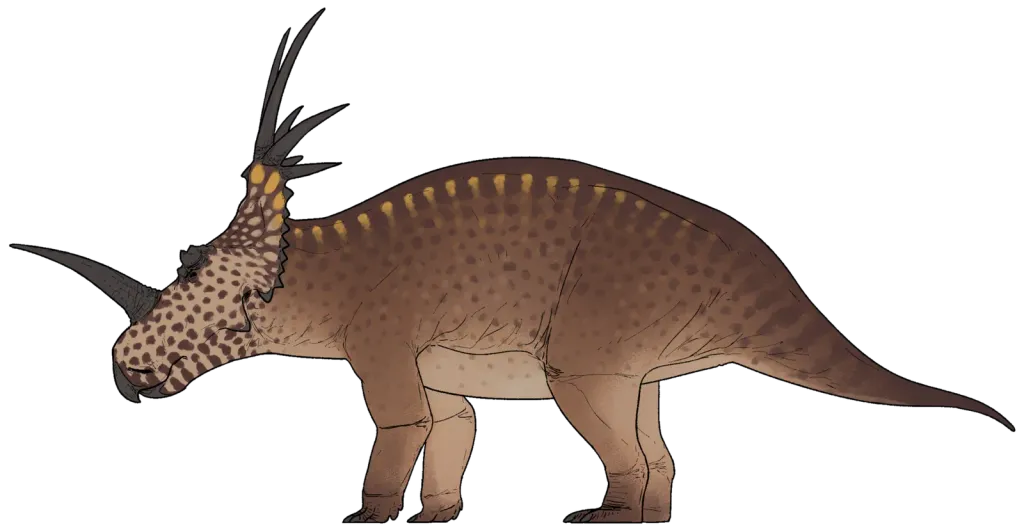
Styracosaurus albertensis
Pronunciación: sty-RAK-oh-SORE-us al-ber-TEN-sis
Ceratopsia · Ceratopsidae
A horned dinosaur from the Late Cretaceous of Alberta, Canada, with a long nose horn and a crown of long spikes on its neck frill. About 5 to 5.5 m long, it browsed low plants on the coastal plains of the Dinosaur Park Formation.
- Horned
- Quadrupedal
- Período
- Cretácico· Campaniense
- Dieta
- Herbívoro
- Longitud
- 5–5,5 m
- Masa
- 1800–2700 kg
- Ubicación
- Alberta, Canada
Respuestas rápidas
- ¿Qué tamaño tenía Styracosaurus albertensis?
- Styracosaurus albertensis medía unos 5–5,5 m de largo. Alcanzaba unos 1,8 m de altura a la cadera. Pesaba alrededor de 1,8–2,7 t. (Wikipedia: Styracosaurus 2026)
- ¿Cuándo vivió Styracosaurus albertensis?
- Styracosaurus albertensis vivió durante el Cretácico Superior, hace unos 75,8–75,1 millones de años. (Paleobiology Database: Styracosaurus alberten… 2026; Eberth et al. 2023)
- ¿Dónde se han encontrado fósiles de Styracosaurus albertensis?
- Se han encontrado fósiles de Styracosaurus albertensis en Dinosaur Park Formation (Alberta) y Canada. (Lambe 1913; Ryan et al. 2007)
- ¿Qué comía Styracosaurus albertensis?
- Styracosaurus albertensis era herbívoro. (Lambe 1913; Ryan et al. 2007)
- ¿Quién nombró a Styracosaurus albertensis y cuándo?
- Styracosaurus albertensis fue descrito por Lawrence M. Lambe en 1913. (Lambe 1913; Paleobiology Database: Styracosaurus alberten… 2026)
En esta página

- Período
- Cretácico75,8–75,1 Ma
- Dieta
- Herbívoro
- Longitud
- 5–5,5 m
- Masa
- 1,8–2,7 t
- Ubicación
- Canada
- Clasificación
- Ceratopsia · Ceratopsidae
- Descrito
- 1913, Lawrence M. Lambe
Resumen
Este contenido está disponible en inglés.
Styracosaurus albertensis lived about 75 million years ago on the coastal plains of what is now southern Alberta, Canada. Charles H. Sternberg found its first skull on the Red Deer River in 1913, and Lawrence Lambe named it the same year; the rest of the skeleton was dug out of the same quarry in 1935.
It was a centrosaurine ceratopsid, a relative of Centrosaurus and more distantly of Triceratops, with a single long nose horn, small brow horns and four to six long spikes along the back of its frill. A subadult skull described by Brown, Holmes and Currie (2020) shows that the frill spikes grew much longer and thicker as the animal matured, while their position stayed the same.
Its beak and rows of shearing cheek teeth were suited to slicing tough plants. Styracosaurus is relatively rare in the Dinosaur Park Formation, where it lived alongside other horned dinosaurs, duck-billed hadrosaurs and tyrannosaurs such as Gorgosaurus.
Significado del nombre
"Spiked lizard", from Greek styrax (the spike at the butt of a spear) and sauros; albertensis for the province of Alberta (Lambe 1913).
Biología y evidencia
Lo que piensan los científicos sobre cómo vivía este animal y qué tan sólida es la evidencia de cada idea.
Crecimiento
The frill spikes of Styracosaurus grew much longer as it matured.
Nivel de evidencia: Evidencia sólidaYoung skulls have short, flat, triangular spikes; in adults they are long and thick, while their position on the frill stays the same.
Evidencia a favor / en contra · 1
Evidencia a favor
Espécimen · Subadult Styracosaurus skull and growth series
A complete skull of the smallest known Styracosaurus (about 80% adult size) compared with adult skulls and bonebed material: the parietal spikes lengthen and thicken through growth but keep their position.
Comportamiento
The horns and frill of Styracosaurus were used mainly for display.
Nivel de evidencia: HipótesisTheir late growth and variability fit signalling to other Styracosaurus; defence and combat have also been proposed.
Evidencia a favor / en contra · 1
Evidencia a favor
Espécimen · Subadult Styracosaurus skull and growth series
A complete skull of the smallest known Styracosaurus (about 80% adult size) compared with adult skulls and bonebed material: the parietal spikes lengthen and thicken through growth but keep their position.
Vida social
Styracosaurus lived in herds.
Nivel de evidencia: HipótesisBonebeds of several individuals suggest group living, as in other centrosaurines, but they can also form by other causes.
Evidencia a favor / en contra · 1
Evidencia a favor
Espécimen · Styracosaurus bonebed
A bonebed with remains of several individuals in the Dinosaur Park Formation.
Tamaño
- Longitud
- 5–5,5 m
- Altura
- 1,8 m
- Masa
- 1800–2700 kg
(18 pies)
(5,9 pies)
Línea de tiempo
Períodos: Campaniense (83,6–72,1 Ma), Cretácico Superior (100,5–66 Ma)
Prosaurolophus maximus-Styracosaurus albertensis assemblage zone of the Dinosaur Park Formation, 75.77-75.10 Ma (U-Pb age model, Eberth et al. 2023); the Onefour specimens fall within the same range. The whole formation spans 76.47-74.44 Ma.
Ubicación
Formaciones
- Dinosaur Park Formation · Alberta
- RTMP Quarry 16, below Happy Jack Ferry, Red Deer River · Dinosaur Park Formation · Alberta · posición aproximada
Estos son los lugares donde se han encontrado fósiles, no toda el área donde vivía el animal.
Ecosistema
Vivió en: Dinosaur Park
hace 76,5–74,4 millones de años · llanura aluvial, llanura costera, sistema fluvial
Late Campanian alluvial and coastal plains on the western shore of the Western Interior Seaway, in what is now southern Alberta.
Mismo ecosistema

Mismo ecosistema

Mismo ecosistema

Clasificación
- cladoDinosauria
- cladoOrnithischia
- cladoCeratopsia
- familiaCeratopsidae
- subfamiliaCentrosaurinae
- géneroStyracosaurus
- especieStyracosaurus albertensis
Estado taxonómico: Válido
Registro fósil

| Número de catálogo | Estado | Institución | Hallado |
|---|---|---|---|
| CMN 344 | Holotipo | Canadian Museum of Nature (CMN) | 1913 |
Lo que se ha encontrado
Holotipo: CMN 344
- Conservado
- Parcial
- Reconstruido
- Desconocido / no registrado
Región por región (tabla)
| Región | Estado |
|---|---|
| Skull | Conservado |
| Mandible | Conservado |
| Teeth | Desconocido / no registrado |
| Cervical vertebrae | Desconocido / no registrado |
| Dorsal vertebrae | Desconocido / no registrado |
| Sacrum | Desconocido / no registrado |
| Caudal vertebrae | Desconocido / no registrado |
| Ribs | Desconocido / no registrado |
| Gastralia | Desconocido / no registrado |
| Scapula / shoulder girdle | Desconocido / no registrado |
| Humerus | Desconocido / no registrado |
| Forearm (radius / ulna) | Desconocido / no registrado |
| Hand (manus) | Desconocido / no registrado |
| Pelvis | Desconocido / no registrado |
| Femur | Desconocido / no registrado |
| Tibia / fibula | Desconocido / no registrado |
| Foot (pes) | Desconocido / no registrado |

Descubrimiento
- Año de descripción
- 1913
- Descrito por
- Lawrence M. Lambe
- Espécimen tipo
- CMN 344
Cronología del descubrimiento
1913 · Descrito formalmente
Lambe names Styracosaurus albertensis
Lawrence Lambe names the "spiked lizard" in The Ottawa Naturalist.
Personas: Lawrence M. Lambe
1913 · Primer material hallado
Charles H. Sternberg finds the Styracosaurus skull
A nearly complete skull is found on the Red Deer River during a Geological Survey of Canada expedition.
Personas: Charles H. Sternberg
1935 · Espécimen recuperado
Rest of the Styracosaurus type skeleton excavated
Levi Sternberg returns to the quarry and collects the lower jaw and skeleton of the same individual.
Personas: Levi Sternberg
2020 · Estudio importante
Subadult Styracosaurus described
Brown, Holmes and Currie describe the smallest known Styracosaurus and its growth.
Personas: Caleb M. Brown
Fuentes
- (2026). Paleobiology Database: Styracosaurus albertensis occurrences and type collection 52487. The Paleobiology Database (paleobiodb.org), data service 1.2, accessed 2026-09-23. https://paleobiodb.org/data1.2/occs/list.txt?taxon_name=Styracosaurus%20albertensis&show=coords,paleoloc,strat,loc,ref&pgm=gplates (se abre en una pestaña nueva)
- (2026). Wikipedia: Styracosaurus. Wikipedia (English), accessed 2026-09-24. https://en.wikipedia.org/wiki/Styracosaurus (se abre en una pestaña nueva)
- Brown, C. M., Holmes, R. & Currie, P. J. (2020). A subadult individual of Styracosaurus albertensis (Ornithischia: Ceratopsidae) with comments on ontogeny and intraspecific variation in Styracosaurus. Vertebrate Anatomy Morphology Palaeontology 8: 67-95. doi:10.18435/vamp29361 (se abre en una pestaña nueva)
- Eberth, D. A., Evans, D. C., Ramezani, J., Kamo, S. L., Brown, C. M., Currie, P. J. & Braman, D. R. (2023). Calibrating geologic strata, dinosaurs, and other fossils at Dinosaur Provincial Park (Alberta, Canada) using a new CA-ID-TIMS U-Pb geochronology. Canadian Journal of Earth Sciences. doi:10.1139/cjes-2023-0037 (se abre en una pestaña nueva)
- Lambe, L. M. (1913). A new genus and species of Ceratopsia from the Belly River Formation of Alberta. The Ottawa Naturalist 27(9): 109-116.
- Ryan, M. J., Holmes, R. & Russell, A. P. (2007). A revision of the late Campanian centrosaurine ceratopsid genus Styracosaurus from the Western Interior of North America. Journal of Vertebrate Paleontology 27: 944-962. doi:10.1671/0272-4634(2007)27[944:AROTLC]2.0.CO;2 (se abre en una pestaña nueva)