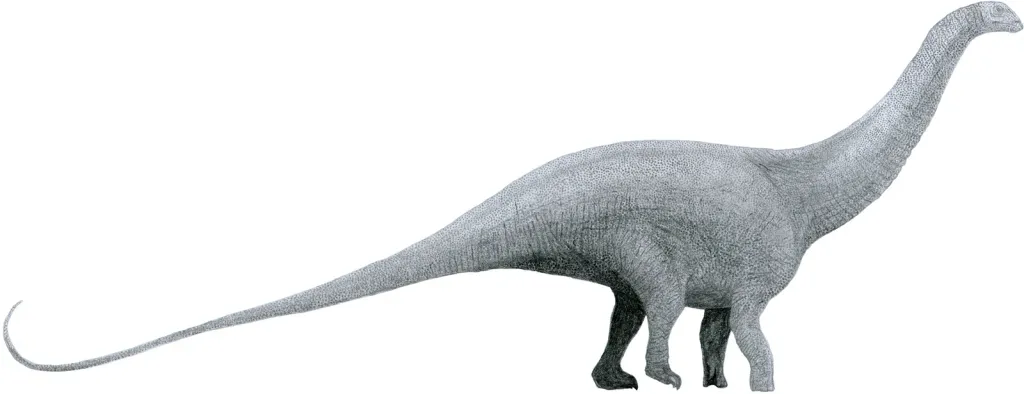
Brontosaurus excelsus
उच्चारण: BRON-toh-SORE-us ek-SEL-sus
Sauropoda · Diplodocidae
The "thunder lizard", a long-necked diplodocid from the Late Jurassic Morrison Formation of the western United States. Sunk into Apatosaurus in 1903, it was restored as a separate genus in 2015 after a specimen-by-specimen study.
- Giant
- Long necked
- Quadrupedal
- Famous specimen
- काल
- जुरासिक· किमेरिजियन
- आहार
- शाकाहारी
- लंबाई
- 21–23 m
- द्रव्यमान
- 15,000–20,000 kg
- स्थान
- Wyoming, Colorado, Utah, United States
त्वरित उत्तर
- Brontosaurus excelsus कितना बड़ा था?
- Brontosaurus excelsus लगभग 21–23 m लंबा था। कूल्हों तक इसकी ऊँचाई लगभग 3.4–4 m थी। इसका वज़न लगभग 15–20 t था। (Wikipedia: Brontosaurus 2026; Paul 2016)
- Brontosaurus excelsus कब रहता था?
- Brontosaurus excelsus उत्तर जुरासिक में, लगभग 15.48–14.31 करोड़ वर्ष पहले रहता था। (Paleobiology Database: Brontosaurus occurrences 2026)
- Brontosaurus excelsus के जीवाश्म कहाँ मिले हैं?
- Brontosaurus excelsus के जीवाश्म Morrison Formation (Colorado) और United States में मिले हैं। (Marsh 1879; Tschopp et al. 2015)
- Brontosaurus excelsus क्या खाता था?
- Brontosaurus excelsus एक शाकाहारी था। (Marsh 1879; Tschopp et al. 2015)
- Brontosaurus excelsus का नाम किसने और कब रखा?
- Brontosaurus excelsus का वर्णन Othniel Charles Marsh ने 1879 में किया। (Marsh 1879; Tschopp et al. 2015)
इस पेज पर

BRON-toh-SORE-us ek-SEL-sus
- काल
- जुरासिक154.8–143.1 Ma
- आहार
- शाकाहारी
- लंबाई
- 21–23 m
- द्रव्यमान
- 15–20 t
- स्थान
- United States
- वर्गीकरण
- Sauropoda · Diplodocidae
- वर्णित
- 1879, Othniel Charles Marsh
अवलोकन
यह सामग्री अंग्रेज़ी में उपलब्ध है।
Brontosaurus excelsus lived in western North America in the Late Jurassic, in the Morrison Formation. Othniel Charles Marsh named it in 1879 from a large skeleton collected at Como Bluff, Wyoming (YPM 1980). That skeleton became the first sauropod ever shown as a complete reconstruction, and made the name famous.
In 1903 Elmer Riggs concluded that Brontosaurus was the same animal as Apatosaurus, named by Marsh two years earlier, and the older name took priority. For more than a century scientists used Apatosaurus while the public kept saying Brontosaurus.
In 2015 Emmanuel Tschopp, Octávio Mateus and Roger Benson compared hundreds of features across diplodocid specimens and found Brontosaurus distinct enough to be a genus again, with three species: B. excelsus, B. parvus and B. yahnahpin. Like its relatives it had a long neck, a massive body and a long, whip-like tail.
नाम का अर्थ
From Greek brontē ("thunder") and sauros ("lizard"); excelsus, Latin for "high" or "noble" (Marsh 1879).
जीवविज्ञान और साक्ष्य
वैज्ञानिक इस जानवर के जीवन के बारे में क्या सोचते हैं, और हर विचार के पक्ष में साक्ष्य कितने मज़बूत हैं।
जैवयांत्रिकी
Brontosaurus and its relatives could crack their tails like a whip at supersonic speed.
साक्ष्य स्तर: विवादितA 1997 model said the tail tip could break the sound barrier. A 2022 model including soft tissue found the tip reached only about 30 m/s and that tissues would fail at supersonic speed.
पक्ष / विपक्ष में साक्ष्य · 2
पक्ष में साक्ष्य
जैवयांत्रिक मॉडल · Supersonic diplodocid tail model
A computer model of the Apatosaurus louisae tail reaching supersonic speed at the tip, like a bullwhip.
विपक्ष में साक्ष्य
जैवयांत्रिक मॉडल · Diplodocid tail multibody model
A multibody model with soft-tissue strength limits: the tail tip reaches about 30 m/s, far below the speed of sound.
अन्य
Brontosaurus has three species: B. excelsus, B. parvus and B. yahnahpin.
साक्ष्य स्तर: मध्यम साक्ष्यTschopp et al. referred Elosaurus parvus and Eobrontosaurus yahnahpin to Brontosaurus alongside the type species.
पक्ष / विपक्ष में साक्ष्य · 1
पक्ष में साक्ष्य
वंशवृक्षीय अनुमान · Specimen-level phylogeny of Diplodocidae
A phylogenetic analysis scoring 81 diplodocid specimens separately, with a numerical criterion for genus and species boundaries; it recovers Brontosaurus as distinct from Apatosaurus.
नमूना: YPM 1980
Brontosaurus is a genus distinct from Apatosaurus.
साक्ष्य स्तर: मध्यम साक्ष्यA specimen-by-specimen analysis found enough differences to separate them again in 2015. Most researchers now use Brontosaurus, but the line between genera is partly a matter of convention.
पक्ष / विपक्ष में साक्ष्य · 1
पक्ष में साक्ष्य
वंशवृक्षीय अनुमान · Specimen-level phylogeny of Diplodocidae
A phylogenetic analysis scoring 81 diplodocid specimens separately, with a numerical criterion for genus and species boundaries; it recovers Brontosaurus as distinct from Apatosaurus.
नमूना: YPM 1980
आकार
- लंबाई
- 21–23 m
- ऊँचाई
- 3.7 mप्रकाशित सीमा 3.4–4 m
- द्रव्यमान
- 15,000–20,000 kg
(75.5 फ़ुट)
YPM 1980 पर आधारित
(12.1 फ़ुट)
YPM 1980 (holotype, femur c. 1.83 m) पर आधारित
समयरेखा
काल: किमेरिजियन (154.8–149.2 Ma), टिथोनियन (149.2–145 Ma), उत्तर जुरासिक (161.5–145 Ma)
First and last appearance bounds of B. excelsus in PBDB (Kimmeridgian-Tithonian, PBDB time scale). The holotype comes from the Brushy Basin Member of the Morrison Formation.
स्थान
संरचनाएँ
- Morrison Formation · Colorado
- Reed's Quarry 10, Como Bluff, Albany County, Wyoming · Morrison Formation · Wyoming · स्थिति अनुमानित
ये वे स्थान हैं जहाँ जीवाश्म मिले हैं, न कि वह पूरा क्षेत्र जहाँ यह जानवर रहता था।
पारितंत्र
यहाँ रहता था: Morrison
156–147 मिलियन वर्ष पहले · बाढ़ का मैदान, नदी तंत्र, खुला वनक्षेत्र, झील
A vast, seasonally dry floodplain crossed by rivers in the western interior of North America in the Late Jurassic, with a wet and a dry season, conifer and fern vegetation along the water and giant sauropods in abundance.
समान पारितंत्र

समान पारितंत्र

समान पारितंत्र

समान पारितंत्र

समान पारितंत्र

समान पारितंत्र

वर्गीकरण
- क्लेडDinosauria
- क्लेडSaurischia
- क्लेडSauropodomorpha
- क्लेडSauropoda
- अधिकुलDiplodocoidea
- कुलDiplodocidae
- उपकुलApatosaurinae
- वंशBrontosaurus
- प्रजातिBrontosaurus excelsus
वर्गिकीय स्थिति: मान्य
जीवाश्म अभिलेख

| कैटलॉग संख्या | स्थिति | संस्थान | मिला |
|---|---|---|---|
| YPM 1980 | होलोटाइप | Yale Peabody Museum (YPM) | 1879 |
हर नमूने में कौन-सी हड्डियाँ सुरक्षित हैं, यह अभी दर्ज नहीं है।

गैलरी

खोज
- वर्णन का वर्ष
- 1879
- वर्णनकर्ता
- Othniel Charles Marsh
- प्ररूप नमूना
- YPM 1980

खोज की समयरेखा
1879 · औपचारिक रूप से वर्णित
Marsh names Brontosaurus excelsus
Marsh names the "thunder lizard" from a skeleton dug at Como Bluff, Wyoming.
लोग: Othniel Charles Marsh
1903 · संशोधन
Riggs sinks Brontosaurus into Apatosaurus
Elmer Riggs concludes that Brontosaurus and Apatosaurus are the same genus; the older name Apatosaurus takes priority.
लोग: Elmer S. Riggs
2015 · संशोधन
Brontosaurus restored as a separate genus
Tschopp, Mateus and Benson revalidate Brontosaurus with three species.
लोग: Emmanuel Tschopp
स्रोत
- (2026). Paleobiology Database: Brontosaurus occurrences. The Paleobiology Database (paleobiodb.org), data service 1.2, accessed 2026-09-23. https://paleobiodb.org/data1.2/occs/list.txt?base_name=Brontosaurus&show=coords,paleoloc,strat,loc,ref&pgm=gplates (नए टैब में खुलता है)
- (2026). Wikipedia: Brontosaurus. Wikipedia (English), accessed 2026-09-23. https://en.wikipedia.org/wiki/Brontosaurus (नए टैब में खुलता है)
- Conti, S., Tschopp, E., Mateus, O., Zanoni, A., Masarati, P. & Sala, G. (2022). Multibody analysis and soft tissue strength refute supersonic dinosaur tail. Scientific Reports 12. doi:10.1038/s41598-022-21633-2 (नए टैब में खुलता है)
- Marsh, O. C. (1879). Notice of new Jurassic reptiles. American Journal of Science, series 3, 18: 501-505.
- Myhrvold, N. P. & Currie, P. J. (1997). Supersonic sauropods? Tail dynamics in the diplodocids. Paleobiology 23: 393-409. doi:10.1017/s0094837300019801 (नए टैब में खुलता है)
- Paul, G. S. (2016). The Princeton Field Guide to Dinosaurs (2nd edition). Princeton University Press.
- Tschopp, E., Mateus, O. & Benson, R. B. J. (2015). A specimen-level phylogenetic analysis and taxonomic revision of Diplodocidae (Dinosauria, Sauropoda). PeerJ 3: e857. doi:10.7717/peerj.857 (नए टैब में खुलता है)