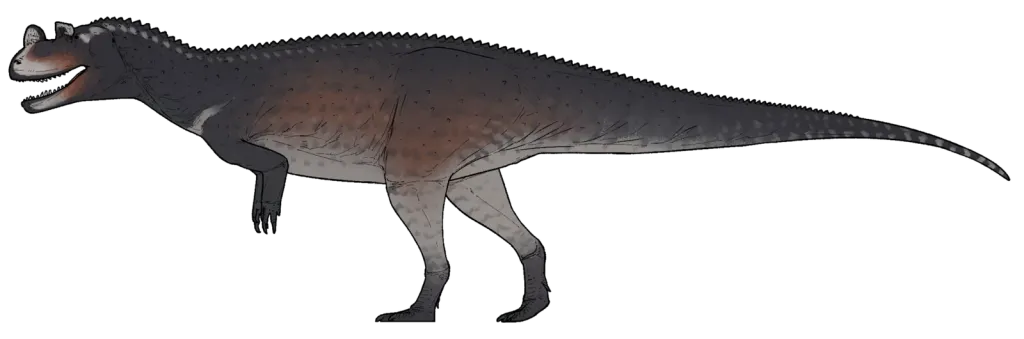
Ceratosaurus nasicornis
उच्चारण: seh-RAT-oh-SORE-us nay-zih-KOR-nis
Ceratosauria · Ceratosauridae
A horned predator from the Late Jurassic Morrison Formation of the western United States, a smaller neighbour of Allosaurus with a blade-like horn on its nose, very long upper teeth and a row of small bony plates along its back.
- Bipedal
- Horned
- Armored
- काल
- जुरासिक· किमेरिजियन
- आहार
- मांसाहारी
- लंबाई
- 5.3–7 m
- द्रव्यमान
- 418–670 kg
- स्थान
- Colorado, Utah, United States
त्वरित उत्तर
- Ceratosaurus nasicornis कितना बड़ा था?
- Ceratosaurus nasicornis लगभग 5.3–7 m लंबा था। कूल्हों तक इसकी ऊँचाई लगभग 1.6–2 m थी। इसका वज़न लगभग 418–670 kg था। (Wikipedia: Ceratosaurus 2026; Paul 2016)
- Ceratosaurus nasicornis कब रहता था?
- Ceratosaurus nasicornis उत्तर जुरासिक में, लगभग 15.22–14.51 करोड़ वर्ष पहले रहता था। (Paleobiology Database: Ceratosaurus occurrences 2026)
- Ceratosaurus nasicornis के जीवाश्म कहाँ मिले हैं?
- Ceratosaurus nasicornis के जीवाश्म Morrison Formation (Colorado) और United States में मिले हैं। (Marsh 1884; Paleobiology Database: Ceratosaurus occurrences 2026)
- Ceratosaurus nasicornis क्या खाता था?
- Ceratosaurus nasicornis एक मांसाहारी था। (Marsh 1884; Paleobiology Database: Ceratosaurus occurrences 2026)
- Ceratosaurus nasicornis का नाम किसने और कब रखा?
- Ceratosaurus nasicornis का वर्णन Othniel Charles Marsh ने 1884 में किया। (Marsh 1884; Paleobiology Database: Ceratosaurus occurrences 2026)
- क्या Ceratosaurus nasicornis Jurassic Park में था?
- हाँ। Ceratosaurus nasicornis Jurassic Park III (2001) में दिखाई देता है। फ़िल्मों में कई बातें काल्पनिक हैं; यह पेज उनकी तुलना जीवाश्म प्रमाणों से करता है। (Wikipedia: Dinosaurs in Jurassic Park 2026; Wikipedia: Ceratosaurus 2026)
इस पेज पर

- काल
- जुरासिक152.2–145.1 Ma
- आहार
- मांसाहारी
- लंबाई
- 5.3–7 m
- द्रव्यमान
- 0.4–0.7 t
- स्थान
- United States
- वर्गीकरण
- Ceratosauria · Ceratosauridae
- वर्णित
- 1884, Othniel Charles Marsh
अवलोकन
यह सामग्री अंग्रेज़ी में उपलब्ध है।
Ceratosaurus nasicornis lived in western North America in the Late Jurassic. Its type skeleton was dug up in 1883-1884 by the farmer Marshall Parker Felch at Garden Park, Colorado, and Othniel Charles Marsh named it in 1884. The skeleton is at the Smithsonian.
It was a medium-sized theropod, around 5 to 7 m long, with a crest-like horn on the snout, bony ridges over the eyes and remarkably long, blade-shaped teeth in the upper jaw. Unlike most theropods it had a row of small osteoderms along the midline of its back.
Ceratosaurus is also known from Utah and from the Lourinhã Formation of Portugal. Two further species named in 2000 are usually treated as the same species. Its closest relatives are the ceratosaurs of the southern continents, such as Carnotaurus.
नाम का अर्थ
"Horned lizard", from Greek keras ("horn") and sauros ("lizard"); nasicornis, Latin for "nose horn" (Marsh 1884).
जीवविज्ञान और साक्ष्य
वैज्ञानिक इस जानवर के जीवन के बारे में क्या सोचते हैं, और हर विचार के पक्ष में साक्ष्य कितने मज़बूत हैं।
त्वचा और आवरण
Ceratosaurus had a row of small bony plates along its back.
साक्ष्य स्तर: प्रत्यक्ष साक्ष्यSmall osteoderms are preserved along the midline, a feature unknown in most other theropods.
पक्ष / विपक्ष में साक्ष्य · 1
पक्ष में साक्ष्य
नमूना · Ceratosaurus nasal horn and osteoderms
A blade-like horn on the fused nasal bones (about 13 cm long in the holotype) and a row of small osteoderms along the back midline.
नमूना: USNM 4735
व्यवहार
The nose horn of Ceratosaurus was used for display rather than fighting.
साक्ष्य स्तर: परिकल्पनाThe horn is thin and blade-like, which suits display better than combat; its real use is unknown.
पक्ष / विपक्ष में साक्ष्य · 1
पक्ष में साक्ष्य
नमूना · Ceratosaurus nasal horn and osteoderms
A blade-like horn on the fused nasal bones (about 13 cm long in the holotype) and a row of small osteoderms along the back midline.
नमूना: USNM 4735
आकार
- लंबाई
- 5.3–7 m
- ऊँचाई
- 1.8 mप्रकाशित सीमा 1.6–2 m
- द्रव्यमान
- 418–670 kg
(23 फ़ुट)
USNM 4735 (5.3-5.7 m); larger individuals about 7 m पर आधारित
(5.9 फ़ुट)
USNM 4735 (holotype) to larger BYU material पर आधारित
USNM 4735 पर आधारित
समयरेखा
काल: किमेरिजियन (154.8–149.2 Ma), टिथोनियन (149.2–145 Ma), उत्तर जुरासिक (161.5–145 Ma)
Late Kimmeridgian-early Tithonian bounds of the type collection in PBDB (Brushy Basin Member, Morrison Formation).
स्थान
संरचनाएँ
- Morrison Formation · Colorado
- Felch Quarry, Garden Park, near Cañon City, Colorado · Morrison Formation · Colorado · स्थिति अनुमानित
ये वे स्थान हैं जहाँ जीवाश्म मिले हैं, न कि वह पूरा क्षेत्र जहाँ यह जानवर रहता था।
पारितंत्र
यहाँ रहता था: Morrison
156–147 मिलियन वर्ष पहले · बाढ़ का मैदान, नदी तंत्र, खुला वनक्षेत्र, झील
A vast, seasonally dry floodplain crossed by rivers in the western interior of North America in the Late Jurassic, with a wet and a dry season, conifer and fern vegetation along the water and giant sauropods in abundance.
समान पारितंत्र

समान पारितंत्र

समान पारितंत्र

समान पारितंत्र

समान पारितंत्र

समान पारितंत्र

वर्गीकरण
- क्लेडDinosauria
- क्लेडSaurischia
- क्लेडTheropoda
- क्लेडNeotheropoda
- क्लेडCeratosauria
- कुलCeratosauridae
- वंशCeratosaurus
- प्रजातिCeratosaurus nasicornis
वर्गिकीय स्थिति: मान्य
जीवाश्म अभिलेख

| कैटलॉग संख्या | स्थिति | संस्थान | मिला |
|---|---|---|---|
| USNM 4735 | होलोटाइप | National Museum of Natural History, Smithsonian Institution (USNM) | 1883 |
क्या मिला है
होलोटाइप: USNM 4735
- संरक्षित
- आंशिक
- पुनर्निर्मित
- अज्ञात / दर्ज नहीं
क्षेत्र-दर-क्षेत्र (तालिका)
| क्षेत्र | स्थिति |
|---|---|
| Skull | संरक्षित · With the nasal horn. |
| Mandible | अज्ञात / दर्ज नहीं |
| Teeth | अज्ञात / दर्ज नहीं |
| Cervical vertebrae | अज्ञात / दर्ज नहीं |
| Dorsal vertebrae | अज्ञात / दर्ज नहीं |
| Sacrum | अज्ञात / दर्ज नहीं |
| Caudal vertebrae | अज्ञात / दर्ज नहीं |
| Ribs | अज्ञात / दर्ज नहीं |
| Gastralia | अज्ञात / दर्ज नहीं |
| Scapula / shoulder girdle | अज्ञात / दर्ज नहीं |
| Humerus | अज्ञात / दर्ज नहीं |
| Forearm (radius / ulna) | अज्ञात / दर्ज नहीं |
| Hand (manus) | अज्ञात / दर्ज नहीं |
| Pelvis | अज्ञात / दर्ज नहीं |
| Femur | अज्ञात / दर्ज नहीं |
| Tibia / fibula | अज्ञात / दर्ज नहीं |
| Foot (pes) | अज्ञात / दर्ज नहीं |

गैलरी

खोज
- वर्णन का वर्ष
- 1884
- वर्णनकर्ता
- Othniel Charles Marsh
- प्ररूप नमूना
- USNM 4735
खोज की समयरेखा
1883 · पहली सामग्री मिली
Felch excavates the Ceratosaurus skeleton
The farmer Marshall Parker Felch digs the skeleton at Garden Park, Colorado, for Marsh (1883-1884).
लोग: Marshall P. Felch
1884 · औपचारिक रूप से वर्णित
Marsh names Ceratosaurus nasicornis
Marsh names the horned theropod in his series on American Jurassic dinosaurs.
लोग: Othniel Charles Marsh
Jurassic Park और Jurassic World में
फ़िल्में
- Jurassic Park III (2001)
यह सामग्री अंग्रेज़ी में उपलब्ध है।
पर्दे पर
A brief appearance in Jurassic Park III.
फ़िल्म बनाम जीवाश्म
- Its nose horn and the bony horns over its eyes are genuine features of the skull.
फ़िल्मों के नाम केवल पहचान के लिए दिए गए हैं। DinoDex का Jurassic Park / Jurassic World फ़्रैंचाइज़ से कोई संबंध नहीं है और न ही उसे उनका समर्थन प्राप्त है। फ़िल्मों में दिखे सभी डायनासोर
स्रोत
- (2026). Paleobiology Database: Ceratosaurus occurrences. The Paleobiology Database (paleobiodb.org), data service 1.2, accessed 2026-09-23. https://paleobiodb.org/data1.2/occs/list.txt?base_name=Ceratosaurus&show=coords,paleoloc,strat,loc,ref&pgm=gplates (नए टैब में खुलता है)
- (2026). Wikipedia: Ceratosaurus. Wikipedia (English), accessed 2026-09-23. https://en.wikipedia.org/wiki/Ceratosaurus (नए टैब में खुलता है)
- (2026). Wikipedia: Dinosaurs in Jurassic Park. Wikipedia. https://en.wikipedia.org/wiki/Dinosaurs_in_Jurassic_Park (नए टैब में खुलता है)
- Marsh, O. C. (1884). Principal characters of American Jurassic dinosaurs. Part VIII. The order Theropoda. American Journal of Science, series 3, 27: 329-340. doi:10.2475/ajs.s3-27.160.329 (नए टैब में खुलता है)
- Paul, G. S. (2016). The Princeton Field Guide to Dinosaurs (2nd edition). Princeton University Press.