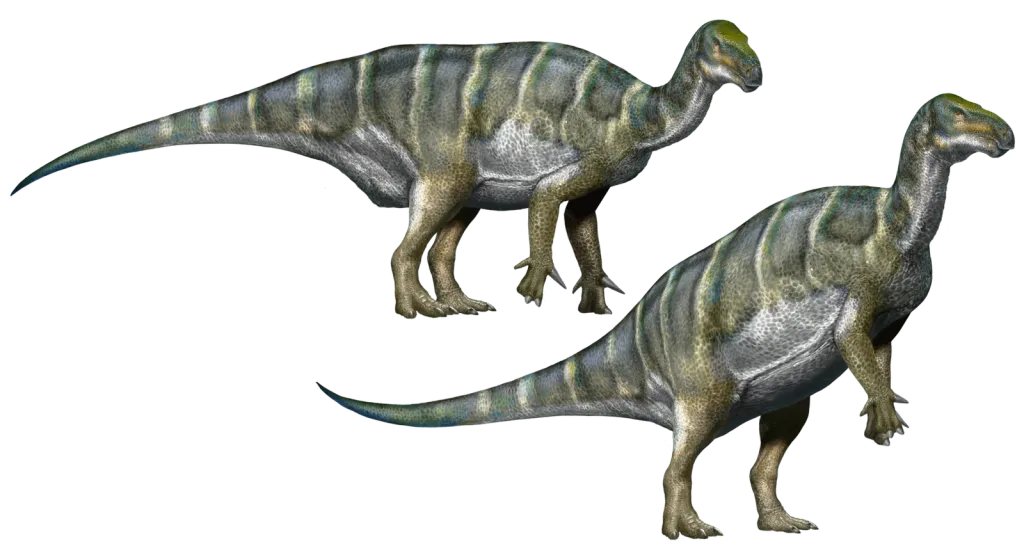
Iguanodon bernissartensis
उच्चारण: ig-WAH-noh-don ber-nis-ar-TEN-sis
Iguanodontia · Iguanodontidae
A large plant-eating ornithopod from the Early Cretaceous of Europe with a conical thumb spike. About thirty skeletons were found 322 m underground in a Belgian coal mine at Bernissart in 1878.
- Famous specimen
- काल
- क्रिटेशियस· बैरेमियन
- आहार
- शाकाहारी
- लंबाई
- 6.3–10 m
- द्रव्यमान
- 4,500 kg
- स्थान
- Hainaut, Belgium, Europe
त्वरित उत्तर
- Iguanodon bernissartensis कितना बड़ा था?
- Iguanodon bernissartensis लगभग 6.3–10 m लंबा था। कूल्हों तक इसकी ऊँचाई लगभग 2.2–2.8 m थी। इसका वज़न लगभग 4.5 t था। (Sciences 2026; Museum & London 2026)
- Iguanodon bernissartensis कब रहता था?
- Iguanodon bernissartensis प्रारंभिक क्रिटेशियस में, लगभग 12.58–11.96 करोड़ वर्ष पहले रहता था। (Paleobiology Database: Iguanodon occurrences 2026)
- Iguanodon bernissartensis के जीवाश्म कहाँ मिले हैं?
- Iguanodon bernissartensis के जीवाश्म Sainte-Barbe Clays Formation (Hainaut) और Belgium में मिले हैं। (Mantell 1825; Boulenger 1881)
- Iguanodon bernissartensis क्या खाता था?
- Iguanodon bernissartensis एक शाकाहारी था। (Mantell 1825; Boulenger 1881)
- Iguanodon bernissartensis का नाम किसने और कब रखा?
- Iguanodon bernissartensis का वर्णन George A. Boulenger ने 1881 में किया। (Boulenger 1881; Paleobiology Database: Iguanodon occurrences 2026)
- क्या Iguanodon bernissartensis Jurassic Park में था?
- हाँ। Iguanodon bernissartensis Jurassic World Dominion (2022) में दिखाई देता है। फ़िल्मों में कई बातें काल्पनिक हैं; यह पेज उनकी तुलना जीवाश्म प्रमाणों से करता है। (Wikipedia: Dinosaurs in Jurassic Park 2026; Mantell 1825)
इस पेज पर

- काल
- क्रिटेशियस125.8–119.6 Ma
- आहार
- शाकाहारी
- लंबाई
- 6.3–10 m
- द्रव्यमान
- 4.5 t
- स्थान
- Belgium, Europe
- वर्गीकरण
- Iguanodontia · Iguanodontidae
- वर्णित
- 1881, George A. Boulenger
अवलोकन
यह सामग्री अंग्रेज़ी में उपलब्ध है।
Iguanodon was the second dinosaur ever named. Gideon Mantell named it in 1825 from teeth found in Sussex that resembled those of an iguana, and he placed a spike on its nose. Only the complete skeletons from Belgium showed that the spike belonged on the thumb.
In 1878 miners at Bernissart, Belgium, found dinosaur bones 322 m underground in a coal mine. Some thirty fairly complete skeletons were recovered, most of them Iguanodon bernissartensis, named by George Boulenger in 1881. From 1882 Louis Dollo and Louis De Pauw mounted them in Brussels, where they are still displayed.
Iguanodon was a heavy animal that could walk on four legs or two. Its hand combined a spike-like thumb, three middle fingers that could bear weight and a grasping fifth finger. It lived in the Barremian to early Aptian, and I. bernissartensis is now the type species of the genus.
नाम का अर्थ
"Iguana tooth", from iguana and Greek odous ("tooth") (Mantell 1825); bernissartensis for Bernissart, Belgium (Boulenger 1881).
जीवविज्ञान और साक्ष्य
वैज्ञानिक इस जानवर के जीवन के बारे में क्या सोचते हैं, और हर विचार के पक्ष में साक्ष्य कितने मज़बूत हैं।
दाँत
Iguanodon was named for teeth that look like an iguana's.
साक्ष्य स्तर: प्रत्यक्ष साक्ष्यMantell compared the worn fossil teeth with those of a living iguana, much smaller but similar in shape.
पक्ष / विपक्ष में साक्ष्य · 1
पक्ष में साक्ष्य
नमूना · Mantell's Iguanodon teeth
Large fossil teeth from Sussex that resembled those of an iguana, the basis of the name Iguanodon.
व्यवहार
Iguanodon used its thumb spike as a weapon.
साक्ष्य स्तर: परिकल्पनाThe spike was probably sheathed in sharp horn and could have been used in defence or combat; food handling has also been suggested. No direct evidence of its use is known.
पक्ष / विपक्ष में साक्ष्य · 1
पक्ष में साक्ष्य
तुलनात्मक शरीर रचना · Iguanodon hand and thumb spike
The thumb is a large conical spike; with the three middle fingers and a grasping fifth finger the hand has three different functions.
नमूना: IRSNB 1534
अन्य
The spike of Iguanodon was on its thumb, not on its nose.
साक्ष्य स्तर: प्रत्यक्ष साक्ष्यMantell had placed a lone spike on the nose. Articulated skeletons from Bernissart showed it sits on the hand.
पक्ष / विपक्ष में साक्ष्य · 2
पक्ष में साक्ष्य
तुलनात्मक शरीर रचना · Iguanodon hand and thumb spike
The thumb is a large conical spike; with the three middle fingers and a grasping fifth finger the hand has three different functions.
नमूना: IRSNB 1534
नमूना · Bernissart Iguanodon skeletons
About thirty relatively complete skeletons recovered 322 m underground in the Bernissart coal mine; eight I. bernissartensis are mounted in Brussels.
नमूना: IRSNB 1534
आकार
- लंबाई
- 6.3–10 m
- ऊँचाई
- 2.5 mप्रकाशित सीमा 2.2–2.8 m
- द्रव्यमान
- 4,500 kg
(32.8 फ़ुट)
Bernissart mounts (IRSNB) पर आधारित
(8.2 फ़ुट)
Bernissart skeletons (femur c. 1.0-1.1 m) पर आधारित
समयरेखा
काल: बैरेमियन (125.8–121.4 Ma), एप्टियन (121.4–113 Ma), प्रारंभिक क्रिटेशियस (145–100.5 Ma)
Barremian-early Aptian bounds of the Bernissart collection in PBDB (PBDB time scale).
स्थान
संरचनाएँ
- Sainte-Barbe Clays Formation · Hainaut
- Sainte-Barbe pit, Bernissart, Hainaut · Sainte-Barbe Clays Formation · Hainaut · स्थिति अनुमानित
ये वे स्थान हैं जहाँ जीवाश्म मिले हैं, न कि वह पूरा क्षेत्र जहाँ यह जानवर रहता था।
पारितंत्र
यहाँ रहता था: Weald Clay
136–125 मिलियन वर्ष पहले · नदी तंत्र, झील, दलदल / आर्द्रभूमि, तटीय मैदान
Early Cretaceous lagoons, lakes and rivers of south-east England, fresh to brackish, in a semi-arid, fire-prone climate.
समान पारितंत्र

यहाँ रहता था: Bernissart
झील, दलदल / आर्द्रभूमि
Early Cretaceous lake in the Mons Basin, Belgium, with laminated clays and lignite; ferns such as Weichselia grew around it.
वर्गीकरण
- क्लेडDinosauria
- क्लेडOrnithischia
- क्लेडOrnithopoda
- क्लेडIguanodontia
- कुलIguanodontidae
- वंशIguanodon
- प्रजातिIguanodon bernissartensis
वर्गिकीय स्थिति: मान्य
जीवाश्म अभिलेख

| कैटलॉग संख्या | स्थिति | संस्थान | मिला |
|---|---|---|---|
| IRSNB 1534 | होलोटाइप | Royal Belgian Institute of Natural Sciences (IRSNB) | 1878 |
हर नमूने में कौन-सी हड्डियाँ सुरक्षित हैं, यह अभी दर्ज नहीं है।

गैलरी

खोज
- वर्णन का वर्ष
- 1881
- वर्णनकर्ता
- George A. Boulenger
- प्ररूप नमूना
- IRSNB 1534

खोज की समयरेखा
1822 · पहली सामग्री मिली
Iguanodon teeth found in Sussex
Large fossil teeth are found in Sussex; the story that Mary Ann Mantell found them is doubted.
लोग: Gideon Mantell
1825 · औपचारिक रूप से वर्णित
Mantell names Iguanodon
Mantell publishes the "iguana tooth" in the Philosophical Transactions.
लोग: Gideon Mantell
1878 · नमूना प्राप्त हुआ
Iguanodon skeletons found in the Bernissart mine
Miners find bones 322 m underground; the museum is told by telegram on 12 April 1878 and about thirty skeletons are recovered.
1881 · औपचारिक रूप से वर्णित
Boulenger names Iguanodon bernissartensis
The Bernissart species is named.
लोग: George A. Boulenger
1882 · प्रमुख अध्ययन
Dollo and De Pauw begin mounting the Bernissart Iguanodons
The first skeleton goes on display in 1883.
लोग: Louis Dollo, Louis De Pauw
Jurassic Park और Jurassic World में
फ़िल्में
- Jurassic World Dominion (2022)
यह सामग्री अंग्रेज़ी में उपलब्ध है।
पर्दे पर
A herd herbivore in Dominion.
फ़िल्म बनाम जीवाश्म
- One of the first dinosaurs ever named (1825), from its teeth; its thumb spike is real, its exact use is not known.
फ़िल्मों के नाम केवल पहचान के लिए दिए गए हैं। DinoDex का Jurassic Park / Jurassic World फ़्रैंचाइज़ से कोई संबंध नहीं है और न ही उसे उनका समर्थन प्राप्त है। फ़िल्मों में दिखे सभी डायनासोर
स्रोत
- (2026). Paleobiology Database: Iguanodon occurrences. The Paleobiology Database (paleobiodb.org), data service 1.2, accessed 2026-09-23. https://paleobiodb.org/data1.2/occs/list.txt?base_name=Iguanodon&show=coords,paleoloc,strat,loc,ref&pgm=gplates (नए टैब में खुलता है)
- (2026). Wikipedia: Iguanodon. Wikipedia (English), accessed 2026-09-23. https://en.wikipedia.org/wiki/Iguanodon (नए टैब में खुलता है)
- (2026). Wikipedia: Dinosaurs in Jurassic Park. Wikipedia. https://en.wikipedia.org/wiki/Dinosaurs_in_Jurassic_Park (नए टैब में खुलता है)
- Boulenger, G. A. (1881). Sur l'arc pelvien chez les dinosauriens de Bernissart. Bulletins de l'Académie royale de Belgique, 3e série, 1(5): 1-11.
- Charig, A. J. & Chapman, S. D. (1998). Iguanodon Mantell, 1825 (Reptilia, Ornithischia): proposed designation of Iguanodon bernissartensis Boulenger in Beneden, 1881 as the type species, and proposed designation of a lectotype. Bulletin of Zoological Nomenclature 55: 99-104. doi:10.5962/bhl.part.157 (नए टैब में खुलता है)
- Mantell, G. (1825). Notice on the Iguanodon, a newly discovered fossil reptile, from the sandstone of Tilgate forest, in Sussex. Philosophical Transactions of the Royal Society of London: 179-186. doi:10.1098/rstl.1825.0010 (नए टैब में खुलता है)
- Natural History Museum, London (2026). Iguanodon: the teeth that led to a dinosaur discovery. nhm.ac.uk. https://www.nhm.ac.uk/discover/the-discovery-of-iguanodon.html (नए टैब में खुलता है)
- Paul, G. S. (2016). The Princeton Field Guide to Dinosaurs (2nd edition). Princeton University Press.
- Royal Belgian Institute of Natural Sciences (2026). The Bernissart Iguanodons at a glance. naturalsciences.be. https://www.naturalsciences.be/en/discover-join/discover/the-bernissart-iguanodons-at-a-glance (नए टैब में खुलता है)