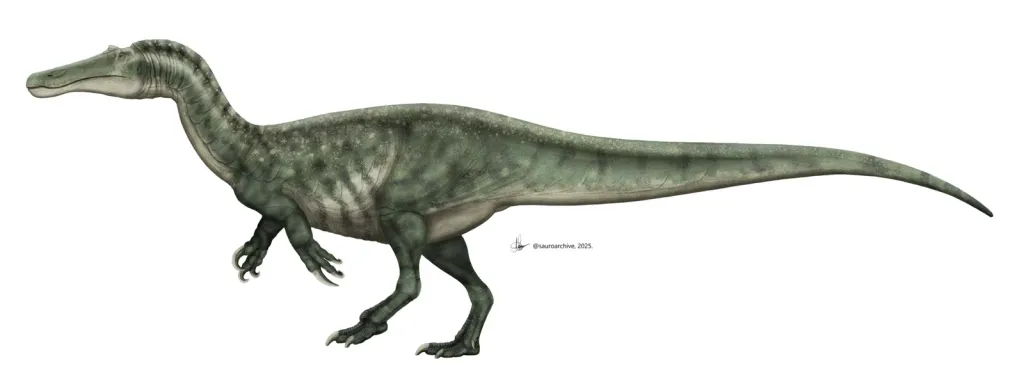
Baryonyx walkeri
उच्चारण: BARE-ee-ON-iks WAW-ker-eye
Tetanurae · Spinosauridae
A fish-eating spinosaurid from the Early Cretaceous of southern England, with a long, crocodile-like snout and a 31 cm thumb claw. Its skeleton, found by an amateur collector in 1983, still held fish scales and Iguanodon bones in its belly.
- Bipedal
- Possibly semiaquatic
- Famous specimen
- काल
- क्रिटेशियस· बैरेमियन
- आहार
- मत्स्यभक्षी
- लंबाई
- 7.5–10 m
- द्रव्यमान
- 1,200–2,000 kg
- स्थान
- Surrey, United Kingdom
त्वरित उत्तर
- Baryonyx walkeri कितना बड़ा था?
- Baryonyx walkeri लगभग 7.5–10 m लंबा था। कूल्हों तक इसकी ऊँचाई लगभग 2.2–2.6 m थी। इसका वज़न लगभग 1.2–2 t था। (Wikipedia: Baryonyx 2026; Paul 2016)
- Baryonyx walkeri कब रहता था?
- Baryonyx walkeri प्रारंभिक क्रिटेशियस में, लगभग 12.58–12.14 करोड़ वर्ष पहले रहता था। (Paleobiology Database: Baryonyx occurrences 2026; Barker et al. 2021)
- Baryonyx walkeri के जीवाश्म कहाँ मिले हैं?
- Baryonyx walkeri के जीवाश्म Weald Clay Formation (Surrey) और United Kingdom में मिले हैं। (Charig & Milner 1986; Barker et al. 2021)
- Baryonyx walkeri क्या खाता था?
- Baryonyx walkeri एक मत्स्यभक्षी या मांसाहारी था। (Charig & Milner 1986; Barker et al. 2021)
- Baryonyx walkeri का नाम किसने और कब रखा?
- Baryonyx walkeri का वर्णन Alan J. Charig & Angela C. Milner ने 1986 में किया। (Charig & Milner 1986; Museum & London 2026)
- क्या Baryonyx walkeri Jurassic Park में था?
- हाँ। Baryonyx walkeri Jurassic World: Fallen Kingdom (2018) और Jurassic World Dominion (2022) में दिखाई देता है। फ़िल्मों में कई बातें काल्पनिक हैं; यह पेज उनकी तुलना जीवाश्म प्रमाणों से करता है। (Wikipedia: Dinosaurs in Jurassic Park 2026; Museum & London 2026)
इस पेज पर

BARE-ee-ON-iks WAW-ker-eye
- काल
- क्रिटेशियस125.8–121.4 Ma
- आहार
- मत्स्यभक्षी
- लंबाई
- 7.5–10 m
- द्रव्यमान
- 1.2–2 t
- स्थान
- United Kingdom
- वर्गीकरण
- Tetanurae · Spinosauridae
- वर्णित
- 1986, Alan J. Charig & Angela C. Milner
अवलोकन
यह सामग्री अंग्रेज़ी में उपलब्ध है।
Baryonyx walkeri lived in southern England in the Barremian, about 125 million years ago, among lagoons and rivers. In January 1983 the amateur collector William Walker found a huge claw in a clay pit near Ockley, Surrey; Natural History Museum staff excavated the skeleton in May and June 1983, and Alan Charig and Angela Milner named it in 1986.
The skeleton (NHMUK PV R9951) is one of the most complete meat-eating dinosaurs found in Britain, with most of the skull. It showed for the first time what spinosaurids looked like: a long, narrow snout with a rosette of teeth at the tip, nostrils set far back and conical, crocodile-like teeth.
Fish scales and bones of a young Iguanodon were found where the stomach had been, so it ate both fish and land animals. It is the best-known spinosaurid from Europe and a key reference for relatives such as Suchomimus and Spinosaurus.
नाम का अर्थ
"Heavy claw", from Greek barys ("heavy") and onyx ("claw"); walkeri honours William Walker, who found it (Charig & Milner 1986).
जीवविज्ञान और साक्ष्य
वैज्ञानिक इस जानवर के जीवन के बारे में क्या सोचते हैं, और हर विचार के पक्ष में साक्ष्य कितने मज़बूत हैं।
भोजन
Baryonyx also ate land animals such as young Iguanodon.
साक्ष्य स्तर: मज़बूत साक्ष्यBones of a young Iguanodon lay in the same abdominal area. Whether it hunted or scavenged them cannot be told.
पक्ष / विपक्ष में साक्ष्य · 1
पक्ष में साक्ष्य
नमूना · Baryonyx stomach contents
Fish scales and bones of a young Iguanodon found in the abdominal region of the holotype.
नमूना: NHMUK PV R9951
Baryonyx ate fish.
साक्ष्य स्तर: प्रत्यक्ष साक्ष्यPartly digested fish scales were found where its stomach had been, the first direct proof of a fish-eating non-bird dinosaur. Its snout and teeth also resemble those of fish-eating crocodiles.
पक्ष / विपक्ष में साक्ष्य · 2
पक्ष में साक्ष्य
नमूना · Baryonyx stomach contents
Fish scales and bones of a young Iguanodon found in the abdominal region of the holotype.
नमूना: NHMUK PV R9951
तुलनात्मक शरीर रचना · Baryonyx skull and teeth
Nostrils set far back, a rosette of teeth at the snout tip and conical, rounded teeth like those of crocodiles.
नमूना: NHMUK PV R9951
आकार
- लंबाई
- 7.5–10 m
- ऊँचाई
- 2.4 mप्रकाशित सीमा 2.2–2.6 m
- द्रव्यमान
- 1,200–2,000 kg
(32.8 फ़ुट)
NHMUK PV R9951 पर आधारित
(7.9 फ़ुट)
NHMUK R9951 (holotype, subadult) पर आधारित
NHMUK PV R9951 पर आधारित
समयरेखा
काल: बैरेमियन (125.8–121.4 Ma), प्रारंभिक क्रिटेशियस (145–100.5 Ma)
Early Barremian bounds of the type collection in PBDB; the NHM gives "around 125 million years".
स्थान
संरचनाएँ
- Weald Clay Formation · Surrey
स्थान
- Smokejacks pit, Wallis Wood, Ockley, Surrey · Weald Clay Formation · Surrey · स्थिति अनुमानित
ये वे स्थान हैं जहाँ जीवाश्म मिले हैं, न कि वह पूरा क्षेत्र जहाँ यह जानवर रहता था।
पारितंत्र
यहाँ रहता था: Weald Clay
136–125 मिलियन वर्ष पहले · नदी तंत्र, झील, दलदल / आर्द्रभूमि, तटीय मैदान
Early Cretaceous lagoons, lakes and rivers of south-east England, fresh to brackish, in a semi-arid, fire-prone climate.
समान पारितंत्र

वर्गीकरण
- क्लेडDinosauria
- क्लेडSaurischia
- क्लेडTheropoda
- क्लेडTetanurae
- अधिकुलMegalosauroidea
- कुलSpinosauridae
- उपकुलBaryonychinae
- वंशBaryonyx
- प्रजातिBaryonyx walkeri
वर्गिकीय स्थिति: मान्य
जीवाश्म अभिलेख

| कैटलॉग संख्या | स्थिति | संस्थान | मिला |
|---|---|---|---|
| NHMUK PV R9951 | होलोटाइप | Natural History Museum, London (NHMUK) | 1983 |
क्या मिला है
होलोटाइप: NHMUK PV R9951
- संरक्षित
- आंशिक
- पुनर्निर्मित
- अज्ञात / दर्ज नहीं
क्षेत्र-दर-क्षेत्र (तालिका)
| क्षेत्र | स्थिति |
|---|---|
| Skull | आंशिक · Snout and braincase. |
| Mandible | आंशिक |
| Teeth | आंशिक |
| Cervical vertebrae | अज्ञात / दर्ज नहीं |
| Dorsal vertebrae | अज्ञात / दर्ज नहीं |
| Sacrum | अज्ञात / दर्ज नहीं |
| Caudal vertebrae | अज्ञात / दर्ज नहीं |
| Ribs | अज्ञात / दर्ज नहीं |
| Gastralia | अज्ञात / दर्ज नहीं |
| Scapula / shoulder girdle | अज्ञात / दर्ज नहीं |
| Humerus | अज्ञात / दर्ज नहीं |
| Forearm (radius / ulna) | अज्ञात / दर्ज नहीं |
| Hand (manus) | आंशिक · Large first-finger claw, 31 cm along the curve. |
| Pelvis | अज्ञात / दर्ज नहीं |
| Femur | अज्ञात / दर्ज नहीं |
| Tibia / fibula | अज्ञात / दर्ज नहीं |
| Foot (pes) | अज्ञात / दर्ज नहीं |

खोज
- वर्णन का वर्ष
- 1986
- वर्णनकर्ता
- Alan J. Charig & Angela C. Milner
- प्ररूप नमूना
- NHMUK PV R9951
खोज की समयरेखा
1983 · पहली सामग्री मिली
William Walker finds the Baryonyx claw
An amateur collector finds a 31 cm claw in a clay pit near Ockley, Surrey, in January 1983; the museum excavates the skeleton that spring.
लोग: William J. Walker
1986 · औपचारिक रूप से वर्णित
Charig and Milner name Baryonyx walkeri
The "heavy claw" is named in Nature.
लोग: Alan J. Charig, Angela C. Milner
2021 · प्रमुख अध्ययन
Two new baryonychines named from the Isle of Wight
Barker and colleagues describe Ceratosuchops and Riparovenator, close relatives of Baryonyx, and argue spinosaurids originated in Europe.
Jurassic Park और Jurassic World में
फ़िल्में
- Jurassic World: Fallen Kingdom (2018)
- Jurassic World Dominion (2022)
यह सामग्री अंग्रेज़ी में उपलब्ध है।
पर्दे पर
A predator on Isla Nublar during the volcanic eruption in Fallen Kingdom.
फ़िल्म बनाम जीवाश्म
- Fish scales found with its stomach contents show it ate fish; its long, crocodile-like snout suited catching them.
फ़िल्मों के नाम केवल पहचान के लिए दिए गए हैं। DinoDex का Jurassic Park / Jurassic World फ़्रैंचाइज़ से कोई संबंध नहीं है और न ही उसे उनका समर्थन प्राप्त है। फ़िल्मों में दिखे सभी डायनासोर
स्रोत
- (2026). Paleobiology Database: Baryonyx occurrences. The Paleobiology Database (paleobiodb.org), data service 1.2, accessed 2026-09-23. https://paleobiodb.org/data1.2/occs/list.txt?base_name=Baryonyx&show=coords,paleoloc,strat,loc,ref&pgm=gplates (नए टैब में खुलता है)
- (2026). Wikipedia: Baryonyx. Wikipedia (English), accessed 2026-09-23. https://en.wikipedia.org/wiki/Baryonyx (नए टैब में खुलता है)
- (2026). Wikipedia: Dinosaurs in Jurassic Park. Wikipedia. https://en.wikipedia.org/wiki/Dinosaurs_in_Jurassic_Park (नए टैब में खुलता है)
- Barker, C. T., Hone, D. W. E., Naish, D., Cau, A., Lockwood, J. A. F., Foster, B., Clarkin, C. E., Schneider, P. & Gostling, N. J. (2021). New spinosaurids from the Wessex Formation (Early Cretaceous, UK) and the European origins of Spinosauridae. Scientific Reports 11. doi:10.1038/s41598-021-97870-8 (नए टैब में खुलता है)
- Charig, A. J. & Milner, A. C. (1986). Baryonyx, a remarkable new theropod dinosaur. Nature 324: 359-361. doi:10.1038/324359a0 (नए टैब में खुलता है)
- Natural History Museum, London (2026). How did Baryonyx change what we knew about spinosaurs?. nhm.ac.uk. https://www.nhm.ac.uk/discover/how-did-baryonyx-change-what-we-knew-about-spinosaurs.html (नए टैब में खुलता है)
- Paul, G. S. (2016). The Princeton Field Guide to Dinosaurs (2nd edition). Princeton University Press.