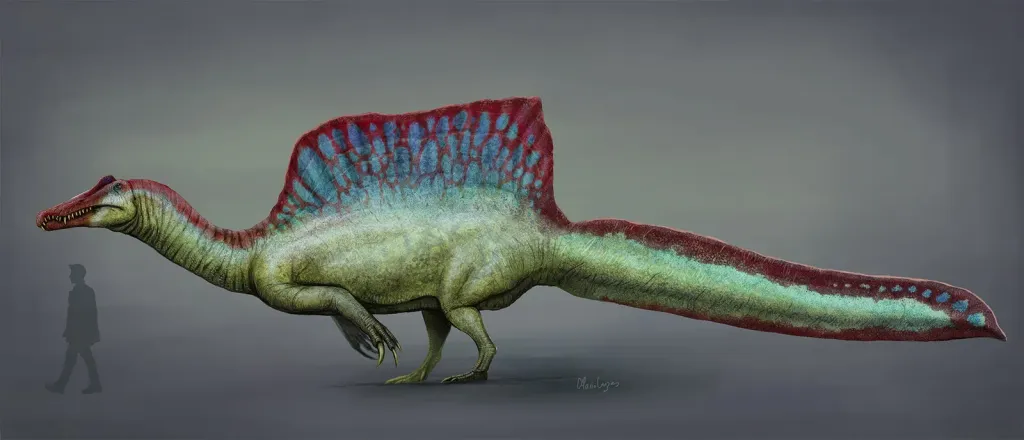
Spinosaurus aegyptiacus
उच्चारण: SPY-noh-SORE-us ee-jip-TIE-ah-kus
Tetanurae · Spinosauridae
A long-snouted, sail-backed spinosaurid theropod from the Cenomanian of North Africa and one of the longest predatory dinosaurs known. How big it was and how much time it spent in water are still debated.
- Sail backed
- Giant
- Possibly semiaquatic
- Unusual anatomy
- Movie icon
- काल
- क्रिटेशियस· सेनोमेनियन
- आहार
- मांसाहारी
- लंबाई
- 13.5–14 m
- द्रव्यमान
- 7,390 kg
- स्थान
- Egypt, Morocco
त्वरित उत्तर
- Spinosaurus aegyptiacus कितना बड़ा था?
- Spinosaurus aegyptiacus लगभग 13.5–14 m लंबा था। कूल्हों तक इसकी ऊँचाई लगभग 2.2–3 m थी। इसका वज़न लगभग 7.4 t था। (Sereno et al. 2022; Ibrahim et al. 2014)
- Spinosaurus aegyptiacus कब रहता था?
- Spinosaurus aegyptiacus उत्तर क्रिटेशियस में, लगभग 10.05–9.39 करोड़ वर्ष पहले रहता था। (Cohen et al. 2023; Dal Sasso et al. 2005)
- Spinosaurus aegyptiacus के जीवाश्म कहाँ मिले हैं?
- Spinosaurus aegyptiacus के जीवाश्म Bahariya Formation (Egypt) और Kem Kem Group (Morocco) में मिले हैं। (Stromer 1915; Dal Sasso et al. 2005)
- Spinosaurus aegyptiacus क्या खाता था?
- Spinosaurus aegyptiacus एक मांसाहारी या मत्स्यभक्षी था। (Stromer 1915; Dal Sasso et al. 2005)
- Spinosaurus aegyptiacus का नाम किसने और कब रखा?
- Spinosaurus aegyptiacus का वर्णन Ernst Stromer ने 1915 में किया। (Stromer 1915; Ibrahim et al. 2014)
- क्या Spinosaurus aegyptiacus Jurassic Park में था?
- हाँ। Spinosaurus aegyptiacus Jurassic Park III (2001) और Jurassic World Rebirth (2025) में दिखाई देता है। फ़िल्मों में कई बातें काल्पनिक हैं; यह पेज उनकी तुलना जीवाश्म प्रमाणों से करता है। (Wikipedia: Dinosaurs in Jurassic Park 2026; Ibrahim et al. 2014)
इस पेज पर

- काल
- क्रिटेशियस100.5–93.9 Ma
- आहार
- मांसाहारी
- लंबाई
- 13.5–14 m
- द्रव्यमान
- 7.4 t
- स्थान
- Egypt, Morocco
- वर्गीकरण
- Tetanurae · Spinosauridae
- वर्णित
- 1915, Ernst Stromer
अवलोकन
यह सामग्री अंग्रेज़ी में उपलब्ध है।
Spinosaurus aegyptiacus lived in North Africa during the Cenomanian, early in the Late Cretaceous. It was named by Ernst Stromer in 1915 from bones found in the Bahariya Formation of Egypt; that holotype was destroyed in an Allied bombing raid on Munich in 1944.
Later finds from the Kem Kem Group of Morocco, including a partial skeleton designated as neotype by Ibrahim et al. (2014), show a long crocodile-like snout, very tall neural spines forming a sail, dense limb bones and short hind legs. Ibrahim et al. (2014) read these as adaptations to a semiaquatic life; Sereno et al. (2022) argued it was a wading, shoreline predator rather than an aquatic pursuit hunter.
Its size is contested. Dal Sasso et al. (2005) scaled a large snout to suggest it exceeded Tyrannosaurus and Giganotosaurus, while the skeletal model of Sereno et al. (2022) is just under 14 m long. The figures below show the range and who proposed each value.
नाम का अर्थ
From Latin spina ("spine", for the tall neural spines) and Greek sauros ("lizard"); aegyptiacus means "Egyptian" (Stromer 1915).
जीवविज्ञान और साक्ष्य
वैज्ञानिक इस जानवर के जीवन के बारे में क्या सोचते हैं, और हर विचार के पक्ष में साक्ष्य कितने मज़बूत हैं।
गति
Spinosaurus was a semiaquatic animal that swam with its tail and hunted underwater.
साक्ष्य स्तर: विवादितOne team argues its fin-like tail and dense bones made it an underwater pursuit predator. Other researchers modelled its body and found it would float and tip over, and argue it waded in shallow water like a heron. The question is open.
पक्ष / विपक्ष में साक्ष्य · 3
पक्ष में साक्ष्य
नमूना · Spinosaurus paddle-like tail (FSAC-KK 11888)
Tall, flexible tail with long neural spines and chevrons, interpreted as a fin for swimming.
नमूना: FSAC-KK 11888
ऊतक विज्ञान · Dense limb bones in spinosaurids
Bone cross-sections show very dense, compact limb bones in Spinosaurus and Baryonyx, like those of animals that dive.
नमूना: FSAC-KK 11888
विपक्ष में साक्ष्य
जैवयांत्रिक मॉडल · Spinosaurus buoyancy and body models
Digital body models finding Spinosaurus unstable and too buoyant to dive or pursue prey underwater; the tail too weak for fast swimming.
मुद्रा
Spinosaurus had short hind legs and may have walked on all fours on land.
साक्ष्य स्तर: विवादितThe 2014 neotype reconstruction had very short legs, which suggested a four-legged gait on land. Critics say the skeleton may mix individuals of different sizes; later work by Sereno et al. (2022) reconstructs it as a biped.
पक्ष / विपक्ष में साक्ष्य · 2
पक्ष में साक्ष्य
नमूना · Spinosaurus paddle-like tail (FSAC-KK 11888)
Tall, flexible tail with long neural spines and chevrons, interpreted as a fin for swimming.
नमूना: FSAC-KK 11888
विपक्ष में साक्ष्य
जैवयांत्रिक मॉडल · Spinosaurus buoyancy and body models
Digital body models finding Spinosaurus unstable and too buoyant to dive or pursue prey underwater; the tail too weak for fast swimming.
भोजन
Spinosaurus ate a lot of fish.
साक्ष्य स्तर: मज़बूत साक्ष्यIts long, narrow jaws and cone-shaped teeth resemble those of fish-eating crocodiles, and the chemistry of spinosaurid teeth suggests they spent time in water. Fish was very likely a large part of the diet, though it probably ate other prey too.
पक्ष / विपक्ष में साक्ष्य · 2
पक्ष में साक्ष्य
तुलनात्मक शरीर रचना · Spinosaurus conical teeth and long snout
Straight conical teeth, interlocking rosette at the jaw tip and a long narrow snout, similar to fish-eating crocodilians.
नमूना: MSNM V4047, BSPG 1912 VIII 19
अन्य · Spinosaurid tooth oxygen isotopes
Oxygen isotope ratios of spinosaurid teeth closer to those of turtles and crocodiles than of other theropods.
अन्य
The sail on the back of Spinosaurus was mainly for display.
साक्ष्य स्तर: परिकल्पनाThe sail, made of neural spines up to about 1.6 m tall, is well documented; its purpose is not. Display is the most common interpretation, but temperature control and other uses have been proposed, and there is no direct test.
आकार
- लंबाई
- 13.5–14 m
- ऊँचाई
- 2.6 mप्रकाशित सीमा 2.2–3 m
- द्रव्यमान
- 7,390 kg
(45.9 फ़ुट)
Composite adult model based on the neotype FSAC-KK 11888 and referred material पर आधारित
(8.5 फ़ुट)
FSAC-KK 11888 (neotype, subadult) scaled to adult size पर आधारित
Adult flesh model (Sereno et al. 2022) पर आधारित
समयरेखा
काल: सेनोमेनियन (100.5–93.9 Ma), उत्तर क्रिटेशियस (100.5–66 Ma)
Ages are the ICS 2023/09 bounds of the Cenomanian, the stage(s) the fossils are assigned to; they bracket the record and are not dated first/last appearances.
स्थान
संरचनाएँ
- Bahariya Formation · Egypt
- Kem Kem Group · Morocco
- Gebel el Dist, Bahariya Oasis, Egypt · Bahariya Formation · Egypt · स्थिति अनुमानित
- Neotype site near Erfoud, Kem Kem beds, Morocco · Kem Kem Group · Morocco · स्थिति अनुमानित
ये वे स्थान हैं जहाँ जीवाश्म मिले हैं, न कि वह पूरा क्षेत्र जहाँ यह जानवर रहता था।
पारितंत्र

यहाँ रहता था: Kem Kem and Bahariya
100.5–93.9 मिलियन वर्ष पहले · नदी तंत्र, डेल्टा, तटीय मैदान, दलदल / आर्द्रभूमि
Cenomanian river systems and deltas along the northern edge of Africa, rich in large fish and crocodyliforms and remarkable for having several giant predatory theropods at once, with comparatively few herbivores preserved.

वर्गीकरण
- क्लेडDinosauria
- क्लेडSaurischia
- क्लेडTheropoda
- क्लेडTetanurae
- अधिकुलMegalosauroidea
- कुलSpinosauridae
- उपकुलSpinosaurinae
- वंशSpinosaurus
- प्रजातिSpinosaurus aegyptiacus
वर्गिकीय स्थिति: मान्य
जीवाश्म अभिलेख

| कैटलॉग संख्या | स्थिति | संस्थान | मिला |
|---|---|---|---|
| BSPG 1912 VIII 19 | होलोटाइप | Bayerische Staatssammlung für Paläontologie und Geologie (BSPG) | 1912 |
| FSAC-KK 11888 | नियोटाइप | Faculté des Sciences Aïn Chock, Université Hassan II (FSAC) | — |
| MSNM V4047 | संदर्भित नमूना | Museo di Storia Naturale di Milano (MSNM) | — |
क्या मिला है
होलोटाइप: BSPG 1912 VIII 19
- संरक्षित
- आंशिक
- पुनर्निर्मित
- अज्ञात / दर्ज नहीं
होलोटाइप: BSPG 1912 VIII 19
क्षेत्र-दर-क्षेत्र (तालिका)
| क्षेत्र | स्थिति |
|---|---|
| Skull | अज्ञात / दर्ज नहीं |
| Mandible | आंशिक · Dentary fragments. |
| Teeth | आंशिक |
| Cervical vertebrae | आंशिक |
| Dorsal vertebrae | आंशिक · With the tall neural spines of the sail. |
| Sacrum | अज्ञात / दर्ज नहीं |
| Caudal vertebrae | अज्ञात / दर्ज नहीं |
| Ribs | आंशिक |
| Gastralia | आंशिक |
| Scapula / shoulder girdle | अज्ञात / दर्ज नहीं |
| Humerus | अज्ञात / दर्ज नहीं |
| Forearm (radius / ulna) | अज्ञात / दर्ज नहीं |
| Hand (manus) | अज्ञात / दर्ज नहीं |
| Pelvis | अज्ञात / दर्ज नहीं |
| Femur | अज्ञात / दर्ज नहीं |
| Tibia / fibula | अज्ञात / दर्ज नहीं |
| Foot (pes) | अज्ञात / दर्ज नहीं |
नियोटाइप: FSAC-KK 11888
क्षेत्र-दर-क्षेत्र (तालिका)
| क्षेत्र | स्थिति |
|---|---|
| Skull | आंशिक |
| Mandible | अज्ञात / दर्ज नहीं |
| Teeth | अज्ञात / दर्ज नहीं |
| Cervical vertebrae | आंशिक |
| Dorsal vertebrae | आंशिक |
| Sacrum | अज्ञात / दर्ज नहीं |
| Caudal vertebrae | संरक्षित · The paddle-like tail described in 2020. |
| Ribs | अज्ञात / दर्ज नहीं |
| Gastralia | अज्ञात / दर्ज नहीं |
| Scapula / shoulder girdle | अज्ञात / दर्ज नहीं |
| Humerus | अज्ञात / दर्ज नहीं |
| Forearm (radius / ulna) | अज्ञात / दर्ज नहीं |
| Hand (manus) | अज्ञात / दर्ज नहीं |
| Pelvis | आंशिक |
| Femur | संरक्षित |
| Tibia / fibula | आंशिक |
| Foot (pes) | आंशिक |
संदर्भित नमूना: MSNM V4047
क्षेत्र-दर-क्षेत्र (तालिका)
| क्षेत्र | स्थिति |
|---|---|
| Skull | आंशिक · Snout (premaxillae and maxillae). |
| Mandible | अज्ञात / दर्ज नहीं |
| Teeth | अज्ञात / दर्ज नहीं |
| Cervical vertebrae | अज्ञात / दर्ज नहीं |
| Dorsal vertebrae | अज्ञात / दर्ज नहीं |
| Sacrum | अज्ञात / दर्ज नहीं |
| Caudal vertebrae | अज्ञात / दर्ज नहीं |
| Ribs | अज्ञात / दर्ज नहीं |
| Gastralia | अज्ञात / दर्ज नहीं |
| Scapula / shoulder girdle | अज्ञात / दर्ज नहीं |
| Humerus | अज्ञात / दर्ज नहीं |
| Forearm (radius / ulna) | अज्ञात / दर्ज नहीं |
| Hand (manus) | अज्ञात / दर्ज नहीं |
| Pelvis | अज्ञात / दर्ज नहीं |
| Femur | अज्ञात / दर्ज नहीं |
| Tibia / fibula | अज्ञात / दर्ज नहीं |
| Foot (pes) | अज्ञात / दर्ज नहीं |

खोज
- वर्णन का वर्ष
- 1915
- वर्णनकर्ता
- Ernst Stromer
- प्ररूप नमूना
- BSPG 1912 VIII 19 (holotype, destroyed 1944); FSAC-KK 11888 (neotype, Ibrahim et al. 2014)

खोज की समयरेखा
1912 · पहली सामग्री मिली
Markgraf collects the Spinosaurus holotype at Bahariya
Richard Markgraf, working for Ernst Stromer, collects bones at Bahariya Oasis, Egypt.
लोग: Richard Markgraf
1915 · औपचारिक रूप से वर्णित
Stromer names Spinosaurus aegyptiacus
Stromer describes the holotype and names the genus for its tall spines.
लोग: Ernst Stromer
1944 · संशोधन
Spinosaurus holotype destroyed in the bombing of Munich
An Allied bombing raid destroys the Bavarian State Collection building and the holotype with it.
2005 · प्रमुख अध्ययन
Dal Sasso et al. describe a giant Spinosaurus snout
A snout from Morocco suggests a very long skull and a large body size.
लोग: Cristiano Dal Sasso
2014 · संशोधन
Neotype designated for Spinosaurus aegyptiacus
Ibrahim et al. describe a partial skeleton from the Kem Kem beds, propose it as neotype, and argue for a semiaquatic lifestyle.
लोग: Nizar Ibrahim
2020 · प्रमुख अध्ययन
The tail of Spinosaurus described
A nearly complete fin-like tail is described as a swimming organ.
लोग: Nizar Ibrahim
Jurassic Park और Jurassic World में
फ़िल्में
- Jurassic Park III (2001)
- Jurassic World Rebirth (2025)
यह सामग्री अंग्रेज़ी में उपलब्ध है।
पर्दे पर
Jurassic Park III's sail-backed villain, a two-legged giant that kills a T. rex and swims after the survivors.
फ़िल्म बनाम जीवाश्म
- Spinosaurus and T. rex never met: they lived on different continents, tens of millions of years apart.
- Its posture and life in water are still debated: newer fossils suggest short hind legs and a paddle-like tail, while other studies see a wading shoreline hunter.
फ़िल्मों के नाम केवल पहचान के लिए दिए गए हैं। DinoDex का Jurassic Park / Jurassic World फ़्रैंचाइज़ से कोई संबंध नहीं है और न ही उसे उनका समर्थन प्राप्त है। फ़िल्मों में दिखे सभी डायनासोर
स्रोत
- (2026). Wikipedia: Dinosaurs in Jurassic Park. Wikipedia. https://en.wikipedia.org/wiki/Dinosaurs_in_Jurassic_Park (नए टैब में खुलता है)
- (2026). Wikipedia: Jurassic World Rebirth. Wikipedia. https://en.wikipedia.org/wiki/Jurassic_World_Rebirth (नए टैब में खुलता है)
- Cohen, K. M., Harper, D. A. T., Gibbard, P. L. & Car, N. (2023). International Chronostratigraphic Chart (v2023/09). International Commission on Stratigraphy. https://stratigraphy.org/ICSchart/ChronostratChart2023-09.pdf (नए टैब में खुलता है)
- Dal Sasso, C., Maganuco, S., Buffetaut, E. & Mendez, M. A. (2005). New information on the skull of the enigmatic theropod Spinosaurus, with remarks on its size and affinities. Journal of Vertebrate Paleontology 25(4): 888-896. doi:10.1671/0272-4634(2005)025[0888:NIOTSO]2.0.CO;2 (नए टैब में खुलता है)
- Hone, D. W. E. & Holtz, T. R. (2021). Evaluating the ecology of Spinosaurus: shoreline generalist or aquatic pursuit specialist?. Palaeontologia Electronica 24(1): a03. doi:10.26879/1110 (नए टैब में खुलता है)
- Ibrahim, N., Maganuco, S., Dal Sasso, C., et al. (2020). Tail-propelled aquatic locomotion in a theropod dinosaur. Nature 581: 67-70. doi:10.1038/s41586-020-2190-3 (नए टैब में खुलता है)
- Ibrahim, N., Sereno, P. C., Dal Sasso, C., Maganuco, S., Fabbri, M., Martill, D. M., Zouhri, S., Myhrvold, N. & Iurino, D. A. (2014). Semiaquatic adaptations in a giant predatory dinosaur. Science 345(6204): 1613-1616. doi:10.1126/science.1258750 (नए टैब में खुलता है)
- Paul, G. S. (2016). The Princeton Field Guide to Dinosaurs (2nd edition). Princeton University Press.
- Sereno, P. C., Myhrvold, N., Henderson, D. M., et al. (2022). Spinosaurus is not an aquatic dinosaur. eLife 11: e80092. doi:10.7554/eLife.80092 (नए टैब में खुलता है)
- Stromer, E. (1915). Ergebnisse der Forschungsreisen Prof. E. Stromers in den Wüsten Ägyptens. II. Wirbeltier-Reste der Baharîje-Stufe (unterstes Cenoman). 3. Das Original des Theropoden Spinosaurus aegyptiacus nov. gen., nov. spec.. Abhandlungen der Königlich Bayerischen Akademie der Wissenschaften, Mathematisch-physikalische Klasse 28(3): 1-32.