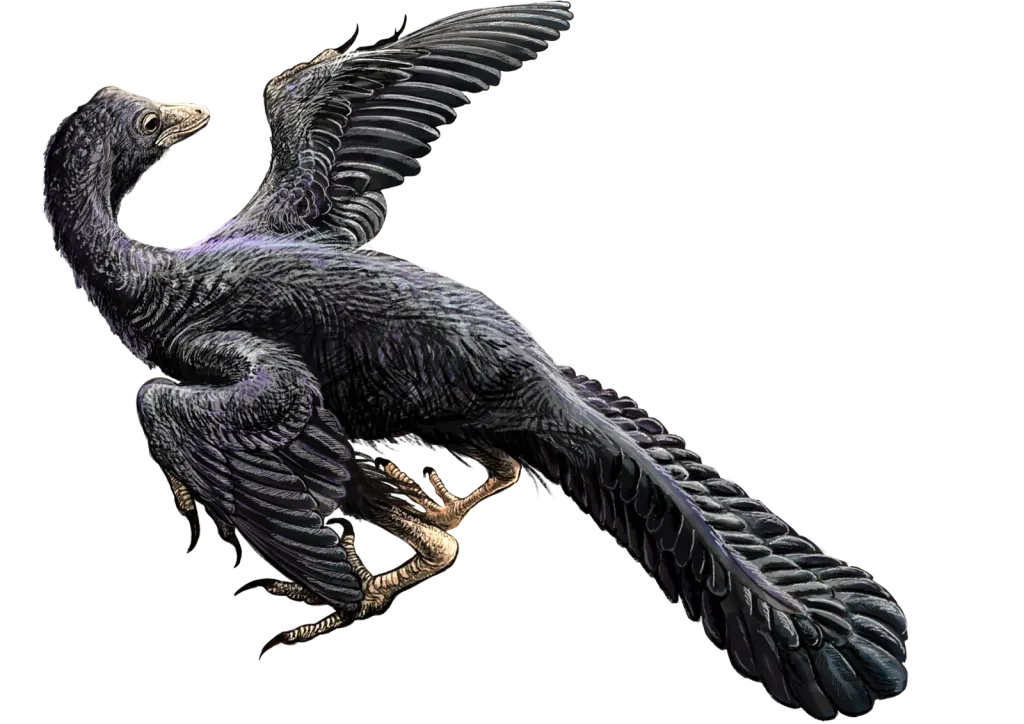
Archaeopteryx lithographica
発音: AR-kee-OP-ter-iks lith-oh-GRAF-ih-kah
Avialae · Archaeopterygidae
A raven-sized feathered theropod from the Late Jurassic limestones of Solnhofen, Bavaria. Usually placed at the base of Avialae, the bird lineage, but it is a transitional animal, not the ancestor of modern birds.
- Feathered
- Bipedal
- Exceptional preservation
- Famous specimen
- Transitional fossil
- 時代
- ジュラ紀· チトニアン期
- 食性
- 肉食
- 全長
- 0.5 m
- 体重
- 不明
- 産地
- Germany, Bavaria
クイックアンサー
- Archaeopteryx lithographicaの大きさは?
- Archaeopteryx lithographicaの全長は約0.5 mでした。腰の高さは約0.1–0.2 mでした。 (Wellnhofer 2009; Paul 2016)
- Archaeopteryx lithographicaはいつ生きていた?
- Archaeopteryx lithographicaはジュラ紀後期、約1.492億〜1.45億年前に生きていました。 (Cohen et al. 2023; Rauhut et al. 2018)
- Archaeopteryx lithographicaの化石はどこで見つかった?
- Archaeopteryx lithographicaの化石はSolnhofen Formation (Bavaria)、Germanyで見つかっています。 (von Meyer 1861; Xu et al. 2011)
- Archaeopteryx lithographicaは何を食べていた?
- Archaeopteryx lithographicaは肉食でした。 (von Meyer 1861; Xu et al. 2011)
- Archaeopteryx lithographicaは誰がいつ命名した?
- Archaeopteryx lithographicaは1861年にHermann von Meyerによって記載されました。 (von Meyer 1861)
このページの内容

- 時代
- ジュラ紀149.2–145 Ma
- 食性
- 肉食
- 全長
- 0.5 m
- 体重
- 不明
- 産地
- Germany
- 分類
- Avialae · Archaeopterygidae
- 記載
- 1861, Hermann von Meyer
概要
このコンテンツは英語でご覧いただけます。
Archaeopteryx lithographica lived about 150 million years ago, in the Late Jurassic, on islands in a warm lagoon sea that covered what is now southern Germany. Its fossils come from the fine lithographic limestones around Solnhofen and Eichstätt in Bavaria. Hermann von Meyer named it in 1861 from a single feather; a nearly complete skeleton, now in London, turned up the same year.
It mixed features of birds and of other small theropods: flight feathers on arms and tail, but also teeth, clawed fingers and a long bony tail. Found two years after On the Origin of Species, it became the classic example of a transitional fossil. Later specimens, such as the one described by Foth, Tischlinger and Rauhut (2014), show pennaceous feathers on the legs as well.
It is popularly called the "first bird", but that phrase needs care. Most analyses place it at or near the base of Avialae, the group that includes modern birds, yet Xu et al. (2011) recovered it closer to Deinonychus and Velociraptor. It is best read as an early member of the bird lineage, not the direct ancestor of living birds, and many feathered dinosaurs from China now blur the line it once drew.
名前の意味
From Greek archaios ("ancient") and pteryx ("feather, wing"); lithographica refers to the lithographic limestone it was found in (von Meyer 1861).
生態と証拠
この動物がどのように暮らしていたかについての科学者の考えと、それぞれの説を支える証拠の強さです。
移動
Archaeopteryx could fly actively, probably in short bursts.
証拠レベル:中程度の証拠Its feathers have the asymmetric shape of flight feathers and its wing bones match those of birds that flap in short bursts. Its shoulder was less advanced than modern birds', so it was not a strong flier.
賛成・反対の証拠 · 2
支持する証拠
組織学 · Archaeopteryx wing bone cross-sections
Synchrotron scans of wing bones show thin walls and a geometry closer to birds that flap in short bursts than to non-flying animals.
羽毛印象 · Archaeopteryx flight feather impressions
Asymmetric flight feathers on the wings and a pair of rows along the tail, preserved in the limestone around the skeletons.
標本: NHMUK PV OR 37001 “London specimen”, MB.Av.101 “Berlin specimen”
皮膚と体表
At least some of the feathers of Archaeopteryx were black.
証拠レベル:中程度の証拠Pigment structures preserved in one isolated feather match those of black feathers in living birds. It says nothing about the rest of the plumage, and the feather's owner is assumed to be Archaeopteryx.
賛成・反対の証拠 · 1
支持する証拠
羽毛印象 · Melanosomes in the isolated Archaeopteryx feather
Fossil pigment structures (melanosomes) in the 1861 feather, compared with living birds, indicate a dark, probably matte black colour.
羽毛
Archaeopteryx had flight feathers on its arms, tail and legs.
証拠レベル:直接証拠The feathers are preserved as impressions in the fine limestone, including asymmetric wing feathers like those of flying birds and, in one specimen, pennaceous leg feathers.
賛成・反対の証拠 · 1
支持する証拠
羽毛印象 · Archaeopteryx flight feather impressions
Asymmetric flight feathers on the wings and a pair of rows along the tail, preserved in the limestone around the skeletons.
標本: NHMUK PV OR 37001 “London specimen”, MB.Av.101 “Berlin specimen”
その他
Archaeopteryx is an early member of the bird lineage (Avialae).
証拠レベル:中程度の証拠Most family-tree analyses put it at the base of the bird lineage, but some place it closer to Velociraptor. It is best read as a close relative near the origin of birds, not the ancestor of living birds.
賛成・反対の証拠 · 1
支持する証拠
系統推定 · Phylogenetic analyses placing Archaeopteryx
Most analyses recover Archaeopteryx as the earliest avialan; Xu et al. (2011) recovered it among deinonychosaurs instead.

サイズ
- 全長
- 0.5 m
- 体高
- 0.2 m文献上の範囲 0.1–0.2 m
- 体重
- 不明
(1.6 フィート)
Largest known specimens に基づく
(0.5 フィート)
Berlin and Thermopolis specimens に基づく
タイムライン
時代: チトニアン期 (149.2–145 Ma), ジュラ紀後期 (161.5–145 Ma)
Ages are the ICS 2023/09 bounds of the Tithonian, the stage(s) the fossils are assigned to; they bracket the record and are not dated first/last appearances. Rauhut et al. (2018) place the oldest specimen (Schamhaupten) at the Kimmeridgian/Tithonian boundary; most specimens are early Tithonian.
産地
累層
- Solnhofen Formation · Bavaria
- Langenaltheim near Solnhofen, Bavaria · Solnhofen Formation · Bavaria · 位置はおおよそ
これは化石が見つかった場所で、この動物が暮らしていた範囲全体ではありません。
生態系
生息環境: Solnhofen archipelago
152–150 百万年前 · 島, 海岸縁, その他
Warm, shallow lagoons behind reefs, dotted with low, dry islands, on the northern margin of the Tethys Sea in the Late Jurassic. The stagnant, salty bottom water let fine lime mud bury carcasses in exceptional detail.

分類
- クレードDinosauria
- クレードSaurischia
- クレードTheropoda
- クレードCoelurosauria
- クレードManiraptora
- クレードAvialae
- 科Archaeopterygidae
- 属Archaeopteryx
- 種Archaeopteryx lithographica
分類上の地位: 有効
化石記録

| 標本番号 | 種別 | 所蔵機関 | 発見 |
|---|---|---|---|
| NHMUK PV OR 37001 “London specimen” | ネオタイプ | Natural History Museum, London (NHMUK) | 1861 |
| MB.Av.101 “Berlin specimen” | 参照標本 | Museum für Naturkunde (MB) | 1876 |
| WDC-CSG-100 “Thermopolis specimen” | 参照標本 | Wyoming Dinosaur Center (WDC) | — |
見つかった部位
ネオタイプ: NHMUK PV OR 37001 “London specimen”
- 保存
- 部分的
- 復元
- 不明・未記録
ネオタイプ: NHMUK PV OR 37001 “London specimen”
部位ごと(表)
| 部位 | 状態 |
|---|---|
| Skull | 部分的 · Braincase only. |
| Mandible | 不明・未記録 |
| Teeth | 不明・未記録 |
| Cervical vertebrae | 不明・未記録 |
| Dorsal vertebrae | 保存 |
| Sacrum | 不明・未記録 |
| Caudal vertebrae | 保存 · Long bony tail with feathers. |
| Ribs | 不明・未記録 |
| Gastralia | 不明・未記録 |
| Scapula / shoulder girdle | 保存 · Furcula. |
| Humerus | 保存 |
| Forearm (radius / ulna) | 不明・未記録 |
| Hand (manus) | 保存 |
| Pelvis | 保存 |
| Femur | 保存 |
| Tibia / fibula | 不明・未記録 |
| Foot (pes) | 保存 |
参照標本: MB.Av.101 “Berlin specimen”
部位ごと(表)
| 部位 | 状態 |
|---|---|
| Skull | 保存 |
| Mandible | 保存 |
| Teeth | 保存 |
| Cervical vertebrae | 保存 |
| Dorsal vertebrae | 保存 |
| Sacrum | 不明・未記録 |
| Caudal vertebrae | 保存 |
| Ribs | 不明・未記録 |
| Gastralia | 不明・未記録 |
| Scapula / shoulder girdle | 保存 |
| Humerus | 保存 |
| Forearm (radius / ulna) | 保存 |
| Hand (manus) | 保存 |
| Pelvis | 保存 |
| Femur | 保存 |
| Tibia / fibula | 保存 |
| Foot (pes) | 保存 |
参照標本: WDC-CSG-100 “Thermopolis specimen”
部位ごと(表)
| 部位 | 状態 |
|---|---|
| Skull | 保存 |
| Mandible | 不明・未記録 |
| Teeth | 不明・未記録 |
| Cervical vertebrae | 不明・未記録 |
| Dorsal vertebrae | 不明・未記録 |
| Sacrum | 不明・未記録 |
| Caudal vertebrae | 不明・未記録 |
| Ribs | 不明・未記録 |
| Gastralia | 不明・未記録 |
| Scapula / shoulder girdle | 不明・未記録 |
| Humerus | 不明・未記録 |
| Forearm (radius / ulna) | 不明・未記録 |
| Hand (manus) | 保存 |
| Pelvis | 不明・未記録 |
| Femur | 不明・未記録 |
| Tibia / fibula | 不明・未記録 |
| Foot (pes) | 保存 |

発見
- 記載年
- 1861
- 記載者
- Hermann von Meyer
- タイプ標本
- NHMUK PV OR 37001 (London specimen; neotype replacing the original isolated feather)

発見の年表
1861 · 標本の発掘
The London specimen is found
A nearly complete skeleton with feathers is found near Langenaltheim and sold to the British Museum in 1862.
1861 · 最初の化石の発見
The Archaeopteryx feather is named
Hermann von Meyer names Archaeopteryx lithographica from an isolated feather found near Solnhofen.
人物:Hermann von Meyer
1863 · 主要な研究
Owen describes the London specimen
Richard Owen describes the skeleton and interprets it as a bird.
人物:Richard Owen
1876 · 標本の発掘
The Berlin specimen is found
The most complete specimen, with its skull, is found near Eichstätt.
2011 · 再検討
London specimen fixed as neotype
The ICZN designates the London skeleton as the name-bearing type, replacing the isolated feather.
出典
- Cohen, K. M., Harper, D. A. T., Gibbard, P. L. & Car, N. (2023). International Chronostratigraphic Chart (v2023/09). International Commission on Stratigraphy. https://stratigraphy.org/ICSchart/ChronostratChart2023-09.pdf(新しいタブで開きます)
- Foth, C., Tischlinger, H. & Rauhut, O. W. M. (2014). New specimen of Archaeopteryx provides insights into the evolution of pennaceous feathers. Nature 511: 79-82. doi:10.1038/nature13467(新しいタブで開きます)
- Paul, G. S. (2016). The Princeton Field Guide to Dinosaurs (2nd edition). Princeton University Press.
- Rauhut, O. W. M., Foth, C. & Tischlinger, H. (2018). The oldest Archaeopteryx (Theropoda: Avialiae): a new specimen from the Kimmeridgian/Tithonian boundary of Schamhaupten, Bavaria. PeerJ 6: e4191. doi:10.7717/peerj.4191(新しいタブで開きます)
- von Meyer, H. (1861). Archaeopteryx lithographica (Vogel-Feder) und Pterodactylus von Solenhofen. Neues Jahrbuch für Mineralogie, Geognosie, Geologie und Petrefakten-Kunde 1861: 678-679.
- Wellnhofer, P. (2009). Archaeopteryx: The Icon of Evolution. Verlag Dr. Friedrich Pfeil, München.
- Xu, X., You, H., Du, K. & Han, F. (2011). An Archaeopteryx-like theropod from China and the origin of Avialae. Nature 475: 465-470. doi:10.1038/nature10288(新しいタブで開きます)