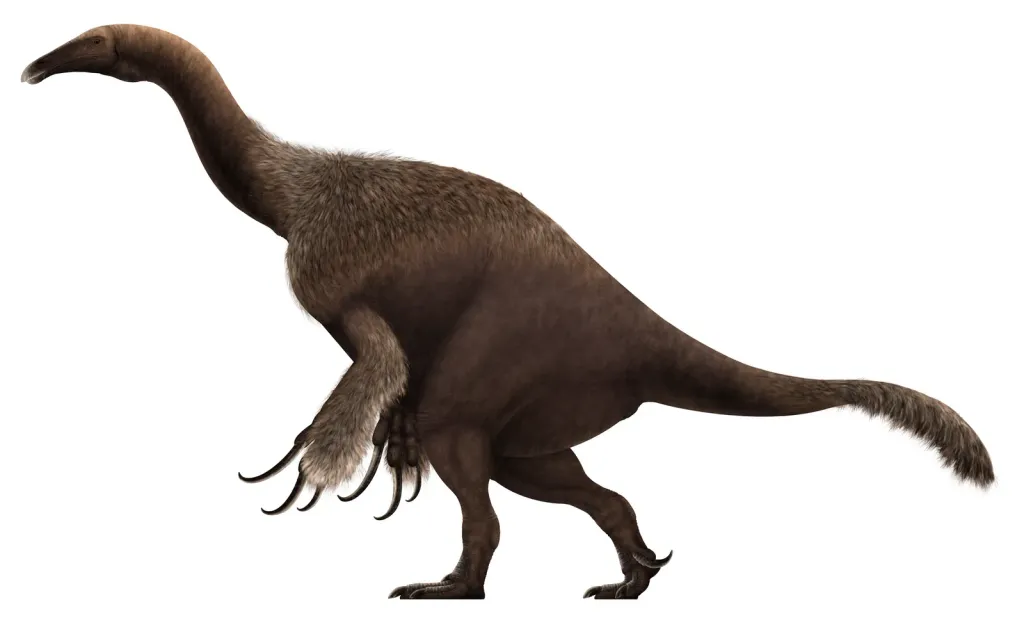
Therizinosaurus cheloniformis
発音: THER-ih-ZIN-oh-SORE-us keh-LOH-nih-FOR-mis
Therizinosauria · Therizinosauridae
A giant therizinosaur from the Late Cretaceous Nemegt Formation of Mongolia, known mainly from its arms and huge hand claws. A theropod that most likely ate plants.
- Feathered
- Bipedal
- Giant
- Giant claws
- Unusual anatomy
- 時代
- 白亜紀· マーストリヒチアン期
- 食性
- 植物食
- 全長
- 9–10 m
- 体重
- 5,000 kg
- 産地
- Mongolia, Ömnögovi Province
クイックアンサー
- Therizinosaurus cheloniformisの大きさは?
- Therizinosaurus cheloniformisの全長は約9–10 mでした。腰の高さは約2.8–3.5 mでした。体重は約5 tでした。 (Paul 2010; Paul 2016)
- Therizinosaurus cheloniformisはいつ生きていた?
- Therizinosaurus cheloniformisは白亜紀後期、約7210万〜6600万年前に生きていました。 (Cohen et al. 2023; Zanno 2010)
- Therizinosaurus cheloniformisの化石はどこで見つかった?
- Therizinosaurus cheloniformisの化石はNemegt Formation (Ömnögovi Province)、Mongoliaで見つかっています。 (Maleev 1954; Zanno 2010)
- Therizinosaurus cheloniformisは何を食べていた?
- Therizinosaurus cheloniformisは植物食でした。 (Maleev 1954; Zanno 2010)
- Therizinosaurus cheloniformisは誰がいつ命名した?
- Therizinosaurus cheloniformisは1954年にEvgeny Maleevによって記載されました。 (Maleev 1954; Zanno 2010)
- Therizinosaurus cheloniformisは『ジュラシック・パーク』に登場しますか?
- はい。Therizinosaurus cheloniformisは『ジュラシック・ワールド/新たなる支配者』 (2022)に登場します。映画には脚色があります。このページでは化石からわかることと比べています。 (Wikipedia: Dinosaurs in Jurassic Park 2026; Lautenschlager 2014)
このページの内容

- 時代
- 白亜紀72.1–66 Ma
- 食性
- 植物食
- 全長
- 9–10 m
- 体重
- 5 t
- 産地
- Mongolia
- 分類
- Therizinosauria · Therizinosauridae
- 記載
- 1954, Evgeny Maleev
概要
このコンテンツは英語でご覧いただけます。
Therizinosaurus cheloniformis lived in what is now the Gobi Desert of Mongolia in the Late Cretaceous. Evgeny Maleev named it in 1954 from enormous flat claws found by a Soviet-Mongolian expedition in the Nemegt Formation, and he took them for the remains of a giant turtle-like reptile.
Later finds of arms and hind limbs showed it was a theropod, part of the strange group Therizinosauria (Zanno 2010). Its relatives had small heads, long necks, broad bellies and four-toed feet. Therizinosaurus itself is known only from limbs and a few other bones, so its full body is reconstructed from those relatives.
Its hand claws are among the longest of any known animal. Despite belonging to the meat-eating theropods, therizinosaurs show leaf-shaped teeth, beaks and wide guts, and Zanno and Makovicky (2011) treat the group as herbivorous. The claws were probably used for pulling down branches, display or defence rather than hunting.
名前の意味
From Greek therizo ("to reap") and sauros ("lizard"): "reaping lizard", for the scythe-like claws; cheloniformis means "turtle-shaped", from Maleev's first interpretation (Maleev 1954).
生態と証拠
この動物がどのように暮らしていたかについての科学者の考えと、それぞれの説を支える証拠の強さです。
摂食
Therizinosaurus was mainly a plant-eater.
証拠レベル:中程度の証拠No skull of Therizinosaurus is known, but its relatives have plant-eater teeth, beaks and wide bellies. It is inferred from them, which is why the evidence is moderate rather than strong.
賛成・反対の証拠 · 1
支持する証拠
比較解剖学 · Therizinosaur leaf-shaped teeth and beaks
Relatives of Therizinosaurus with skulls show leaf-shaped cheek teeth and a toothless beak at the front of the jaws, as in plant-eaters.
羽毛
Therizinosaurus probably had some feathers.
証拠レベル:仮説No skin or feathers are known from Therizinosaurus. Smaller relatives had filament feathers, but very large animals may have lost much of their coat, so this is an inference.
賛成・反対の証拠 · 1
支持する証拠
羽毛印象 · Filamentous feathers on Beipiaosaurus
A smaller Early Cretaceous therizinosaur from China preserved with feather-like filaments.
バイオメカニクス
The giant claws of Therizinosaurus were used to pull branches, not to dig or kill.
証拠レベル:仮説Computer models show the long, gently curved claws would break under digging loads but could hook and pull branches. Display and defence are also possible.
賛成・反対の証拠 · 1
支持する証拠
バイオメカニクスモデル · Therizinosaur claw finite-element models
Models of therizinosaur claws find the long, straight claws of Therizinosaurus poorly suited to digging and better for pulling vegetation or display.
標本: PIN 551-483
サイズ
- 全長
- 9–10 m
- 体高
- 3.1 m文献上の範囲 2.8–3.5 m
- 体重
- 5,000 kg
(32.8 フィート)
(10.2 フィート)
IGM 100/45 (partial hindlimb) に基づく
タイムライン
時代: マーストリヒチアン期 (72.1–66 Ma), 白亜紀後期 (100.5–66 Ma)
Ages are the ICS 2023/09 bounds of the Maastrichtian, the stage(s) the fossils are assigned to; they bracket the record and are not dated first/last appearances. The Nemegt Formation is usually considered early Maastrichtian, but it has no radiometric dates; some authors allow a late Campanian age.
産地
累層
- Nemegt Formation · Ömnögovi Province
- Nemegt Basin, Ömnögovi, Mongolia · Nemegt Formation · Ömnögovi Province · 位置はおおよそ
これは化石が見つかった場所で、この動物が暮らしていた範囲全体ではありません。
生態系

生息環境: Nemegt
72–68 百万年前 · 河川系, 氾濫原, 森林, 沼地・湿地
Wetter than the Djadokhta dunes before it: braided rivers, channels and floodplain forests in the Late Cretaceous Gobi, supporting large herbivores and the tyrannosaurid Tarbosaurus.


分類
- クレードDinosauria
- クレードSaurischia
- クレードTheropoda
- クレードCoelurosauria
- クレードManiraptora
- クレードTherizinosauria
- 科Therizinosauridae
- 属Therizinosaurus
- 種Therizinosaurus cheloniformis
分類上の地位: 有効
化石記録

| 標本番号 | 種別 | 所蔵機関 | 発見 |
|---|---|---|---|
| PIN 551-483 | ホロタイプ | Borissiak Paleontological Institute, Russian Academy of Sciences (PIN) | 1948 |
| MPC-D 100/15 | 参照標本 | Institute of Paleontology, Mongolian Academy of Sciences (MPC) | — |
見つかった部位
ホロタイプ: PIN 551-483
- 保存
- 部分的
- 復元
- 不明・未記録
ホロタイプ: PIN 551-483
部位ごと(表)
| 部位 | 状態 |
|---|---|
| Skull | 不明・未記録 |
| Mandible | 不明・未記録 |
| Teeth | 不明・未記録 |
| Cervical vertebrae | 不明・未記録 |
| Dorsal vertebrae | 不明・未記録 |
| Sacrum | 不明・未記録 |
| Caudal vertebrae | 不明・未記録 |
| Ribs | 部分的 · Rib fragment. |
| Gastralia | 不明・未記録 |
| Scapula / shoulder girdle | 不明・未記録 |
| Humerus | 不明・未記録 |
| Forearm (radius / ulna) | 不明・未記録 |
| Hand (manus) | 部分的 · Three ungual claws. |
| Pelvis | 不明・未記録 |
| Femur | 不明・未記録 |
| Tibia / fibula | 不明・未記録 |
| Foot (pes) | 不明・未記録 |
参照標本: MPC-D 100/15
部位ごと(表)
| 部位 | 状態 |
|---|---|
| Skull | 不明・未記録 |
| Mandible | 不明・未記録 |
| Teeth | 不明・未記録 |
| Cervical vertebrae | 不明・未記録 |
| Dorsal vertebrae | 不明・未記録 |
| Sacrum | 不明・未記録 |
| Caudal vertebrae | 不明・未記録 |
| Ribs | 不明・未記録 |
| Gastralia | 不明・未記録 |
| Scapula / shoulder girdle | 保存 |
| Humerus | 保存 |
| Forearm (radius / ulna) | 保存 |
| Hand (manus) | 部分的 |
| Pelvis | 不明・未記録 |
| Femur | 不明・未記録 |
| Tibia / fibula | 不明・未記録 |
| Foot (pes) | 不明・未記録 |

発見
- 記載年
- 1954
- 記載者
- Evgeny Maleev
- タイプ標本
- PIN 551-483
発見の年表
1948 · 最初の化石の発見
Soviet-Mongolian expedition collects giant claws
Huge flat claws are collected in the Nemegt Basin.
1954 · 正式に記載
Maleev names Therizinosaurus as a turtle-like reptile
Maleev names the animal and interprets it as a giant turtle-like reptile.
人物:Evgeny Maleev
1976 · 主要な研究
Barsbold describes Therizinosaurus arms
New arm material shows Therizinosaurus was a dinosaur with enormous hands.
人物:Rinchen Barsbold
『ジュラシック・パーク』『ジュラシック・ワールド』での登場
映画
- ジュラシック・ワールド/新たなる支配者 (2022)
このコンテンツは英語でご覧いただけます。
映画での描かれ方
A feathered, near-blind giant with scythe-like claws that impales the Giganotosaurus at the climax of Dominion.
映画と化石の違い
- It was a plant eater: the giant claws were probably for pulling down branches, not for fighting predators.
- Feathers are plausible: a close relative preserves feather-like filaments.
映画のタイトルは作品の特定のためにのみ記載しています。DinoDex は『ジュラシック・パーク』/『ジュラシック・ワールド』シリーズとは無関係であり、その承認を受けていません。 映画に登場する恐竜をすべて見る
出典
- (2026). Wikipedia: Dinosaurs in Jurassic Park. Wikipedia. https://en.wikipedia.org/wiki/Dinosaurs_in_Jurassic_Park(新しいタブで開きます)
- Cohen, K. M., Harper, D. A. T., Gibbard, P. L. & Car, N. (2023). International Chronostratigraphic Chart (v2023/09). International Commission on Stratigraphy. https://stratigraphy.org/ICSchart/ChronostratChart2023-09.pdf(新しいタブで開きます)
- Lautenschlager, S. (2014). Morphological and functional diversity in therizinosaur claws and the implications for theropod claw evolution. Proceedings of the Royal Society B 281: 20140497. doi:10.1098/rspb.2014.0497(新しいタブで開きます)
- Maleev, E. A. (1954). Novyy cherepakhoobraznyy yashcher v Mongolii [New turtle-like reptile in Mongolia]. Priroda 1954(3): 106-108.
- Paul, G. S. (2010). The Princeton Field Guide to Dinosaurs. Princeton University Press.
- Paul, G. S. (2016). The Princeton Field Guide to Dinosaurs (2nd edition). Princeton University Press.
- Xu, X., Tang, Z. & Wang, X. (1999). A therizinosauroid dinosaur with integumentary structures from China. Nature 399: 350-354. doi:10.1038/20670(新しいタブで開きます)
- Zanno, L. E. (2010). A taxonomic and phylogenetic re-evaluation of Therizinosauria (Dinosauria: Maniraptora). Journal of Systematic Palaeontology 8(4): 503-543. doi:10.1080/14772011003644595(新しいタブで開きます)
- Zanno, L. E. & Makovicky, P. J. (2011). Herbivorous ecomorphology and specialization patterns in theropod dinosaur evolution. Proceedings of the National Academy of Sciences 108(1): 232-237. doi:10.1073/pnas.1011924108(新しいタブで開きます)