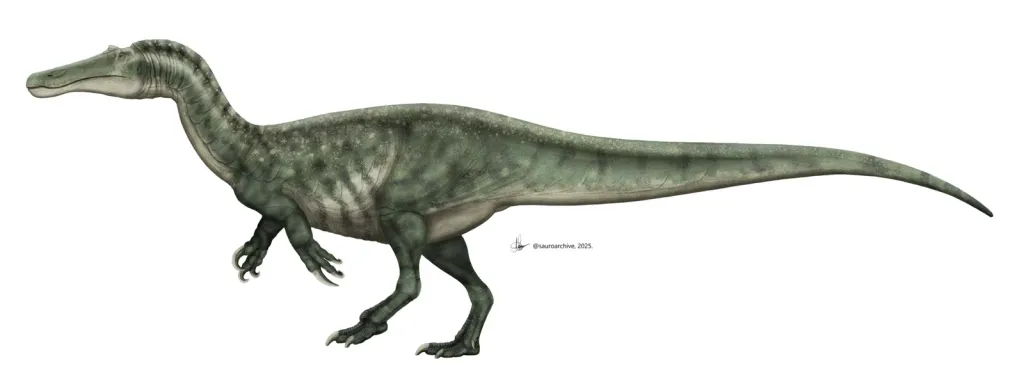
Baryonyx walkeri
発音: BARE-ee-ON-iks WAW-ker-eye
Tetanurae · Spinosauridae
A fish-eating spinosaurid from the Early Cretaceous of southern England, with a long, crocodile-like snout and a 31 cm thumb claw. Its skeleton, found by an amateur collector in 1983, still held fish scales and Iguanodon bones in its belly.
- Bipedal
- Possibly semiaquatic
- Famous specimen
- 時代
- 白亜紀· バレミアン期
- 食性
- 魚食
- 全長
- 7.5–10 m
- 体重
- 1,200–2,000 kg
- 産地
- Surrey, United Kingdom
クイックアンサー
- Baryonyx walkeriの大きさは?
- Baryonyx walkeriの全長は約7.5–10 mでした。腰の高さは約2.2–2.6 mでした。体重は約1.2–2 tでした。 (Wikipedia: Baryonyx 2026; Paul 2016)
- Baryonyx walkeriはいつ生きていた?
- Baryonyx walkeriは白亜紀前期、約1.258億〜1.214億年前に生きていました。 (Paleobiology Database: Baryonyx occurrences 2026; Barker et al. 2021)
- Baryonyx walkeriの化石はどこで見つかった?
- Baryonyx walkeriの化石はWeald Clay Formation (Surrey)、United Kingdomで見つかっています。 (Charig & Milner 1986; Barker et al. 2021)
- Baryonyx walkeriは何を食べていた?
- Baryonyx walkeriは魚食または肉食でした。 (Charig & Milner 1986; Barker et al. 2021)
- Baryonyx walkeriは誰がいつ命名した?
- Baryonyx walkeriは1986年にAlan J. Charig & Angela C. Milnerによって記載されました。 (Charig & Milner 1986; Museum & London 2026)
- Baryonyx walkeriは『ジュラシック・パーク』に登場しますか?
- はい。Baryonyx walkeriは『ジュラシック・ワールド/炎の王国』 (2018)、『ジュラシック・ワールド/新たなる支配者』 (2022)に登場します。映画には脚色があります。このページでは化石からわかることと比べています。 (Wikipedia: Dinosaurs in Jurassic Park 2026; Museum & London 2026)
このページの内容

BARE-ee-ON-iks WAW-ker-eye
- 時代
- 白亜紀125.8–121.4 Ma
- 食性
- 魚食
- 全長
- 7.5–10 m
- 体重
- 1.2–2 t
- 産地
- United Kingdom
- 分類
- Tetanurae · Spinosauridae
- 記載
- 1986, Alan J. Charig & Angela C. Milner
概要
このコンテンツは英語でご覧いただけます。
Baryonyx walkeri lived in southern England in the Barremian, about 125 million years ago, among lagoons and rivers. In January 1983 the amateur collector William Walker found a huge claw in a clay pit near Ockley, Surrey; Natural History Museum staff excavated the skeleton in May and June 1983, and Alan Charig and Angela Milner named it in 1986.
The skeleton (NHMUK PV R9951) is one of the most complete meat-eating dinosaurs found in Britain, with most of the skull. It showed for the first time what spinosaurids looked like: a long, narrow snout with a rosette of teeth at the tip, nostrils set far back and conical, crocodile-like teeth.
Fish scales and bones of a young Iguanodon were found where the stomach had been, so it ate both fish and land animals. It is the best-known spinosaurid from Europe and a key reference for relatives such as Suchomimus and Spinosaurus.
名前の意味
"Heavy claw", from Greek barys ("heavy") and onyx ("claw"); walkeri honours William Walker, who found it (Charig & Milner 1986).
生態と証拠
この動物がどのように暮らしていたかについての科学者の考えと、それぞれの説を支える証拠の強さです。
摂食
Baryonyx also ate land animals such as young Iguanodon.
証拠レベル:強い証拠Bones of a young Iguanodon lay in the same abdominal area. Whether it hunted or scavenged them cannot be told.
賛成・反対の証拠 · 1
支持する証拠
標本 · Baryonyx stomach contents
Fish scales and bones of a young Iguanodon found in the abdominal region of the holotype.
標本: NHMUK PV R9951
Baryonyx ate fish.
証拠レベル:直接証拠Partly digested fish scales were found where its stomach had been, the first direct proof of a fish-eating non-bird dinosaur. Its snout and teeth also resemble those of fish-eating crocodiles.
賛成・反対の証拠 · 2
支持する証拠
標本 · Baryonyx stomach contents
Fish scales and bones of a young Iguanodon found in the abdominal region of the holotype.
標本: NHMUK PV R9951
比較解剖学 · Baryonyx skull and teeth
Nostrils set far back, a rosette of teeth at the snout tip and conical, rounded teeth like those of crocodiles.
標本: NHMUK PV R9951
サイズ
- 全長
- 7.5–10 m
- 体高
- 2.4 m文献上の範囲 2.2–2.6 m
- 体重
- 1,200–2,000 kg
(32.8 フィート)
NHMUK PV R9951 に基づく
(7.9 フィート)
NHMUK R9951 (holotype, subadult) に基づく
NHMUK PV R9951 に基づく
タイムライン
時代: バレミアン期 (125.8–121.4 Ma), 白亜紀前期 (145–100.5 Ma)
Early Barremian bounds of the type collection in PBDB; the NHM gives "around 125 million years".
産地
累層
- Weald Clay Formation · Surrey
- Smokejacks pit, Wallis Wood, Ockley, Surrey · Weald Clay Formation · Surrey · 位置はおおよそ
これは化石が見つかった場所で、この動物が暮らしていた範囲全体ではありません。
生態系
生息環境: Weald Clay
136–125 百万年前 · 河川系, 湖, 沼地・湿地, 海岸平野
Early Cretaceous lagoons, lakes and rivers of south-east England, fresh to brackish, in a semi-arid, fire-prone climate.

分類
- クレードDinosauria
- クレードSaurischia
- クレードTheropoda
- クレードTetanurae
- 上科Megalosauroidea
- 科Spinosauridae
- 亜科Baryonychinae
- 属Baryonyx
- 種Baryonyx walkeri
分類上の地位: 有効
化石記録

| 標本番号 | 種別 | 所蔵機関 | 発見 |
|---|---|---|---|
| NHMUK PV R9951 | ホロタイプ | Natural History Museum, London (NHMUK) | 1983 |
見つかった部位
ホロタイプ: NHMUK PV R9951
- 保存
- 部分的
- 復元
- 不明・未記録
部位ごと(表)
| 部位 | 状態 |
|---|---|
| Skull | 部分的 · Snout and braincase. |
| Mandible | 部分的 |
| Teeth | 部分的 |
| Cervical vertebrae | 不明・未記録 |
| Dorsal vertebrae | 不明・未記録 |
| Sacrum | 不明・未記録 |
| Caudal vertebrae | 不明・未記録 |
| Ribs | 不明・未記録 |
| Gastralia | 不明・未記録 |
| Scapula / shoulder girdle | 不明・未記録 |
| Humerus | 不明・未記録 |
| Forearm (radius / ulna) | 不明・未記録 |
| Hand (manus) | 部分的 · Large first-finger claw, 31 cm along the curve. |
| Pelvis | 不明・未記録 |
| Femur | 不明・未記録 |
| Tibia / fibula | 不明・未記録 |
| Foot (pes) | 不明・未記録 |

発見
- 記載年
- 1986
- 記載者
- Alan J. Charig & Angela C. Milner
- タイプ標本
- NHMUK PV R9951
発見の年表
1983 · 最初の化石の発見
William Walker finds the Baryonyx claw
An amateur collector finds a 31 cm claw in a clay pit near Ockley, Surrey, in January 1983; the museum excavates the skeleton that spring.
人物:William J. Walker
1986 · 正式に記載
Charig and Milner name Baryonyx walkeri
The "heavy claw" is named in Nature.
人物:Alan J. Charig, Angela C. Milner
2021 · 主要な研究
Two new baryonychines named from the Isle of Wight
Barker and colleagues describe Ceratosuchops and Riparovenator, close relatives of Baryonyx, and argue spinosaurids originated in Europe.
『ジュラシック・パーク』『ジュラシック・ワールド』での登場
映画
- ジュラシック・ワールド/炎の王国 (2018)
- ジュラシック・ワールド/新たなる支配者 (2022)
このコンテンツは英語でご覧いただけます。
映画での描かれ方
A predator on Isla Nublar during the volcanic eruption in Fallen Kingdom.
映画と化石の違い
- Fish scales found with its stomach contents show it ate fish; its long, crocodile-like snout suited catching them.
映画のタイトルは作品の特定のためにのみ記載しています。DinoDex は『ジュラシック・パーク』/『ジュラシック・ワールド』シリーズとは無関係であり、その承認を受けていません。 映画に登場する恐竜をすべて見る
出典
- (2026). Paleobiology Database: Baryonyx occurrences. The Paleobiology Database (paleobiodb.org), data service 1.2, accessed 2026-09-23. https://paleobiodb.org/data1.2/occs/list.txt?base_name=Baryonyx&show=coords,paleoloc,strat,loc,ref&pgm=gplates(新しいタブで開きます)
- (2026). Wikipedia: Baryonyx. Wikipedia (English), accessed 2026-09-23. https://en.wikipedia.org/wiki/Baryonyx(新しいタブで開きます)
- (2026). Wikipedia: Dinosaurs in Jurassic Park. Wikipedia. https://en.wikipedia.org/wiki/Dinosaurs_in_Jurassic_Park(新しいタブで開きます)
- Barker, C. T., Hone, D. W. E., Naish, D., Cau, A., Lockwood, J. A. F., Foster, B., Clarkin, C. E., Schneider, P. & Gostling, N. J. (2021). New spinosaurids from the Wessex Formation (Early Cretaceous, UK) and the European origins of Spinosauridae. Scientific Reports 11. doi:10.1038/s41598-021-97870-8(新しいタブで開きます)
- Charig, A. J. & Milner, A. C. (1986). Baryonyx, a remarkable new theropod dinosaur. Nature 324: 359-361. doi:10.1038/324359a0(新しいタブで開きます)
- Natural History Museum, London (2026). How did Baryonyx change what we knew about spinosaurs?. nhm.ac.uk. https://www.nhm.ac.uk/discover/how-did-baryonyx-change-what-we-knew-about-spinosaurs.html(新しいタブで開きます)
- Paul, G. S. (2016). The Princeton Field Guide to Dinosaurs (2nd edition). Princeton University Press.