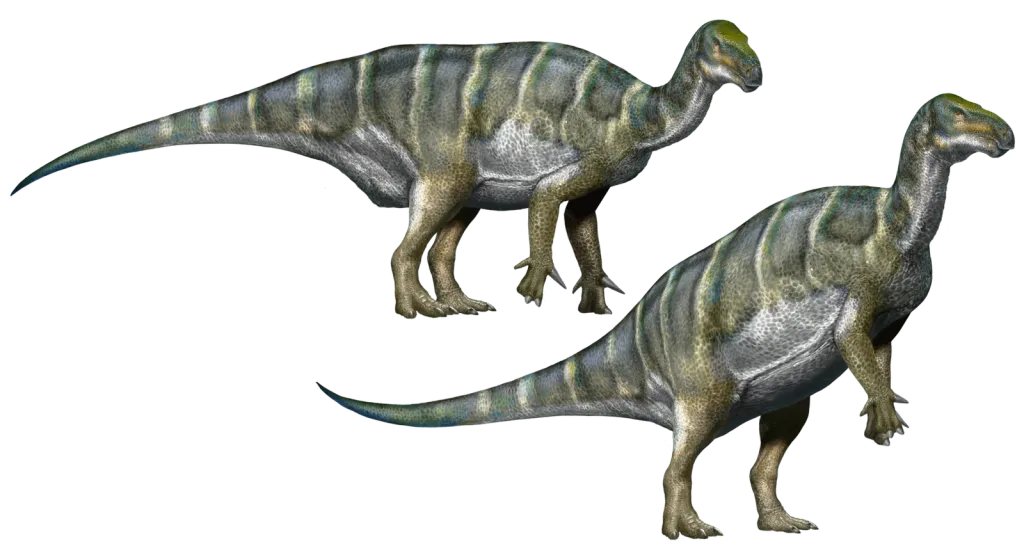
Iguanodon bernissartensis
発音: ig-WAH-noh-don ber-nis-ar-TEN-sis
Iguanodontia · Iguanodontidae
A large plant-eating ornithopod from the Early Cretaceous of Europe with a conical thumb spike. About thirty skeletons were found 322 m underground in a Belgian coal mine at Bernissart in 1878.
- Famous specimen
- 時代
- 白亜紀· バレミアン期
- 食性
- 植物食
- 全長
- 6.3–10 m
- 体重
- 4,500 kg
- 産地
- Hainaut, Belgium, Europe
クイックアンサー
- Iguanodon bernissartensisの大きさは?
- Iguanodon bernissartensisの全長は約6.3–10 mでした。腰の高さは約2.2–2.8 mでした。体重は約4.5 tでした。 (Sciences 2026; Museum & London 2026)
- Iguanodon bernissartensisはいつ生きていた?
- Iguanodon bernissartensisは白亜紀前期、約1.258億〜1.196億年前に生きていました。 (Paleobiology Database: Iguanodon occurrences 2026)
- Iguanodon bernissartensisの化石はどこで見つかった?
- Iguanodon bernissartensisの化石はSainte-Barbe Clays Formation (Hainaut)、Belgiumで見つかっています。 (Mantell 1825; Boulenger 1881)
- Iguanodon bernissartensisは何を食べていた?
- Iguanodon bernissartensisは植物食でした。 (Mantell 1825; Boulenger 1881)
- Iguanodon bernissartensisは誰がいつ命名した?
- Iguanodon bernissartensisは1881年にGeorge A. Boulengerによって記載されました。 (Boulenger 1881; Paleobiology Database: Iguanodon occurrences 2026)
- Iguanodon bernissartensisは『ジュラシック・パーク』に登場しますか?
- はい。Iguanodon bernissartensisは『ジュラシック・ワールド/新たなる支配者』 (2022)に登場します。映画には脚色があります。このページでは化石からわかることと比べています。 (Wikipedia: Dinosaurs in Jurassic Park 2026; Mantell 1825)
このページの内容

- 時代
- 白亜紀125.8–119.6 Ma
- 食性
- 植物食
- 全長
- 6.3–10 m
- 体重
- 4.5 t
- 産地
- Belgium, Europe
- 分類
- Iguanodontia · Iguanodontidae
- 記載
- 1881, George A. Boulenger
概要
このコンテンツは英語でご覧いただけます。
Iguanodon was the second dinosaur ever named. Gideon Mantell named it in 1825 from teeth found in Sussex that resembled those of an iguana, and he placed a spike on its nose. Only the complete skeletons from Belgium showed that the spike belonged on the thumb.
In 1878 miners at Bernissart, Belgium, found dinosaur bones 322 m underground in a coal mine. Some thirty fairly complete skeletons were recovered, most of them Iguanodon bernissartensis, named by George Boulenger in 1881. From 1882 Louis Dollo and Louis De Pauw mounted them in Brussels, where they are still displayed.
Iguanodon was a heavy animal that could walk on four legs or two. Its hand combined a spike-like thumb, three middle fingers that could bear weight and a grasping fifth finger. It lived in the Barremian to early Aptian, and I. bernissartensis is now the type species of the genus.
名前の意味
"Iguana tooth", from iguana and Greek odous ("tooth") (Mantell 1825); bernissartensis for Bernissart, Belgium (Boulenger 1881).
生態と証拠
この動物がどのように暮らしていたかについての科学者の考えと、それぞれの説を支える証拠の強さです。
歯
Iguanodon was named for teeth that look like an iguana's.
証拠レベル:直接証拠Mantell compared the worn fossil teeth with those of a living iguana, much smaller but similar in shape.
賛成・反対の証拠 · 1
支持する証拠
標本 · Mantell's Iguanodon teeth
Large fossil teeth from Sussex that resembled those of an iguana, the basis of the name Iguanodon.
行動
Iguanodon used its thumb spike as a weapon.
証拠レベル:仮説The spike was probably sheathed in sharp horn and could have been used in defence or combat; food handling has also been suggested. No direct evidence of its use is known.
賛成・反対の証拠 · 1
支持する証拠
比較解剖学 · Iguanodon hand and thumb spike
The thumb is a large conical spike; with the three middle fingers and a grasping fifth finger the hand has three different functions.
標本: IRSNB 1534
その他
The spike of Iguanodon was on its thumb, not on its nose.
証拠レベル:直接証拠Mantell had placed a lone spike on the nose. Articulated skeletons from Bernissart showed it sits on the hand.
賛成・反対の証拠 · 2
支持する証拠
比較解剖学 · Iguanodon hand and thumb spike
The thumb is a large conical spike; with the three middle fingers and a grasping fifth finger the hand has three different functions.
標本: IRSNB 1534
標本 · Bernissart Iguanodon skeletons
About thirty relatively complete skeletons recovered 322 m underground in the Bernissart coal mine; eight I. bernissartensis are mounted in Brussels.
標本: IRSNB 1534
サイズ
- 全長
- 6.3–10 m
- 体高
- 2.5 m文献上の範囲 2.2–2.8 m
- 体重
- 4,500 kg
(32.8 フィート)
Bernissart mounts (IRSNB) に基づく
(8.2 フィート)
Bernissart skeletons (femur c. 1.0-1.1 m) に基づく
タイムライン
時代: バレミアン期 (125.8–121.4 Ma), アプチアン期 (121.4–113 Ma), 白亜紀前期 (145–100.5 Ma)
Barremian-early Aptian bounds of the Bernissart collection in PBDB (PBDB time scale).
産地
累層
- Sainte-Barbe Clays Formation · Hainaut
- Sainte-Barbe pit, Bernissart, Hainaut · Sainte-Barbe Clays Formation · Hainaut · 位置はおおよそ
これは化石が見つかった場所で、この動物が暮らしていた範囲全体ではありません。
生態系
生息環境: Weald Clay
136–125 百万年前 · 河川系, 湖, 沼地・湿地, 海岸平野
Early Cretaceous lagoons, lakes and rivers of south-east England, fresh to brackish, in a semi-arid, fire-prone climate.

生息環境: Bernissart
湖, 沼地・湿地
Early Cretaceous lake in the Mons Basin, Belgium, with laminated clays and lignite; ferns such as Weichselia grew around it.
分類
- クレードDinosauria
- クレードOrnithischia
- クレードOrnithopoda
- クレードIguanodontia
- 科Iguanodontidae
- 属Iguanodon
- 種Iguanodon bernissartensis
分類上の地位: 有効
化石記録

| 標本番号 | 種別 | 所蔵機関 | 発見 |
|---|---|---|---|
| IRSNB 1534 | ホロタイプ | Royal Belgian Institute of Natural Sciences (IRSNB) | 1878 |
各標本にどの骨が残っているかはまだ記録されていません。

ギャラリー

発見
- 記載年
- 1881
- 記載者
- George A. Boulenger
- タイプ標本
- IRSNB 1534

発見の年表
1822 · 最初の化石の発見
Iguanodon teeth found in Sussex
Large fossil teeth are found in Sussex; the story that Mary Ann Mantell found them is doubted.
人物:Gideon Mantell
1825 · 正式に記載
Mantell names Iguanodon
Mantell publishes the "iguana tooth" in the Philosophical Transactions.
人物:Gideon Mantell
1878 · 標本の発掘
Iguanodon skeletons found in the Bernissart mine
Miners find bones 322 m underground; the museum is told by telegram on 12 April 1878 and about thirty skeletons are recovered.
1881 · 正式に記載
Boulenger names Iguanodon bernissartensis
The Bernissart species is named.
人物:George A. Boulenger
1882 · 主要な研究
Dollo and De Pauw begin mounting the Bernissart Iguanodons
The first skeleton goes on display in 1883.
人物:Louis Dollo, Louis De Pauw
『ジュラシック・パーク』『ジュラシック・ワールド』での登場
映画
- ジュラシック・ワールド/新たなる支配者 (2022)
このコンテンツは英語でご覧いただけます。
映画での描かれ方
A herd herbivore in Dominion.
映画と化石の違い
- One of the first dinosaurs ever named (1825), from its teeth; its thumb spike is real, its exact use is not known.
映画のタイトルは作品の特定のためにのみ記載しています。DinoDex は『ジュラシック・パーク』/『ジュラシック・ワールド』シリーズとは無関係であり、その承認を受けていません。 映画に登場する恐竜をすべて見る
出典
- (2026). Paleobiology Database: Iguanodon occurrences. The Paleobiology Database (paleobiodb.org), data service 1.2, accessed 2026-09-23. https://paleobiodb.org/data1.2/occs/list.txt?base_name=Iguanodon&show=coords,paleoloc,strat,loc,ref&pgm=gplates(新しいタブで開きます)
- (2026). Wikipedia: Iguanodon. Wikipedia (English), accessed 2026-09-23. https://en.wikipedia.org/wiki/Iguanodon(新しいタブで開きます)
- (2026). Wikipedia: Dinosaurs in Jurassic Park. Wikipedia. https://en.wikipedia.org/wiki/Dinosaurs_in_Jurassic_Park(新しいタブで開きます)
- Boulenger, G. A. (1881). Sur l'arc pelvien chez les dinosauriens de Bernissart. Bulletins de l'Académie royale de Belgique, 3e série, 1(5): 1-11.
- Charig, A. J. & Chapman, S. D. (1998). Iguanodon Mantell, 1825 (Reptilia, Ornithischia): proposed designation of Iguanodon bernissartensis Boulenger in Beneden, 1881 as the type species, and proposed designation of a lectotype. Bulletin of Zoological Nomenclature 55: 99-104. doi:10.5962/bhl.part.157(新しいタブで開きます)
- Mantell, G. (1825). Notice on the Iguanodon, a newly discovered fossil reptile, from the sandstone of Tilgate forest, in Sussex. Philosophical Transactions of the Royal Society of London: 179-186. doi:10.1098/rstl.1825.0010(新しいタブで開きます)
- Natural History Museum, London (2026). Iguanodon: the teeth that led to a dinosaur discovery. nhm.ac.uk. https://www.nhm.ac.uk/discover/the-discovery-of-iguanodon.html(新しいタブで開きます)
- Paul, G. S. (2016). The Princeton Field Guide to Dinosaurs (2nd edition). Princeton University Press.
- Royal Belgian Institute of Natural Sciences (2026). The Bernissart Iguanodons at a glance. naturalsciences.be. https://www.naturalsciences.be/en/discover-join/discover/the-bernissart-iguanodons-at-a-glance(新しいタブで開きます)