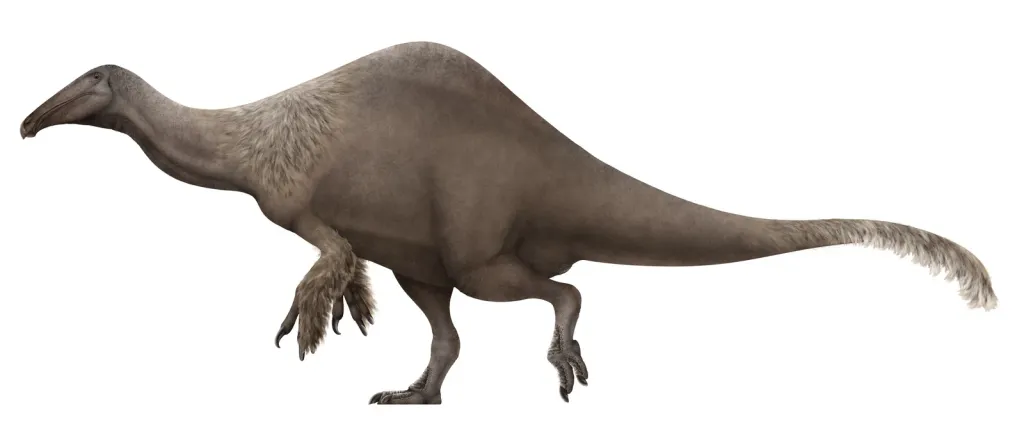
Deinocheirus mirificus
発音: DYE-noh-KY-rus mih-RIF-ih-kus
Ornithomimosauria · Deinocheiridae
A giant, humpbacked ornithomimosaur from the Late Cretaceous of Mongolia, known for decades only from a pair of 2.4 m arms. New skeletons in 2014 revealed a duck-like snout, a sail on its back and a stomach full of stones and fish.
- Bipedal
- Giant
- Giant claws
- Sail backed
- Unusual anatomy
- 時代
- 白亜紀· マーストリヒチアン期
- 食性
- 雑食
- 全長
- 11 m
- 体重
- 6,360 kg
- 産地
- Ömnögovi Province, Mongolia, Asia
クイックアンサー
- Deinocheirus mirificusの大きさは?
- Deinocheirus mirificusの全長は約11 mでした。腰の高さは約2.9–3.5 mでした。体重は約6.4 tでした。 (Wikipedia: Deinocheirus 2026; Lee et al. 2014)
- Deinocheirus mirificusはいつ生きていた?
- Deinocheirus mirificusは白亜紀後期、約7210万〜6600万年前に生きていました。 (Paleobiology Database: Deinocheirus occurrences 2026; Cohen et al. 2023)
- Deinocheirus mirificusの化石はどこで見つかった?
- Deinocheirus mirificusの化石はNemegt Formation (Ömnögovi Province)、Mongoliaで見つかっています。 (Osmólska & Roniewicz 1970; Lee et al. 2014)
- Deinocheirus mirificusは何を食べていた?
- Deinocheirus mirificusは雑食でした。 (Osmólska & Roniewicz 1970; Lee et al. 2014)
- Deinocheirus mirificusは誰がいつ命名した?
- Deinocheirus mirificusは1970年にHalszka Osmólska & Ewa Roniewiczによって記載されました。 (Osmólska & Roniewicz 1970; Lee et al. 2014)
このページの内容

DYE-noh-KY-rus mih-RIF-ih-kus
- 時代
- 白亜紀72.1–66 Ma
- 食性
- 雑食
- 全長
- 11 m
- 体重
- 6.4 t
- 産地
- Mongolia, Asia
- 分類
- Ornithomimosauria · Deinocheiridae
- 記載
- 1970, Halszka Osmólska & Ewa Roniewicz
概要
このコンテンツは英語でご覧いただけます。
Deinocheirus mirificus lived in the Nemegt Formation of Mongolia at the end of the Cretaceous. The 1965 Polish-Mongolian expedition found its holotype at Altan Uul III: mostly a pair of giant forelimbs, 2.4 m long, with shoulder girdles. Halszka Osmólska and Ewa Roniewicz named it in 1970, and for almost fifty years it remained a mystery.
Two new skeletons, found in 2006 and 2009, were described by Lee and colleagues in 2014. Deinocheirus turned out to be the largest ornithomimosaur: a heavily built, slow animal with a long, toothless snout, a deep jaw, very tall spines along the back, short hind legs and broad, blunt toe claws.
More than a thousand gastroliths and fish remains in its body cavity suggest it was a giant omnivore of wet environments. Parts of one skeleton had been poached and sold abroad before being returned to Mongolia in 2014.
名前の意味
"Terrible hand", from Greek deinos ("terrible") and cheir ("hand"); mirificus, Latin for "unusual, peculiar" (Osmólska & Roniewicz 1970).
生態と証拠
この動物がどのように暮らしていたかについての科学者の考えと、それぞれの説を支える証拠の強さです。
移動
Deinocheirus was a slow, heavy animal rather than a runner.
証拠レベル:中程度の証拠Unlike its fast relatives, it had short hind limbs and a heavily built body.
賛成・反対の証拠 · 1
支持する証拠
標本 · New Deinocheirus skeletons
Two skeletons showing an elongate snout, deep jaw, tall neural spines, a pygostyle, a U-shaped furcula, an expanded pelvis, short hind limbs and broad-tipped toe claws.
摂食
Deinocheirus was a giant omnivore that also ate fish.
証拠レベル:中程度の証拠Its skull suggests plant-eating, while gut stones and fish remains show a mixed diet in wet environments.
賛成・反対の証拠 · 2
支持する証拠
標本 · Deinocheirus gastroliths and stomach contents
More than a thousand gastroliths and fish remains in the body cavity.
標本: MPC-D 100/127
標本 · New Deinocheirus skeletons
Two skeletons showing an elongate snout, deep jaw, tall neural spines, a pygostyle, a U-shaped furcula, an expanded pelvis, short hind limbs and broad-tipped toe claws.
その他
Deinocheirus was the largest ornithomimosaur.
証拠レベル:強い証拠Phylogenetic analysis of the new skeletons places it in Ornithomimosauria, the "ostrich dinosaurs", of which it is by far the biggest.
賛成・反対の証拠 · 1
支持する証拠
標本 · New Deinocheirus skeletons
Two skeletons showing an elongate snout, deep jaw, tall neural spines, a pygostyle, a U-shaped furcula, an expanded pelvis, short hind limbs and broad-tipped toe claws.
サイズ
- 全長
- 11 m
- 体高
- 3.2 m文献上の範囲 2.9–3.5 m
- 体重
- 6,360 kg
(36.1 フィート)
(10.5 フィート)
MPC-D 100/127 (femur c. 1.32 m) に基づく
タイムライン
時代: マーストリヒチアン期 (72.1–66 Ma), 白亜紀後期 (100.5–66 Ma)
Maastrichtian bounds of the type collection in PBDB.
産地
累層
- Nemegt Formation · Ömnögovi Province
- Altan Uul III, Nemegt Basin, Ömnögovi · Nemegt Formation · Ömnögovi Province · 位置はおおよそ
これは化石が見つかった場所で、この動物が暮らしていた範囲全体ではありません。
生態系

生息環境: Nemegt
72–68 百万年前 · 河川系, 氾濫原, 森林, 沼地・湿地
Wetter than the Djadokhta dunes before it: braided rivers, channels and floodplain forests in the Late Cretaceous Gobi, supporting large herbivores and the tyrannosaurid Tarbosaurus.


分類
- クレードDinosauria
- クレードSaurischia
- クレードTheropoda
- クレードCoelurosauria
- クレードOrnithomimosauria
- 科Deinocheiridae
- 属Deinocheirus
- 種Deinocheirus mirificus
分類上の地位: 有効
化石記録

| 標本番号 | 種別 | 所蔵機関 | 発見 |
|---|---|---|---|
| MPC-D 100/18 | ホロタイプ | Institute of Paleontology, Mongolian Academy of Sciences (MPC) | 1965 |
| MPC-D 100/127 | 参照標本 | Institute of Paleontology, Mongolian Academy of Sciences (MPC) | 2009 |
| MPC-D 100/128 | 参照標本 | Institute of Paleontology, Mongolian Academy of Sciences (MPC) | 2006 |
見つかった部位
ホロタイプ: MPC-D 100/18
- 保存
- 部分的
- 復元
- 不明・未記録
ホロタイプ: MPC-D 100/18
部位ごと(表)
| 部位 | 状態 |
|---|---|
| Skull | 不明・未記録 |
| Mandible | 不明・未記録 |
| Teeth | 不明・未記録 |
| Cervical vertebrae | 不明・未記録 |
| Dorsal vertebrae | 不明・未記録 |
| Sacrum | 不明・未記録 |
| Caudal vertebrae | 不明・未記録 |
| Ribs | 不明・未記録 |
| Gastralia | 不明・未記録 |
| Scapula / shoulder girdle | 保存 |
| Humerus | 保存 |
| Forearm (radius / ulna) | 保存 |
| Hand (manus) | 保存 |
| Pelvis | 不明・未記録 |
| Femur | 不明・未記録 |
| Tibia / fibula | 不明・未記録 |
| Foot (pes) | 不明・未記録 |
参照標本: MPC-D 100/127
部位ごと(表)
| 部位 | 状態 |
|---|---|
| Skull | 不明・未記録 |
| Mandible | 不明・未記録 |
| Teeth | 不明・未記録 |
| Cervical vertebrae | 不明・未記録 |
| Dorsal vertebrae | 不明・未記録 |
| Sacrum | 不明・未記録 |
| Caudal vertebrae | 不明・未記録 |
| Ribs | 不明・未記録 |
| Gastralia | 不明・未記録 |
| Scapula / shoulder girdle | 不明・未記録 |
| Humerus | 不明・未記録 |
| Forearm (radius / ulna) | 保存 |
| Hand (manus) | 保存 |
| Pelvis | 不明・未記録 |
| Femur | 不明・未記録 |
| Tibia / fibula | 不明・未記録 |
| Foot (pes) | 不明・未記録 |

発見
- 記載年
- 1970
- 記載者
- Halszka Osmólska & Ewa Roniewicz
- タイプ標本
- MPC-D 100/18
発見の年表
1965 · 最初の化石の発見
Giant arms found at Altan Uul III
The Polish-Mongolian expedition collects a pair of 2.4 m forelimbs.
人物:Zofia Kielan-Jaworowska
1970 · 正式に記載
Osmólska and Roniewicz name Deinocheirus
The "terrible hand" is named with its own family.
人物:Halszka Osmólska, Ewa Roniewicz
2014 · 主要な研究
Deinocheirus mystery solved
Lee and colleagues describe two new skeletons revealing the whole animal.
人物:Yuong-Nam Lee, Philip J. Currie
出典
- (2026). Paleobiology Database: Deinocheirus occurrences. The Paleobiology Database (paleobiodb.org), data service 1.2, accessed 2026-09-23. https://paleobiodb.org/data1.2/occs/list.txt?base_name=Deinocheirus&show=coords,paleoloc,strat,loc,ref&pgm=gplates(新しいタブで開きます)
- (2026). Wikipedia: Deinocheirus. Wikipedia (English), accessed 2026-09-23. https://en.wikipedia.org/wiki/Deinocheirus(新しいタブで開きます)
- Cohen, K. M., Harper, D. A. T., Gibbard, P. L. & Car, N. (2023). International Chronostratigraphic Chart (v2023/09). International Commission on Stratigraphy. https://stratigraphy.org/ICSchart/ChronostratChart2023-09.pdf(新しいタブで開きます)
- Lee, Y.-N., Barsbold, R., Currie, P. J., Kobayashi, Y., Lee, H.-J., Godefroit, P., Escuillié, F. & Chinzorig, T. (2014). Resolving the long-standing enigmas of a giant ornithomimosaur Deinocheirus mirificus. Nature 515: 257-260. doi:10.1038/nature13874(新しいタブで開きます)
- Osmólska, H. & Roniewicz, E. (1970). Deinocheiridae, a new family of theropod dinosaurs. Palaeontologia Polonica 21: 5-19.
- Paul, G. S. (2016). The Princeton Field Guide to Dinosaurs (2nd edition). Princeton University Press.