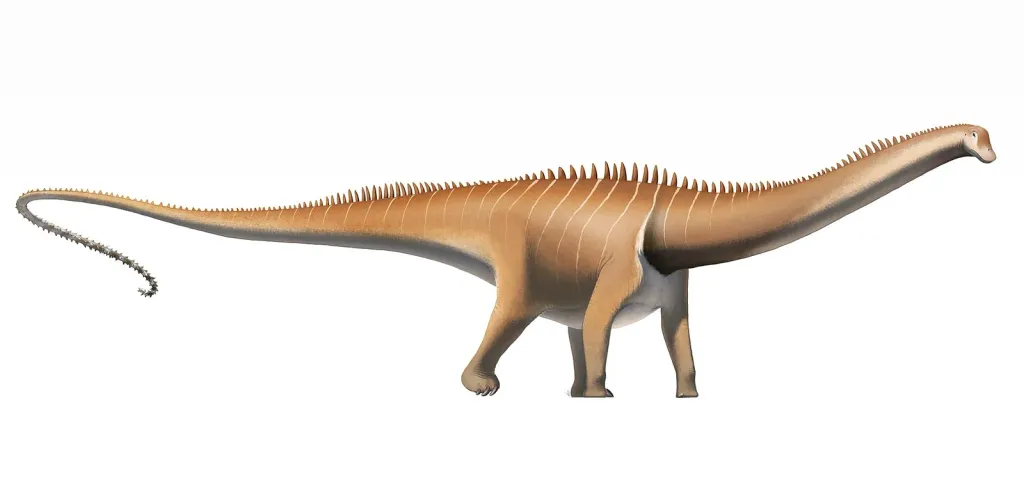
Diplodocus carnegii
発音: dih-PLOD-oh-kus kar-NEG-ee-eye
Sauropoda · Diplodocidae
A very long, slender sauropod from the Late Jurassic Morrison Formation of Wyoming, with a whip-like tail. Its skeleton, "Dippy", was cast and sent to museums around the world, making it one of the most seen dinosaurs anywhere.
- Giant
- Long necked
- Quadrupedal
- Famous specimen
- 時代
- ジュラ紀· キンメリッジアン期
- 食性
- 植物食
- 全長
- 24–26 m
- 体重
- 12,000–14,800 kg
- 産地
- Wyoming, United States, Colorado
クイックアンサー
- Diplodocus carnegiiの大きさは?
- Diplodocus carnegiiの全長は約24–26 mでした。腰の高さは約3–3.4 mでした。体重は約12–14.8 tでした。 (Wikipedia: Diplodocus 2026; Paul 2016)
- Diplodocus carnegiiはいつ生きていた?
- Diplodocus carnegiiはジュラ紀後期、約1.548億〜1.431億年前に生きていました。 (Paleobiology Database: Diplodocus occurrences 2026)
- Diplodocus carnegiiの化石はどこで見つかった?
- Diplodocus carnegiiの化石はMorrison Formation (Colorado)、United Statesで見つかっています。 (Marsh 1878; Hatcher 1901)
- Diplodocus carnegiiは何を食べていた?
- Diplodocus carnegiiは植物食でした。 (Marsh 1878; Hatcher 1901)
- Diplodocus carnegiiは誰がいつ命名した?
- Diplodocus carnegiiは1901年にJohn Bell Hatcherによって記載されました。 (Hatcher 1901; Tschopp et al. 2015)
このページの内容

dih-PLOD-oh-kus kar-NEG-ee-eye
- 時代
- ジュラ紀154.8–143.1 Ma
- 食性
- 植物食
- 全長
- 24–26 m
- 体重
- 12–14.8 t
- 産地
- United States
- 分類
- Sauropoda · Diplodocidae
- 記載
- 1901, John Bell Hatcher
概要
このコンテンツは英語でご覧いただけます。
Diplodocus carnegii lived in western North America in the Late Jurassic. John Bell Hatcher named it in 1901 from a skeleton (CM 84) dug up at Sheep Creek, Wyoming, by a Carnegie Museum crew, and named it after the museum's patron, Andrew Carnegie. Carnegie gave casts of the mounted skeleton, nicknamed "Dippy", to museums in Europe and Latin America.
Diplodocus was long and relatively light for a sauropod, with a horizontal neck, peg-like teeth at the front of the jaws and a tail of about 80 vertebrae ending in a thin whip. The genus is named for the double-beamed chevron bones under its tail.
The first species, D. longus (Marsh 1878), is based on poor material, and a proposal to make D. carnegii the type species was rejected by the ICZN in 2018. Whether the tail could crack like a bullwhip at supersonic speed is debated: a 1997 model said yes, a 2022 model found the tip reached only about 30 m/s.
名前の意味
From Greek diploos ("double") and dokos ("beam"), for the double chevron bones under the tail (Marsh 1878); carnegii honours Andrew Carnegie (Hatcher 1901).
生態と証拠
この動物がどのように暮らしていたかについての科学者の考えと、それぞれの説を支える証拠の強さです。
皮膚と体表
Diplodocus had a row of pointed spines along its back.
証拠レベル:仮説Spines were found with diplodocid skin impressions, but not with a Diplodocus carnegii skeleton, and their position on the body is inferred.
賛成・反対の証拠 · 1
支持する証拠
皮膚印象 · Diplodocid dermal spines
Skin impressions from a diplodocid quarry in Wyoming with narrow, pointed keratinous spines, reconstructed as a row along the midline.
バイオメカニクス
Diplodocus could crack its tail like a whip at supersonic speed.
証拠レベル:議論ありA 1997 model said the tail tip could break the sound barrier. A 2022 model including soft tissue found the tip reached only about 30 m/s and that tissues would fail at supersonic speed.
賛成・反対の証拠 · 2
支持する証拠
バイオメカニクスモデル · Supersonic diplodocid tail model
A computer model of the Apatosaurus louisae tail reaching supersonic speed at the tip, like a bullwhip.
反する証拠
バイオメカニクスモデル · Diplodocid tail multibody model
A multibody model with soft-tissue strength limits: the tail tip reaches about 30 m/s, far below the speed of sound.
その他
Diplodocus longus, not D. carnegii, is the type species of Diplodocus.
証拠レベル:直接証拠This is a naming decision, not a biological finding: in 2018 the ICZN kept the original type species even though its fossils are poor.
賛成・反対の証拠 · 1
支持する証拠
その他 · ICZN Opinion 2425 on the type species of Diplodocus
The Commission declined to replace D. longus with D. carnegii as the type species.
サイズ
- 全長
- 24–26 m
- 体高
- 3.2 m文献上の範囲 3–3.4 m
- 体重
- 12,000–14,800 kg
(85.3 フィート)
CM 84 に基づく
(10.5 フィート)
CM 84 (holotype, femur 1.54 m) に基づく
CM 84 に基づく
タイムライン
時代: キンメリッジアン期 (154.8–149.2 Ma), チトニアン期 (149.2–145 Ma), ジュラ紀後期 (161.5–145 Ma)
First and last appearance bounds of D. carnegii in PBDB (Kimmeridgian-Tithonian, PBDB time scale).
産地
累層
- Morrison Formation · Colorado
- Sheep Creek Quarry D, Albany County, Wyoming · Morrison Formation · Wyoming · 位置はおおよそ
これは化石が見つかった場所で、この動物が暮らしていた範囲全体ではありません。
生態系
生息環境: Morrison
156–147 百万年前 · 氾濫原, 河川系, 疎林, 湖
A vast, seasonally dry floodplain crossed by rivers in the western interior of North America in the Late Jurassic, with a wet and a dry season, conifer and fern vegetation along the water and giant sauropods in abundance.


分類
- クレードDinosauria
- クレードSaurischia
- クレードSauropodomorpha
- クレードSauropoda
- 上科Diplodocoidea
- 科Diplodocidae
- 亜科Diplodocinae
- 属Diplodocus
- 種Diplodocus carnegii
分類上の地位: 有効
化石記録

| 標本番号 | 種別 | 所蔵機関 | 発見 |
|---|---|---|---|
| CM 84 “Dippy” | ホロタイプ | Carnegie Museum of Natural History (CM) | 1899 |
| CM 94 | パラタイプ | Carnegie Museum of Natural History (CM) | — |
見つかった部位
ホロタイプ: CM 84 “Dippy”
- 保存
- 部分的
- 復元
- 不明・未記録
部位ごと(表)
| 部位 | 状態 |
|---|---|
| Skull | 不明・未記録 |
| Mandible | 不明・未記録 |
| Teeth | 不明・未記録 |
| Cervical vertebrae | 保存 |
| Dorsal vertebrae | 部分的 |
| Sacrum | 不明・未記録 |
| Caudal vertebrae | 部分的 |
| Ribs | 不明・未記録 |
| Gastralia | 不明・未記録 |
| Scapula / shoulder girdle | 不明・未記録 |
| Humerus | 不明・未記録 |
| Forearm (radius / ulna) | 不明・未記録 |
| Hand (manus) | 不明・未記録 |
| Pelvis | 不明・未記録 |
| Femur | 不明・未記録 |
| Tibia / fibula | 不明・未記録 |
| Foot (pes) | 不明・未記録 |

ギャラリー

発見
- 記載年
- 1901
- 記載者
- John Bell Hatcher
- タイプ標本
- CM 84

発見の年表
1878 · 正式に記載
Marsh names Diplodocus
Marsh names Diplodocus longus from fragmentary material from Garden Park, Colorado.
人物:Othniel Charles Marsh
1899 · 標本の発掘
Carnegie Museum crew finds CM 84 at Sheep Creek
A large, well-preserved Diplodocus skeleton is excavated in Albany County, Wyoming.
1901 · 正式に記載
Hatcher names Diplodocus carnegii
Hatcher names the species after Andrew Carnegie.
人物:John Bell Hatcher
2018 · 再検討
ICZN keeps D. longus as the type species of Diplodocus
A proposal to make D. carnegii the type species is rejected.
出典
- (2026). Paleobiology Database: Diplodocus occurrences. The Paleobiology Database (paleobiodb.org), data service 1.2, accessed 2026-09-23. https://paleobiodb.org/data1.2/occs/list.txt?base_name=Diplodocus&show=coords,paleoloc,strat,loc,ref&pgm=gplates(新しいタブで開きます)
- (2026). Wikipedia: Diplodocus. Wikipedia (English), accessed 2026-09-23. https://en.wikipedia.org/wiki/Diplodocus(新しいタブで開きます)
- Conti, S., Tschopp, E., Mateus, O., Zanoni, A., Masarati, P. & Sala, G. (2022). Multibody analysis and soft tissue strength refute supersonic dinosaur tail. Scientific Reports 12. doi:10.1038/s41598-022-21633-2(新しいタブで開きます)
- Hatcher, J. B. (1901). Diplodocus (Marsh): its osteology, taxonomy, and probable habits, with a restoration of the skeleton. Memoirs of the Carnegie Museum 1: 1-63. doi:10.5962/p.234818(新しいタブで開きます)
- International Commission on Zoological Nomenclature (2018). Opinion 2425 (Case 3700) – Diplodocus Marsh, 1878 (Dinosauria, Sauropoda): Diplodocus longus Marsh, 1878 maintained as the type species. Bulletin of Zoological Nomenclature 75. https://www.biotaxa.org/bzn/article/view/44176(新しいタブで開きます)
- Marsh, O. C. (1878). Principal characters of American Jurassic dinosaurs. Part I. American Journal of Science, series 3, 16: 411-416.
- Myhrvold, N. P. & Currie, P. J. (1997). Supersonic sauropods? Tail dynamics in the diplodocids. Paleobiology 23: 393-409. doi:10.1017/s0094837300019801(新しいタブで開きます)
- Paul, G. S. (2016). The Princeton Field Guide to Dinosaurs (2nd edition). Princeton University Press.
- Tschopp, E., Mateus, O. & Benson, R. B. J. (2015). A specimen-level phylogenetic analysis and taxonomic revision of Diplodocidae (Dinosauria, Sauropoda). PeerJ 3: e857. doi:10.7717/peerj.857(新しいタブで開きます)