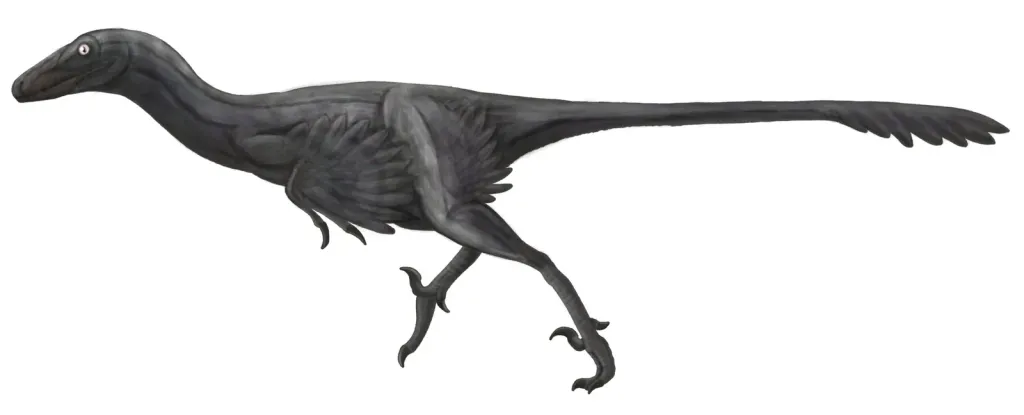
Troodon formosus
発音: TROH-oh-don for-MOH-sus
Maniraptora · Troodontidae
A small, big-brained, bird-like predator from the Late Cretaceous of North America, named in 1856 from a single tooth. Nests from Montana suggest that males brooded the eggs. Whether the name is still usable is debated.
- Bipedal
- Feathered
- Sickle claw
- Eggs known
- 時代
- 白亜紀· カンパニアン期
- 食性
- 肉食
- 全長
- 不明
- 体重
- 不明
- 産地
- Montana, Alberta, United States, Canada
クイックアンサー
- Troodon formosusの大きさは?
- 腰の高さは約0.8–1 mでした。 (Paul 2016)
- Troodon formosusはいつ生きていた?
- Troodon formosusは白亜紀後期、約7950万〜7440万年前に生きていました。 (Paleobiology Database: Troodon occurrences 2026; Rogers et al. 2016)
- Troodon formosusの化石はどこで見つかった?
- Troodon formosusの化石はJudith River Formation (Montana)、Dinosaur Park Formation (Alberta)、United States、Canadaで見つかっています。 (Leidy 1856; Varricchio et al. 1997)
- Troodon formosusは何を食べていた?
- Troodon formosusは肉食または雑食でした。 (Leidy 1856; Varricchio et al. 1997)
- Troodon formosusは誰がいつ命名した?
- Troodon formosusは1856年にJoseph Leidyによって記載されました。 (Leidy 1856; Paleobiology Database: Troodon occurrences 2026)
このページの内容

TROH-oh-don for-MOH-sus
- 時代
- 白亜紀79.5–74.4 Ma
- 食性
- 肉食
- 全長
- 不明
- 体重
- 不明
- 産地
- United States, Canada
- 分類
- Maniraptora · Troodontidae
- 記載
- 1856, Joseph Leidy
概要
このコンテンツは英語でご覧いただけます。
Troodon formosus was named by Joseph Leidy in 1856 from one serrated tooth collected by Ferdinand Hayden in 1855 in the Judith River badlands of Montana. For more than a century it was one of the earliest-named North American dinosaurs, and many small troodontid skeletons from the Campanian of Montana and Alberta were referred to it.
Troodontids were slender, long-legged predators with large eyes, big brains for dinosaurs and an enlarged, retractable second toe claw. Clutches of paired, elongated eggs from Egg Mountain in Montana, some with an adult on top, have been attributed to Troodon (Varricchio et al. 1997).
The clutches are large relative to the adults, and the brooding adults lack the bone features of egg-laying females, which suggests that males cared for the eggs, as in many living birds (Varricchio et al. 2008). A single tooth cannot separate closely related species, so several authors treat Troodon formosus as a doubtful name and use Stenonychosaurus for the Canadian skeletons.
名前の意味
"Wounding tooth", from Greek trōō ("to wound") and odous ("tooth"), for its serrated teeth; formosus, Latin for "beautiful" (Leidy 1856).
生態と証拠
この動物がどのように暮らしていたかについての科学者の考えと、それぞれの説を支える証拠の強さです。
卵
Troodon laid its eggs in pairs in a partly buried clutch.
証拠レベル:中程度の証拠Clutches from Montana show paired eggs, which suggests two working oviducts laying one egg each at intervals. The attribution of the eggs to Troodon itself rests on associated skeletons.
賛成・反対の証拠 · 1
支持する証拠
標本 · Egg Mountain troodontid clutches
Clutches of paired, elongated eggs from the Two Medicine Formation of Montana, attributed to Troodon, some associated with adults.
営巣
Troodon fathers brooded the eggs.
証拠レベル:仮説The clutches are very large for the adults, as in birds where males incubate, and the adults on the nests show no signs of recent egg-laying. Care by males may have evolved before birds.
賛成・反対の証拠 · 2
支持する証拠
組織学 · Clutch volume and brooding-adult histology
Large clutch volumes scale with a bird paternal-care model, and the adults found on clutches lack the bone features of egg-laying females.
標本 · Egg Mountain troodontid clutches
Clutches of paired, elongated eggs from the Two Medicine Formation of Montana, attributed to Troodon, some associated with adults.
その他
Troodon formosus, based on a single tooth, is a valid name.
証拠レベル:議論ありA 2017 study found the type tooth undiagnostic and revived Stenonychosaurus for Canadian skeletons; later work has proposed a neotype to keep Troodon. Which name applies to which fossils is unsettled.
賛成・反対の証拠 · 1
支持する証拠
標本 · Egg Mountain troodontid clutches
Clutches of paired, elongated eggs from the Two Medicine Formation of Montana, attributed to Troodon, some associated with adults.

サイズ
- 全長
- 不明
- 体高
- 0.9 m文献上の範囲 0.8–1 m
- 体重
- 不明
(3 フィート)
全長が不明のため、大きさの比較はまだありません。
タイムライン
時代: カンパニアン期 (83.6–72.1 Ma), 白亜紀後期 (100.5–66 Ma)
Span of its formations: the Judith River Formation of the type area, about 79.5-75.2 Ma (Ar/Ar, Rogers et al. 2016, read in a secondary summary only), and the Dinosaur Park Formation, 76.47-74.44 Ma (Eberth et al. 2023). The type tooth is not tied to a dated level and referred material is debated.
産地
累層
- Judith River Formation · Montana
- Dinosaur Park Formation · Alberta
- Judith River badlands, Fergus County, Montana · Judith River Formation · Montana · 位置はおおよそ
これは化石が見つかった場所で、この動物が暮らしていた範囲全体ではありません。
生態系
生息環境: Dinosaur Park
76.5–74.4 百万年前 · 氾濫原, 海岸平野, 河川系
Late Campanian alluvial and coastal plains on the western shore of the Western Interior Seaway, in what is now southern Alberta.


分類
- クレードDinosauria
- クレードSaurischia
- クレードTheropoda
- クレードCoelurosauria
- クレードManiraptora
- 科Troodontidae
- 属Troodon
- 種Troodon formosus
分類上の地位: 有効
化石記録

| 標本番号 | 種別 | 所蔵機関 | 発見 |
|---|---|---|---|
| ANSP 9259 | ホロタイプ | Academy of Natural Sciences of Drexel University (ANSP) | 1855 |
見つかった部位
ホロタイプ: ANSP 9259
- 保存
- 部分的
- 復元
- 不明・未記録
部位ごと(表)
| 部位 | 状態 |
|---|---|
| Skull | 不明・未記録 |
| Mandible | 不明・未記録 |
| Teeth | 部分的 · One tooth. |
| Cervical vertebrae | 不明・未記録 |
| Dorsal vertebrae | 不明・未記録 |
| Sacrum | 不明・未記録 |
| Caudal vertebrae | 不明・未記録 |
| Ribs | 不明・未記録 |
| Gastralia | 不明・未記録 |
| Scapula / shoulder girdle | 不明・未記録 |
| Humerus | 不明・未記録 |
| Forearm (radius / ulna) | 不明・未記録 |
| Hand (manus) | 不明・未記録 |
| Pelvis | 不明・未記録 |
| Femur | 不明・未記録 |
| Tibia / fibula | 不明・未記録 |
| Foot (pes) | 不明・未記録 |
発見
- 記載年
- 1856
- 記載者
- Joseph Leidy
- タイプ標本
- ANSP 9259
発見の年表
1856 · 正式に記載
Leidy names Troodon from a tooth
Leidy names Troödon formosus from a tooth collected by Hayden in 1855.
人物:Joseph Leidy, Ferdinand V. Hayden
1997 · 主要な研究
Troodon nests described from Egg Mountain
Varricchio and colleagues describe clutches and nests from Montana.
人物:David J. Varricchio
2008 · 主要な研究
Paternal care proposed for Troodon
Clutch size and bone histology suggest males brooded the eggs.
人物:David J. Varricchio
出典
- (2026). Paleobiology Database: Troodon occurrences. The Paleobiology Database (paleobiodb.org), data service 1.2, accessed 2026-09-23. https://paleobiodb.org/data1.2/occs/list.txt?base_name=Troodon&show=coords,paleoloc,strat,loc,ref&pgm=gplates(新しいタブで開きます)
- Eberth, D. A., Evans, D. C., Ramezani, J., Kamo, S. L., Brown, C. M., Currie, P. J. & Braman, D. R. (2023). Calibrating geologic strata, dinosaurs, and other fossils at Dinosaur Provincial Park (Alberta, Canada) using a new CA-ID-TIMS U-Pb geochronology. Canadian Journal of Earth Sciences. doi:10.1139/cjes-2023-0037(新しいタブで開きます)
- Leidy, J. (1856). Notices of remains of extinct reptiles and fishes, discovered by Dr. F. V. Hayden in the bad lands of the Judith River, Nebraska Territory. Proceedings of the Academy of Natural Sciences of Philadelphia.
- Paul, G. S. (2016). The Princeton Field Guide to Dinosaurs (2nd edition). Princeton University Press.
- Rogers, R. R. et al. (2016). Age, correlation, and lithostratigraphic revision of the Upper Cretaceous (Campanian) Judith River Formation in its type area (north-central Montana), with a comparison of low- and high-accommodation alluvial records. The Journal of Geology 124(1). doi:10.1086/684289(新しいタブで開きます)
- Varricchio, D. J., Jackson, F., Borkowski, J. J. & Horner, J. R. (1997). Nest and egg clutches of the dinosaur Troodon formosus and the evolution of avian reproductive traits. Nature 385: 247-250. doi:10.1038/385247a0(新しいタブで開きます)
- Varricchio, D. J., Moore, J. R., Erickson, G. M., Norell, M. A., Jackson, F. D. & Borkowski, J. J. (2008). Avian paternal care had dinosaur origin. Science 322: 1826-1828. doi:10.1126/science.1163245(新しいタブで開きます)