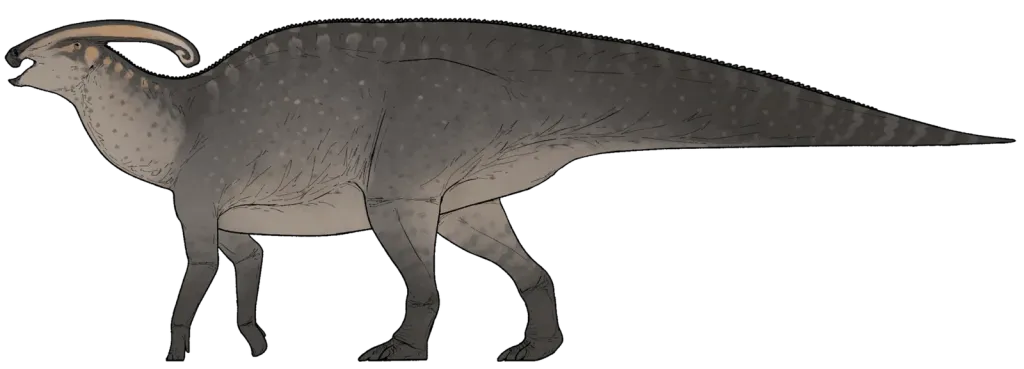
Parasaurolophus walkeri
発音: PAR-ah-sore-OL-oh-fus WAW-ker-eye
Ornithopoda · Hadrosauridae
A duck-billed dinosaur from the Late Cretaceous of Alberta, famous for a long, backward-curving hollow crest. Air from the nose ran through tubes inside the crest, which may have worked as a resonating chamber for deep calls.
- Crested
- Skin impressions known
- 時代
- 白亜紀· カンパニアン期
- 食性
- 植物食
- 全長
- 7.5–10 m
- 体重
- 2,600 kg
- 産地
- Alberta, Canada
クイックアンサー
- Parasaurolophus walkeriの大きさは?
- Parasaurolophus walkeriの全長は約7.5–10 mでした。腰の高さは約2.2–2.8 mでした。体重は約2.6 tでした。 (Farke et al. 2013; Wikipedia: Parasaurolophus 2026)
- Parasaurolophus walkeriはいつ生きていた?
- Parasaurolophus walkeriは白亜紀後期、約7650万〜7580万年前に生きていました。 (Paleobiology Database: Parasaurolophus occurr… 2026; Eberth et al. 2023)
- Parasaurolophus walkeriの化石はどこで見つかった?
- Parasaurolophus walkeriの化石はDinosaur Park Formation (Alberta)、Canadaで見つかっています。 (Parks 1922; Weishampel 1981)
- Parasaurolophus walkeriは何を食べていた?
- Parasaurolophus walkeriは植物食でした。 (Parks 1922; Weishampel 1981)
- Parasaurolophus walkeriは誰がいつ命名した?
- Parasaurolophus walkeriは1922年にWilliam A. Parksによって記載されました。 (Parks 1922; Paleobiology Database: Parasaurolophus occurr… 2026)
- Parasaurolophus walkeriは『ジュラシック・パーク』に登場しますか?
- はい。Parasaurolophus walkeriは『ジュラシック・パーク』 (1993)、『ロスト・ワールド/ジュラシック・パーク』 (1997)、『ジュラシック・パークIII』 (2001)、『ジュラシック・ワールド』 (2015)、『ジュラシック・ワールド/炎の王国』 (2018)、『ジュラシック・ワールド/新たなる支配者』 (2022)、『ジュラシック・ワールド/復活の大地』 (2025)に登場します。映画には脚色があります。このページでは化石からわかることと比べています。 (Wikipedia: Dinosaurs in Jurassic Park 2026; Weishampel 1981)
このページの内容

- 時代
- 白亜紀76.5–75.8 Ma
- 食性
- 植物食
- 全長
- 7.5–10 m
- 体重
- 2.6 t
- 産地
- Canada
- 分類
- Ornithopoda · Hadrosauridae
- 記載
- 1922, William A. Parks
概要
このコンテンツは英語でご覧いただけます。
Parasaurolophus walkeri lived in western North America in the Late Cretaceous (Campanian). William Parks named it in 1922 from a skull and partial skeleton (ROM 768) collected in the Dinosaur Park Formation along the Red Deer River, Alberta. Two other species, P. tubicen and P. cyrtocristatus, come from New Mexico and Utah.
It was a large hadrosaur that could walk on two or four legs. Its crest was formed by the nasal and premaxillary bones, and the nasal passages looped through it. David Weishampel (1981) modelled the crest as a resonating tube; for the type specimen the lowest frequency comes out at about 48 Hz, a very deep sound.
A juvenile from Utah (RAM 14000), about 2.5 m long and probably less than a year old, shows that the crest started as a low bump and began growing at less than a quarter of adult skull size, earlier than in other crested hadrosaurs (Farke et al. 2013). Small patches of scaly skin are preserved with it.
名前の意味
"Near crested lizard", from Greek para ("beside, near"), sauros ("lizard") and lophos ("crest"), after Saurolophus; walkeri honours Sir Byron Edmund Walker (Parks 1922).
生態と証拠
この動物がどのように暮らしていたかについての科学者の考えと、それぞれの説を支える証拠の強さです。
皮膚と体表
Parasaurolophus had scaly skin.
証拠レベル:強い証拠Small skin patches are preserved with the juvenile, as in other hadrosaurs, where skin impressions are common.
賛成・反対の証拠 · 1
支持する証拠
皮膚印象 · RAM 14000 skin impressions
Two small patches of skin impression (under 5 cm) preserved with the juvenile skeleton.
標本: RAM 14000 “Joe”
成長
A 2.5 m Parasaurolophus was probably less than a year old.
証拠レベル:中程度の証拠Its leg bone shows fast-growing juvenile tissue with no annual growth lines.
賛成・反対の証拠 · 1
支持する証拠
組織学 · RAM 14000 tibia histology
Well-vascularised juvenile bone with no growth lines, suggesting an animal in its first year.
標本: RAM 14000 “Joe”
Parasaurolophus started growing its crest earlier than other crested hadrosaurs.
証拠レベル:中程度の証拠A juvenile already had a small crest at less than a quarter of adult skull size; in Corythosaurus the crest appears at about half adult size. It rests on one well-preserved juvenile.
賛成・反対の証拠 · 1
支持する証拠
標本 · RAM 14000 juvenile crest
A 2.5 m juvenile with a low, semicircular crest: crest growth began at less than 25% of maximum skull size, against 50% in Corythosaurus.
標本: RAM 14000 “Joe”
感覚
The crest of Parasaurolophus worked as a resonating chamber for deep calls.
証拠レベル:仮説Air passages loop through the crest, and acoustic models of the adult crest give very low frequencies. Soft tissues are not preserved, so the calls themselves cannot be observed.
賛成・反対の証拠 · 1
支持する証拠
バイオメカニクスモデル · Parasaurolophus crest resonance model
The nasal passages inside the crest modelled as a resonating tube: 3.46 m of tube in ROM 768 gives a first mode of about 48 Hz.
標本: ROM 768
サイズ
- 全長
- 7.5–10 m
- 体高
- 2.5 m文献上の範囲 2.2–2.8 m
- 体重
- 2,600 kg
(32.8 フィート)
ROM 768 に基づく
(8.2 フィート)
ROM 768 (holotype) に基づく
タイムライン
時代: カンパニアン期 (83.6–72.1 Ma), 白亜紀後期 (100.5–66 Ma)
P. walkeri is known from the lower 30 m of the Dinosaur Park Formation, the Corythosaurus-Centrosaurus assemblage zone, 76.47-75.77 Ma (U-Pb age model, Eberth et al. 2023). Other Parasaurolophus species (Kaiparowits, Fruitland) are not this profile.
産地
累層
- Dinosaur Park Formation · Alberta
- Red Deer River below Sand Creek, Dinosaur Park Formation, Alberta · Dinosaur Park Formation · Alberta · 位置はおおよそ
- Kaiparowits Formation, Grand Staircase-Escalante National Monument, Utah · Kaiparowits Formation · Utah · 位置はおおよそ
これは化石が見つかった場所で、この動物が暮らしていた範囲全体ではありません。
生態系
生息環境: Dinosaur Park
76.5–74.4 百万年前 · 氾濫原, 海岸平野, 河川系
Late Campanian alluvial and coastal plains on the western shore of the Western Interior Seaway, in what is now southern Alberta.


分類
- クレードDinosauria
- クレードOrnithischia
- クレードOrnithopoda
- 科Hadrosauridae
- 亜科Lambeosaurinae
- 属Parasaurolophus
- 種Parasaurolophus walkeri
分類上の地位: 有効
化石記録

| 標本番号 | 種別 | 所蔵機関 | 発見 |
|---|---|---|---|
| ROM 768 | ホロタイプ | Royal Ontario Museum (ROM) | 1920 |
| RAM 14000 “Joe” | 参照標本 | Raymond M. Alf Museum of Paleontology (RAM) | — |
見つかった部位
ホロタイプ: ROM 768
- 保存
- 部分的
- 復元
- 不明・未記録
ホロタイプ: ROM 768
部位ごと(表)
| 部位 | 状態 |
|---|---|
| Skull | 保存 · With the full tube crest. |
| Mandible | 不明・未記録 |
| Teeth | 不明・未記録 |
| Cervical vertebrae | 不明・未記録 |
| Dorsal vertebrae | 不明・未記録 |
| Sacrum | 不明・未記録 |
| Caudal vertebrae | 不明・未記録 |
| Ribs | 不明・未記録 |
| Gastralia | 不明・未記録 |
| Scapula / shoulder girdle | 不明・未記録 |
| Humerus | 不明・未記録 |
| Forearm (radius / ulna) | 不明・未記録 |
| Hand (manus) | 不明・未記録 |
| Pelvis | 不明・未記録 |
| Femur | 部分的 |
| Tibia / fibula | 不明・未記録 |
| Foot (pes) | 不明・未記録 |
参照標本: RAM 14000 “Joe”
部位ごと(表)
| 部位 | 状態 |
|---|---|
| Skull | 保存 |
| Mandible | 保存 |
| Teeth | 不明・未記録 |
| Cervical vertebrae | 不明・未記録 |
| Dorsal vertebrae | 不明・未記録 |
| Sacrum | 不明・未記録 |
| Caudal vertebrae | 不明・未記録 |
| Ribs | 不明・未記録 |
| Gastralia | 不明・未記録 |
| Scapula / shoulder girdle | 不明・未記録 |
| Humerus | 保存 |
| Forearm (radius / ulna) | 不明・未記録 |
| Hand (manus) | 不明・未記録 |
| Pelvis | 保存 |
| Femur | 保存 |
| Tibia / fibula | 保存 |
| Foot (pes) | 不明・未記録 |

ギャラリー

発見
- 記載年
- 1922
- 記載者
- William A. Parks
- タイプ標本
- ROM 768
発見の年表
1920 · 最初の化石の発見
University of Toronto party collects the Parasaurolophus holotype
A skull with a long tube crest and much of the skeleton are collected on the Red Deer River, Alberta.
1922 · 正式に記載
Parks names Parasaurolophus walkeri
Parks names the new crested hadrosaur.
人物:William A. Parks
1981 · 主要な研究
Weishampel models the Parasaurolophus crest as a resonator
An acoustic analysis proposes that lambeosaurine crests produced low-frequency calls.
人物:David B. Weishampel
2013 · 主要な研究
Juvenile Parasaurolophus described from Utah
The smallest and most complete Parasaurolophus shows how the crest grew.
人物:Andrew A. Farke
『ジュラシック・パーク』『ジュラシック・ワールド』での登場
映画
- ジュラシック・パーク (1993)
- ロスト・ワールド/ジュラシック・パーク (1997)
- ジュラシック・パークIII (2001)
- ジュラシック・ワールド (2015)
- ジュラシック・ワールド/炎の王国 (2018)
- ジュラシック・ワールド/新たなる支配者 (2022)
- ジュラシック・ワールド/復活の大地 (2025)
このコンテンツは英語でご覧いただけます。
映画での描かれ方
A background herd animal in every film of the series.
映画と化石の違い
- Its long hollow crest probably worked as a resonating chamber for low-pitched calls; the films mostly use it as scenery.
映画のタイトルは作品の特定のためにのみ記載しています。DinoDex は『ジュラシック・パーク』/『ジュラシック・ワールド』シリーズとは無関係であり、その承認を受けていません。 映画に登場する恐竜をすべて見る
出典
- (2026). Paleobiology Database: Parasaurolophus occurrences. The Paleobiology Database (paleobiodb.org), data service 1.2, accessed 2026-09-23. https://paleobiodb.org/data1.2/occs/list.txt?base_name=Parasaurolophus&show=coords,paleoloc,strat,loc,ref&pgm=gplates(新しいタブで開きます)
- (2026). Wikipedia: Parasaurolophus. Wikipedia (English), accessed 2026-09-23. https://en.wikipedia.org/wiki/Parasaurolophus(新しいタブで開きます)
- (2026). Wikipedia: Dinosaurs in Jurassic Park. Wikipedia. https://en.wikipedia.org/wiki/Dinosaurs_in_Jurassic_Park(新しいタブで開きます)
- (2026). Wikipedia: Jurassic World Rebirth. Wikipedia. https://en.wikipedia.org/wiki/Jurassic_World_Rebirth(新しいタブで開きます)
- Eberth, D. A., Evans, D. C., Ramezani, J., Kamo, S. L., Brown, C. M., Currie, P. J. & Braman, D. R. (2023). Calibrating geologic strata, dinosaurs, and other fossils at Dinosaur Provincial Park (Alberta, Canada) using a new CA-ID-TIMS U-Pb geochronology. Canadian Journal of Earth Sciences. doi:10.1139/cjes-2023-0037(新しいタブで開きます)
- Farke, A. A., Chok, D. J., Herrero, A., Scolieri, B. & Werning, S. (2013). Ontogeny in the tube-crested dinosaur Parasaurolophus (Hadrosauridae) and heterochrony in hadrosaurids. PeerJ 1: e182. doi:10.7717/peerj.182(新しいタブで開きます)
- Parks, W. A. (1922). Parasaurolophus walkeri, a new genus and species of crested trachodont dinosaur. University of Toronto Studies, Geology Series 13: 1-32.
- Paul, G. S. (2016). The Princeton Field Guide to Dinosaurs (2nd edition). Princeton University Press.
- Weishampel, D. B. (1981). Acoustic analyses of potential vocalization in lambeosaurine dinosaurs (Reptilia: Ornithischia). Paleobiology 7: 252-261. doi:10.1017/s0094837300004036(新しいタブで開きます)