How Long Was Diplodocus Compared to a Bus?
About 24 to 26 metres: two city buses parked end to end. Most of that was neck and tail, which is why Diplodocus was long but surprisingly light.
Este conteúdo está disponível em inglês.
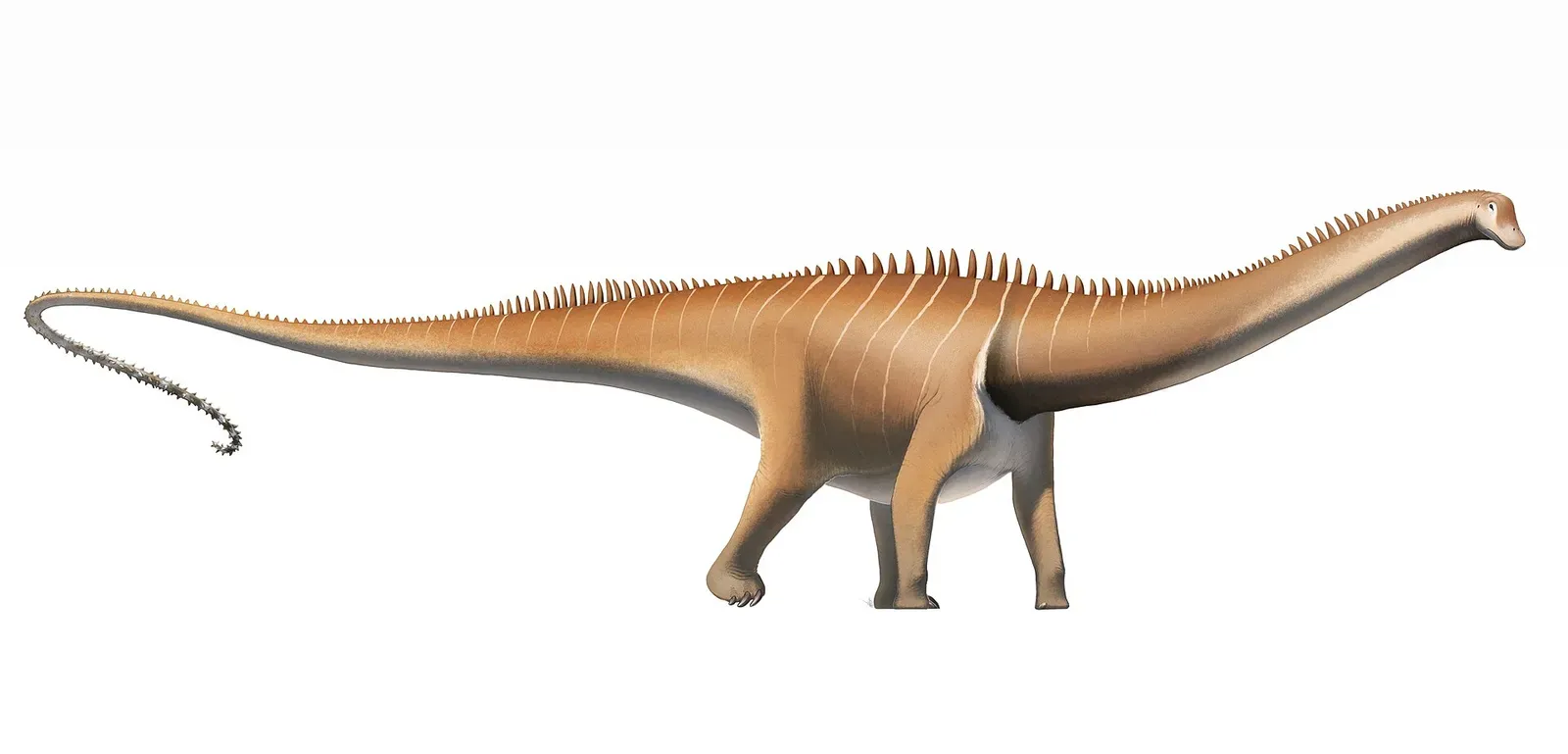
Diplodocus carnegii was about 24 to 26 m (79 to 85 ft) long, the length usually given for the skeleton CM 84 described by John Bell Hatcher in 1901. That is roughly two 12-metre (40 ft) city buses parked nose to tail, but it weighed only about 12 to 14.8 tonnes (13 to 16 short tons), roughly the weight of one city bus.
So Diplodocus was one of the longest dinosaurs known from a good skeleton, without being one of the heaviest.
Diplodocus vs a bus at a glance
- Length: Diplodocus about 24 to 26 m (79 to 85 ft); a standard city bus about 12 m (40 ft).
- Weight: Diplodocus about 12 to 14.8 t (13 to 16 short tons), a range of published estimates.
- Hip height (estimated): about 3 to 3.4 m (9.8 to 11.2 ft), around the roof of a city bus.
- When: the Late Jurassic, about 155 to 143 million years ago.
- Where: the Morrison Formation of Wyoming, USA.
How long was Diplodocus, really?
The benchmark is CM 84, the type specimen of D. carnegii, found in Wyoming and described by Hatcher (1901). It was cast and sent to museums around the world as "Dippy", which is why its outline is so familiar. The 24 to 26 m range comes from secondary summaries of the published estimates and is marked low confidence on the DinoDex profile until the primary figures are checked.
Why a range? Nobody has found every tail vertebra of one individual. The end of a Diplodocus tail was a long, thin whip of small bones, and small bones are easy to lose. How many you restore changes the total by metres.

Why was Diplodocus so long but so light?
Most of its length was neck and tail, and both were built light. The neck vertebrae were hollowed out by air sacs, a feature shared with birds, which cut weight without losing strength. The tail tapered to a whip. Only the trunk in the middle carried the bulk of the body.
That is why estimates of 12 to 14.8 tonnes are modest for its length. For comparison, a titanosaur like Argentinosaurus may have been only somewhat longer, at a quoted 30 to 35 m, yet several times heavier. See was Argentinosaurus the biggest dinosaur ever?
How tall was Diplodocus?
Height depends on posture, which is still debated for sauropod necks. The one number we can estimate from the bones is hip height: about 3 to 3.4 m, derived from the hind limb of CM 84 and recorded as a low-confidence estimate (Paul 2016). In other words, its hips were at about the height of a city bus roof.
How does Diplodocus compare with its neighbours?
The Morrison Formation had several giant sauropods living in the same landscapes:
- [Apatosaurus](/dinosaurs/apatosaurus-ajax): about 21 to 23 m (69 to 75 ft), shorter but much bulkier.
- [Brontosaurus](/dinosaurs/brontosaurus-excelsus): about 21 to 23 m (69 to 75 ft), also heavily built.
- [Brachiosaurus](/dinosaurs/brachiosaurus-altithorax): long front legs and a high shoulder; see Brachiosaurus vs Argentinosaurus.
Diplodocus was the stretched, slender one of the group. You can line them up on the compare tool.
How many buses long was Diplodocus?
Take a standard 12-metre city bus. Two of them end to end make 24 metres, the short end of the range for CM 84; add a family car and you reach about 26 metres. Laid out beside those two buses, most of the Diplodocus would be neck and tail: the part with legs under it would cover only a fraction of one bus.
Next to a person the scale is even stranger. An adult human, about 1.7 m (5 ft 7 in) tall, would be shorter than the animal's hip height and roughly a fifteenth of its length.
Where to see Diplodocus
The species name honours Andrew Carnegie, the industrialist who paid for the excavation. Casts of CM 84 stand in museums across Europe and the Americas, and the original is at the Carnegie Museum of Natural History in Pittsburgh. On DinoDex, the Morrison Formation page links every profile from the same rocks.
Quick answers
- How long was Diplodocus? About 24 to 26 m (79 to 85 ft), roughly two city buses.
- How heavy was Diplodocus? About 12 to 14.8 t (13 to 16 short tons), light for its length.
- Was Diplodocus the longest dinosaur? One of the longest known from a good skeleton; some titanosaurs may have been longer, but they are known from less complete remains.

Sources
- Hatcher, J. B.. (1901). Diplodocus (Marsh): its osteology, taxonomy, and probable habits, with a restoration of the skeleton. Memoirs of the Carnegie Museum 1: 1-63 doi:10.5962/p.234818
- (2026). Wikipedia: Diplodocus. Wikipedia (English), accessed 2026-09-23 Link
- Paul, G. S.. (2016). The Princeton Field Guide to Dinosaurs (2nd edition). Princeton University Press
Dinossauros relacionados


Mostrando 4 de 4
Posts relacionados

Size & comparisons
Was Argentinosaurus the Biggest Dinosaur Ever?
By weight, Argentinosaurus is the leading candidate, at roughly 65 to 83 tonnes. But it is known from a handful of bones, and Patagotitan is close behind.
DinoDex team · 27 de setembro de 2026 · 4 min de leitura

Size & comparisons
Brachiosaurus vs Argentinosaurus: Tallest vs Heaviest
Argentinosaurus was more than twice as heavy. Brachiosaurus was built to reach high, with long front legs, but the evidence for which stood taller is thin.
DinoDex team · 27 de setembro de 2026 · 3 min de leitura

Explainers
How Complete Are Dinosaur Fossils? Less Than You Think
Complete dinosaur skeletons are rare, and many species are known from a skull or a handful of bones. Here is why, and what it means for the numbers you read.
DinoDex team · 26 de setembro de 2026 · 5 min de leitura