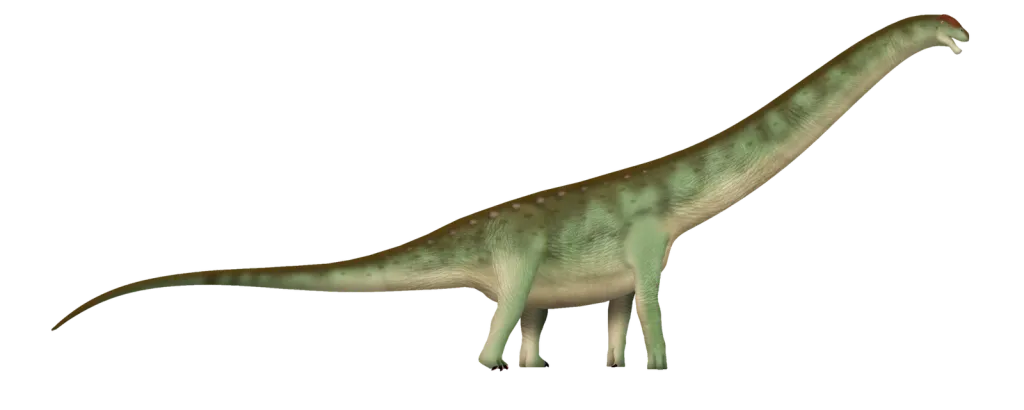
Argentinosaurus huinculensis
Pronounced ar-jen-TEE-noh-SORE-us hwin-koo-LEN-sis
Titanosauria
A titanosaur from the Late Cretaceous of Patagonia, Argentina, and one of the heaviest land animals known, estimated at 65 to 75 tonnes. It is known from only a few enormous bones: back vertebrae, part of the hip and a lower leg bone.
- Giant
- Long necked
- Quadrupedal
- Period
- Cretaceous· Cenomanian
- Diet
- Herbivore
- Length
- 30–35 m
- Mass
- 65,000–83,000 kg
- Location
- Neuquén Province, Argentina
Quick answers
- How big was Argentinosaurus huinculensis?
- Argentinosaurus huinculensis was about 30–35 m long. It stood about 4.8–5.5 m tall at the hips. It weighed about 65–83 t. (Wikipedia: Argentinosaurus 2026; Paul 2016)
- When did Argentinosaurus huinculensis live?
- Argentinosaurus huinculensis lived during the Late Cretaceous, about 100.5–89.8 million years ago. (Cohen et al. 2023; Garrido 2010)
- Where have Argentinosaurus huinculensis fossils been found?
- Fossils of Argentinosaurus huinculensis have been found in Huincul Formation (Neuquén Province) and Argentina. (Bonaparte & Coria 1993; Paul 2019)
- What did Argentinosaurus huinculensis eat?
- Argentinosaurus huinculensis was a herbivore. (Bonaparte & Coria 1993; Paul 2019)
- Who named Argentinosaurus huinculensis, and when?
- Argentinosaurus huinculensis was described by José F. Bonaparte & Rodolfo A. Coria in 1993. (Bonaparte & Coria 1993; Paleobiology Database: Argentinosaurus occurr… 2026)
On this page

- Period
- Cretaceous100.5–89.8 Ma
- Diet
- Herbivore
- Length
- 30–35 m
- Mass
- 65–83 t
- Location
- Argentina
- Classification
- Titanosauria
- Described
- 1993, José F. Bonaparte & Rodolfo A. Coria
Overview
Argentinosaurus huinculensis lived in what is now Neuquén Province, Argentina, in the Late Cretaceous. A rancher, Guillermo Heredia, found its first bone in 1987 on the Las Overas farm near Plaza Huincul, and José Bonaparte and Rodolfo Coria named it in 1993. The fossils are kept at the Museo Carmen Funes in Plaza Huincul.
Only a small part of the skeleton is known: seven back (dorsal) vertebrae, five hip (sacral) vertebrae, rib fragments and a fibula from the lower leg. The back vertebrae are much larger and longer than those of any other described titanosaur, which is why most researchers rank it among the largest land animals of all time.
Its size can only be estimated from these bones and from better-known relatives. Gregory Paul (2019) estimated 65 to 75 tonnes; a computer model of the museum reconstruction gave about 83 tonnes (Sellers et al. 2013). The same study simulated its walk and found that such a giant could move, but only at a slow pace.
Name meaning
"Argentine lizard", from Argentina and Greek sauros; huinculensis refers to Plaza Huincul, the town near the find (Bonaparte & Coria 1993).
Biology & evidence
What scientists think about how this animal lived, and how strong the evidence for each idea is.
Locomotion
Argentinosaurus could walk, but only at a slow pace.
Evidence level: HypothesisA computer model with estimated muscles managed to walk; its best gait was slow. The result depends on many assumed soft-tissue values.
Evidence for / against · 1
Evidence for
Biomechanical model · Argentinosaurus gait simulation
A musculoskeletal model evolved a walking gait; its best speed is equivalent to a slow human walk in dimensionless terms.
Other
Argentinosaurus is known from only a small part of its skeleton.
Evidence level: Direct evidenceThe holotype consists of back and hip vertebrae, rib fragments and a lower leg bone; the rest of the body is reconstructed from relatives.
Evidence for / against · 1
Evidence for
Specimen · Argentinosaurus holotype vertebrae
Seven dorsal and five sacral vertebrae whose centra are much longer and bulkier than those of Patagotitan, Puertasaurus, Notocolossus, Dreadnoughtus or Futalognkosaurus.
Specimen: MCF-PVPH-1
Argentinosaurus was one of the heaviest land animals that ever lived.
Evidence level: Moderate evidenceIts back vertebrae are larger than those of any other described titanosaur, and different methods give 65 to more than 80 tonnes. Because so little of the skeleton is known, the exact figure is uncertain.
Evidence for / against · 3
Evidence for
Specimen · Argentinosaurus holotype vertebrae
Seven dorsal and five sacral vertebrae whose centra are much longer and bulkier than those of Patagotitan, Puertasaurus, Notocolossus, Dreadnoughtus or Futalognkosaurus.
Specimen: MCF-PVPH-1
Biomechanical model · Argentinosaurus volumetric mass model
A volumetric model built on a skeletal restoration gives 65-75 tonnes.
Specimen: MCF-PVPH-1
Biomechanical model · Argentinosaurus convex-hull model of the Carmen Funes reconstruction
A LiDAR scan of the museum reconstruction, convex-hulled segment by segment, gives a body mass of 83,230 kg.
Size
- Length
- 30–35 m
- Height
- 5 mpublished range 4.8–5.5 m
- Mass
- 65,000–83,000 kg
(114.8 ft)
Based on MCF-PVPH-1
(16.4 ft)
Based on MCF-PVPH-1 (femur shaft only)
Based on MCF-PVPH-1
Timeline
Periods: Cenomanian (100.5–93.9 Ma), Turonian (93.9–89.8 Ma), Late Cretaceous (100.5–66 Ma)
Stage bounds (ICS 2023/09) of the Cenomanian-Turonian: the Huincul Formation is usually placed in the upper Cenomanian-lower Turonian (Garrido 2010). The 1993 description and PBDB still give a Middle Albian age (110.1-106.3 Ma); the dispute is noted, not averaged.
Location
Formations
- Huincul Formation · Neuquén Province
- Estancia Las Overas, near Plaza Huincul, Neuquén · Huincul Formation · Neuquén Province · position approximate
These are the places where fossils have been found, not the full area where the animal lived.
Ecosystem
Lived in: Huincul
river system, floodplain
Seasonally dry plains crossed by ephemeral or seasonal streams in the Neuquén Basin of northern Patagonia. Its age is disputed (Albian in older works, Cenomanian-Turonian in recent ones), so no age is recorded here.
Classification
- cladeDinosauria
- cladeSaurischia
- cladeSauropodomorpha
- cladeSauropoda
- cladeMacronaria
- cladeTitanosauria
- genusArgentinosaurus
- speciesArgentinosaurus huinculensis
Taxonomic status: Valid
Fossil record

| Catalog number | Status | Institution | Found |
|---|---|---|---|
| MCF-PVPH-1 | Holotype | Museo Municipal Carmen Funes (MCF) | 1987 |
| MLP-DP 46-VIII-21-3 | Referred specimen | Museo de La Plata (MLP) | — |
What has been found
Holotype: MCF-PVPH-1
- Preserved
- Partial
- Reconstructed
- Unknown / not recorded
Holotype: MCF-PVPH-1
Region by region (table)
| Region | State |
|---|---|
| Skull | Unknown / not recorded |
| Mandible | Unknown / not recorded |
| Teeth | Unknown / not recorded |
| Cervical vertebrae | Unknown / not recorded |
| Dorsal vertebrae | Partial · Seven dorsal vertebrae, six with centra (Paul 2019). |
| Sacrum | Partial · Five sacral vertebrae. |
| Caudal vertebrae | Unknown / not recorded |
| Ribs | Partial · Rib fragments (secondary source). |
| Gastralia | Unknown / not recorded |
| Scapula / shoulder girdle | Unknown / not recorded |
| Humerus | Unknown / not recorded |
| Forearm (radius / ulna) | Unknown / not recorded |
| Hand (manus) | Unknown / not recorded |
| Pelvis | Unknown / not recorded |
| Femur | Unknown / not recorded |
| Tibia / fibula | Partial · A fibula, first identified as a tibia (lower leg; no separate fibula region in the ontology). |
| Foot (pes) | Unknown / not recorded |
Referred specimen: MLP-DP 46-VIII-21-3
Region by region (table)
| Region | State |
|---|---|
| Skull | Unknown / not recorded |
| Mandible | Unknown / not recorded |
| Teeth | Unknown / not recorded |
| Cervical vertebrae | Unknown / not recorded |
| Dorsal vertebrae | Unknown / not recorded |
| Sacrum | Unknown / not recorded |
| Caudal vertebrae | Unknown / not recorded |
| Ribs | Unknown / not recorded |
| Gastralia | Unknown / not recorded |
| Scapula / shoulder girdle | Unknown / not recorded |
| Humerus | Unknown / not recorded |
| Forearm (radius / ulna) | Unknown / not recorded |
| Hand (manus) | Unknown / not recorded |
| Pelvis | Unknown / not recorded |
| Femur | Partial |
| Tibia / fibula | Unknown / not recorded |
| Foot (pes) | Unknown / not recorded |

Discovery
- Year described
- 1993
- Described by
- José F. Bonaparte & Rodolfo A. Coria
- Type specimen
- MCF-PVPH-1
Discovery timeline
1987 · First material found
Guillermo Heredia finds the first Argentinosaurus bone
A rancher finds a huge bone on his farm near Plaza Huincul, Neuquén.
People: Guillermo Heredia
1993 · Formally described
Bonaparte and Coria name Argentinosaurus huinculensis
Named in Ameghiniana as a new, gigantic titanosaur.
People: José F. Bonaparte, Rodolfo Coria
2013 · Major study
Argentinosaurus walks in a computer simulation
Sellers and colleagues scan the museum reconstruction and simulate its gait.
People: William I. Sellers, Rodolfo Coria
2019 · Major study
Paul compares the largest titanosaurs
A size comparison of giant titanosaurs puts Argentinosaurus at 65-75 tonnes, above Patagotitan.
People: Gregory S. Paul
Sources
- (2026). Paleobiology Database: Argentinosaurus occurrences. The Paleobiology Database (paleobiodb.org), data service 1.2, accessed 2026-09-23. https://paleobiodb.org/data1.2/occs/list.txt?base_name=Argentinosaurus&show=coords,paleoloc,strat,loc,ref&pgm=gplates (opens in a new tab)
- (2026). Wikipedia: Argentinosaurus. Wikipedia (English), accessed 2026-09-23. https://en.wikipedia.org/wiki/Argentinosaurus (opens in a new tab)
- Bonaparte, J. F. & Coria, R. A. (1993). Un nuevo y gigantesco saurópodo titanosaurio de la Formación Río Limay (Albiano-Cenomaniano) de la Provincia del Neuquén, Argentina. Ameghiniana 30(3): 271-282.
- Cohen, K. M., Harper, D. A. T., Gibbard, P. L. & Car, N. (2023). International Chronostratigraphic Chart (v2023/09). International Commission on Stratigraphy. https://stratigraphy.org/ICSchart/ChronostratChart2023-09.pdf (opens in a new tab)
- Garrido, A. C. (2010). Stratigraphy of the Neuquén Group, Upper Cretaceous of the Neuquén Basin (Argentina): new proposal for lithostratigraphic ordaining. Revista del Museo Argentino de Ciencias Naturales 12: 121-177. doi:10.22179/revmacn.12.239 (opens in a new tab)
- Mazzetta, G. V., Christiansen, P. & Fariña, R. A. (2004). Giants and bizarres: body size of some southern South American Cretaceous dinosaurs. Historical Biology 16: 71-83. doi:10.1080/08912960410001715132 (opens in a new tab)
- Paul, G. S. (2016). The Princeton Field Guide to Dinosaurs (2nd edition). Princeton University Press.
- Paul, G. S. (2019). Determining the largest known land animal: a critical comparison of differing methods for restoring the volume and mass of extinct animals. Annals of Carnegie Museum 85(4): 335-358. doi:10.2992/007.085.0403 (opens in a new tab)
- Sellers, W. I., Margetts, L., Coria, R. A. & Manning, P. L. (2013). March of the Titans: the locomotor capabilities of sauropod dinosaurs. PLoS ONE 8: e78733. doi:10.1371/journal.pone.0078733 (opens in a new tab)