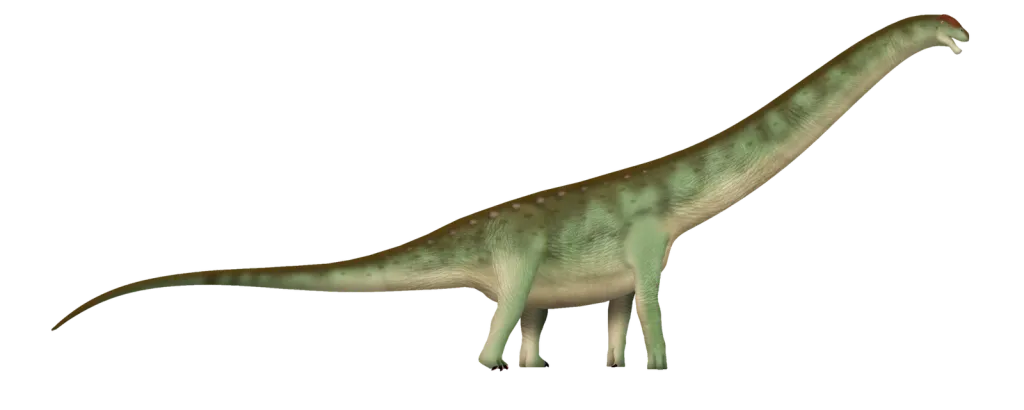
Argentinosaurus huinculensis
读音: ar-jen-TEE-noh-SORE-us hwin-koo-LEN-sis
Titanosauria
A titanosaur from the Late Cretaceous of Patagonia, Argentina, and one of the heaviest land animals known, estimated at 65 to 75 tonnes. It is known from only a few enormous bones: back vertebrae, part of the hip and a lower leg bone.
- Giant
- Long necked
- Quadrupedal
- 时代
- 白垩纪· 塞诺曼阶
- 食性
- 植食性
- 体长
- 30–35 m
- 体重
- 65,000–83,000 kg
- 地点
- Neuquén Province, Argentina
快速问答
- Argentinosaurus huinculensis有多大?
- Argentinosaurus huinculensis体长约30–35 m。髋部高约4.8–5.5 m。体重约65–83 t。 (Wikipedia: Argentinosaurus 2026; Paul 2016)
- Argentinosaurus huinculensis生活在什么时候?
- Argentinosaurus huinculensis生活在晚白垩世,约1.005亿至8980万年前。 (Cohen et al. 2023; Garrido 2010)
- 在哪里发现过Argentinosaurus huinculensis的化石?
- Argentinosaurus huinculensis的化石发现于Huincul Formation (Neuquén Province)和Argentina。 (Bonaparte & Coria 1993; Paul 2019)
- Argentinosaurus huinculensis吃什么?
- Argentinosaurus huinculensis是植食性。 (Bonaparte & Coria 1993; Paul 2019)
- Argentinosaurus huinculensis由谁命名,何时命名?
- Argentinosaurus huinculensis由José F. Bonaparte & Rodolfo A. Coria于1993年描述。 (Bonaparte & Coria 1993; Paleobiology Database: Argentinosaurus occurr… 2026)
本页内容

- 时代
- 白垩纪100.5–89.8 Ma
- 食性
- 植食性
- 体长
- 30–35 m
- 体重
- 65–83 t
- 产地
- Argentina
- 分类
- Titanosauria
- 命名
- 1993, José F. Bonaparte & Rodolfo A. Coria
概览
此内容目前仅提供英文版。
Argentinosaurus huinculensis lived in what is now Neuquén Province, Argentina, in the Late Cretaceous. A rancher, Guillermo Heredia, found its first bone in 1987 on the Las Overas farm near Plaza Huincul, and José Bonaparte and Rodolfo Coria named it in 1993. The fossils are kept at the Museo Carmen Funes in Plaza Huincul.
Only a small part of the skeleton is known: seven back (dorsal) vertebrae, five hip (sacral) vertebrae, rib fragments and a fibula from the lower leg. The back vertebrae are much larger and longer than those of any other described titanosaur, which is why most researchers rank it among the largest land animals of all time.
Its size can only be estimated from these bones and from better-known relatives. Gregory Paul (2019) estimated 65 to 75 tonnes; a computer model of the museum reconstruction gave about 83 tonnes (Sellers et al. 2013). The same study simulated its walk and found that such a giant could move, but only at a slow pace.
名称含义
"Argentine lizard", from Argentina and Greek sauros; huinculensis refers to Plaza Huincul, the town near the find (Bonaparte & Coria 1993).
生物学与证据
科学家对这种动物生活方式的看法,以及每种观点的证据有多充分。
运动方式
Argentinosaurus could walk, but only at a slow pace.
证据等级:假说A computer model with estimated muscles managed to walk; its best gait was slow. The result depends on many assumed soft-tissue values.
支持 / 反对证据 · 1
支持证据
生物力学模型 · Argentinosaurus gait simulation
A musculoskeletal model evolved a walking gait; its best speed is equivalent to a slow human walk in dimensionless terms.
其他
Argentinosaurus is known from only a small part of its skeleton.
证据等级:直接证据The holotype consists of back and hip vertebrae, rib fragments and a lower leg bone; the rest of the body is reconstructed from relatives.
支持 / 反对证据 · 1
支持证据
标本 · Argentinosaurus holotype vertebrae
Seven dorsal and five sacral vertebrae whose centra are much longer and bulkier than those of Patagotitan, Puertasaurus, Notocolossus, Dreadnoughtus or Futalognkosaurus.
标本: MCF-PVPH-1
Argentinosaurus was one of the heaviest land animals that ever lived.
证据等级:中等证据Its back vertebrae are larger than those of any other described titanosaur, and different methods give 65 to more than 80 tonnes. Because so little of the skeleton is known, the exact figure is uncertain.
支持 / 反对证据 · 3
支持证据
标本 · Argentinosaurus holotype vertebrae
Seven dorsal and five sacral vertebrae whose centra are much longer and bulkier than those of Patagotitan, Puertasaurus, Notocolossus, Dreadnoughtus or Futalognkosaurus.
标本: MCF-PVPH-1
生物力学模型 · Argentinosaurus volumetric mass model
A volumetric model built on a skeletal restoration gives 65-75 tonnes.
标本: MCF-PVPH-1
生物力学模型 · Argentinosaurus convex-hull model of the Carmen Funes reconstruction
A LiDAR scan of the museum reconstruction, convex-hulled segment by segment, gives a body mass of 83,230 kg.
体型
- 体长
- 30–35 m
- 身高
- 5 m文献范围 4.8–5.5 m
- 体重
- 65,000–83,000 kg
(114.8 英尺)
依据 MCF-PVPH-1
(16.4 英尺)
依据 MCF-PVPH-1 (femur shaft only)
依据 MCF-PVPH-1
时间线
时代: 塞诺曼阶 (100.5–93.9 Ma), 土伦阶 (93.9–89.8 Ma), 晚白垩世 (100.5–66 Ma)
Stage bounds (ICS 2023/09) of the Cenomanian-Turonian: the Huincul Formation is usually placed in the upper Cenomanian-lower Turonian (Garrido 2010). The 1993 description and PBDB still give a Middle Albian age (110.1-106.3 Ma); the dispute is noted, not averaged.
产地
地层
- Huincul Formation · Neuquén Province
- Estancia Las Overas, near Plaza Huincul, Neuquén · Huincul Formation · Neuquén Province · 位置为近似值
这些是发现化石的地点,而不是该动物生活的全部范围。
生态系统
生活于: Huincul
河流水系, 泛滥平原
Seasonally dry plains crossed by ephemeral or seasonal streams in the Neuquén Basin of northern Patagonia. Its age is disputed (Albian in older works, Cenomanian-Turonian in recent ones), so no age is recorded here.
分类
- 演化支Dinosauria
- 演化支Saurischia
- 演化支Sauropodomorpha
- 演化支Sauropoda
- 演化支Macronaria
- 演化支Titanosauria
- 属Argentinosaurus
- 种Argentinosaurus huinculensis
分类地位: 有效
化石记录

| 编号 | 类型 | 收藏机构 | 发现年份 |
|---|---|---|---|
| MCF-PVPH-1 | 正模标本 | Museo Municipal Carmen Funes (MCF) | 1987 |
| MLP-DP 46-VIII-21-3 | 归入标本 | Museo de La Plata (MLP) | — |
已发现的部分
正模标本: MCF-PVPH-1
- 保存
- 部分保存
- 复原
- 未知 / 未记录
正模标本: MCF-PVPH-1
按部位查看(表格)
| 部位 | 状态 |
|---|---|
| Skull | 未知 / 未记录 |
| Mandible | 未知 / 未记录 |
| Teeth | 未知 / 未记录 |
| Cervical vertebrae | 未知 / 未记录 |
| Dorsal vertebrae | 部分保存 · Seven dorsal vertebrae, six with centra (Paul 2019). |
| Sacrum | 部分保存 · Five sacral vertebrae. |
| Caudal vertebrae | 未知 / 未记录 |
| Ribs | 部分保存 · Rib fragments (secondary source). |
| Gastralia | 未知 / 未记录 |
| Scapula / shoulder girdle | 未知 / 未记录 |
| Humerus | 未知 / 未记录 |
| Forearm (radius / ulna) | 未知 / 未记录 |
| Hand (manus) | 未知 / 未记录 |
| Pelvis | 未知 / 未记录 |
| Femur | 未知 / 未记录 |
| Tibia / fibula | 部分保存 · A fibula, first identified as a tibia (lower leg; no separate fibula region in the ontology). |
| Foot (pes) | 未知 / 未记录 |
归入标本: MLP-DP 46-VIII-21-3
按部位查看(表格)
| 部位 | 状态 |
|---|---|
| Skull | 未知 / 未记录 |
| Mandible | 未知 / 未记录 |
| Teeth | 未知 / 未记录 |
| Cervical vertebrae | 未知 / 未记录 |
| Dorsal vertebrae | 未知 / 未记录 |
| Sacrum | 未知 / 未记录 |
| Caudal vertebrae | 未知 / 未记录 |
| Ribs | 未知 / 未记录 |
| Gastralia | 未知 / 未记录 |
| Scapula / shoulder girdle | 未知 / 未记录 |
| Humerus | 未知 / 未记录 |
| Forearm (radius / ulna) | 未知 / 未记录 |
| Hand (manus) | 未知 / 未记录 |
| Pelvis | 未知 / 未记录 |
| Femur | 部分保存 |
| Tibia / fibula | 未知 / 未记录 |
| Foot (pes) | 未知 / 未记录 |

发现
- 命名年份
- 1993
- 命名者
- José F. Bonaparte & Rodolfo A. Coria
- 模式标本
- MCF-PVPH-1
发现时间线
1987 · 首次发现材料
Guillermo Heredia finds the first Argentinosaurus bone
A rancher finds a huge bone on his farm near Plaza Huincul, Neuquén.
人物:Guillermo Heredia
1993 · 正式命名
Bonaparte and Coria name Argentinosaurus huinculensis
Named in Ameghiniana as a new, gigantic titanosaur.
人物:José F. Bonaparte, Rodolfo Coria
2013 · 重要研究
Argentinosaurus walks in a computer simulation
Sellers and colleagues scan the museum reconstruction and simulate its gait.
人物:William I. Sellers, Rodolfo Coria
2019 · 重要研究
Paul compares the largest titanosaurs
A size comparison of giant titanosaurs puts Argentinosaurus at 65-75 tonnes, above Patagotitan.
人物:Gregory S. Paul
参考文献
- (2026). Paleobiology Database: Argentinosaurus occurrences. The Paleobiology Database (paleobiodb.org), data service 1.2, accessed 2026-09-23. https://paleobiodb.org/data1.2/occs/list.txt?base_name=Argentinosaurus&show=coords,paleoloc,strat,loc,ref&pgm=gplates(在新标签页中打开)
- (2026). Wikipedia: Argentinosaurus. Wikipedia (English), accessed 2026-09-23. https://en.wikipedia.org/wiki/Argentinosaurus(在新标签页中打开)
- Bonaparte, J. F. & Coria, R. A. (1993). Un nuevo y gigantesco saurópodo titanosaurio de la Formación Río Limay (Albiano-Cenomaniano) de la Provincia del Neuquén, Argentina. Ameghiniana 30(3): 271-282.
- Cohen, K. M., Harper, D. A. T., Gibbard, P. L. & Car, N. (2023). International Chronostratigraphic Chart (v2023/09). International Commission on Stratigraphy. https://stratigraphy.org/ICSchart/ChronostratChart2023-09.pdf(在新标签页中打开)
- Garrido, A. C. (2010). Stratigraphy of the Neuquén Group, Upper Cretaceous of the Neuquén Basin (Argentina): new proposal for lithostratigraphic ordaining. Revista del Museo Argentino de Ciencias Naturales 12: 121-177. doi:10.22179/revmacn.12.239(在新标签页中打开)
- Mazzetta, G. V., Christiansen, P. & Fariña, R. A. (2004). Giants and bizarres: body size of some southern South American Cretaceous dinosaurs. Historical Biology 16: 71-83. doi:10.1080/08912960410001715132(在新标签页中打开)
- Paul, G. S. (2016). The Princeton Field Guide to Dinosaurs (2nd edition). Princeton University Press.
- Paul, G. S. (2019). Determining the largest known land animal: a critical comparison of differing methods for restoring the volume and mass of extinct animals. Annals of Carnegie Museum 85(4): 335-358. doi:10.2992/007.085.0403(在新标签页中打开)
- Sellers, W. I., Margetts, L., Coria, R. A. & Manning, P. L. (2013). March of the Titans: the locomotor capabilities of sauropod dinosaurs. PLoS ONE 8: e78733. doi:10.1371/journal.pone.0078733(在新标签页中打开)