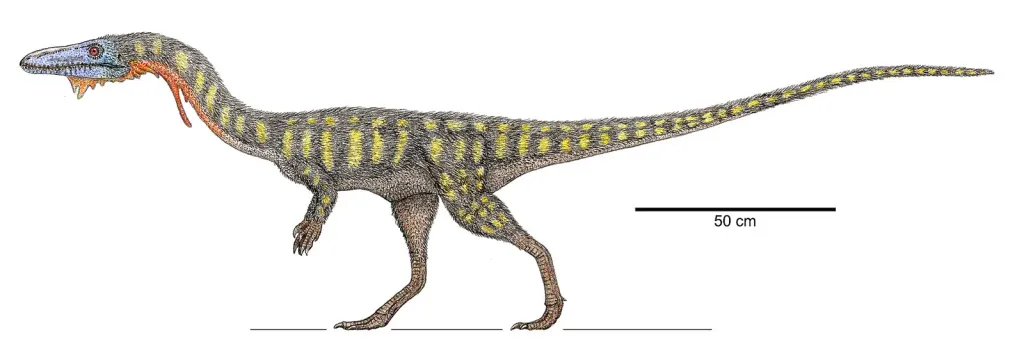
Coelophysis bauri
读音: SEE-loh-FY-sis BOW-er-eye
Neotheropoda · Coelophysidae
One of the earliest known theropods, a slender, 3 m predator from the Late Triassic of New Mexico. Hundreds of skeletons from the Ghost Ranch quarry make it one of the best-known early dinosaurs.
- Bipedal
- Famous specimen
- 时代
- 三叠纪· 晚三叠世
- 食性
- 肉食性
- 体长
- 3 m
- 体重
- 15–25 kg
- 地点
- New Mexico, United States
快速问答
- Coelophysis bauri有多大?
- Coelophysis bauri体长约3 m。髋部高约0.5–0.7 m。体重约15–25 kg。 (Wikipedia: Coelophysis 2026; Paul 2016)
- Coelophysis bauri生活在什么时候?
- Coelophysis bauri生活在晚三叠世,约2.057亿至2.014亿年前。 (Paleobiology Database: Coelophysis bauri coll… 2026)
- 在哪里发现过Coelophysis bauri的化石?
- Coelophysis bauri的化石发现于Chinle Formation (New Mexico)和United States。 (Cope 1887; Colbert 1947)
- Coelophysis bauri吃什么?
- Coelophysis bauri是肉食性。 (Cope 1887; Colbert 1947)
- Coelophysis bauri由谁命名,何时命名?
- Coelophysis bauri由Edward Drinker Cope于1887年描述。 (Cope 1887; Paleobiology Database: Coelophysis bauri coll… 2026)
本页内容

SEE-loh-FY-sis BOW-er-eye
- 时代
- 三叠纪205.7–201.4 Ma
- 食性
- 肉食性
- 体长
- 3 m
- 体重
- 0–0 t
- 产地
- United States
- 分类
- Neotheropoda · Coelophysidae
- 命名
- 1887, Edward Drinker Cope
概览
此内容目前仅提供英文版。
Coelophysis bauri lived at the end of the Triassic in what is now northern New Mexico, near the equator of the supercontinent Pangaea. Edward Drinker Cope named its first, fragmentary bones as Coelurus bauri in 1887 and moved them to the new genus Coelophysis in 1889.
In 1947 George Whitaker, in Edwin Colbert's American Museum crew, found a bonebed at Ghost Ranch packed with complete skeletons of all sizes. Because Cope's scrappy type bones could not be matched to them with certainty, the ICZN made a complete Ghost Ranch skeleton, AMNH 7224, the neotype in 1996.
It was a lightly built, two-legged hunter up to about 3 m long with a long, narrow head and grasping hands. Some Ghost Ranch skeletons were long said to hold eaten juveniles of their own kind, but Nesbitt and colleagues (2006) showed the "gut contents" were small crocodile-line reptiles, not young Coelophysis.
名称含义
"Hollow form", from Greek koilos ("hollow") and physis ("form"), for its hollow bones; bauri honours the palaeontologist Georg Baur (Cope 1887, 1889).
生物学与证据
科学家对这种动物生活方式的看法,以及每种观点的证据有多充分。
进食
Coelophysis ate small crocodile-line reptiles.
证据等级:有力证据The gut contents of Ghost Ranch skeletons belong to early crocodylomorphs.
支持 / 反对证据 · 1
支持证据
标本 · Coelophysis "cannibal" gut contents re-examined
Anatomy and histology of the supposed juvenile Coelophysis inside two Ghost Ranch skeletons show they are early crocodylomorphs.

体型
- 体长
- 3 m
- 身高
- 0.6 m文献范围 0.5–0.7 m
- 体重
- 15–25 kg
(9.8 英尺)
(2 英尺)
依据 Ghost Ranch adults
时间线
时代: 晚三叠世 (237–201.4 Ma), 三叠纪 (251.9–201.4 Ma)
Rhaetian bin of the Ghost Ranch neotype quarry in PBDB. Cope's original sites are binned as Norian (227.3-205.7 Ma); the Petrified Forest Member is dated to about 211.9 Ma (secondary), and the age of the Ghost Ranch beds is debated.
产地
地层
- Chinle Formation · New Mexico
- Ghost Ranch Quarry (Whitaker Quarry), Rio Arriba County · Chinle Formation · New Mexico · 位置为近似值
这些是发现化石的地点,而不是该动物生活的全部范围。
生态系统

生活于: Chinle (Ghost Ranch)
205.7–201.4 百万年前 · 泛滥平原, 河流水系
Late Triassic river floodplains of north-central New Mexico, near the equator of Pangaea; the Ghost Ranch bonebed is a crevasse-splay deposit.
分类
- 演化支Dinosauria
- 演化支Saurischia
- 演化支Theropoda
- 演化支Neotheropoda
- 总科Coelophysoidea
- 科Coelophysidae
- 属Coelophysis
- 种Coelophysis bauri
分类地位: 有效
化石记录

| 编号 | 类型 | 收藏机构 | 发现年份 |
|---|---|---|---|
| AMNH 7224 | 新模标本 | American Museum of Natural History (AMNH) | 1947 |
已发现的部分
新模标本: AMNH 7224
- 保存
- 部分保存
- 复原
- 未知 / 未记录
按部位查看(表格)
| 部位 | 状态 |
|---|---|
| Skull | 保存 |
| Mandible | 未知 / 未记录 |
| Teeth | 未知 / 未记录 |
| Cervical vertebrae | 保存 |
| Dorsal vertebrae | 保存 |
| Sacrum | 未知 / 未记录 |
| Caudal vertebrae | 未知 / 未记录 |
| Ribs | 未知 / 未记录 |
| Gastralia | 未知 / 未记录 |
| Scapula / shoulder girdle | 未知 / 未记录 |
| Humerus | 未知 / 未记录 |
| Forearm (radius / ulna) | 未知 / 未记录 |
| Hand (manus) | 未知 / 未记录 |
| Pelvis | 保存 |
| Femur | 保存 |
| Tibia / fibula | 未知 / 未记录 |
| Foot (pes) | 未知 / 未记录 |

发现
- 命名年份
- 1887
- 命名者
- Edward Drinker Cope
- 模式标本
- AMNH 7224
发现时间线
1881 · 首次发现材料
Baldwin collects the first Coelophysis bones
David Baldwin collects fragmentary bones at Arroyo Seco, Rio Arriba County, for Cope.
人物:David Baldwin
1887 · 正式命名
Cope names Coelurus bauri
Cope names the species in the genus Coelurus; he erects Coelophysis for it in 1889.
人物:Edward Drinker Cope
1947 · 标本出土
Ghost Ranch Coelophysis quarry discovered
George Whitaker of Colbert's crew finds a bonebed full of complete skeletons.
人物:George Whitaker, Edwin H. Colbert
2006 · 重要研究
Coelophysis cannibalism refuted
Nesbitt and colleagues show the gut contents are crocodylomorphs.
人物:Sterling J. Nesbitt, Mark A. Norell
参考文献
- (2026). Paleobiology Database: Coelophysis bauri collections 48422 (Ghost Ranch) and 52498 (Arroyo Seco). The Paleobiology Database (paleobiodb.org), data service 1.2, accessed 2026-09-23. https://paleobiodb.org/data1.2/colls/list.json?coll_id=48422,52498&show=paleoloc,strat,loc,ref,geo&pgm=gplates&vocab=pbdb(在新标签页中打开)
- (2026). Wikipedia: Coelophysis. Wikipedia (English), accessed 2026-09-24. https://en.wikipedia.org/wiki/Coelophysis(在新标签页中打开)
- Colbert, E. H. (1947). The little dinosaurs of Ghost Ranch. Natural History 56(9).
- Cope, E. D. (1887). The dinosaurian genus Coelurus. American Naturalist 21: 367-369.
- Nesbitt, S. J., Turner, A. H., Erickson, G. M. & Norell, M. A. (2006). Prey choice and cannibalistic behaviour in the theropod Coelophysis. Biology Letters 2: 611-614. doi:10.1098/rsbl.2006.0524(在新标签页中打开)
- Paul, G. S. (2016). The Princeton Field Guide to Dinosaurs (2nd edition). Princeton University Press.