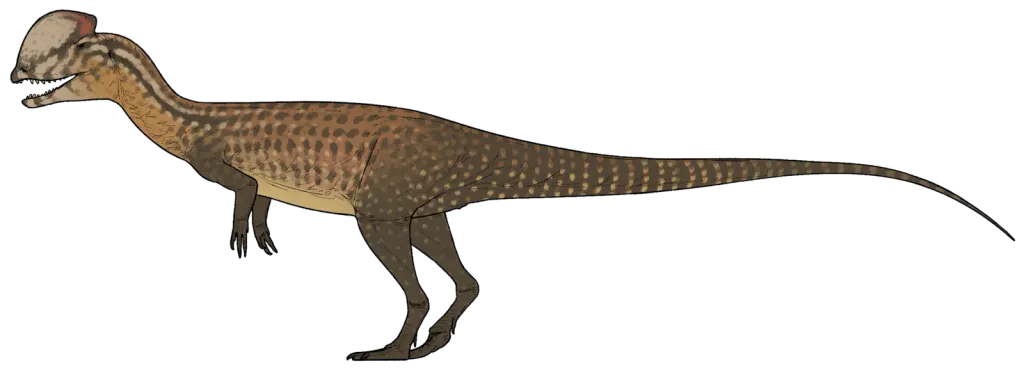
Dilophosaurus wetherilli
读音: dye-LOF-oh-SORE-us weh-THER-il-eye
Neotheropoda · Dilophosauridae
A large Early Jurassic theropod from the Kayenta Formation of Arizona with two thin crests on its skull. The neck frill and venom spitting of Jurassic Park are fiction with no fossil support.
- Crested
- Bipedal
- Movie icon
- Trackways known
- 时代
- 侏罗纪· 辛涅缪尔阶
- 食性
- 肉食性
- 体长
- 7 m
- 体重
- 400 kg
- 地点
- Arizona
快速问答
- Dilophosaurus wetherilli有多大?
- Dilophosaurus wetherilli体长约7 m。髋部高约1.3–1.6 m。体重约400 kg。 (Marsh & Rowe 2020; Paul 2016)
- Dilophosaurus wetherilli生活在什么时候?
- Dilophosaurus wetherilli生活在早侏罗世,约1.995亿至1.842亿年前。 (Cohen et al. 2023; Marsh & Rowe 2020)
- 在哪里发现过Dilophosaurus wetherilli的化石?
- Dilophosaurus wetherilli的化石发现于Kayenta Formation (Arizona)。 (Welles 1954; Welles 1970)
- Dilophosaurus wetherilli吃什么?
- Dilophosaurus wetherilli是肉食性。 (Welles 1954; Welles 1970)
- Dilophosaurus wetherilli由谁命名,何时命名?
- Dilophosaurus wetherilli由Samuel P. Welles于1954年描述。 (Welles 1954; Welles 1970)
- Dilophosaurus wetherilli出现在《侏罗纪公园》里吗?
- 是的。Dilophosaurus wetherilli出现在《侏罗纪公园》 (1993)、《侏罗纪世界3》 (2022)和《侏罗纪世界:重生》 (2025)中。电影有不少虚构成分;本页将其与化石证据进行了对比。 (Wikipedia: Dinosaurs in Jurassic Park 2026; Marsh & Rowe 2020)
本页内容

- 时代
- 侏罗纪199.5–184.2 Ma
- 食性
- 肉食性
- 体长
- 7 m
- 体重
- 0.4 t
- 分类
- Neotheropoda · Dilophosauridae
- 命名
- 1954, Samuel P. Welles
概览
此内容目前仅提供英文版。
Dilophosaurus wetherilli lived in what is now northern Arizona during the Early Jurassic. Its bones come from the Kayenta Formation, on Navajo Nation land. Samuel Welles described the first skeletons in 1954 as a new species of Megalosaurus and, after a later specimen showed its paired skull crests, gave it its own genus in 1970.
It was one of the largest predators of its time: a slender, long-legged theropod with a pair of thin, arched crests along the top of the skull and a notch between the premaxilla and maxilla in the upper jaw. Marsh and Rowe (2020) redescribed all known specimens and showed that the skull was sturdier than once thought, not weak or fragile.
The Dilophosaurus of the film Jurassic Park is much smaller, has an expandable neck frill and spits venom. None of this is known from fossils: there is no evidence for a frill or for venom, and the real animal was far larger (Marsh & Rowe 2020). The crests were probably for display.
名称含义
From Greek di- ("two"), lophos ("crest") and sauros ("lizard"): "two-crested lizard" (Welles 1970); wetherilli honours John Wetherill, a Navajo trader and explorer (Welles 1954).
生物学与证据
科学家对这种动物生活方式的看法,以及每种观点的证据有多充分。
姿态
Dilophosaurus-like theropods rested like birds, with the palms of their hands facing each other.
证据等级:中等证据A trace fossil in Utah preserves a large theropod sitting down, with its hands held facing inward like a bird's wings. It is not proven that the trace maker was Dilophosaurus itself.
支持 / 反对证据 · 1
支持证据
遗迹化石 · St. George theropod resting trace
An Early Jurassic trace of a large theropod sitting, with impressions of feet, hips and hands held facing inward, attributed to a Dilophosaurus-like animal.
伤病
The Dilophosaurus holotype survived many serious injuries.
证据等级:直接证据The type specimen has broken and infected arm bones that had healed, showing it lived for a long time after being badly hurt.
支持 / 反对证据 · 1
支持证据
标本 · Healed injuries on the Dilophosaurus holotype
Eight pathologies on the arm and shoulder of UCMP 37302, including fractures and bone infection, many healed.
标本: UCMP 37302
其他
Dilophosaurus had no neck frill and did not spit venom; both are film inventions.
证据等级:有力证据No fossil shows a frill or a venom gland, and nothing in the skull hints at either. The film also made it much smaller than the real, roughly 7 m animal.
支持 / 反对证据 · 1
支持证据
比较解剖学 · Dilophosaurus skull redescription
Redescription of all specimens showing a well-joined skull with a strong bite for its size, not a weak one.
标本: UCMP 37302, UCMP 77270
The two crests of Dilophosaurus were for display, not for fighting.
证据等级:假说The crests are thin and hollow, too fragile to use as weapons. Display to rivals or mates is the likely role, as with crests of modern birds, but it cannot be tested directly.
支持 / 反对证据 · 1
支持证据
标本 · Paired thin crests on Dilophosaurus skulls
Two thin, arched crests of bone along the top of the skull, fragile and full of air spaces.
标本: UCMP 77270

体型
- 体长
- 7 m
- 身高
- 1.4 m文献范围 1.3–1.6 m
- 体重
- 400 kg
(23 英尺)
依据 Largest known individuals (Kayenta Formation)
(4.6 英尺)
依据 UCMP 77270 (femur c. 0.55 m)
时间线
时代: 辛涅缪尔阶 (199.5–192.9 Ma), 普林斯巴赫阶 (192.9–184.2 Ma), 早侏罗世 (201.4–174.7 Ma)
Ages are the ICS 2023/09 bounds of the Sinemurian and Pliensbachian, the stage(s) the fossils are assigned to; they bracket the record and are not dated first/last appearances. The Kayenta Formation is commonly assigned to these stages; its precise age is uncertain and was not verified against a dated section.
产地
地层
- Kayenta Formation · Arizona
地点
- Dilophosaurus type locality, near Tuba City, Navajo Nation, Arizona · Kayenta Formation · Arizona · 位置为近似值
这些是发现化石的地点,而不是该动物生活的全部范围。
生态系统
生活于: Kayenta
196–183 百万年前 · 河流水系, 泛滥平原, 沙漠 / 沙丘
Early Jurassic rivers and floodplains in what is now northern Arizona, between the great dune fields of the Wingate and Navajo sandstones, with a seasonal, fairly dry climate.
分类
- 演化支Dinosauria
- 演化支Saurischia
- 演化支Theropoda
- 演化支Neotheropoda
- 科Dilophosauridae
- 属Dilophosaurus
- 种Dilophosaurus wetherilli
分类地位: 有效
化石记录

| 编号 | 类型 | 收藏机构 | 发现年份 |
|---|---|---|---|
| UCMP 37302 | 正模标本 | University of California Museum of Paleontology (UCMP) | 1942 |
| UCMP 37303 | 副模标本 | University of California Museum of Paleontology (UCMP) | 1942 |
| UCMP 77270 | 归入标本 | University of California Museum of Paleontology (UCMP) | 1964 |
已发现的部分
正模标本: UCMP 37302
- 保存
- 部分保存
- 复原
- 未知 / 未记录
正模标本: UCMP 37302
按部位查看(表格)
| 部位 | 状态 |
|---|---|
| Skull | 部分保存 |
| Mandible | 部分保存 |
| Teeth | 未知 / 未记录 |
| Cervical vertebrae | 保存 |
| Dorsal vertebrae | 保存 |
| Sacrum | 未知 / 未记录 |
| Caudal vertebrae | 未知 / 未记录 |
| Ribs | 未知 / 未记录 |
| Gastralia | 未知 / 未记录 |
| Scapula / shoulder girdle | 未知 / 未记录 |
| Humerus | 保存 · With healed injuries (Senter & Juengst 2016). |
| Forearm (radius / ulna) | 保存 |
| Hand (manus) | 部分保存 |
| Pelvis | 部分保存 |
| Femur | 保存 |
| Tibia / fibula | 保存 |
| Foot (pes) | 未知 / 未记录 |
副模标本: UCMP 37303
按部位查看(表格)
| 部位 | 状态 |
|---|---|
| Skull | 部分保存 |
| Mandible | 未知 / 未记录 |
| Teeth | 未知 / 未记录 |
| Cervical vertebrae | 未知 / 未记录 |
| Dorsal vertebrae | 部分保存 |
| Sacrum | 未知 / 未记录 |
| Caudal vertebrae | 未知 / 未记录 |
| Ribs | 未知 / 未记录 |
| Gastralia | 未知 / 未记录 |
| Scapula / shoulder girdle | 未知 / 未记录 |
| Humerus | 未知 / 未记录 |
| Forearm (radius / ulna) | 未知 / 未记录 |
| Hand (manus) | 未知 / 未记录 |
| Pelvis | 未知 / 未记录 |
| Femur | 未知 / 未记录 |
| Tibia / fibula | 未知 / 未记录 |
| Foot (pes) | 未知 / 未记录 |
归入标本: UCMP 77270
按部位查看(表格)
| 部位 | 状态 |
|---|---|
| Skull | 保存 · Both crests. |
| Mandible | 保存 |
| Teeth | 未知 / 未记录 |
| Cervical vertebrae | 未知 / 未记录 |
| Dorsal vertebrae | 未知 / 未记录 |
| Sacrum | 未知 / 未记录 |
| Caudal vertebrae | 未知 / 未记录 |
| Ribs | 未知 / 未记录 |
| Gastralia | 未知 / 未记录 |
| Scapula / shoulder girdle | 未知 / 未记录 |
| Humerus | 未知 / 未记录 |
| Forearm (radius / ulna) | 未知 / 未记录 |
| Hand (manus) | 未知 / 未记录 |
| Pelvis | 未知 / 未记录 |
| Femur | 未知 / 未记录 |
| Tibia / fibula | 未知 / 未记录 |
| Foot (pes) | 未知 / 未记录 |

发现
- 命名年份
- 1954
- 命名者
- Samuel P. Welles
- 模式标本
- UCMP 37302
发现时间线
1942 · 首次发现材料
Jesse Williams leads Camp's team to the Dilophosaurus bones
A Navajo man, Jesse Williams, shows a UCMP expedition led by Charles Camp the site in the Kayenta Formation.
人物:Jesse Williams, Charles L. Camp
1954 · 正式命名
Welles names Megalosaurus wetherilli
The skeletons are first described as a new species of Megalosaurus.
人物:Samuel P. Welles
1970 · 更名
Crested specimen found and Dilophosaurus named
A specimen found in 1964 with both crests leads Welles to name the new genus Dilophosaurus.
人物:Samuel P. Welles
2020 · 重要研究
Marsh and Rowe redescribe Dilophosaurus
A full redescription of all known specimens and a new family-tree analysis.
人物:Adam D. Marsh
《侏罗纪公园》与《侏罗纪世界》中的形象
电影
- 侏罗纪公园 (1993)
- 侏罗纪世界3 (2022)
- 侏罗纪世界:重生 (2025)
此内容目前仅提供英文版。
银幕形象
A small dinosaur with a retractable neck frill that spits blinding venom; it kills Dennis Nedry in the first film.
电影与化石对比
- No fossil shows a neck frill or venom: both were invented for the film (the frill was inspired by the living frilled lizard).
- The real Dilophosaurus was much larger, around 6 to 7 m long; the film shrank it so audiences would not confuse it with the raptors.
- Its two thin crests on top of the skull are real and are its best-known feature in the fossils.
电影名称仅用于识别。DinoDex 与《侏罗纪公园》/《侏罗纪世界》系列无任何关联,也未获其认可。 所有在电影中出现的恐龙
参考文献
- (2026). Wikipedia: Dinosaurs in Jurassic Park. Wikipedia. https://en.wikipedia.org/wiki/Dinosaurs_in_Jurassic_Park(在新标签页中打开)
- (2026). Wikipedia: Jurassic World Rebirth. Wikipedia. https://en.wikipedia.org/wiki/Jurassic_World_Rebirth(在新标签页中打开)
- Cohen, K. M., Harper, D. A. T., Gibbard, P. L. & Car, N. (2023). International Chronostratigraphic Chart (v2023/09). International Commission on Stratigraphy. https://stratigraphy.org/ICSchart/ChronostratChart2023-09.pdf(在新标签页中打开)
- Marsh, A. D. & Rowe, T. B. (2020). A comprehensive anatomical and phylogenetic evaluation of Dilophosaurus wetherilli (Dinosauria, Theropoda) with descriptions of new specimens from the Kayenta Formation of northern Arizona. Journal of Paleontology 94(S78): 1-103. doi:10.1017/jpa.2020.14(在新标签页中打开)
- Paul, G. S. (2016). The Princeton Field Guide to Dinosaurs (2nd edition). Princeton University Press.
- Shay, D. & Duncan, J. (1993). The Making of Jurassic Park. Ballantine Books.
- Welles, S. P. (1954). New Jurassic dinosaur from the Kayenta Formation of Arizona. Geological Society of America Bulletin 65(6): 591-598. doi:10.1130/0016-7606(1954)65[591:NJDFTK]2.0.CO;2(在新标签页中打开)
- Welles, S. P. (1970). Dilophosaurus (Reptilia: Saurischia), a new name for a dinosaur. Journal of Paleontology 44(5): 989.