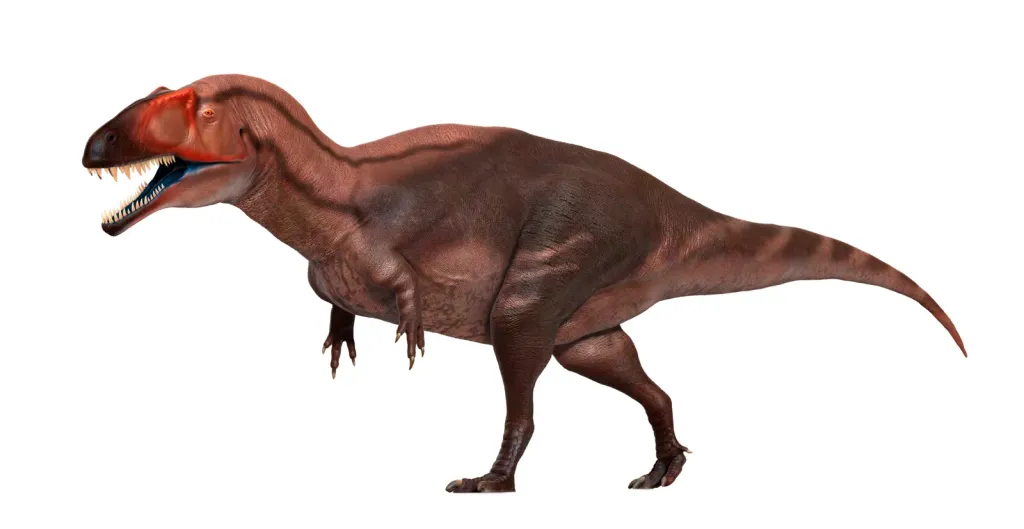
Acrocanthosaurus atokensis
Pronounced AK-roh-KAN-thoh-SORE-us ah-toh-KEN-sis
Tetanurae · Carcharodontosauridae
A large carcharodontosaurid predator from the Early Cretaceous of North America, with a ridge of very tall spines along its neck and back. Its best skeleton, "Fran", was found in Oklahoma and is in North Carolina.
- Bipedal
- Giant
- Apex predator
- Sail backed
- Trackways known
- Period
- Cretaceous· Aptian
- Diet
- Carnivore
- Length
- 11–12 m
- Mass
- 4,400–8,400 kg
- Location
- Oklahoma, United States
Quick answers
- How big was Acrocanthosaurus atokensis?
- Acrocanthosaurus atokensis was about 11–12 m long. It stood about 2.8–3.2 m tall at the hips. It weighed about 4.4–8.4 t. (Wikipedia: Acrocanthosaurus 2026; Paul 2016)
- When did Acrocanthosaurus atokensis live?
- Acrocanthosaurus atokensis lived during the Early Cretaceous, about 121.4–113.2 million years ago. (Paleobiology Database: Acrocanthosaurus occur… 2026; Eddy & Clarke 2011)
- Where have Acrocanthosaurus atokensis fossils been found?
- Fossils of Acrocanthosaurus atokensis have been found in Antlers Formation (Oklahoma) and United States. (Stovall & Langston 1950; Eddy & Clarke 2011)
- What did Acrocanthosaurus atokensis eat?
- Acrocanthosaurus atokensis was a carnivore. (Stovall & Langston 1950; Eddy & Clarke 2011)
- Who named Acrocanthosaurus atokensis, and when?
- Acrocanthosaurus atokensis was described by J. Willis Stovall & Wann Langston Jr. in 1950. (Stovall & Langston 1950; Eddy & Clarke 2011)
On this page

- Period
- Cretaceous121.4–113.2 Ma
- Diet
- Carnivore
- Length
- 11–12 m
- Mass
- 4.4–8.4 t
- Location
- United States
- Classification
- Tetanurae · Carcharodontosauridae
- Described
- 1950, J. Willis Stovall & Wann Langston Jr.
Overview
Acrocanthosaurus atokensis lived in North America in the Early Cretaceous (Aptian-Albian). J. Willis Stovall and Wann Langston Jr. named it in 1950 from two partial skeletons found in the Antlers Formation of Atoka County, Oklahoma (OMNH 10146 and 10147).
Its name, "high-spined lizard", refers to the very tall spines on its neck and back vertebrae, which probably supported a thick muscular ridge rather than a thin sail. A nearly complete skull (NCSM 14345, "Fran") was found near Idabel, Oklahoma, and is displayed at the North Carolina Museum of Natural Sciences.
It was one of the largest predators of its time, around 11 to 12 m long. Eddy and Clarke (2011) restudied the skull and placed it within the Carcharodontosauridae, the family of Giganotosaurus and Carcharodontosaurus. Large theropod trackways in the Glen Rose Formation of Texas are often attributed to it.
Name meaning
"High-spined lizard", from Greek akra ("high"), akantha ("spine") and sauros ("lizard"); atokensis for Atoka County, Oklahoma (Stovall & Langston 1950).
Biology & evidence
What scientists think about how this animal lived, and how strong the evidence for each idea is.
Locomotion
The large theropod trackways of the Glen Rose Formation were made by Acrocanthosaurus.
Evidence level: HypothesisIt is the only large theropod known from the region at the right time, but footprints cannot be matched to a species with certainty.
Evidence for / against · 1
Evidence for
Trackway · Glen Rose large theropod trackways
Large three-toed theropod footprints in the Glen Rose Formation of Texas, including those along the Paluxy River.
Other
Acrocanthosaurus was a carcharodontosaurid, a relative of Giganotosaurus.
Evidence level: Strong evidenceDetailed study of its skull places it inside Carcharodontosauridae, in agreement with several other analyses; a few earlier ones linked it more closely to Allosaurus.
Evidence for / against · 1
Evidence for
Phylogenetic inference · Acrocanthosaurus skull phylogeny
A re-described skull (NCSM 14345) scored in a new allosauroid dataset places Acrocanthosaurus well within Carcharodontosauridae.
Specimen: NCSM 14345 “Fran”
Acrocanthosaurus had a ridge of very tall spines along its neck and back.
Evidence level: Direct evidenceThe spines are preserved on its vertebrae. They probably anchored a thick muscular ridge rather than a thin sail; the soft tissue is not preserved.
Evidence for / against · 1
Evidence for
Specimen · Acrocanthosaurus tall neural spines
Exceptionally tall neural spines along the neck and back vertebrae, the feature that gives the genus its name.
Specimen: OMNH 10147

Size
- Length
- 11–12 m
- Height
- 3 mpublished range 2.8–3.2 m
- Mass
- 4,400–8,400 kg
(39.4 ft)
Based on NCSM 14345
(9.8 ft)
Based on NCSM 14345 (femur c. 1.28 m)
Based on NCSM 14345
Timeline
Periods: Aptian (121.4–113 Ma), Albian (113–100.5 Ma), Early Cretaceous (145–100.5 Ma)
Aptian bounds of the type collection in PBDB (PBDB time scale). Eddy & Clarke give the Trinity Group as Aptian-Albian, and other referred material is younger.
Location
Formations
- Antlers Formation · Oklahoma
Places
- Atoka County, Oklahoma (Antlers Formation) · Antlers Formation · Oklahoma · position approximate
These are the places where fossils have been found, not the full area where the animal lived.
Ecosystem
Lived in: Antlers
120–112 million years ago · floodplain, river system, coastal plain
Early Cretaceous plains of the Trinity Group in Oklahoma, Arkansas and north-east Texas.
Same ecosystem

Classification
- cladeDinosauria
- cladeSaurischia
- cladeTheropoda
- cladeTetanurae
- superfamilyAllosauroidea
- familyCarcharodontosauridae
- genusAcrocanthosaurus
- speciesAcrocanthosaurus atokensis
Taxonomic status: Valid
Fossil record

| Catalog number | Status | Institution | Found |
|---|---|---|---|
| OMNH 10146 | Holotype | Sam Noble Oklahoma Museum of Natural History (OMNH) | — |
| OMNH 10147 | Paratype | Sam Noble Oklahoma Museum of Natural History (OMNH) | — |
| NCSM 14345 “Fran” | Referred specimen | North Carolina Museum of Natural Sciences (NCSM) | — |
What has been found
Holotype: OMNH 10146
- Preserved
- Partial
- Reconstructed
- Unknown / not recorded
Holotype: OMNH 10146
Region by region (table)
| Region | State |
|---|---|
| Skull | Partial · Braincase and posterior skull fragments. |
| Mandible | Partial |
| Teeth | Unknown / not recorded |
| Cervical vertebrae | Unknown / not recorded |
| Dorsal vertebrae | Unknown / not recorded |
| Sacrum | Unknown / not recorded |
| Caudal vertebrae | Unknown / not recorded |
| Ribs | Unknown / not recorded |
| Gastralia | Unknown / not recorded |
| Scapula / shoulder girdle | Unknown / not recorded |
| Humerus | Unknown / not recorded |
| Forearm (radius / ulna) | Unknown / not recorded |
| Hand (manus) | Unknown / not recorded |
| Pelvis | Unknown / not recorded |
| Femur | Unknown / not recorded |
| Tibia / fibula | Unknown / not recorded |
| Foot (pes) | Unknown / not recorded |
Referred specimen: NCSM 14345 “Fran”
Region by region (table)
| Region | State |
|---|---|
| Skull | Preserved |
| Mandible | Preserved |
| Teeth | Unknown / not recorded |
| Cervical vertebrae | Unknown / not recorded |
| Dorsal vertebrae | Unknown / not recorded |
| Sacrum | Unknown / not recorded |
| Caudal vertebrae | Unknown / not recorded |
| Ribs | Unknown / not recorded |
| Gastralia | Unknown / not recorded |
| Scapula / shoulder girdle | Unknown / not recorded |
| Humerus | Unknown / not recorded |
| Forearm (radius / ulna) | Unknown / not recorded |
| Hand (manus) | Unknown / not recorded |
| Pelvis | Unknown / not recorded |
| Femur | Unknown / not recorded |
| Tibia / fibula | Unknown / not recorded |
| Foot (pes) | Unknown / not recorded |

Discovery
- Year described
- 1950
- Described by
- J. Willis Stovall & Wann Langston Jr.
- Type specimen
- OMNH 10146
Discovery timeline
1950 · Formally described
Stovall and Langston name Acrocanthosaurus
The "high-spined lizard" is named from two skeletons from Atoka County, Oklahoma.
People: J. Willis Stovall, Wann Langston Jr.
2011 · Major study
Eddy and Clarke redescribe the skull of Acrocanthosaurus
The fully prepared skull of "Fran" is described and used to place Acrocanthosaurus among carcharodontosaurids.
Sources
- (2026). Paleobiology Database: Acrocanthosaurus occurrences. The Paleobiology Database (paleobiodb.org), data service 1.2, accessed 2026-09-23. https://paleobiodb.org/data1.2/occs/list.txt?base_name=Acrocanthosaurus&show=coords,paleoloc,strat,loc,ref&pgm=gplates (opens in a new tab)
- (2026). Wikipedia: Acrocanthosaurus. Wikipedia (English), accessed 2026-09-23. https://en.wikipedia.org/wiki/Acrocanthosaurus (opens in a new tab)
- Eddy, D. R. & Clarke, J. A. (2011). New information on the cranial anatomy of Acrocanthosaurus atokensis and its implications for the phylogeny of Allosauroidea (Dinosauria: Theropoda). PLoS ONE 6: e17932. doi:10.1371/journal.pone.0017932 (opens in a new tab)
- Paul, G. S. (2016). The Princeton Field Guide to Dinosaurs (2nd edition). Princeton University Press.
- Stovall, J. W. & Langston, W., Jr. (1950). Acrocanthosaurus atokensis, a new genus and species of Lower Cretaceous Theropoda from Oklahoma. American Midland Naturalist 43: 696. doi:10.2307/2421859 (opens in a new tab)