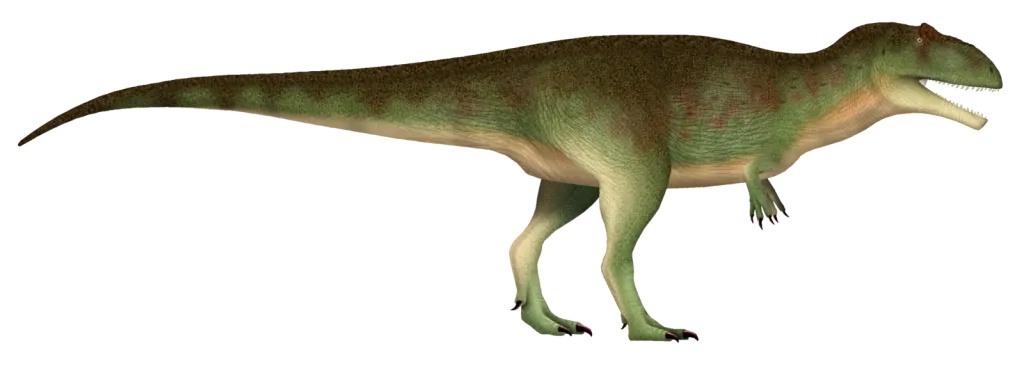
Giganotosaurus carolinii
Pronounced JIG-an-OH-toe-SORE-us kar-oh-LEE-nee-eye
Tetanurae · Carcharodontosauridae
A giant carcharodontosaurid theropod from the Cenomanian of Patagonia, Argentina, and one of the largest land predators known, rivalling Tyrannosaurus rex in length.
- Bipedal
- Giant
- Apex predator
- Movie icon
- Period
- Cretaceous· Cenomanian
- Diet
- Carnivore
- Length
- 12.5–13.2 m
- Mass
- 6,000–8,000 kg
- Location
- Argentina, Neuquén Province
Quick answers
- How big was Giganotosaurus carolinii?
- Giganotosaurus carolinii was about 12.5–13.2 m long. It stood about 3–3.6 m tall at the hips. It weighed about 6–8 t. (Coria & Salgado 1995; Calvo & Coria 1998)
- When did Giganotosaurus carolinii live?
- Giganotosaurus carolinii lived during the Late Cretaceous, about 100.5–93.9 million years ago. (Cohen et al. 2023; Coria & Salgado 1995)
- Where have Giganotosaurus carolinii fossils been found?
- Fossils of Giganotosaurus carolinii have been found in Candeleros Formation (Neuquén Province) and Argentina. (Coria & Salgado 1995; Calvo & Coria 1998)
- What did Giganotosaurus carolinii eat?
- Giganotosaurus carolinii was a carnivore. (Coria & Salgado 1995; Calvo & Coria 1998)
- Who named Giganotosaurus carolinii, and when?
- Giganotosaurus carolinii was described by Rodolfo Coria & Leonardo Salgado in 1995. (Coria & Salgado 1995)
- Was Giganotosaurus carolinii in Jurassic Park?
- Yes. Giganotosaurus carolinii appears in Jurassic World Dominion (2022). Dominion's main dinosaur villain, billed as the largest carnivore that ever lived. It was about as big as T. rex, not clearly bigger; Spinosaurus was probably longer than both. (Wikipedia: Dinosaurs in Jurassic Park 2026; Coria & Salgado 1995)
On this page

- Period
- Cretaceous100.5–93.9 Ma
- Diet
- Carnivore
- Length
- 12.5–13.2 m
- Mass
- 6–8 t
- Location
- Argentina
- Classification
- Tetanurae · Carcharodontosauridae
- Described
- 1995, Rodolfo Coria & Leonardo Salgado
Overview
Giganotosaurus carolinii lived in what is now Neuquén Province, Argentina, during the Cenomanian, early in the Late Cretaceous. Amateur fossil hunter Rubén Carolini found the holotype (MUCPv-Ch 1) in the Candeleros Formation in 1993, and Rodolfo Coria and Leonardo Salgado named it in 1995.
It belonged to the Carcharodontosauridae, a group of large allosauroids, and was only distantly related to Tyrannosaurus. Its skull was long and narrow with blade-like teeth.
Coria and Salgado (1995) estimated the holotype at about 12.5 m and 6 to 8 tonnes. A larger referred lower jaw (MUCPv-95) suggests some individuals were bigger, and mass estimates vary widely between methods.
Name meaning
From Greek gigas ("giant"), notos ("south") and sauros ("lizard"): "giant southern lizard"; carolinii honours its discoverer, Rubén Carolini (Coria & Salgado 1995).
Biology & evidence
What scientists think about how this animal lived, and how strong the evidence for each idea is.
Teeth
Giganotosaurus had thin, blade-like teeth for slicing flesh, not for crushing bone.
Evidence level: Strong evidenceIts teeth are flattened blades with serrations, like those of other carcharodontosaurids, and its jaws are lighter than those of T. rex.
Evidence for / against · 1
Evidence for
Comparative anatomy · Giganotosaurus blade-like teeth and narrow jaws
Thin, serrated teeth and a relatively narrow, lightly built snout, suited to slicing flesh rather than crushing bone.
Specimen: MUCPv-Ch 1
Social life
Giganotosaurus may have hunted in groups.
Evidence level: Weak evidenceThe evidence is indirect: several individuals of its relative Mapusaurus were found together. A shared death site does not prove they lived or hunted together.
Evidence for / against · 1
Evidence for
Specimen · Mapusaurus multi-individual bonebed
A bonebed with at least seven individuals of the related carcharodontosaurid Mapusaurus, of different sizes.
Other
Giganotosaurus was larger than Tyrannosaurus rex.
Evidence level: DisputedThe two were of comparable size. Estimates depend on incomplete skeletons and on the method used, and the ranges overlap; neither can be declared bigger with confidence.
Evidence for / against · 1
Evidence for
Comparative anatomy · Skull-length size estimates for Giganotosaurus
Body size estimated from skull length and from the larger dentary MUCPv-95; results overlap with the largest T. rex.
Specimen: MUCPv-Ch 1, MUCPv-95
Size
- Length
- 12.5–13.2 m
- Height
- 3.3 mpublished range 3–3.6 m
- Mass
- 6,000–8,000 kg
(43.3 ft)
Based on MUCPv-Ch 1 (holotype); MUCPv-95 (referred dentary) for the upper value
(10.8 ft)
Based on MUCPv-Ch 1 (holotype, femur c. 1.37 m)
Based on MUCPv-Ch 1 (holotype)
Timeline
Periods: Cenomanian (100.5–93.9 Ma), Late Cretaceous (100.5–66 Ma)
Ages are the ICS 2023/09 bounds of the Cenomanian, the stage(s) the fossils are assigned to; they bracket the record and are not dated first/last appearances.
Location
Formations
- Candeleros Formation · Neuquén Province
- Giganotosaurus type locality, near Villa El Chocón, Neuquén · Candeleros Formation · Neuquén Province · position approximate
These are the places where fossils have been found, not the full area where the animal lived.
Ecosystem

Lived in: Candeleros
100.5–93.9 million years ago · river system, floodplain, desert / dunes
Braided rivers, floodplains and seasonal dune fields in the Cenomanian of northern Patagonia, home to giant rebbachisaurid and titanosaur sauropods and to Giganotosaurus.
Classification
- cladeDinosauria
- cladeSaurischia
- cladeTheropoda
- cladeTetanurae
- superfamilyAllosauroidea
- familyCarcharodontosauridae
- genusGiganotosaurus
- speciesGiganotosaurus carolinii
Taxonomic status: Valid
Fossil record

| Catalog number | Status | Institution | Found |
|---|---|---|---|
| MUCPv-Ch 1 | Holotype | Museo Municipal Ernesto Bachmann (MUCPv-Ch) | 1993 |
| MUCPv-95 | Referred specimen | Museo Municipal Ernesto Bachmann (MUCPv-Ch) | — |
What has been found
Holotype: MUCPv-Ch 1
- Preserved
- Partial
- Reconstructed
- Unknown / not recorded
Holotype: MUCPv-Ch 1
Region by region (table)
| Region | State |
|---|---|
| Skull | Partial |
| Mandible | Partial |
| Teeth | Unknown / not recorded |
| Cervical vertebrae | Unknown / not recorded |
| Dorsal vertebrae | Partial |
| Sacrum | Partial |
| Caudal vertebrae | Partial |
| Ribs | Unknown / not recorded |
| Gastralia | Unknown / not recorded |
| Scapula / shoulder girdle | Unknown / not recorded |
| Humerus | Unknown / not recorded |
| Forearm (radius / ulna) | Unknown / not recorded |
| Hand (manus) | Unknown / not recorded |
| Pelvis | Partial |
| Femur | Preserved |
| Tibia / fibula | Preserved |
| Foot (pes) | Unknown / not recorded |
Referred specimen: MUCPv-95
Region by region (table)
| Region | State |
|---|---|
| Skull | Unknown / not recorded |
| Mandible | Partial · Dentary only. |
| Teeth | Unknown / not recorded |
| Cervical vertebrae | Unknown / not recorded |
| Dorsal vertebrae | Unknown / not recorded |
| Sacrum | Unknown / not recorded |
| Caudal vertebrae | Unknown / not recorded |
| Ribs | Unknown / not recorded |
| Gastralia | Unknown / not recorded |
| Scapula / shoulder girdle | Unknown / not recorded |
| Humerus | Unknown / not recorded |
| Forearm (radius / ulna) | Unknown / not recorded |
| Hand (manus) | Unknown / not recorded |
| Pelvis | Unknown / not recorded |
| Femur | Unknown / not recorded |
| Tibia / fibula | Unknown / not recorded |
| Foot (pes) | Unknown / not recorded |

Discovery
- Year described
- 1995
- Described by
- Rodolfo Coria & Leonardo Salgado
- Type specimen
- MUCPv-Ch 1
Discovery timeline
1993 · First material found
Rubén Carolini finds Giganotosaurus
An amateur fossil hunter finds the skeleton near Villa El Chocón, Neuquén.
People: Rubén Carolini
1995 · Formally described
Coria and Salgado name Giganotosaurus carolinii
Published in Nature as a giant carnivore from Patagonia.
People: Rodolfo Coria, Leonardo Salgado
1998 · Major study
A larger Giganotosaurus dentary described
Calvo and Coria describe a dentary suggesting an even larger individual.
In Jurassic Park & Jurassic World
Films
- Jurassic World Dominion (2022)
On screen
Dominion's main dinosaur villain, billed as the largest carnivore that ever lived.
Film vs fossils
- It was about as big as T. rex, not clearly bigger; Spinosaurus was probably longer than both.
Film titles are used for identification only. DinoDex is not affiliated with or endorsed by the Jurassic Park / Jurassic World franchise. All dinosaurs seen in the films
Sources
- (2026). Wikipedia: Dinosaurs in Jurassic Park. Wikipedia. https://en.wikipedia.org/wiki/Dinosaurs_in_Jurassic_Park (opens in a new tab)
- Calvo, J. O. & Coria, R. A. (1998). New specimen of Giganotosaurus carolinii (Coria & Salgado, 1995), supports it as the largest theropod ever found. Gaia 15: 117-122.
- Cohen, K. M., Harper, D. A. T., Gibbard, P. L. & Car, N. (2023). International Chronostratigraphic Chart (v2023/09). International Commission on Stratigraphy. https://stratigraphy.org/ICSchart/ChronostratChart2023-09.pdf (opens in a new tab)
- Coria, R. A. & Salgado, L. (1995). A new giant carnivorous dinosaur from the Cretaceous of Patagonia. Nature 377: 224-226. doi:10.1038/377224a0 (opens in a new tab)
- Paul, G. S. (2016). The Princeton Field Guide to Dinosaurs (2nd edition). Princeton University Press.
- Therrien, F. & Henderson, D. M. (2007). My theropod is bigger than yours ... or not: estimating body size from skull length in theropods. Journal of Vertebrate Paleontology 27(1): 108-115. doi:10.1671/0272-4634(2007)27[108:MTIBTY]2.0.CO;2 (opens in a new tab)