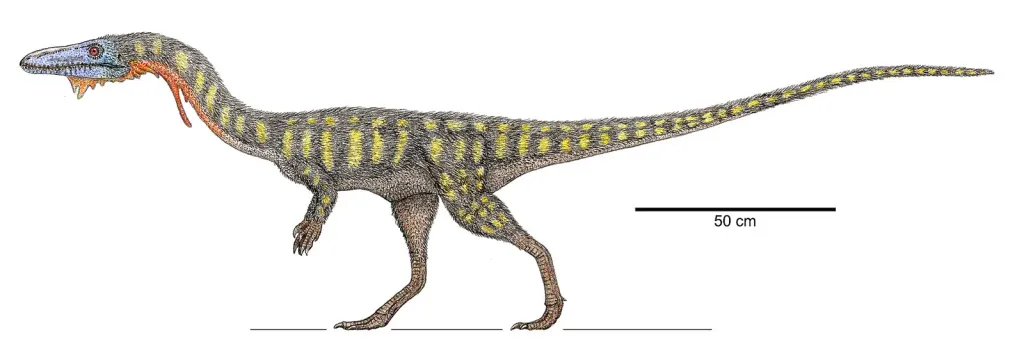
Coelophysis bauri
Pronounced SEE-loh-FY-sis BOW-er-eye
Neotheropoda · Coelophysidae
One of the earliest known theropods, a slender, 3 m predator from the Late Triassic of New Mexico. Hundreds of skeletons from the Ghost Ranch quarry make it one of the best-known early dinosaurs.
- Bipedal
- Famous specimen
- Period
- Triassic· Late Triassic
- Diet
- Carnivore
- Length
- 3 m
- Mass
- 15–25 kg
- Location
- New Mexico, United States
Quick answers
- How big was Coelophysis bauri?
- Coelophysis bauri was about 3 m long. It stood about 0.5–0.7 m tall at the hips. It weighed about 15–25 kg. (Wikipedia: Coelophysis 2026; Paul 2016)
- When did Coelophysis bauri live?
- Coelophysis bauri lived during the Late Triassic, about 205.7–201.4 million years ago. (Paleobiology Database: Coelophysis bauri coll… 2026)
- Where have Coelophysis bauri fossils been found?
- Fossils of Coelophysis bauri have been found in Chinle Formation (New Mexico) and United States. (Cope 1887; Colbert 1947)
- What did Coelophysis bauri eat?
- Coelophysis bauri was a carnivore. (Cope 1887; Colbert 1947)
- Who named Coelophysis bauri, and when?
- Coelophysis bauri was described by Edward Drinker Cope in 1887. (Cope 1887; Paleobiology Database: Coelophysis bauri coll… 2026)
On this page

SEE-loh-FY-sis BOW-er-eye
- Period
- Triassic205.7–201.4 Ma
- Diet
- Carnivore
- Length
- 3 m
- Mass
- 0–0 t
- Location
- United States
- Classification
- Neotheropoda · Coelophysidae
- Described
- 1887, Edward Drinker Cope
Overview
Coelophysis bauri lived at the end of the Triassic in what is now northern New Mexico, near the equator of the supercontinent Pangaea. Edward Drinker Cope named its first, fragmentary bones as Coelurus bauri in 1887 and moved them to the new genus Coelophysis in 1889.
In 1947 George Whitaker, in Edwin Colbert's American Museum crew, found a bonebed at Ghost Ranch packed with complete skeletons of all sizes. Because Cope's scrappy type bones could not be matched to them with certainty, the ICZN made a complete Ghost Ranch skeleton, AMNH 7224, the neotype in 1996.
It was a lightly built, two-legged hunter up to about 3 m long with a long, narrow head and grasping hands. Some Ghost Ranch skeletons were long said to hold eaten juveniles of their own kind, but Nesbitt and colleagues (2006) showed the "gut contents" were small crocodile-line reptiles, not young Coelophysis.
Name meaning
"Hollow form", from Greek koilos ("hollow") and physis ("form"), for its hollow bones; bauri honours the palaeontologist Georg Baur (Cope 1887, 1889).
Biology & evidence
What scientists think about how this animal lived, and how strong the evidence for each idea is.
Feeding
Coelophysis ate small crocodile-line reptiles.
Evidence level: Strong evidenceThe gut contents of Ghost Ranch skeletons belong to early crocodylomorphs.
Evidence for / against · 1
Evidence for
Specimen · Coelophysis "cannibal" gut contents re-examined
Anatomy and histology of the supposed juvenile Coelophysis inside two Ghost Ranch skeletons show they are early crocodylomorphs.

Size
- Length
- 3 m
- Height
- 0.6 mpublished range 0.5–0.7 m
- Mass
- 15–25 kg
(9.8 ft)
(2 ft)
Based on Ghost Ranch adults
Timeline
Periods: Late Triassic (237–201.4 Ma), Triassic (251.9–201.4 Ma)
Rhaetian bin of the Ghost Ranch neotype quarry in PBDB. Cope's original sites are binned as Norian (227.3-205.7 Ma); the Petrified Forest Member is dated to about 211.9 Ma (secondary), and the age of the Ghost Ranch beds is debated.
Location
Formations
- Chinle Formation · New Mexico
Places
- Ghost Ranch Quarry (Whitaker Quarry), Rio Arriba County · Chinle Formation · New Mexico · position approximate
These are the places where fossils have been found, not the full area where the animal lived.
Ecosystem

Lived in: Chinle (Ghost Ranch)
205.7–201.4 million years ago · floodplain, river system
Late Triassic river floodplains of north-central New Mexico, near the equator of Pangaea; the Ghost Ranch bonebed is a crevasse-splay deposit.
Classification
- cladeDinosauria
- cladeSaurischia
- cladeTheropoda
- cladeNeotheropoda
- superfamilyCoelophysoidea
- familyCoelophysidae
- genusCoelophysis
- speciesCoelophysis bauri
Taxonomic status: Valid
Fossil record

| Catalog number | Status | Institution | Found |
|---|---|---|---|
| AMNH 7224 | Neotype | American Museum of Natural History (AMNH) | 1947 |
What has been found
Neotype: AMNH 7224
- Preserved
- Partial
- Reconstructed
- Unknown / not recorded
Region by region (table)
| Region | State |
|---|---|
| Skull | Preserved |
| Mandible | Unknown / not recorded |
| Teeth | Unknown / not recorded |
| Cervical vertebrae | Preserved |
| Dorsal vertebrae | Preserved |
| Sacrum | Unknown / not recorded |
| Caudal vertebrae | Unknown / not recorded |
| Ribs | Unknown / not recorded |
| Gastralia | Unknown / not recorded |
| Scapula / shoulder girdle | Unknown / not recorded |
| Humerus | Unknown / not recorded |
| Forearm (radius / ulna) | Unknown / not recorded |
| Hand (manus) | Unknown / not recorded |
| Pelvis | Preserved |
| Femur | Preserved |
| Tibia / fibula | Unknown / not recorded |
| Foot (pes) | Unknown / not recorded |

Discovery
- Year described
- 1887
- Described by
- Edward Drinker Cope
- Type specimen
- AMNH 7224
Discovery timeline
1881 · First material found
Baldwin collects the first Coelophysis bones
David Baldwin collects fragmentary bones at Arroyo Seco, Rio Arriba County, for Cope.
People: David Baldwin
1887 · Formally described
Cope names Coelurus bauri
Cope names the species in the genus Coelurus; he erects Coelophysis for it in 1889.
People: Edward Drinker Cope
1947 · Specimen recovered
Ghost Ranch Coelophysis quarry discovered
George Whitaker of Colbert's crew finds a bonebed full of complete skeletons.
People: George Whitaker, Edwin H. Colbert
2006 · Major study
Coelophysis cannibalism refuted
Nesbitt and colleagues show the gut contents are crocodylomorphs.
People: Sterling J. Nesbitt, Mark A. Norell
Sources
- (2026). Paleobiology Database: Coelophysis bauri collections 48422 (Ghost Ranch) and 52498 (Arroyo Seco). The Paleobiology Database (paleobiodb.org), data service 1.2, accessed 2026-09-23. https://paleobiodb.org/data1.2/colls/list.json?coll_id=48422,52498&show=paleoloc,strat,loc,ref,geo&pgm=gplates&vocab=pbdb (opens in a new tab)
- (2026). Wikipedia: Coelophysis. Wikipedia (English), accessed 2026-09-24. https://en.wikipedia.org/wiki/Coelophysis (opens in a new tab)
- Colbert, E. H. (1947). The little dinosaurs of Ghost Ranch. Natural History 56(9).
- Cope, E. D. (1887). The dinosaurian genus Coelurus. American Naturalist 21: 367-369.
- Nesbitt, S. J., Turner, A. H., Erickson, G. M. & Norell, M. A. (2006). Prey choice and cannibalistic behaviour in the theropod Coelophysis. Biology Letters 2: 611-614. doi:10.1098/rsbl.2006.0524 (opens in a new tab)
- Paul, G. S. (2016). The Princeton Field Guide to Dinosaurs (2nd edition). Princeton University Press.