Dilophosaurus wetherilli
Pronounced dye-LOF-oh-SORE-us weh-THER-il-eye
Neotheropoda · Dilophosauridae
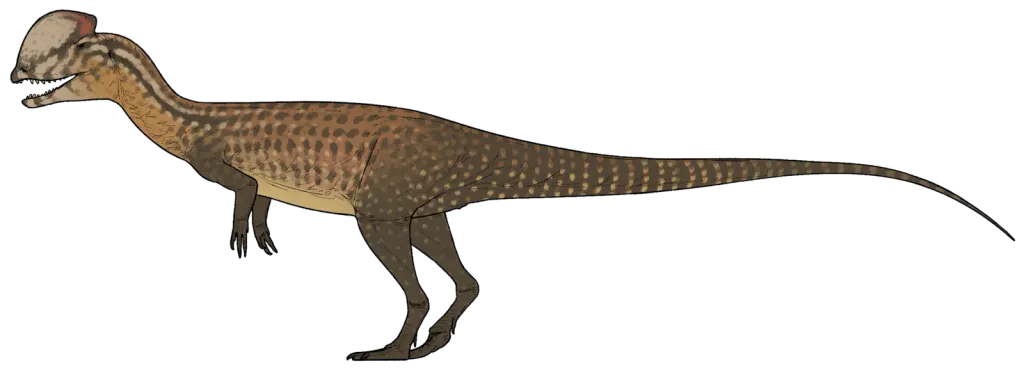
A large Early Jurassic theropod from the Kayenta Formation of Arizona with two thin crests on its skull. The neck frill and venom spitting of Jurassic Park are fiction with no fossil support.
- Crested
- Bipedal
- Movie icon
- Trackways known
- Period
- Jurassic· Sinemurian
- Diet
- Carnivore
- Length
- 7 m
- Mass
- 400 kg
- Location
- Arizona
Quick answers
- How big was Dilophosaurus wetherilli?
- Dilophosaurus wetherilli was about 7 m long. It stood about 1.3–1.6 m tall at the hips. It weighed about 400 kg. (Marsh & Rowe 2020; Paul 2016)
- When did Dilophosaurus wetherilli live?
- Dilophosaurus wetherilli lived during the Early Jurassic, about 199.5–184.2 million years ago. (Cohen et al. 2023; Marsh & Rowe 2020)
- Where have Dilophosaurus wetherilli fossils been found?
- Fossils of Dilophosaurus wetherilli have been found in Kayenta Formation (Arizona). (Welles 1954; Welles 1970)
- What did Dilophosaurus wetherilli eat?
- Dilophosaurus wetherilli was a carnivore. (Welles 1954; Welles 1970)
- Who named Dilophosaurus wetherilli, and when?
- Dilophosaurus wetherilli was described by Samuel P. Welles in 1954. (Welles 1954; Welles 1970)
- Was Dilophosaurus wetherilli in Jurassic Park?
- Yes. Dilophosaurus wetherilli appears in Jurassic Park (1993), Jurassic World Dominion (2022), and Jurassic World Rebirth (2025). A small dinosaur with a retractable neck frill that spits blinding venom; it kills Dennis Nedry in the first film. No fossil shows a neck frill or venom: both were invented for the film (the frill was inspired by the living frilled lizard). (Wikipedia: Dinosaurs in Jurassic Park 2026; Marsh & Rowe 2020)
On this page

- Period
- Jurassic199.5–184.2 Ma
- Diet
- Carnivore
- Length
- 7 m
- Mass
- 0.4 t
- Classification
- Neotheropoda · Dilophosauridae
- Described
- 1954, Samuel P. Welles
Overview
Dilophosaurus wetherilli lived in what is now northern Arizona during the Early Jurassic. Its bones come from the Kayenta Formation, on Navajo Nation land. Samuel Welles described the first skeletons in 1954 as a new species of Megalosaurus and, after a later specimen showed its paired skull crests, gave it its own genus in 1970.
It was one of the largest predators of its time: a slender, long-legged theropod with a pair of thin, arched crests along the top of the skull and a notch between the premaxilla and maxilla in the upper jaw. Marsh and Rowe (2020) redescribed all known specimens and showed that the skull was sturdier than once thought, not weak or fragile.
The Dilophosaurus of the film Jurassic Park is much smaller, has an expandable neck frill and spits venom. None of this is known from fossils: there is no evidence for a frill or for venom, and the real animal was far larger (Marsh & Rowe 2020). The crests were probably for display.
Name meaning
From Greek di- ("two"), lophos ("crest") and sauros ("lizard"): "two-crested lizard" (Welles 1970); wetherilli honours John Wetherill, a Navajo trader and explorer (Welles 1954).
Biology & evidence
What scientists think about how this animal lived, and how strong the evidence for each idea is.
Posture
Dilophosaurus-like theropods rested like birds, with the palms of their hands facing each other.
Evidence level: Moderate evidenceA trace fossil in Utah preserves a large theropod sitting down, with its hands held facing inward like a bird's wings. It is not proven that the trace maker was Dilophosaurus itself.
Evidence for / against · 1
Evidence for
Trace fossil · St. George theropod resting trace
An Early Jurassic trace of a large theropod sitting, with impressions of feet, hips and hands held facing inward, attributed to a Dilophosaurus-like animal.
Injuries & disease
The Dilophosaurus holotype survived many serious injuries.
Evidence level: Direct evidenceThe type specimen has broken and infected arm bones that had healed, showing it lived for a long time after being badly hurt.
Evidence for / against · 1
Evidence for
Specimen · Healed injuries on the Dilophosaurus holotype
Eight pathologies on the arm and shoulder of UCMP 37302, including fractures and bone infection, many healed.
Specimen: UCMP 37302
Other
Dilophosaurus had no neck frill and did not spit venom; both are film inventions.
Evidence level: Strong evidenceNo fossil shows a frill or a venom gland, and nothing in the skull hints at either. The film also made it much smaller than the real, roughly 7 m animal.
Evidence for / against · 1
Evidence for
Comparative anatomy · Dilophosaurus skull redescription
Redescription of all specimens showing a well-joined skull with a strong bite for its size, not a weak one.
Specimen: UCMP 37302, UCMP 77270
The two crests of Dilophosaurus were for display, not for fighting.
Evidence level: HypothesisThe crests are thin and hollow, too fragile to use as weapons. Display to rivals or mates is the likely role, as with crests of modern birds, but it cannot be tested directly.
Evidence for / against · 1
Evidence for
Specimen · Paired thin crests on Dilophosaurus skulls
Two thin, arched crests of bone along the top of the skull, fragile and full of air spaces.
Specimen: UCMP 77270

Size
- Length
- 7 m
- Height
- 1.4 mpublished range 1.3–1.6 m
- Mass
- 400 kg
(23 ft)
Based on Largest known individuals (Kayenta Formation)
(4.6 ft)
Based on UCMP 77270 (femur c. 0.55 m)
Timeline
Periods: Sinemurian (199.5–192.9 Ma), Pliensbachian (192.9–184.2 Ma), Early Jurassic (201.4–174.7 Ma)
Ages are the ICS 2023/09 bounds of the Sinemurian and Pliensbachian, the stage(s) the fossils are assigned to; they bracket the record and are not dated first/last appearances. The Kayenta Formation is commonly assigned to these stages; its precise age is uncertain and was not verified against a dated section.
Location
Formations
- Kayenta Formation · Arizona
Places
- Dilophosaurus type locality, near Tuba City, Navajo Nation, Arizona · Kayenta Formation · Arizona · position approximate
These are the places where fossils have been found, not the full area where the animal lived.
Ecosystem
Lived in: Kayenta
196–183 million years ago · river system, floodplain, desert / dunes
Early Jurassic rivers and floodplains in what is now northern Arizona, between the great dune fields of the Wingate and Navajo sandstones, with a seasonal, fairly dry climate.
Classification
- cladeDinosauria
- cladeSaurischia
- cladeTheropoda
- cladeNeotheropoda
- familyDilophosauridae
- genusDilophosaurus
- speciesDilophosaurus wetherilli
Taxonomic status: Valid
Fossil record

| Catalog number | Status | Institution | Found |
|---|---|---|---|
| UCMP 37302 | Holotype | University of California Museum of Paleontology (UCMP) | 1942 |
| UCMP 37303 | Paratype | University of California Museum of Paleontology (UCMP) | 1942 |
| UCMP 77270 | Referred specimen | University of California Museum of Paleontology (UCMP) | 1964 |
What has been found
Holotype: UCMP 37302
- Preserved
- Partial
- Reconstructed
- Unknown / not recorded
Holotype: UCMP 37302
Region by region (table)
| Region | State |
|---|---|
| Skull | Partial |
| Mandible | Partial |
| Teeth | Unknown / not recorded |
| Cervical vertebrae | Preserved |
| Dorsal vertebrae | Preserved |
| Sacrum | Unknown / not recorded |
| Caudal vertebrae | Unknown / not recorded |
| Ribs | Unknown / not recorded |
| Gastralia | Unknown / not recorded |
| Scapula / shoulder girdle | Unknown / not recorded |
| Humerus | Preserved · With healed injuries (Senter & Juengst 2016). |
| Forearm (radius / ulna) | Preserved |
| Hand (manus) | Partial |
| Pelvis | Partial |
| Femur | Preserved |
| Tibia / fibula | Preserved |
| Foot (pes) | Unknown / not recorded |
Paratype: UCMP 37303
Region by region (table)
| Region | State |
|---|---|
| Skull | Partial |
| Mandible | Unknown / not recorded |
| Teeth | Unknown / not recorded |
| Cervical vertebrae | Unknown / not recorded |
| Dorsal vertebrae | Partial |
| Sacrum | Unknown / not recorded |
| Caudal vertebrae | Unknown / not recorded |
| Ribs | Unknown / not recorded |
| Gastralia | Unknown / not recorded |
| Scapula / shoulder girdle | Unknown / not recorded |
| Humerus | Unknown / not recorded |
| Forearm (radius / ulna) | Unknown / not recorded |
| Hand (manus) | Unknown / not recorded |
| Pelvis | Unknown / not recorded |
| Femur | Unknown / not recorded |
| Tibia / fibula | Unknown / not recorded |
| Foot (pes) | Unknown / not recorded |
Referred specimen: UCMP 77270
Region by region (table)
| Region | State |
|---|---|
| Skull | Preserved · Both crests. |
| Mandible | Preserved |
| Teeth | Unknown / not recorded |
| Cervical vertebrae | Unknown / not recorded |
| Dorsal vertebrae | Unknown / not recorded |
| Sacrum | Unknown / not recorded |
| Caudal vertebrae | Unknown / not recorded |
| Ribs | Unknown / not recorded |
| Gastralia | Unknown / not recorded |
| Scapula / shoulder girdle | Unknown / not recorded |
| Humerus | Unknown / not recorded |
| Forearm (radius / ulna) | Unknown / not recorded |
| Hand (manus) | Unknown / not recorded |
| Pelvis | Unknown / not recorded |
| Femur | Unknown / not recorded |
| Tibia / fibula | Unknown / not recorded |
| Foot (pes) | Unknown / not recorded |

Discovery
- Year described
- 1954
- Described by
- Samuel P. Welles
- Type specimen
- UCMP 37302
Discovery timeline
1942 · First material found
Jesse Williams leads Camp's team to the Dilophosaurus bones
A Navajo man, Jesse Williams, shows a UCMP expedition led by Charles Camp the site in the Kayenta Formation.
People: Jesse Williams, Charles L. Camp
1954 · Formally described
Welles names Megalosaurus wetherilli
The skeletons are first described as a new species of Megalosaurus.
People: Samuel P. Welles
1970 · Renamed
Crested specimen found and Dilophosaurus named
A specimen found in 1964 with both crests leads Welles to name the new genus Dilophosaurus.
People: Samuel P. Welles
2020 · Major study
Marsh and Rowe redescribe Dilophosaurus
A full redescription of all known specimens and a new family-tree analysis.
People: Adam D. Marsh
In Jurassic Park & Jurassic World
Films
- Jurassic Park (1993)
- Jurassic World Dominion (2022)
- Jurassic World Rebirth (2025)
On screen
A small dinosaur with a retractable neck frill that spits blinding venom; it kills Dennis Nedry in the first film.
Film vs fossils
- No fossil shows a neck frill or venom: both were invented for the film (the frill was inspired by the living frilled lizard).
- The real Dilophosaurus was much larger, around 6 to 7 m long; the film shrank it so audiences would not confuse it with the raptors.
- Its two thin crests on top of the skull are real and are its best-known feature in the fossils.
Film titles are used for identification only. DinoDex is not affiliated with or endorsed by the Jurassic Park / Jurassic World franchise. All dinosaurs seen in the films
Sources
- (2026). Wikipedia: Dinosaurs in Jurassic Park. Wikipedia. https://en.wikipedia.org/wiki/Dinosaurs_in_Jurassic_Park (opens in a new tab)
- (2026). Wikipedia: Jurassic World Rebirth. Wikipedia. https://en.wikipedia.org/wiki/Jurassic_World_Rebirth (opens in a new tab)
- Cohen, K. M., Harper, D. A. T., Gibbard, P. L. & Car, N. (2023). International Chronostratigraphic Chart (v2023/09). International Commission on Stratigraphy. https://stratigraphy.org/ICSchart/ChronostratChart2023-09.pdf (opens in a new tab)
- Marsh, A. D. & Rowe, T. B. (2020). A comprehensive anatomical and phylogenetic evaluation of Dilophosaurus wetherilli (Dinosauria, Theropoda) with descriptions of new specimens from the Kayenta Formation of northern Arizona. Journal of Paleontology 94(S78): 1-103. doi:10.1017/jpa.2020.14 (opens in a new tab)
- Paul, G. S. (2016). The Princeton Field Guide to Dinosaurs (2nd edition). Princeton University Press.
- Shay, D. & Duncan, J. (1993). The Making of Jurassic Park. Ballantine Books.
- Welles, S. P. (1954). New Jurassic dinosaur from the Kayenta Formation of Arizona. Geological Society of America Bulletin 65(6): 591-598. doi:10.1130/0016-7606(1954)65[591:NJDFTK]2.0.CO;2 (opens in a new tab)
- Welles, S. P. (1970). Dilophosaurus (Reptilia: Saurischia), a new name for a dinosaur. Journal of Paleontology 44(5): 989.