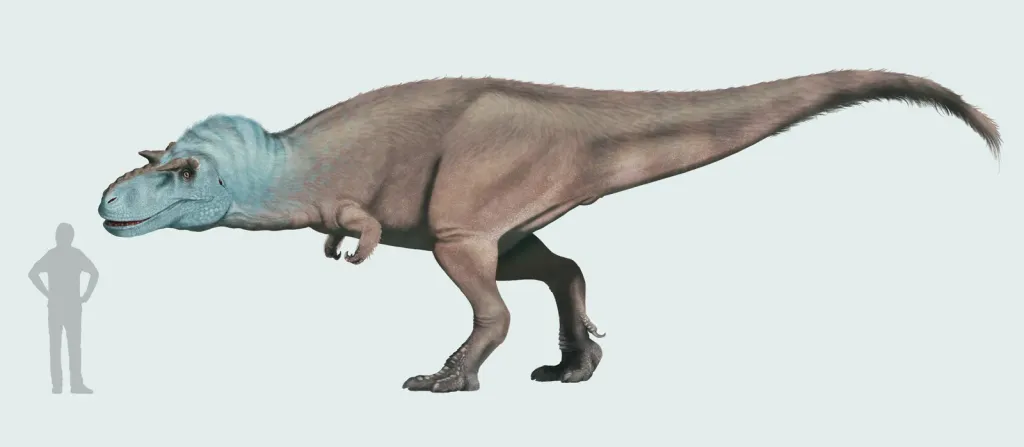
Gorgosaurus libratus
Pronounced GOR-goh-SORE-us lih-BRAH-tus
Coelurosauria · Tyrannosauridae
An 8 to 9 m tyrannosaur from the Late Cretaceous of Alberta and Montana, the best-represented tyrannosaurid in the fossil record. A juvenile found with two young feathered dinosaurs in its stomach shows how its diet changed as it grew.
- Bipedal
- Apex predator
- Period
- Cretaceous· Campanian
- Diet
- Carnivore
- Length
- 8–9 m
- Mass
- 2,000–3,000 kg
- Location
- Alberta, Canada
Quick answers
- How big was Gorgosaurus libratus?
- Gorgosaurus libratus was about 8–9 m long. It stood about 2.3–2.8 m tall at the hips. It weighed about 2–3 t. (Wikipedia: Gorgosaurus 2026; Currie 2003)
- When did Gorgosaurus libratus live?
- Gorgosaurus libratus lived during the Late Cretaceous, about 76.5–73 million years ago. (Paleobiology Database: Gorgosaurus libratus t… 2026; Therrien et al. 2023)
- Where have Gorgosaurus libratus fossils been found?
- Fossils of Gorgosaurus libratus have been found in Dinosaur Park Formation (Alberta) and Canada. (Lambe 1914; Currie 2003)
- What did Gorgosaurus libratus eat?
- Gorgosaurus libratus was a carnivore. (Lambe 1914; Currie 2003)
- Who named Gorgosaurus libratus, and when?
- Gorgosaurus libratus was described by Lawrence M. Lambe in 1914. (Lambe 1914; Paleobiology Database: Gorgosaurus libratus t… 2026)
On this page

GOR-goh-SORE-us lih-BRAH-tus
- Period
- Cretaceous76.5–73 Ma
- Diet
- Carnivore
- Length
- 8–9 m
- Mass
- 2–3 t
- Location
- Canada
- Classification
- Coelurosauria · Tyrannosauridae
- Described
- 1914, Lawrence M. Lambe
Overview
Gorgosaurus libratus lived about 75 million years ago on the coastal floodplains of the Dinosaur Park Formation in Alberta, Canada, and in Montana. Charles M. Sternberg found a nearly complete skeleton on the Red Deer River in 1913, and Lawrence Lambe named it in 1914; it was the first tyrannosaurid found with a complete hand.
It was a close relative of Albertosaurus, lighter built than Tyrannosaurus, with long legs and tiny two-fingered arms. Dozens of skeletons of all ages make it the best-known tyrannosaurid, and some researchers treat it as a species of Albertosaurus.
A juvenile, 5 to 7 years old and about 335 kg, preserves the hind legs of two yearling Citipes, small oviraptorosaurs, in its stomach (Therrien et al. 2023). Young Gorgosaurus hunted small, young dinosaurs and only later switched to large herbivores such as hadrosaurs and ceratopsians.
Name meaning
"Fierce lizard", from Greek gorgos ("terrible, fierce") and sauros; libratus, Latin for "balanced" (Lambe 1914).
Biology & evidence
What scientists think about how this animal lived, and how strong the evidence for each idea is.
Feeding
Young Gorgosaurus hunted small, young dinosaurs before switching to large herbivores.
Evidence level: Strong evidenceA juvenile's stomach holds only the legs of two yearling feathered theropods; the shift to megaherbivores probably began as individuals approached about 600 kg.
Evidence for / against · 1
Evidence for
Specimen · Juvenile Gorgosaurus with Citipes stomach contents
Two dismembered yearling caenagnathids eaten in two separate meals by a 5-7-year-old, 335 kg Gorgosaurus.
Specimen: TMP 2009.12.14
Growth
Gorgosaurus changed body proportions as it grew.
Evidence level: Strong evidenceJuveniles had narrow skulls, blade-like teeth and long slender legs; adults were more robust.
Evidence for / against · 1
Evidence for
Specimen · Gorgosaurus growth series
Dozens of skeletons from juveniles to adults, the most complete growth series of any tyrannosaurid.

Size
- Length
- 8–9 m
- Height
- 2.5 mpublished range 2.3–2.8 m
- Mass
- 2,000–3,000 kg
(29.5 ft)
(8.2 ft)
Based on large adults (femur c. 1.0 m)
Timeline
Periods: Campanian (83.6–72.1 Ma), Late Cretaceous (100.5–66 Ma)
About 76.5-73 Ma for the genus (Wikipedia); the Dinosaur Park Formation juvenile is about 75.3 Ma (Therrien et al. 2023). PBDB bins the type collection as late Campanian (83.6-72.2 Ma).
Location
Formations
- Dinosaur Park Formation · Alberta
- RTMP Quarry 36, Berry Creek, Red Deer River · Dinosaur Park Formation · Alberta · position approximate
These are the places where fossils have been found, not the full area where the animal lived.
Ecosystem
Lived in: Dinosaur Park
76.5–74.4 million years ago · floodplain, coastal plain, river system
Late Campanian alluvial and coastal plains on the western shore of the Western Interior Seaway, in what is now southern Alberta.
Same ecosystem

Same ecosystem

Same ecosystem

Classification
- cladeDinosauria
- cladeSaurischia
- cladeTheropoda
- cladeCoelurosauria
- superfamilyTyrannosauroidea
- familyTyrannosauridae
- subfamilyAlbertosaurinae
- genusGorgosaurus
- speciesGorgosaurus libratus
Taxonomic status: Valid
Fossil record

| Catalog number | Status | Institution | Found |
|---|---|---|---|
| CMN 2120 | Holotype | Canadian Museum of Nature (CMN) | 1913 |
| TMP 2009.12.14 | Referred specimen | Royal Tyrrell Museum of Palaeontology (TMP) | — |
What has been found
Holotype: CMN 2120
- Preserved
- Partial
- Reconstructed
- Unknown / not recorded
Holotype: CMN 2120
Region by region (table)
| Region | State |
|---|---|
| Skull | Preserved |
| Mandible | Unknown / not recorded |
| Teeth | Unknown / not recorded |
| Cervical vertebrae | Unknown / not recorded |
| Dorsal vertebrae | Unknown / not recorded |
| Sacrum | Unknown / not recorded |
| Caudal vertebrae | Unknown / not recorded |
| Ribs | Unknown / not recorded |
| Gastralia | Unknown / not recorded |
| Scapula / shoulder girdle | Unknown / not recorded |
| Humerus | Unknown / not recorded |
| Forearm (radius / ulna) | Unknown / not recorded |
| Hand (manus) | Preserved |
| Pelvis | Unknown / not recorded |
| Femur | Unknown / not recorded |
| Tibia / fibula | Unknown / not recorded |
| Foot (pes) | Unknown / not recorded |
Referred specimen: TMP 2009.12.14
Region by region (table)
| Region | State |
|---|---|
| Skull | Preserved |
| Mandible | Unknown / not recorded |
| Teeth | Unknown / not recorded |
| Cervical vertebrae | Unknown / not recorded |
| Dorsal vertebrae | Unknown / not recorded |
| Sacrum | Unknown / not recorded |
| Caudal vertebrae | Unknown / not recorded |
| Ribs | Unknown / not recorded |
| Gastralia | Unknown / not recorded |
| Scapula / shoulder girdle | Unknown / not recorded |
| Humerus | Unknown / not recorded |
| Forearm (radius / ulna) | Unknown / not recorded |
| Hand (manus) | Unknown / not recorded |
| Pelvis | Unknown / not recorded |
| Femur | Unknown / not recorded |
| Tibia / fibula | Preserved |
| Foot (pes) | Unknown / not recorded |

Discovery
- Year described
- 1914
- Described by
- Lawrence M. Lambe
- Type specimen
- CMN 2120
Discovery timeline
1913 · First material found
Charles M. Sternberg finds the Gorgosaurus holotype
A nearly complete skeleton is found near Berry Creek on the Red Deer River.
People: Charles M. Sternberg
1914 · Formally described
Lambe names Gorgosaurus libratus
Named in The Ottawa Naturalist.
People: Lawrence M. Lambe
2023 · Major study
Juvenile Gorgosaurus stomach contents described
Therrien and colleagues describe the first tyrannosaur with stomach contents in place.
People: François Therrien, Darla K. Zelenitsky
Sources
- (2026). Paleobiology Database: Gorgosaurus libratus type collection 11897. The Paleobiology Database (paleobiodb.org), data service 1.2, accessed 2026-09-23. https://paleobiodb.org/data1.2/colls/list.json?coll_id=11897&show=paleoloc,strat,loc,ref,geo&pgm=gplates&vocab=pbdb (opens in a new tab)
- (2026). Wikipedia: Gorgosaurus. Wikipedia (English), accessed 2026-09-24. https://en.wikipedia.org/wiki/Gorgosaurus (opens in a new tab)
- Currie, P. J. (2003). Allometric growth in tyrannosaurids (Dinosauria: Theropoda) from the Upper Cretaceous of North America and Asia. Canadian Journal of Earth Sciences 40: 651-665. doi:10.1139/e02-083 (opens in a new tab)
- Lambe, L. M. (1914). On the fore-limb of a carnivorous dinosaur from the Belly River Formation of Alberta, and a new genus of Ceratopsia from the same horizon, with remarks on the integument of some Cretaceous herbivorous dinosaurs. The Ottawa Naturalist 27(10): 129-135.
- Paul, G. S. (2016). The Princeton Field Guide to Dinosaurs (2nd edition). Princeton University Press.
- Therrien, F., Zelenitsky, D. K., Tanaka, K., Voris, J. T., Erickson, G. M., Currie, P. J., DeBuhr, C. L. & Kobayashi, Y. (2023). Exceptionally preserved stomach contents of a young tyrannosaurid reveal an ontogenetic dietary shift in an iconic extinct predator. Science Advances 9: eadi0505. doi:10.1126/sciadv.adi0505 (opens in a new tab)