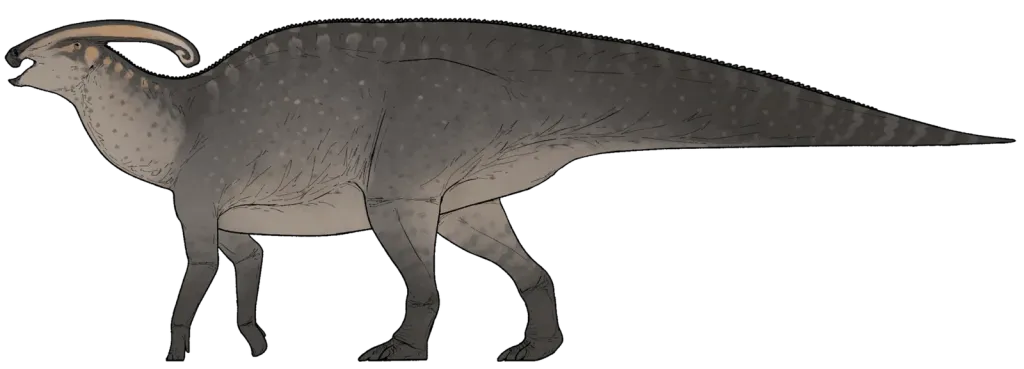
Parasaurolophus walkeri
Pronounced PAR-ah-sore-OL-oh-fus WAW-ker-eye
Ornithopoda · Hadrosauridae
A duck-billed dinosaur from the Late Cretaceous of Alberta, famous for a long, backward-curving hollow crest. Air from the nose ran through tubes inside the crest, which may have worked as a resonating chamber for deep calls.
- Crested
- Skin impressions known
- Period
- Cretaceous· Campanian
- Diet
- Herbivore
- Length
- 7.5–10 m
- Mass
- 2,600 kg
- Location
- Alberta, Canada
Quick answers
- How big was Parasaurolophus walkeri?
- Parasaurolophus walkeri was about 7.5–10 m long. It stood about 2.2–2.8 m tall at the hips. It weighed about 2.6 t. (Farke et al. 2013; Wikipedia: Parasaurolophus 2026)
- When did Parasaurolophus walkeri live?
- Parasaurolophus walkeri lived during the Late Cretaceous, about 76.5–75.8 million years ago. (Paleobiology Database: Parasaurolophus occurr… 2026; Eberth et al. 2023)
- Where have Parasaurolophus walkeri fossils been found?
- Fossils of Parasaurolophus walkeri have been found in Dinosaur Park Formation (Alberta) and Canada. (Parks 1922; Weishampel 1981)
- What did Parasaurolophus walkeri eat?
- Parasaurolophus walkeri was a herbivore. (Parks 1922; Weishampel 1981)
- Who named Parasaurolophus walkeri, and when?
- Parasaurolophus walkeri was described by William A. Parks in 1922. (Parks 1922; Paleobiology Database: Parasaurolophus occurr… 2026)
- Was Parasaurolophus walkeri in Jurassic Park?
- Yes. Parasaurolophus walkeri appears in Jurassic Park (1993), The Lost World: Jurassic Park (1997), Jurassic Park III (2001), Jurassic World (2015), Jurassic World: Fallen Kingdom (2018), Jurassic World Dominion (2022), and Jurassic World Rebirth (2025). A background herd animal in every film of the series. Its long hollow crest probably worked as a resonating chamber for low-pitched calls; the films mostly use it as scenery. (Wikipedia: Dinosaurs in Jurassic Park 2026; Weishampel 1981)
On this page

- Period
- Cretaceous76.5–75.8 Ma
- Diet
- Herbivore
- Length
- 7.5–10 m
- Mass
- 2.6 t
- Location
- Canada
- Classification
- Ornithopoda · Hadrosauridae
- Described
- 1922, William A. Parks
Overview
Parasaurolophus walkeri lived in western North America in the Late Cretaceous (Campanian). William Parks named it in 1922 from a skull and partial skeleton (ROM 768) collected in the Dinosaur Park Formation along the Red Deer River, Alberta. Two other species, P. tubicen and P. cyrtocristatus, come from New Mexico and Utah.
It was a large hadrosaur that could walk on two or four legs. Its crest was formed by the nasal and premaxillary bones, and the nasal passages looped through it. David Weishampel (1981) modelled the crest as a resonating tube; for the type specimen the lowest frequency comes out at about 48 Hz, a very deep sound.
A juvenile from Utah (RAM 14000), about 2.5 m long and probably less than a year old, shows that the crest started as a low bump and began growing at less than a quarter of adult skull size, earlier than in other crested hadrosaurs (Farke et al. 2013). Small patches of scaly skin are preserved with it.
Name meaning
"Near crested lizard", from Greek para ("beside, near"), sauros ("lizard") and lophos ("crest"), after Saurolophus; walkeri honours Sir Byron Edmund Walker (Parks 1922).
Biology & evidence
What scientists think about how this animal lived, and how strong the evidence for each idea is.
Skin & covering
Parasaurolophus had scaly skin.
Evidence level: Strong evidenceSmall skin patches are preserved with the juvenile, as in other hadrosaurs, where skin impressions are common.
Evidence for / against · 1
Evidence for
Skin impression · RAM 14000 skin impressions
Two small patches of skin impression (under 5 cm) preserved with the juvenile skeleton.
Specimen: RAM 14000 “Joe”
Growth
A 2.5 m Parasaurolophus was probably less than a year old.
Evidence level: Moderate evidenceIts leg bone shows fast-growing juvenile tissue with no annual growth lines.
Evidence for / against · 1
Evidence for
Histology · RAM 14000 tibia histology
Well-vascularised juvenile bone with no growth lines, suggesting an animal in its first year.
Specimen: RAM 14000 “Joe”
Parasaurolophus started growing its crest earlier than other crested hadrosaurs.
Evidence level: Moderate evidenceA juvenile already had a small crest at less than a quarter of adult skull size; in Corythosaurus the crest appears at about half adult size. It rests on one well-preserved juvenile.
Evidence for / against · 1
Evidence for
Specimen · RAM 14000 juvenile crest
A 2.5 m juvenile with a low, semicircular crest: crest growth began at less than 25% of maximum skull size, against 50% in Corythosaurus.
Specimen: RAM 14000 “Joe”
Senses
The crest of Parasaurolophus worked as a resonating chamber for deep calls.
Evidence level: HypothesisAir passages loop through the crest, and acoustic models of the adult crest give very low frequencies. Soft tissues are not preserved, so the calls themselves cannot be observed.
Evidence for / against · 1
Evidence for
Biomechanical model · Parasaurolophus crest resonance model
The nasal passages inside the crest modelled as a resonating tube: 3.46 m of tube in ROM 768 gives a first mode of about 48 Hz.
Specimen: ROM 768
Size
- Length
- 7.5–10 m
- Height
- 2.5 mpublished range 2.2–2.8 m
- Mass
- 2,600 kg
(32.8 ft)
Based on ROM 768
(8.2 ft)
Based on ROM 768 (holotype)
Timeline
Periods: Campanian (83.6–72.1 Ma), Late Cretaceous (100.5–66 Ma)
P. walkeri is known from the lower 30 m of the Dinosaur Park Formation, the Corythosaurus-Centrosaurus assemblage zone, 76.47-75.77 Ma (U-Pb age model, Eberth et al. 2023). Other Parasaurolophus species (Kaiparowits, Fruitland) are not this profile.
Location
Formations
- Dinosaur Park Formation · Alberta
- Red Deer River below Sand Creek, Dinosaur Park Formation, Alberta · Dinosaur Park Formation · Alberta · position approximate
- Kaiparowits Formation, Grand Staircase-Escalante National Monument, Utah · Kaiparowits Formation · Utah · position approximate
These are the places where fossils have been found, not the full area where the animal lived.
Ecosystem
Lived in: Dinosaur Park
76.5–74.4 million years ago · floodplain, coastal plain, river system
Late Campanian alluvial and coastal plains on the western shore of the Western Interior Seaway, in what is now southern Alberta.
Same ecosystem

Same ecosystem

Same ecosystem

Classification
- cladeDinosauria
- cladeOrnithischia
- cladeOrnithopoda
- familyHadrosauridae
- subfamilyLambeosaurinae
- genusParasaurolophus
- speciesParasaurolophus walkeri
Taxonomic status: Valid
Fossil record

| Catalog number | Status | Institution | Found |
|---|---|---|---|
| ROM 768 | Holotype | Royal Ontario Museum (ROM) | 1920 |
| RAM 14000 “Joe” | Referred specimen | Raymond M. Alf Museum of Paleontology (RAM) | — |
What has been found
Holotype: ROM 768
- Preserved
- Partial
- Reconstructed
- Unknown / not recorded
Holotype: ROM 768
Region by region (table)
| Region | State |
|---|---|
| Skull | Preserved · With the full tube crest. |
| Mandible | Unknown / not recorded |
| Teeth | Unknown / not recorded |
| Cervical vertebrae | Unknown / not recorded |
| Dorsal vertebrae | Unknown / not recorded |
| Sacrum | Unknown / not recorded |
| Caudal vertebrae | Unknown / not recorded |
| Ribs | Unknown / not recorded |
| Gastralia | Unknown / not recorded |
| Scapula / shoulder girdle | Unknown / not recorded |
| Humerus | Unknown / not recorded |
| Forearm (radius / ulna) | Unknown / not recorded |
| Hand (manus) | Unknown / not recorded |
| Pelvis | Unknown / not recorded |
| Femur | Partial |
| Tibia / fibula | Unknown / not recorded |
| Foot (pes) | Unknown / not recorded |
Referred specimen: RAM 14000 “Joe”
Region by region (table)
| Region | State |
|---|---|
| Skull | Preserved |
| Mandible | Preserved |
| Teeth | Unknown / not recorded |
| Cervical vertebrae | Unknown / not recorded |
| Dorsal vertebrae | Unknown / not recorded |
| Sacrum | Unknown / not recorded |
| Caudal vertebrae | Unknown / not recorded |
| Ribs | Unknown / not recorded |
| Gastralia | Unknown / not recorded |
| Scapula / shoulder girdle | Unknown / not recorded |
| Humerus | Preserved |
| Forearm (radius / ulna) | Unknown / not recorded |
| Hand (manus) | Unknown / not recorded |
| Pelvis | Preserved |
| Femur | Preserved |
| Tibia / fibula | Preserved |
| Foot (pes) | Unknown / not recorded |

Gallery

Discovery
- Year described
- 1922
- Described by
- William A. Parks
- Type specimen
- ROM 768
Discovery timeline
1920 · First material found
University of Toronto party collects the Parasaurolophus holotype
A skull with a long tube crest and much of the skeleton are collected on the Red Deer River, Alberta.
1922 · Formally described
Parks names Parasaurolophus walkeri
Parks names the new crested hadrosaur.
People: William A. Parks
1981 · Major study
Weishampel models the Parasaurolophus crest as a resonator
An acoustic analysis proposes that lambeosaurine crests produced low-frequency calls.
People: David B. Weishampel
2013 · Major study
Juvenile Parasaurolophus described from Utah
The smallest and most complete Parasaurolophus shows how the crest grew.
People: Andrew A. Farke
In Jurassic Park & Jurassic World
Films
- Jurassic Park (1993)
- The Lost World: Jurassic Park (1997)
- Jurassic Park III (2001)
- Jurassic World (2015)
- Jurassic World: Fallen Kingdom (2018)
- Jurassic World Dominion (2022)
- Jurassic World Rebirth (2025)
On screen
A background herd animal in every film of the series.
Film vs fossils
- Its long hollow crest probably worked as a resonating chamber for low-pitched calls; the films mostly use it as scenery.
Film titles are used for identification only. DinoDex is not affiliated with or endorsed by the Jurassic Park / Jurassic World franchise. All dinosaurs seen in the films
Sources
- (2026). Paleobiology Database: Parasaurolophus occurrences. The Paleobiology Database (paleobiodb.org), data service 1.2, accessed 2026-09-23. https://paleobiodb.org/data1.2/occs/list.txt?base_name=Parasaurolophus&show=coords,paleoloc,strat,loc,ref&pgm=gplates (opens in a new tab)
- (2026). Wikipedia: Parasaurolophus. Wikipedia (English), accessed 2026-09-23. https://en.wikipedia.org/wiki/Parasaurolophus (opens in a new tab)
- (2026). Wikipedia: Dinosaurs in Jurassic Park. Wikipedia. https://en.wikipedia.org/wiki/Dinosaurs_in_Jurassic_Park (opens in a new tab)
- (2026). Wikipedia: Jurassic World Rebirth. Wikipedia. https://en.wikipedia.org/wiki/Jurassic_World_Rebirth (opens in a new tab)
- Eberth, D. A., Evans, D. C., Ramezani, J., Kamo, S. L., Brown, C. M., Currie, P. J. & Braman, D. R. (2023). Calibrating geologic strata, dinosaurs, and other fossils at Dinosaur Provincial Park (Alberta, Canada) using a new CA-ID-TIMS U-Pb geochronology. Canadian Journal of Earth Sciences. doi:10.1139/cjes-2023-0037 (opens in a new tab)
- Farke, A. A., Chok, D. J., Herrero, A., Scolieri, B. & Werning, S. (2013). Ontogeny in the tube-crested dinosaur Parasaurolophus (Hadrosauridae) and heterochrony in hadrosaurids. PeerJ 1: e182. doi:10.7717/peerj.182 (opens in a new tab)
- Parks, W. A. (1922). Parasaurolophus walkeri, a new genus and species of crested trachodont dinosaur. University of Toronto Studies, Geology Series 13: 1-32.
- Paul, G. S. (2016). The Princeton Field Guide to Dinosaurs (2nd edition). Princeton University Press.
- Weishampel, D. B. (1981). Acoustic analyses of potential vocalization in lambeosaurine dinosaurs (Reptilia: Ornithischia). Paleobiology 7: 252-261. doi:10.1017/s0094837300004036 (opens in a new tab)