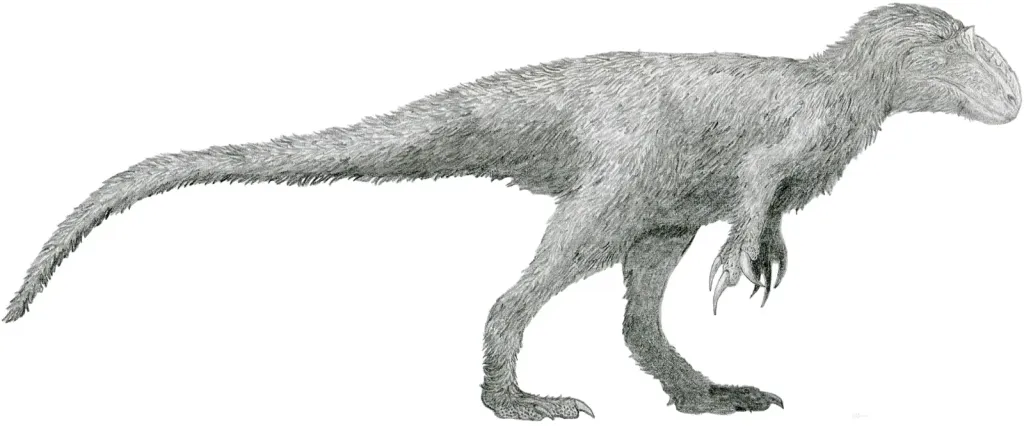
Yutyrannus huali
Pronounced YOO-tie-RAN-us hoo-AH-lee
Coelurosauria
A large early tyrannosauroid from the Early Cretaceous of Liaoning, China, covered in long filament-like feathers. At about a tonne and a half it is the largest dinosaur with direct evidence of feathers.
- Feathered
- Bipedal
- Giant
- Exceptional preservation
- Period
- Cretaceous· Barremian
- Diet
- Carnivore
- Length
- 9 m
- Mass
- 1,410 kg
- Location
- Liaoning, China, Asia
Quick answers
- How big was Yutyrannus huali?
- Yutyrannus huali was about 9 m long. It stood about 1.9–2.3 m tall at the hips. It weighed about 1.4 t. (Wikipedia: Yutyrannus 2026; Paul 2016)
- When did Yutyrannus huali live?
- Yutyrannus huali lived during the Early Cretaceous, about 125.8–119.6 million years ago. (Paleobiology Database: Yutyrannus occurrences 2026)
- Where have Yutyrannus huali fossils been found?
- Fossils of Yutyrannus huali have been found in Yixian Formation (Liaoning) and China. (Xu et al. 2012; Paleobiology Database: Yutyrannus occurrences 2026)
- What did Yutyrannus huali eat?
- Yutyrannus huali was a carnivore. (Xu et al. 2012; Paleobiology Database: Yutyrannus occurrences 2026)
- Who named Yutyrannus huali, and when?
- Yutyrannus huali was described by Xu Xing et al. in 2012. (Xu et al. 2012; Paleobiology Database: Yutyrannus occurrences 2026)
On this page

YOO-tie-RAN-us hoo-AH-lee
- Period
- Cretaceous125.8–119.6 Ma
- Diet
- Carnivore
- Length
- 9 m
- Mass
- 1.4 t
- Location
- China, Asia
- Classification
- Coelurosauria
- Described
- 2012, Xu Xing et al.
Overview
Yutyrannus huali lived in north-eastern China in the Early Cretaceous, in the Yixian Formation of Liaoning. Xu Xing and colleagues named it in 2012 from three nearly complete skeletons of two growth stages, said to come from a quarry near Batuyingzi, Beipiao.
It was a primitive relative of Tyrannosaurus, with a skull like later tyrannosauroids but three fingers on each hand. All three skeletons show long, simple filamentous feathers, up to about 20 cm long, on several parts of the body.
It was the first direct evidence that a gigantic dinosaur was extensively feathered, which opened the question of whether later giant tyrannosaurs such as T. rex also had feathers. The Yixian climate is reconstructed as relatively cool, which may have favoured an insulating coat.
Name meaning
"Beautiful feathered tyrant", from Mandarin yǔ ("feather") and Greek tyrannos ("tyrant"), with huáli ("beautiful") for the plumage (Xu et al. 2012).
Biology & evidence
What scientists think about how this animal lived, and how strong the evidence for each idea is.
Feathers
Yutyrannus was covered in long, filament-like feathers.
Evidence level: Direct evidenceFeathers are preserved on several parts of all three skeletons, the first direct evidence of an extensively feathered giant dinosaur.
Evidence for / against · 1
Evidence for
Feather impression · Yutyrannus filamentous feathers
Long filamentous feathers preserved on the three skeletons, up to about 20 cm long.
Specimen: ZCDM V5000
Metabolism
The feathers of Yutyrannus helped it keep warm in a cool climate.
Evidence level: HypothesisThe Yixian climate is reconstructed as relatively cool; insulation is one possible function of the feathers, display is another.
Evidence for / against · 1
Evidence for
Feather impression · Yutyrannus filamentous feathers
Long filamentous feathers preserved on the three skeletons, up to about 20 cm long.
Specimen: ZCDM V5000
Other
Yutyrannus was an early relative of the tyrannosaurids.
Evidence level: Strong evidenceIts skull resembles later tyrannosaurs, but its three-fingered hand and ordinary foot are primitive.
Evidence for / against · 1
Evidence for
Comparative anatomy · Yutyrannus skull and hand anatomy
Skull features shared with derived tyrannosauroids, with a three-fingered hand like basal tyrannosauroids.
Specimen: ZCDM V5000

Size
- Length
- 9 m
- Height
- 2.1 mpublished range 1.9–2.3 m
- Mass
- 1,410 kg
(29.5 ft)
Based on ZCDM V5000
(6.9 ft)
Based on ZCDM V5000 (femur c. 0.85 m)
Based on ZCDM V5000
Timeline
Periods: Barremian (125.8–121.4 Ma), Aptian (121.4–113 Ma), Early Cretaceous (145–100.5 Ma)
Late Barremian-early Aptian bounds of the type collection in PBDB.
Location
Formations
- Yixian Formation · Liaoning
- Near Batuyingzi, Beipiao, Liaoning (Yixian Formation) · Yixian Formation · Liaoning · position approximate
These are the places where fossils have been found, not the full area where the animal lived.
Ecosystem

Lived in: Jehol Biota
135–121 million years ago · lake, swamp / wetland, forest
Early Cretaceous wetlands and lakes of north-eastern China with seasonal rainfall and frequent volcanic eruptions; ash falls into anoxic lakes preserved feathers and soft tissue.

Classification
- cladeDinosauria
- cladeSaurischia
- cladeTheropoda
- cladeCoelurosauria
- superfamilyTyrannosauroidea
- genusYutyrannus
- speciesYutyrannus huali
Taxonomic status: Valid
Fossil record

| Catalog number | Status | Institution | Found |
|---|---|---|---|
| ZCDM V5000 | Holotype | Zhucheng Dinosaur Museum (ZCDM) | — |
What has been found
Holotype: ZCDM V5000
- Preserved
- Partial
- Reconstructed
- Unknown / not recorded
Region by region (table)
| Region | State |
|---|---|
| Skull | Preserved |
| Mandible | Unknown / not recorded |
| Teeth | Unknown / not recorded |
| Cervical vertebrae | Unknown / not recorded |
| Dorsal vertebrae | Unknown / not recorded |
| Sacrum | Unknown / not recorded |
| Caudal vertebrae | Unknown / not recorded |
| Ribs | Unknown / not recorded |
| Gastralia | Unknown / not recorded |
| Scapula / shoulder girdle | Unknown / not recorded |
| Humerus | Unknown / not recorded |
| Forearm (radius / ulna) | Unknown / not recorded |
| Hand (manus) | Unknown / not recorded |
| Pelvis | Unknown / not recorded |
| Femur | Unknown / not recorded |
| Tibia / fibula | Unknown / not recorded |
| Foot (pes) | Unknown / not recorded |
Discovery
- Year described
- 2012
- Described by
- Xu Xing et al.
- Type specimen
- ZCDM V5000
Discovery timeline
2012 · Formally described
Xu et al. name Yutyrannus huali
A gigantic feathered tyrannosauroid is described in Nature from three skeletons.
People: Xu Xing
Sources
- (2026). Paleobiology Database: Yutyrannus occurrences. The Paleobiology Database (paleobiodb.org), data service 1.2, accessed 2026-09-23. https://paleobiodb.org/data1.2/occs/list.txt?base_name=Yutyrannus&show=coords,paleoloc,strat,loc,ref&pgm=gplates (opens in a new tab)
- (2026). Wikipedia: Yutyrannus. Wikipedia (English), accessed 2026-09-23. https://en.wikipedia.org/wiki/Yutyrannus (opens in a new tab)
- Paul, G. S. (2016). The Princeton Field Guide to Dinosaurs (2nd edition). Princeton University Press.
- Xu, X., Wang, K., Zhang, K., Ma, Q., Xing, L., Sullivan, C., Hu, D., Cheng, S. & Wang, S. (2012). A gigantic feathered dinosaur from the Lower Cretaceous of China. Nature 484: 92-95. doi:10.1038/nature10906 (opens in a new tab)